


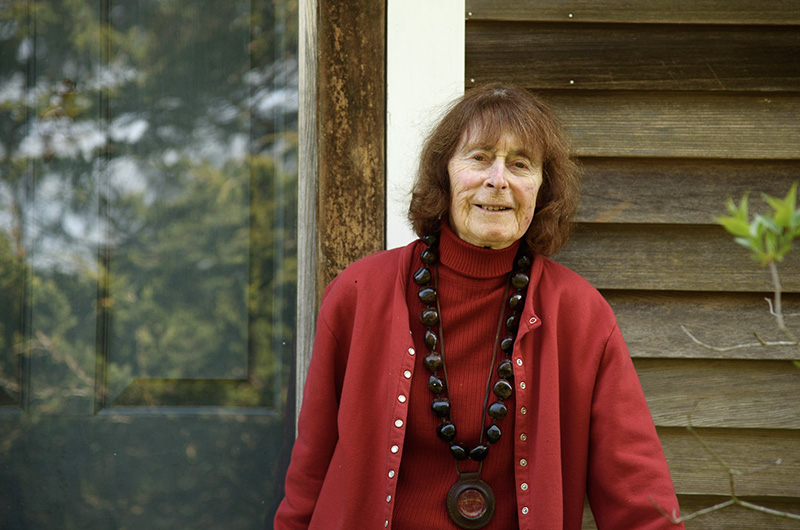
Phyllis Meras turned 90 on May 10, and along with her official title as contributing editor at the Gazette, she holds the unofficial title of oldest living employee at the paper.
Phyllis Meras has itchy feet.
Every day she walks the roads and woods around her house off Music street in West Tisbury, going on rambles with her friends Anna Alley and Susan Block, chronicling the flora and fauna of the changing seasons on the Island. Walking and traveling is an ingrained habit, cultivated during a journalism career that spans more than seven decades, and by her estimation has taken her to more than 100 countries, while writing for the Providence Journal, New York Times and Ladies Home Journal, just to name a few.
“I remember riding an elephant in India, but I’d forgotten about riding an ostrich in South Africa,” she said during a recent interview at her home, recalling moments from her long career.
But it all began at the Vineyard Gazette.
Ms. Meras turned 90 on May 10, and along with her official title as contributing editor at the Gazette, she holds the unofficial title of oldest living employee at the paper. She got her start in 1946 when she was 15, publishing a poem in the Gazette titled Sailing. She was a Vineyard summer kid, living in Exeter, N.H. in the off season and East Chop in summers. She wanted to be a writer and a journalist, it had always been her dream.
She worked as an intern at the Gazette in the summers of 1952 and 1953. She eventually worked as a reporter, and was managing editor from 1970 to 1974. For more than 40 years she has written an annual Christmas poem for the paper, becoming the journalistic equivalent of Santa Claus, conjuring up imaginary presents for Islanders old and young.
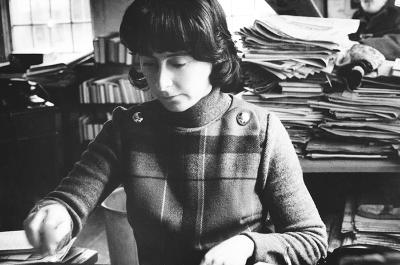
Ms. Meras at the paper in 1970, when she was the managing editor.
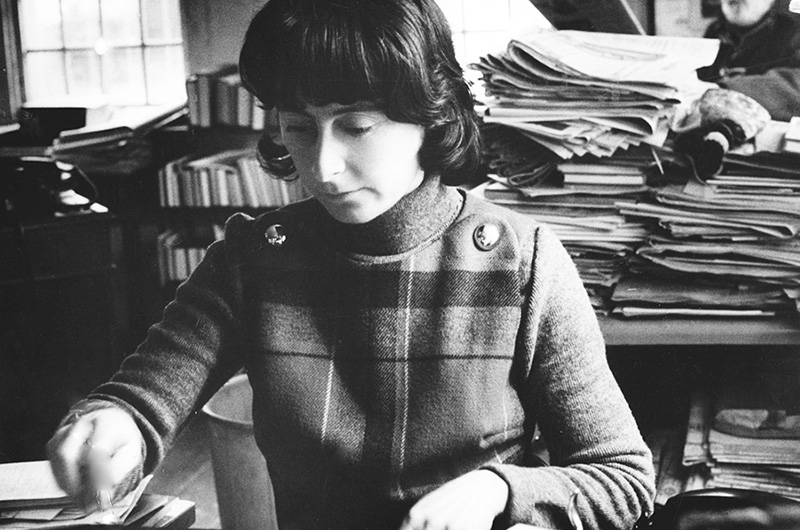
Ms. Meras at the paper in 1970, when she was the managing editor.
Just this past month she contributed an essay on a spring walk in West Tisbury, proving yet again that her lineage with the paper has no peer — her first published piece and her most recent piece span 75 years.
In 1952, when she was hired as a summer intern, Ms. Meras had just finished her junior year at Wellesley College, and publishers Henry and Elizabeth Bowie Hough took her under their wing. She recalled a moment from that summer when a woman came in to the office to talk with Mr. Hough.
“She began telling him about her garden and how wonderful the garden was, with all the flowers, and he just said yes, yes, yes — and I thought isn’t this tiresome,” she said. “And then the next day, when the Gazette came out, it was filled with this wonderful story written by Mr. Hough about the woman’s garden. It was a very good lesson in being a reporter.”
The Houghs also passed along a lesson in kindness to the young reporter when she applied to the Columbia University School of Journalism.
“They saw that I got in and helped to pay my way,” she said.
But journalism was still very much a man’s world in the 1950s. Ms. Meras was told upon graduating from Columbia that no one would hire a woman in New York. So she set her sights on the Providence Journal, one of the top daily newspapers in the country at the time. They were interested in her.
And then they weren’t.
“I was called into the dean’s office and when I went to see him, he told me, oh, I’m terribly sorry, they thought your name was Philip. They’re not interested now that they found out your name is Phyllis.”
Undeterred, Ms. Meras took the train to Providence to plead her case.
“Luckily, the assistant to the woman’s page editor was out sick when I arrived at the paper and she never came back. I think six of us from my Columbia class were hired. The five men got $20 more a week than I did, of course.”
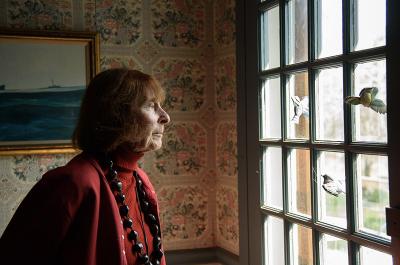
Long journalism career included stints at the New York Times and 25 years with the Providence Journal.
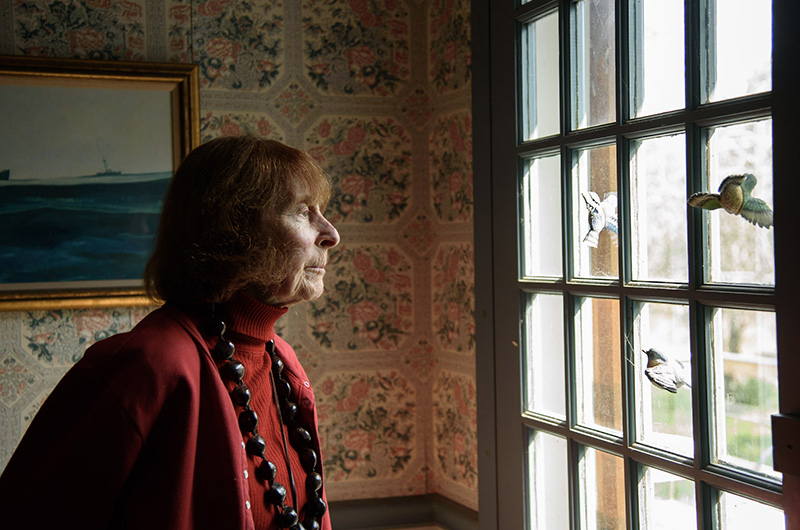
Long journalism career included stints at the New York Times and 25 years with the Providence Journal.
At the Journal, where she worked for 25 years, she covered a variety of beats but always had an eye on international stories and travel, and eventually became the travel editor.
She also later worked on the travel desk at the New York Times.
“Working on a travel desk meant you didn’t get to write the stories but since I knew what travel stories had been written, when I went on vacation I would choose a place to go to where I knew no story had been written,” she said. “So I went to Senegal because there hadn’t been a story about Senegal. Then I went to Ethiopia.”
She took a leave from the New York Times when she was awarded a Pulitzer fellowship in critical writing.
While in Switzerland on another fellowship, she began writing author profiles.
“My father’s cousin was at the time the leading publisher in Paris and so my father said why don’t you go see him and ask him if you can go interview authors. And he said yes and the first person I interviewed was Simone de Beauvior,” she said.
She interviewed Truman Capote, Norman Mailer, Carson McCullers, William Styron, John Updike, Kurt Vonnegut — the list is long but it does not include V.S. Naipaul or Jean Paul Sartre, although she tried.
“The fact that I hadn’t read enough of Naipaul’s work to satisfy him, meant that he refused to talk with me about his writing at all. He just rattled on about the traffic from the airport that went by his house and annoyed him. Another failed one was Sartre, who had agreed to see me, but when I knocked over a card table full of his secretary’s notes as I walked nervously through the apartment door, I was turned away and never got closer to him than hearing him clear his throat.”
In the 1970s, she took a freelance job reporting on a Pan Am around-the-world flight, with stops in numerous countries. The gig came with no expense account, and while she received first-class treatment aboard the plane, once it landed she was left to fend for herself. In London she stayed at a Salvation Army. In Iran a young boy came to her rescue.
“There were no rooms in the hotels because there was a Muslim festival going on,” she recalled. “And I kept walking up and down the streets and a little boy saw me. This was in the very last days of the Shah, and he said, ‘Why are you coming to this hotel so often?’ And I said, ‘I can’t leave because there are no flights going out and I have no place to stay.’ And he said, ‘Oh, I have a room. You may have my room.’ And so he gave me his room and he slept on the floor outside.”
Another time in Berlin, she caught the watchful eye of the East German police and still has a Stasi file to prove it. There she stayed with a woman who would become a lifelong friend, but at the time she did not know the woman’s son in law was a member of the East German army.
Later a simple correspondence aroused suspicion. “She was in the hospital and a postcard I sent to her was intercepted by him,” Ms. Meras said. “And since my German was limited and her English was limited I didn’t write much on the postcard, just the cats are well, the weather is fine.”
The cryptic phrasing looked odd to the East German police, especially considering where Ms. Meras was living: Martha’s Vineyard.
“This was when McNamara [Secretary of Defense Robert McNamara] was here and Katzenbach [U.S. Attorney General Nick Katzenbach] was here, and they knew this, and that fascinated me, always,” she said.
If the East German authorities knew how important cats and their well-being have always been to Ms. Meras, they might have relaxed. On the narrow dirt road to her West Tisbury home there are no fewer than eight signs alerting drivers to watch out for cats.
She has had numerous feline friends over the years — many of them now buried under an old apple tree outside. These days a pretty 13-year-old calico she adopted this past winter has the run of the house.
Ms. Meras moved into the house in 1982 after marrying Tom Cocroft, a well-known Island artist and painter who died in 1989.
“It’s a Bow House,” she said. “The roof is supposed to resemble the bottom of a boat turned upside down. In those days, there was only one of those on the Island. I think it was at Squibnocket. Tom had always admired it.”
The house is pleasantly filled with clutter, mostly books, including 13 that Ms. Meras has authored. Numerous boxes of her old clippings, from the Gazette and everywhere else, stand sentry on the living room floor, on the dining room table, on shelves, as she goes about the business of organizing her long life.
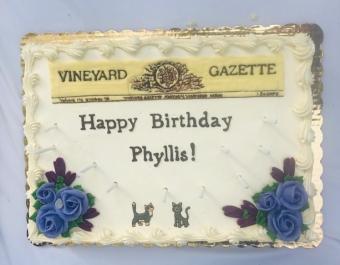
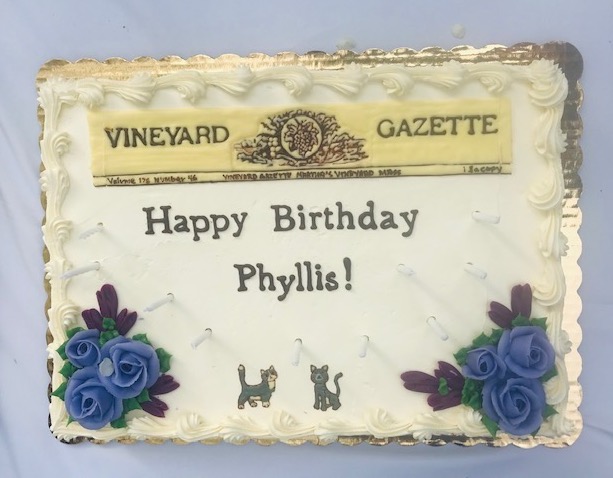
This week on her 90th birthday friends threw a surprise party for her, complete with a cake from the Black Dog decorated with an exact replica of the black-and-white Gazette flag.
“I made all kinds of mistakes,” she said, considering her career. “But I did learn one thing: how to say in many languages, would you help me with my luggage, please?”
And she learned another thing, she said, as she looked about the room and gestured to the boxes of clippings.
“None of this would have happened had it not been for the Vineyard Gazette.”
Comments
I always appreciate your keen
Gabrielle West TisburyI always appreciate your keen observations and I look forward to see you ride a turkey down Music Street.
Wishing you a very Happy
Diane Brickman Shulman Reno, NevadaWishing you a very Happy Birthday.
Happy Birthday Phyllis! Thank
rob the roofer new jerseyHappy Birthday Phyllis! Thank God for your itchy feet.
What a fabulous article !
Suzanne Trotta Lee .NHWhat a fabulous article ! Phyllis is an amazing woman...Known her for yrs and think the world of her...
Congratulations! Growing up
Stephen Fortlouis Wilmington, NCCongratulations! Growing up in Rhode Island, Phyllis Meras was already a familiar byline when I began summering on Chappy with my in-laws in the late 1970’s. Absent from the Vineyard for the past five years, being able to read her fine journalism is a connection with so much of my life. Thank you for being a familiar voice that has provided continuity and comfort for nearly 70 years. Cheers!
This was delightful! A legend
Jason Gay NeptuneThis was delightful! A legend.
Great article about Phyllis,
Anna Alley W TISBURYGreat article about Phyllis, who has more energy than you, me and three people put together, always has a deadline of something she is writing, and always interested in what is going on everywhere in the world, and especially the Vineyard. Carry on Phyllis.
Oh, the stories the young
Mandy Locke Raleigh, NCOh, the stories the young Vineyard Gazette reporters living in her studio apartment could tell about Phyllis. I'm delighted to read this piece and will be warmed by my own memories of Phyllis today. See you at the reunion this eve.
In 1973, when I was 23,
Robert Tobey Greenfield, MAIn 1973, when I was 23, Phyllis was my first editor, and a thoughtful and encouraging influence was she.
Phyllis came to Toronto twice
Toby Condliffe Toronto, OntarioPhyllis came to Toronto twice to write articles for, I think, the Providence Journal. We had been friends since my stint as Business Manager at the Gazette, 1972-4. She stayed with my wife and me. Forgetting that Phyllis has no interest in sports, when she asked me what was new in Toronto, I told her the Hockey Hall of Fame. The next day she dutifully went off and wrote it up for the Journal. Later, on her own, she discovered our unique Bata Shoe Museum which she found much more to her liking.
Phyllis was an institution at
Pam Thomas Newport RIPhyllis was an institution at the Providence Journal! Kind, quirky and fun. No better combo.
So good to know that you’re
Elliot kriegerSo good to know that you’re doing well and still writing!
Mentor, friend/family since
jean Rossi CranstonMentor, friend/family since the 70's, not a fan of travel, but have seen the world twice through Phyllis' eyes. I have many hours spent listening to her wonderful stories as well. Happy Birthday Phyllis!!!.
Happy Birthday Phyllis. What
Bobbie Maniece-Harrison New York CityHappy Birthday Phyllis. What an amazing life. Thanks for sharing with so many of us.
Thank you for lifting my
Michael Zide Amhers, MAThank you for lifting my spirits with your mention of appreciation for the beautiful flowers all around us if we only take a moment to look. I miss my own Vineyard years, now in the past. Reading about you and the Gazette brought back wonderful memories. Happy birthday to you.
Add new comment