

Environmental damage, plastic waste and personal safety hazards — those were among the complaints that bubbled up at a hearing at the Martha’s Vineyard Commission Thursday.
Environmental damage, plastic waste and personal safety hazards — those were among the complaints that bubbled up at a hearing at the Martha’s Vineyard Commission Thursday, as opponents of the regional high school’s proposed athletic field renovation took the stage in the latest installment of the project’s review.
The public hearing also included continued testimony from project advocates and high school officials, who emphasized the practicality of the project and the turf field.
Thursday marked the second full hearing for the project, which is under review by the commission as a development of regional impact (DRI). The hearing’s agenda was rescheduled after a hearing originally scheduled for Feb. 4 was cut short due to a disruptive Zoom bombing incident.
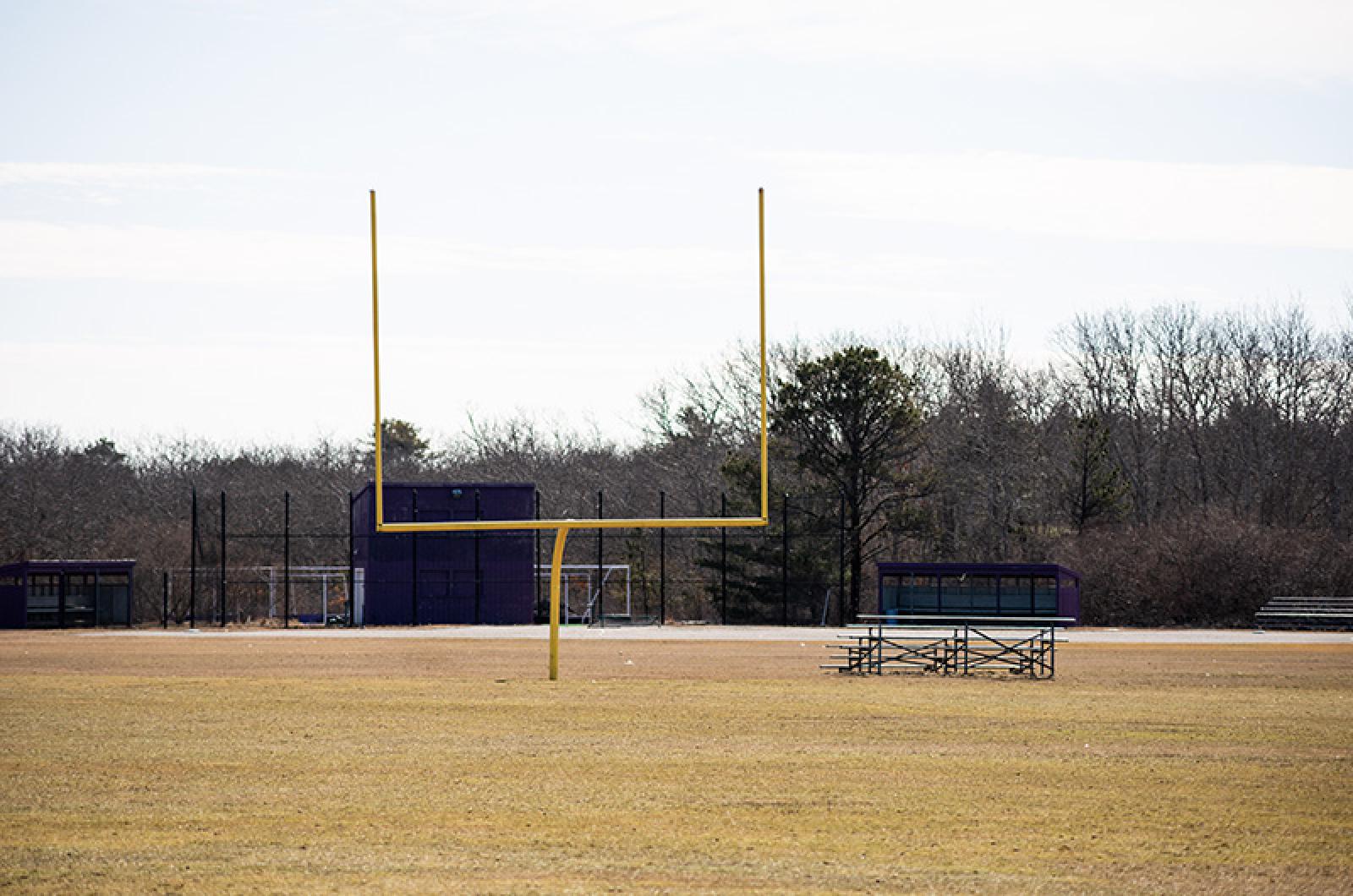
The high school’s $7 million plan to renovate its aging athletic fields proposes installing five new natural grass fields and a new synthetic turf track and field and grandstand, but the inclusion of a synthetic infield has kicked up a cloud of controversy in the community, drawing sharp divisions between Islanders on both sides of the issue.
Thursday’s hearing, which drew more than 125 participants and 20 speakers, tackled testimonies from a lengthy list of Island organizations averse to the turf, including the project’s primary opponent — the Field Fund, which have been advocating for grass field renovations since 2017.
An inaugural hearing covered details of the high school’s application and testimony from a half-dozen project advocates.
On Thursday, Dardanella Slavin, a founding member of the Field Fund, began testimony with a near 30-minute overview of the Field Fund’s position, calling the synthetic turf dangerous, environmentally hazardous and out of line with Island conservation goals.
“At the moment the Island community is rallying to reduce our carbon footprint, our plastic consumption and . . . prioritize climate action. The installation of a plastic field is antithetical to the direction the Island is heading,” Ms. Slavin said.
In a series of testimonies that followed, community members and organization leaders, many of whom testified on behalf of the Field Fund, pulled at similar threads, voicing emphatic — and in some cases dire — concerns about a plastic field’s impact on climate change.
Suzan Bellincampi, executive director of the Felix Neck Wildlife Santuary, a Massachusetts Audubon Society property, said runoff from the field could seep into the Island’s groundwater, threatening bird sanctuaries and wildlife. Brendan O’Neill of the Vineyard Conservation Society said the decaying plastic left over as the field ages would threaten sustainability, and oceanographer Sara-Jeanne Royer said turf field plastics emit dangerous levels of greenhouse gas.
“It’s the worst-case scenario by making the decision of using synthetic turf for the future . . . it’s basically promoting climate change,” Ms. Royer said.
Although hearing chairman Doug Sederholm had strictly prohibited discussion of field toxicology — a topic scheduled for discussion at the next hearing, a handful of presenters still delved into the issue, forcing Mr. Sederholm to stop or reschedule the testimony. Testimony pertaining to crumb-rubber infill was also disqualified after a representative of the high school said the material was not included in the project.
As the conversation broadened, University of Washington soccer coach Amy Griffin and parent Josh Thompson advocated vehemently for a grass field alternative, citing their superiority in competitive and professional soccer. Others, including seasonal homeowner Diana Conway, focused on the consequences of turf fields, including their high rates of injury and their propensity to overheat.
“I like to compare synthetic turf to a bad relationship . . . It gets dangerously hot, it’s toxic to everyone around me, it’s unsustainable . . . and it’s really hard to get rid of,” Ms. Conway said.
Islander Doug Ruskin aimed his complaints more directly at the high school, citing their refusal to join finance committee meetings and their lack of transparency with taxpayers. The high school has not publicly disclosed the project’s private funding source.
“[This] review is our only chance to get the answers that have been sought,” Mr. Ruskin said.
But the evening was not confined to criticisms.
In a broader public comment period, proponents of the project, led by a panel of high school coaches, argued that a synthetic field was essential to a strong athletic program. Rebecca Nutton, varsity field hockey coach, voiced full-throated support for the project on behalf of her team. Joined by coaches from the school’s lacrosse and cross country programs, Ms. Nutton touched on her experience as a player and coach.
“My personal experience in field hockey has been the thread that guided me in my life path so far and I know the same can be said for all young athletes,” she said. “[It] tends to be those who speak up, or are the loudest, are those with the complaints. So I want to speak tonight for those who are not aware of what could be lost if this project does not pass.”
High school soccer coach John Walsh, who noted the advantages of grass fields, focused on practicality in his remarks.
“My thoughts are that while grass is king — I would love to have a grass field playable surface that we could have our kids and our whole community play on — it’s just not feasible,” he said. “The idea that we would be the one unicorn that’s able to actually make lasting playable grass surfaces, I think, is a bit of a pipe dream.”
At the close of the hearing, in a five-minute rebuttal from the high school allotted by Mr. Sederholm, assistant superintendent Richard Smith defended the project.
“I became affiliated with this specific proposal because I also feel there is a need, and that need is to support the care of children . . . this project, the synthetic field in particular, is something that supports the care of children,” he said.
All further comments were deferred, as the hearing ran up against its three-hour limit. A formal discussion of toxicology and additional public testimony are on the agenda for March 4.
“We will be doing at least one more, if not two or three more sessions of this. We’re going to do whatever it takes,” Mr. Sederholm said.
Comments
If the turf field is put in
Cement Truck Driver Edgartown but used to be VHIf the turf field is put in some serious thought ought to be put in to redesigning the field so it faces north/south instead of how its supposed to go in now, which is basically east/west. If it is installed, the sun will be a factor in games played after school because of the sun setting.
This guy makes a good point.
refThis guy makes a good point.
The field was positioned to
Terry Donahue EdgartownThe field was positioned to maximize the available space. If we had designed the field East & West it would have impacted the layout of all of the other playing surfaces
Excellent work as always, Ms.
Fish Mama EdgartownExcellent work as always, Ms. Coleman!
While a turf field may benefit some of our kids teams in the short term, how can we possibly weigh that against the long term ecological impacts it would have on our island?? While I'm a big supporter of athletics for my kids and was once (long ago!) a high school athlete myself, the importance of any game pales in comparison to the existential threat of climate change.
Why doesn't someone ask the
Larry Vaughn egg harborWhy doesn't someone ask the students or the children their thoughts. This would be a project for them why not seek their opinion. The foot print of one track and field is not going to change the climate of the island. I say the students deserve the best product we can offer them. They have been living through a pandemic where NO is the only words they hear. Do something right for the youth I promise you it will warm even the chilliest of mind and hearts.
Larry, you are so correct and
Islander61 OBLarry, you are so correct and it is on the record that the AD and the design team met with the athletes and coaches and it was unanimously approved by both groups. There are a multitude of students who have written letters to the commission in support. Their voice is important and the opposition of this project doesn't want the student's voice to count because it doesn't support their objective, which is, do what ever possible to get this project defeated at the commission. Most of their support are by people who do not use the fields. If you watched the last meeting look at those who opposed the project, a soccer coach from Washington State, a ocean researcher from Hawaii, a field designer from the south, adults who don't have students in the schools using the fields, and one person who is a summer resident. So far, only one past student athlete has been able to speak and she spoke eloquently in support and need for the project. Lastly, the school administration, who speak for their students, want this project completed. Some say they don't like the look, well beauty is in the eye of the beholder. As an athlete, a well designed stadium field is beautiful.
Grass fields require more
Joseph edgartownGrass fields require more ongoing maintenance than synthetics fields. But isn't there a way to resolve some of this through the High School's Vocational training? Landscaping is such an important industry for our Island. Or perhaps solve some of the maintenance and related manpower requirements by issuing community service credits to students? At the High School we have about 200 seniors who are old enough to perform military service for our country. Shouldn't there be some expectation that students can help maintain the grass fields for which they are direct beneficiaries and in the process defray some maintenance costs and avoid synthetic turf solutions? We might actually teach some leadership and life skills in the process. If we didn't have the donor money advocating for synthetic solutions, we would be looking for creative solutions. I recommend we look for these solutions nonetheless.
As someone who has played at
Slater MVAs someone who has played at a collegiate level, mho is that an artificial playing surface pales in comparison to a well maintained grass field. But let’s face the truth here, neither field will ever be maintained correctly at this particular school.
Most anywhere else in the
Bob EdgartownMost anywhere else in the globe schools would be loving to have either of these choices. It is interesting that both sides have there own experts about either choice. But we like to live on fantasy island here and do what feels good. The reality is our kids will suffer from lack of experience on a track field that is used by most schools across the globe. If we only have grass fields it would be like only teaching our kids about liberals point of view and not conservative points of view. We need to have multi dimensional children who can perform in any environment. Save your energy people for something more important like having the children in school full time.
In response to high school
Thomas Bena ChilmarkIn response to high school soccer coach John Walsh, who said,“My thoughts are that while grass is king — I would love to have a grass field playable surface that we could have our kids and our whole community play on — it’s just not feasible,”, I would say that we've never given grass a chance. Because the high school has never properly maintained their fields, we haven't seen what they would look like with adequate care and using the right equipment.
Add new comment