


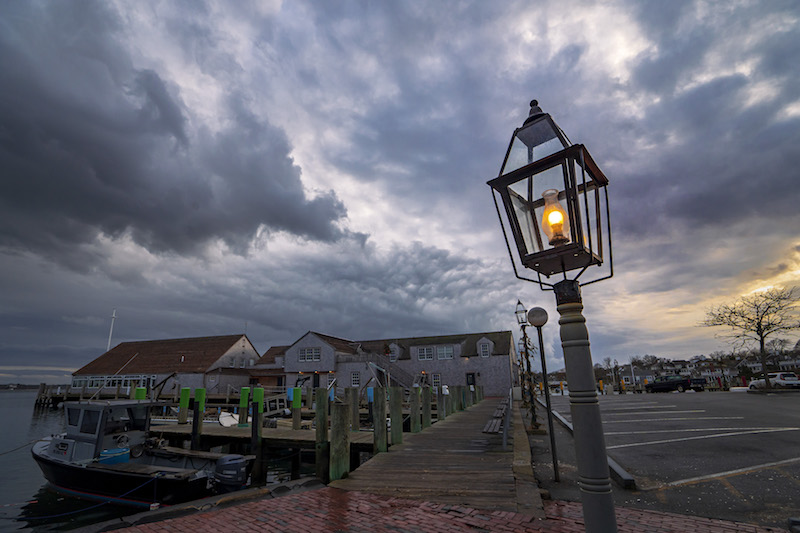
The Martha’s Vineyard Commission aired its new energy policy in front of the Edgartown selectmen Monday.
The Martha’s Vineyard Commission aired its new energy policy and introduced its new climate change planner in front of the Edgartown selectmen on Monday.
The energy policy, pitched at a commission meeting in the fall, would apply to new commercial developments and residential subdivisions on the Island, focusing on heat pump installation, all-electric systems and on-site solar generation.
The policy has made the rounds at selectmen’s meetings across the Island over the past months, with Monday’s presentation in Edgartown completing the cycle before the commission is scheduled to vote on the policy in February.
Commissioner Ben Robinson presented the policy in conjunction with evidence showing the impacts of climate change on both the Island and world. This year was the hottest on record, Mr. Robinson said, and the planet has seen more billion-dollar disasters than ever before — a problem that continues to grow.
“Evolution won’t be able to keep up with the temperature changes we are producing, and that will have dire impacts on life on Earth,” Mr. Robinson said.
He explained that heat pumps are 59 per cent more efficient and produced fewer emissions than oil or propane, even if the electric energy comes from the grid. Mr. Robinson said the grid will get cleaner over time, particularly with the Vineyard Wind project, and that the price of renewable energy is declining.
Impetus for the new policy comes from the commission approving a nonbinding resolution in late 2019 to get to 50 per cent renewable energy by 2030, and 100 per cent renewable energy by 2040. Both Aquinnah and West Tisbury have also joined the resolution, which is set to come before other towns as warrant articles this spring.
Selectman Arthur Smadbeck asked whether state legislators were working on a proposal to allow towns to supply energy from their solar fields for non-municipal uses — a use that is currently restricted by utility companies like Eversource. Mr. Robinson said that the discussion has come up but that there is no legislation in place to make the change.
The commission’s policy would apply to commercial developments and residential subdivisions. Mr. Robinson noted that a variety of recent projects, such as the Oak Bluffs town hall and the Martha’s Vineyard Community Services building, would have fit the new policy.
“It’s a policy that’s achievable,” Mr. Robinson said.
Liz Durkee, the commission’s new climate change planner, also introduced herself in front of selectmen. Ms. Durkee said she would be working with the commission in five different areas to address climate change on an Islandwide basis, including climate education, energy, climate adaptation, human health and safety, and economic issues related to climate change.
“You got a big job, and we certainly will be looking to you for guidance and help,” Mr. Smadbeck said.
Comments
We have long experience with
MDW EdgartownWe have long experience with heat pumps and mini-splits. Heat pumps begin to lose efficiency at sub-40 degree temps and becomes inefficient, outrageously costly and virtually worthless (because they blow cold air) when the temperature dips below 20. That's because the very modest amount of heat that's generated by these devices (that is, if they don't shut down) at those low temps is via the coil, which ends up running continuously. In our mainland house, for instance, running the heat pump in a 1,000 sq. ft. addition added over $700 per month to an electric bill that otherwise ran $300 per month, plus or minus, during the winter (an oil-based, forced hot air system supports the rest of the house). Consequently, we decided to shut it down in the winter and rely on ambient heat during the day and, at times, a space heater when it is particularly cold at night. Our electric bills are once again $300 per month. We installed a mini-split in our island residence, but limit its use to providing a/c and dehumidification in a hard to service part of the house during the summer. I would never consider constructing a residence in this region that solely relies on this heat source.
I have 2 Mitsubishi heat
Carla Cooper EdgartownI have 2 Mitsubishi heat pumps that were cheaper to install than a gas fired furnace and they run all winter, keep my home and office toasty warm and at temps well below 40 degrees. They’re running now in these frigid temps. AND they are also my AC in the summer. So I really dont know what you're talking about.
Well-taken but a bit
MV Homeowner EdgartownWell-taken but a bit misinformed. Most heat pumps have some sort of “backup” heat source — electric, gas/propane, or oil — to handle the “sub-40’s” temperature referenced here. The system sets a “balance point” — the temperature at which the heat pump stops running and signals the “back up” heat source to run instead. Thus, the heat pump should not be running when the outside air temp heat close to freezing (or above — the “balance point” temp is set by the homeowner and can be easily adjusted). Heat pumps do work — one just needs to have the proper equipment and know-how to make them operate most efficiently.
You should have your system
Jon KatamaYou should have your system checked out. I guarantee it’s not working correctly more than likely the pump isn’t working and is using all electric backup this would cause a huge electric bill.
There are a LOT of
Darrell King Edgartown/BelmontThere are a LOT of misconceptions here in these comments. First of all, heat pumps from the last decade or so are WAY more efficient than electric baseboard heating, by about a factor of three. Secondly, they are now capable of producing heat even when the outdoor temperature gets down to -5. Yes, they become less efficient as the delta T (difference between desired indoor temperature and outdoor temperature) gets larger, but still decently efficient at very low temperatures. Thirdly, in all new construction proper building techniques can result in extremely efficient buildings, heating- and cooling-wise, for slightly more cost upfront but lower operating costs, completely offsetting those initial costs. Air source heat pumps are used extensively in Maine, New Hampshire, and Vermont. The Vineyard is considerably milder in winter and summer than the rest of New England, so they're a no-brainer here on the Island. Finally, the switch to all electric heating and transportation is our ticket out of the current climate crisis, with the grid becoming greener every year. There is ZERO justification for using fossil fuels any longer than absolutely necessary. We heat (and cool) both of our residences exclusively with heat pumps.
How will the electricity
here we go again edgHow will the electricity necessary be generated? Coal? Oil? Nuclear? Natural gas? Our former governor blocked the expansion of the diameter of an existing natural gas pipeline for political points, which leaves New England with a deficit when we need more clean natural gas for power plants to generate electricity. Unless the MVC coordinates with the politicians on the mainland, its a pointless proposal. Nobody argues that the world had a warm year, but I do recall in or about 1975 we were told to expect another ice age. just saying.. there are climate cycles.
And... when I built my 'all
here we go again edgAnd... when I built my 'all electric' home back in 1983, it was ENCOURAGED by the electric utility here (commelectric prior to nstar). So at the time, in order to avoid the dirty oil heat, we had 'efficient' electric, with a thermostat in every room. In order to encourage this, there was a 'space heating rate' in which the price of electricity kilowatts on the bill was reduced as MORE was used. Of course years later, in the interest of profits, with the swipe of a pen that rate was eliminated, thus making 'clean' electric heat uneconomical. So if the electric company or the government offers a ''deal'....be wary. just my personal experience here on the island.
Bottom line is heat pumps
Ron BelmontBottom line is heat pumps/mini splits are not designed for our region. IMO there good for 45 degrees or higher temp
It is hard to figure what the
Bob EdgartownIt is hard to figure what the right thing to do is, this issue is very complicated. One thing for sure is higher cost for wind energy is coming our way. The cost of this new position at the MVC is not coming that is here and forever. The cradle to grave issue with batteries, wind generators etc.. has not been proven to be an overall benefit for the planet. Most of this sounds good by well meaning people but the financial cost is often overlooked.
I'd like to know what the
Mike ChilmarkI'd like to know what the asserted Eversource 'restriction' on municipal-owned or -operated solar facilities providing power to non-muni users is based on. After co-developing about 30 MW of solar PV -- including community solar -- in MA, I've never run across such a 'restriction.' Municipal Light Districts generally are not subject to utility limits within their boundaries & can provide power to anyone they choose within those boundaries. Towns that are not MLDs still have a range of options (in conjunction with PV developers) to provide such solar power to their residents & businesses.
Given the comments above, it
Rob Hannemann ChilmarkGiven the comments above, it's appropriate to point out that heat pump technology has advanced dramatically over the past decade. (Google "cold climate heat pumps".) At this point, heat pumps are quite appropriate for our climate zone and are provably more economical than propane or oil. As anecdotal data: I heat my 3000 square foot house in Chilmark with air-source heat pumps. This morning it was 12 deg F outside. My house was a toasty 72 deg F (we do lower the thermostat at night).
Add new comment