

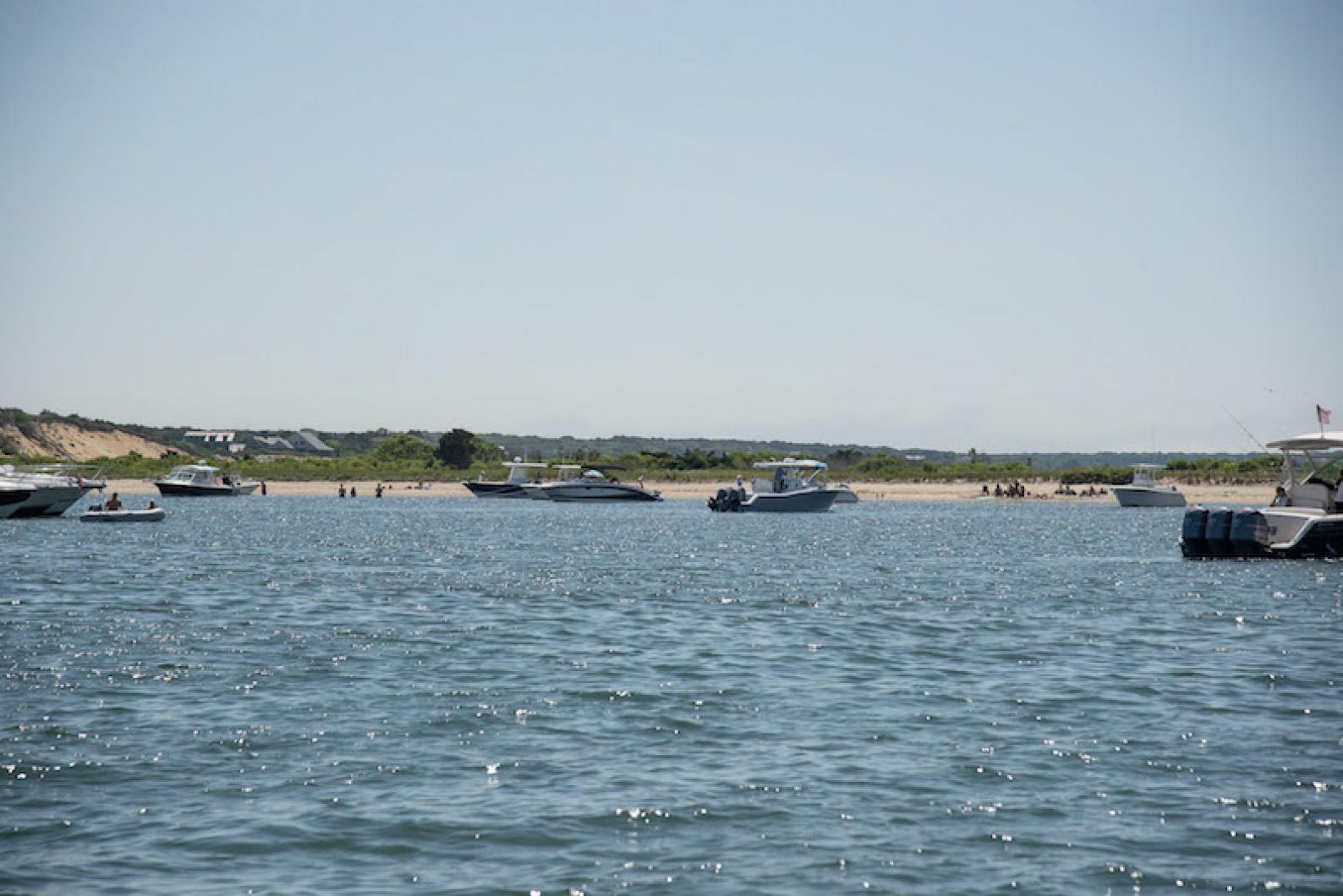
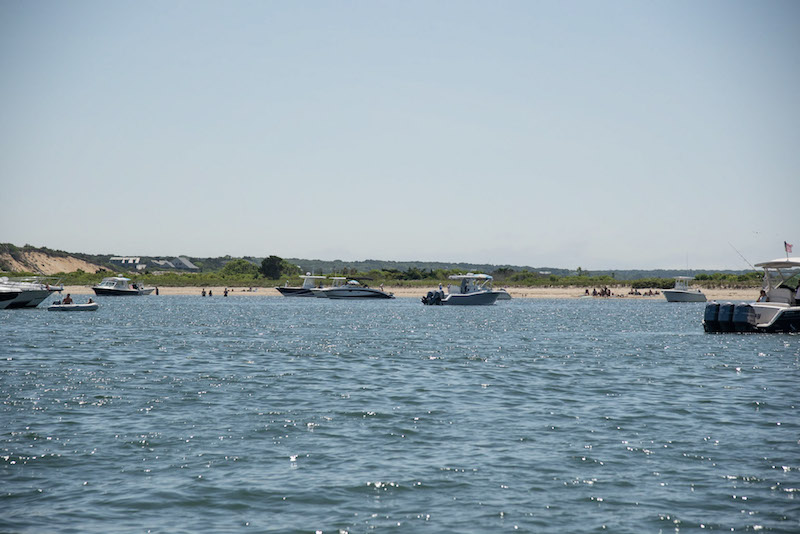
After one of the busiest summers in recent memory for recreational boating in Cape Pogue Pond, the Edgartown marine advisory committee is proposing a temporary ban on anchoring in the pond.
After one of the busiest summers in recent memory for recreational boating in Cape Pogue Pond, the Edgartown marine advisory committee is proposing a temporary ban on anchoring in the pond, amid concerns about preserving the globally rare coastal embayment.
The proposal would ban boaters from anchoring in almost the entire pond, save for a small, sandy stretch just northwest of the opening known as the Gut. Surrounded by conservation land, most of it owned by the Trustees of Reservations, Cape Pogue Pond has long had one of the richest and most productive bay scallop beds in Massachusetts.
All of Cape Pogue Wildlife Refuge was designated some years ago as a district of critical planning concern (DCPC), a special overlay planning district enacted through the Martha’s Vineyard Commission.
But increasing use of the pristine pond by recreational boaters in recent years has set up a delicate balancing act between recreational and ecological stakeholders.
This past summer was a record year for recreational boating around the Island, including at Cape Pogue, when hundreds of vessels filled the pond on Fridays, Saturdays and Sundays between July and September according to town harbor master Charlie Blair.
Now town officials say the scales have tipped.
All three members of the marine advisory committee — Bruce McIntosh, Martin (Skip) Tomassian and Scott Morgan — support the proposal, according to minutes from advisory committee meetings and an interview with Mr. McIntosh, who is chairman. The Edgartown planning board has also voiced approval for the moratorium, voting in a Nov. 17 meeting to support it, according to administrator Doug Finn.
“The Edgartown planning board heard from members of the Edgartown marine advisory committee, and the Edgartown shellfish constable, who expressed concerns regarding the impact of recreational boating — specifically anchoring and rafting — on the marine wildlife of Cape Pogue,” Mr. Finn wrote to town administrator James Hagerty in an email provided to the Gazette. “After deliberation, it was voted, to recommend and support a moratorium on anchoring in Cape Pogue for a period of one year, or until revised regulations regarding use and activity in the area are approved, whichever comes sooner.”
In a brief interview, Mr. Hagerty said a ban on anchoring in the pond would have to come from town selectmen. Mr. Finn said in an email that the planning board and marine advisory committee would both be sending letters to the selectmen expressing their stance.
A similar proposal was recommended to the town selectmen last year by the marine advisory committee, but was met with hesitance from selectmen. The proposal was ultimately tabled because of the coronavirus pandemic.
Ironically, one year later, members of the marine advisory committee and town officials felt it was the pandemic that prompted recreational boating in the pond to get out of control this past summer.
“There was a lot of discussion about it last winter. Then the selectmen said, when Covid happened, that they didn’t want to change anything this year,” Mr. McIntosh said. “But boating took off this year. Everybody bought new boats, and came from wherever . . . there were maybe 150 boats anchored in there, which it is just not designed to handle.”
Cape Pogue Pond — surrounded by approximately seven miles of an ecologically unique, question-marked shaped barrier beach on Chappaquiddick — is home to oysters, steamers, quahaugs and some of the region’s last fertile shellfishing grounds for bay scallops. The remote spit of land, which contains nesting grounds for rare birds, including piping plovers, is primarily owned and managed by the Trustees. A handful of houses, most of them old summer camps, are situated in the wildlife refuge.
Although shellfish catch in the pond has declined dramatically since the 1980s, when more than 100 commercial scallopers would bring in 25,000 bushels annually, the pond still has approximately 20 regular commercial bay scallopers, who haul between 5,000 and 10,000 bushels per year.
The decline is only part of a long story of development and use, shellfish constable Paul Bagnall said.
“As the population of people on the Island increases, there seems to be some reason the population of scallops decreases. That happens for a number of different reasons,” he said. “Nitrogen in the water. More boating use. But we’ve always caught a significant portion of the state’s bay scallops. And we still take a significant amount . . . it’s a premier scallop area for the state of Massachusetts, let alone the town of Edgartown.”
The health of scallop beds is contingent on a dense growth of eelgrass, which provides protection for bay scallops during their post-larval phase. Bay scallop seed in thickets of eelgrass have a higher rate of survival, attaching themselves closer to the top of the canopy and avoiding ground predators, like crabs and conch.
Anchoring threatens the habitat, pulling eelgrass out of the ground and damaging the beds. Whereas scallop drags are designed to go over the eelgrass growth, anchors are designed to root under it.
“Eelgrass is a keystone species,” Mr. Bagnall said. “We want people to come and have a good time, but not to decimate a scallop crop.”
Mr. McIntosh said the anchoring ban would be focused on areas of the pond containing eelgrass, not the traditional sandy-bottom landing spots just west of the Gut, which he hoped would stay open to boats and beachgoers.
“What everybody wants to do is to help save the pond, or the gut. That’s the interest,” Mr. McIntosh said. “Everybody should be on the same page with the health, ecologically, of the pond. And, obviously, you don’t want to have a Coney Island-like circus going on down there, either.”
Mr. Blair the harbor master and others have also expressed safety concerns about the rise in boating before the selectmen this summer, especially as commercial kiteboarding has proliferated in the pond. Kiteboarders say denying them permits would hurt their business. After tense discussion this summer, selectmen ultimately approved permits despite a proposal from the marine advisory committee to deny them.
Mr. Hagerty said that the anchorage issue would likely be taken up by the selectmen at a meeting sometime in January.
“It’s a balance,” he said. “It’s a balance of Cape Pogue being a recreational area. It’s a balance of the shellfishing. It’s a balance of landowners.”
Comments
Many thanks for prioritizing
Local MVYMany thanks for prioritizing the protection of that priceless resource over more boats coming over from Falmouth to drop anchor and have at it. Three cheers.
They should charge boaters to
Cement Truck Driver Edgartown but used to be VHThey should charge boaters to anchor in Cape Pogue. Off Islanders and out of towners pay more. If you are renting or own reduced rate.
Wonderful to see that
Alec Walsh ChilmarkWonderful to see that Edgartown stepped up to protect Cape Pogue after last summer's circus . It is a treasure and needs protection.
The majority of the boats
fact checker edgThe majority of the boats were on the beach beginning at the gut and people were on the beach adjacent to their boats. There were a few anchored, but if the point is to not allow boaters to clog up the pond, something needs to be done about not allowing boats to 'beach' in the area. My observations indicated that a large group of boaters, specifically Falmouth (as indicated on the boat homeport name) have 'discovered' this pristine area. Whether they no longer go to Tashmoo , or faced limited 'rafting' in OB harbor,or can't 'beach it' at State beach, they have now found a new place. I'd say most were well behaved and didn't have a 'party atmosphere' like the boats 'rafted up' in OB harbor.
Cape Pogue is a special place
Brooke CCape Pogue is a special place that requires preservation for future generations. Our family has spent countless lazy afternoons out there for a generation, sometimes arriving my boat and sometimes by over-sand vehicle. The combination of warm, shallow water, protection from wind and waves, and ample sea life makes it the perfect place for young kids to snorkel, dive and explore the marine world. It is truly a wonderland for children.
The pandemic-driven boat volumes this past summer were truly unprecedented in my time out there. And there were many more large boats (30+ feet), with heavier anchors that do more damage to the seabed. Whether that will continue after the pandemic is anyone’s guess, but if it does I’d support limits.
But the devil is really in the details on implementing thoughtful usage limits. I urge the selectmen and other decision makers to seek a lot of public comment from all stakeholders, study precedents elsewhere, and not lose sight of the fact this is one of the best spots on the island for young families, the rare kind of magical place where lifelong memories are forged. It shouldn’t be rationed beyond ecological necessity.
And if you reduce boat access, the unintended consequence will be more vehicle traffic on the beaches, which causes a different type of ecological damage, more traffic on Chappy, longer ferry lines, etc.
Having explored the seabed of Cape Pogue during long open water swims, there is definitely a lot of sensitive eel grass habitat and economically valuable shellfish beds. But there are also large sections of the pond that are not. At present, all the boat volume is getting concentrated along a fairly small section between the Gut and the windmill house that is overused. If, for example, there were a few small designated areas spaced around the pond, where you could beach a Whaler, or tie up in a small field of 5 moorings to snorkel, that could address the anchoring damage (and generate day pass mooring revenue to the town for shellfish mgmt). And a 15-foot whaler gently skidded onto the beach, and a 34-foot center console that weighs 6-tons and uses dual anchors don’t have the same ecological footprint, so that question requires some careful thought too. Size matters.
Finally, Cape Pogue has become a magnet for regional boaters from around southern New England. On any given weekend last summer, more than half the boats were flagged from ports along the South Cape, so whatever policy is ultimately implemented, it will need to be publicized well across a large catchment area of local boaters.
How do you balance all these competing interests and preserve Cape Pogue for future generations? I wish I had a silver bullet. But please go carefully up the middle on this one. The ecology must be preserved, no one questions that objective, but the next generation of family memories is also at stake here.
If there is really a concern
Wj EdgartownIf there is really a concern for protecting scallop beds and eel grass, then the Town should install a mooring field in Cape Pogue. Moorings would protect the eel grass from anchors. Kite surfing doesn’t hurt eel grass, by the way. Don’t make this a NIMBY issue masquerading as an ecological issue.
Several years ago the
Philip Walsh Miami, FloridaSeveral years ago the Oceanographic Institute in Woods Hole published a study that stated, “... the purity of the water in the Cape Poge compares favorably to that of a remote Pacific atoll.” That we’re nibbling at the edge of the cookie while recreational boaters overcrowd this priceless assert is astounding. Anything less than banning all power boats save those belonging to those residing on the pond and commercial fishing vessels will prove unsuccessful in preserving the Cape Poge. Barring those measures, there will soon come a proliferation of algae that will block sunlight from reaching the bottom, after which all will be dead within twelve months. Long Island’s Great South Bay experienced this in the early eighties, putting an end to to one of the Atlantic Seaboard’s greatest sources of bay scallops, hard shell clams and oysters. Ironically, the watery desert left behind proved to be good for only one thing - recreational boating, almost exclusively in the form of power vessels. Aside from providing the right experience, the environmental impact of kayaks and small sailboats is minimal.
Most fisheries ultimately
James Riley EdgartownMost fisheries ultimately decline because of over-fishing. Has anyone considered that this is the cause of declining scallop catches? It would be a shame to limit recreational uses of the pond if over-fishing is the real problem. Also, has anyone measured nitrogen levels in the pond, to determine the effect of development?
Perhaps a sensible compromise
Caitlin McNally OBPerhaps a sensible compromise might be to only allow smaller boat to anchor. This would still give islanders with smaller boats the opportunity to use this beloved island resource, while discouraging larger boats from the cape from coming over and creating a mob scene.
The no fun island is earning
Bob EdgartownThe no fun island is earning its name. To bad the old people running the system now do not remember how to have fun. I was there once a week this summer and for the last 30 summers as well. Yes a few more boats but not the huge issue some would make you think.
I disagree. It was the worst
T Bone Oak BluffsI disagree. It was the worst it's been in the 28 years I've driven on Chappy.
Just an observation. I find
Steve FalmouthJust an observation. I find it interesting how the Vineyarders want to blame everyone else for their problems... I seriously doubt “Falmouth” boaters are the problem there, but if you promise not to fish for our albies during the so called vineyard derby, I’ll stay out of cape pogue
Here's a thought. There is no
baffled edgHere's a thought. There is no place for Vineyarders to tie up our boats in Falmouth if we want to shop. So until there is some reciprocity don't spoil it for us in Cape Pogue.
Why not just issue permits
Ric Smith EdgartownWhy not just issue permits like the oversand permit. Having summered on the island for 40 years and boated in cape pogue completely restricting the area is too drastic a measure. The area is already off limits on shore for much of the summer.
The governance of the island needs more representation by second home owners who pay taxes without representation, not just the year round minority.
Norton's Point looks like
Nick EdgartownNorton's Point looks like Nauset beach and Cape Pogue Pond looks like an overcrowded marina. Call someplace paradise, kiss it goodbye.
Agree with above problems and
Nick EdgartownAgree with above problems and watched escalation over last year. We've enjoyed the area for many years with our small boat. It's gotten out of control with boaters from other areas. I'm all for protecting the environment, but restricting all boating prevents future generations from appreciating this area. I would have a size limit of less than 23 ft and or/permit system to keep volume and impact down.
We have been boating for a
long time boater capeWe have been boating for a long time, grabbing a mooring or anchoring in edgartown, an escape was always go to pogue to get away from everything, when we tried that this summer we ended up back at lighthouse beach because there where less people, although it was overcrowded with piping plovers
Would be great if there was a
Scott EdgartownWould be great if there was a way to limit usage of this great resource without shutting it off completely. Seems to me that offering seasonal permits to enter the gut would be a great way to reduce "traffic" and still make it accessible. Would need a ranger to patrol but the permit costs could pay for the ranger (probably only necessary on weekends).
Add new comment