

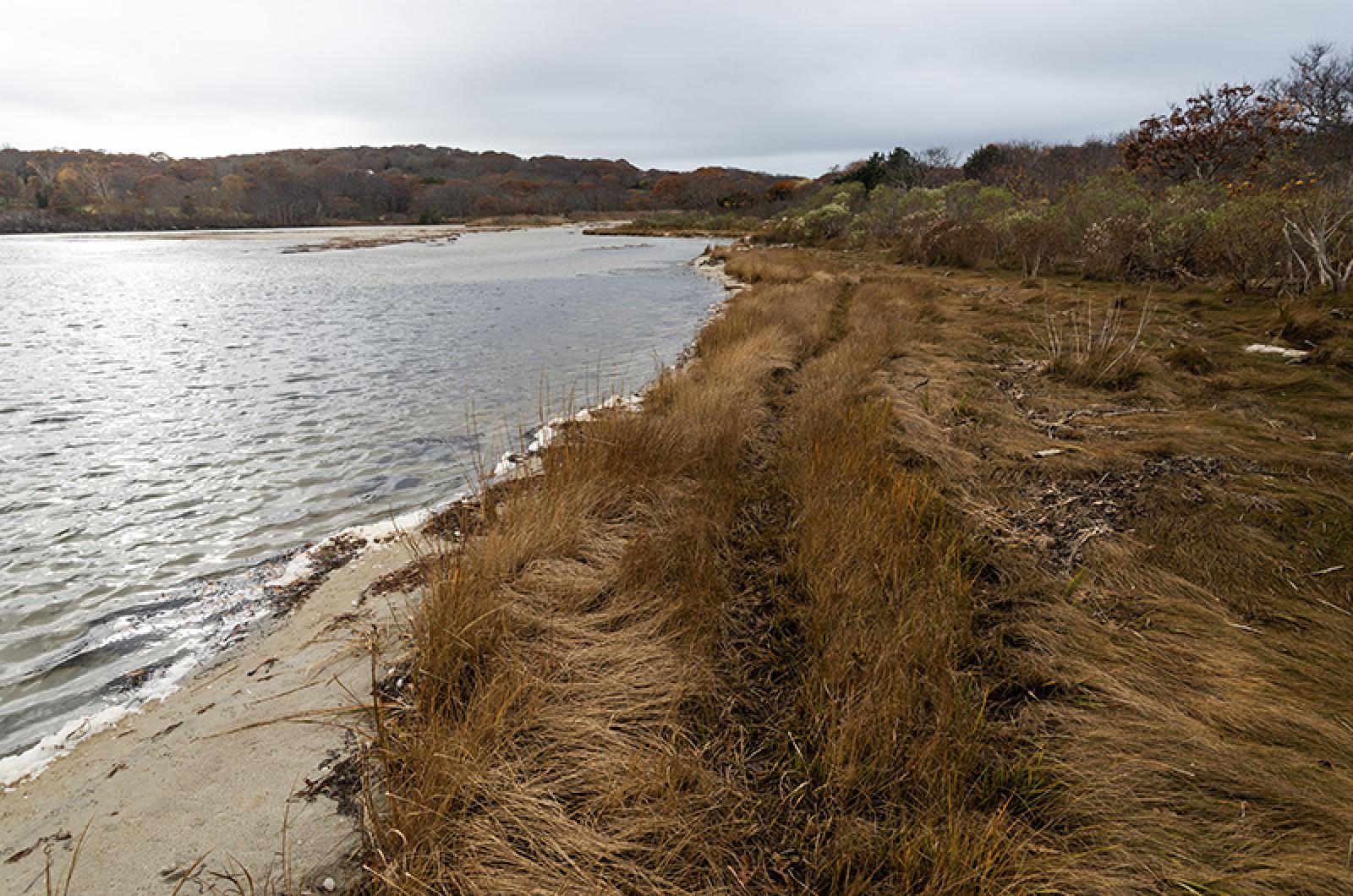
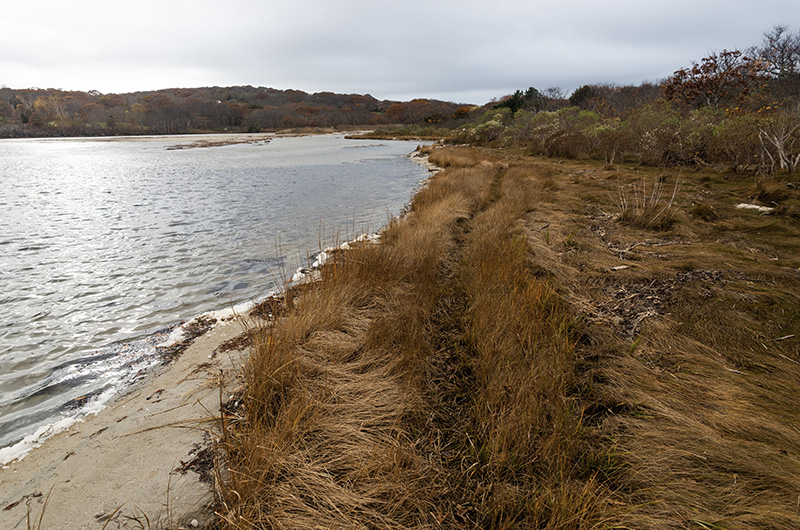
When Dr. Jim Haney, a professor of biological science at the University of New Hampshire, first saw the results of cyanobacteria sampling from six of the Island's coastal ponds, he thought there had been a mistake.
When Dr. Jim Haney, a professor of biological science at the University of New Hampshire, first saw the results of cyanobacteria sampling from six of the Island’s coastal ponds, he thought there had been a mistake.
A seasoned zoologist who has spent much of the past two decades researching the impacts of tiny, microscopic cyanobacteria in pond systems, Mr. Haney had never seen results like the ones that were coming from Martha’s Vineyard. The Island’s brackish coastal ponds, such as James Pond, Wintucket Cove in the Edgartown Great Pond and Chilmark Pond, were reporting higher levels of BMAA — a known neurotoxin that can be released from cyanobacteria — than he had recorded in any water system in the region, including highly polluted ponds across the state.
But there was another reason Mr. Haney had never seen results like on the Vineyard before: he had never studied brackish ponds.
“We never tested ponds with high salinities,” Mr. Haney said in a recent followup interview with the Gazette. “That’s one of the reasons when we got those results with the high levels that the first thing we did was go back and test our methods, adding salt to make sure that it wasn’t producing some sort of artifact, because I had some sleepless nights to be very honest with you about that.”
According to Mr. Haney, the Vineyard and its 13 or so unique Great Pond ecosystems are at the forefront of a completely nascent science — one that neither he, nor any marine biologist, has studied in great detail before.
While Mr. Haney has extensive experience sampling freshwater ponds — which are often more frequently used, considered to be dirtier, and thus, more scrutinized from a public health perspective than saltwater ponds — the presence of cyanobacteria, toxins and algae blooms in saltwater pond systems like the Vineyards’ represent an unexplored frontier.

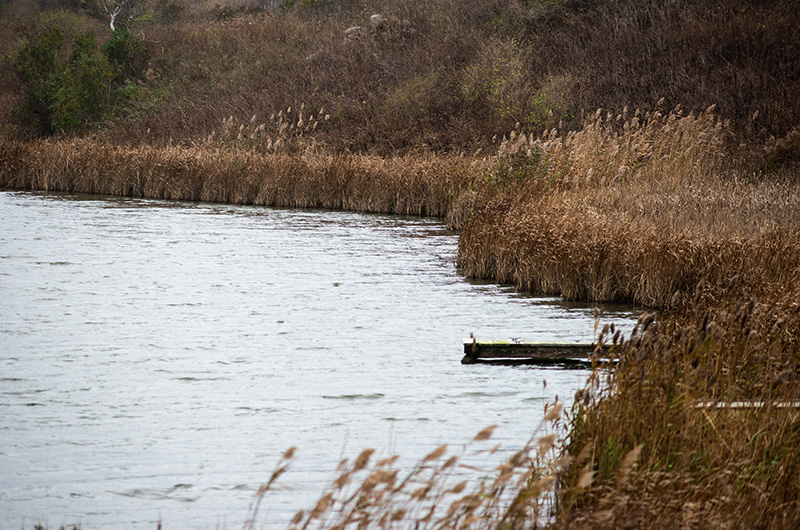
Study was initiated after a man became sick while crabbing in Chilmark Pond.
Study was initiated after a man became sick while crabbing in Chilmark Pond.
The testing conducted by the University of New Hampshire was initiated earlier this fall by Island health agents and the Martha’s Vineyard Commission after an adult man was sickened while crabbing in Chilmark Pond. Large algae blooms were observed in the pond throughout this summer, prompting its closure to recreation. And last summer, Chilmark health officials said a dog died after drinking water from the pond.
Although often informally known as blue-green algae, cyanobacteria, or microscopic bacteria that live in all water systems on the planet, are actually ancient microorganisms that share traits with algae, such as the ability to perform photosynthesis. In fact, they were the first photosynthetic organisms to evolve on Earth, dating back three billion years, and their presence in Island ponds is a well-documented, healthy part of the ecosystem.
But a dramatic increase in the presence of the bacteria can cause harmful algae blooms, resulting in blue-green discoloration in the water column that often looks like pea soup or spilled paint. Ingestion, or even skin contact with the blooms, can be harmful to humans, causing gastrointestinal symptoms, irritation, liver issues and neurological problems.
Newer branches of science are also trying to determine the impacts of cyanotoxins in the air and the food web, as well as the impacts from invisible picocyanobacteria (which is suspected to emit BMAA). And it is generally agreed that because of warming temperatures in the Northeast and increased nutrient levels in water systems, the frequency of cyanobacteria algal blooms will increase.
In a presentation with the Edgartown Great Pond Foundation, Stony Brook University scientist Dr. Christopher Gobler compared the Island’s pond system to southern Long Island, noting that a dog death there had initiated monitoring back in 2011 and that the years since had seen great improvement in the quantity and impact of algae blooms. He said the Vineyard’s level of microcystins, one of the most commonly-studied harmful toxins emitted from cyanobacteria, were actually far below even the Environmental Protection Agency’s threshold for drinking water.
“Even the highest level that was found in the Martha’s Vineyard water bodies are quite low, relative to the standards,” Mr. Gobler said. “And again, the drinking water standards are based on chronic consumption.”
But the high presence of BMAA — a much less-studied cyanotoxin — in the Island’s saltiest ponds was unexpected. While visible algae blooms, which concentrate cyanotoxins in localized high levels, are easy to see, and thus, easier to avoid, invisible picocyanobacteria present different scientific, and public health, conundrums.
“One of the things that really concerned us, quite candidly, was making sure that the high levels of BMAA was not some sort of a fluke, and whether that translates to high levels of aerosols,” Mr. Haney said. “We have no idea. With BMAA, the science is not that far. So, what we’re asking is, can we identify some possible causes? And because the aerosols represent something that we all share, we want to see if they are present, what their levels are, and could they represent some potential threat.”
Both Mr. Haney and Mr. Gobler felt that it was too early to draw any hard conclusions about the safety of the ponds for recreational use. They agreed that Islanders should always avoid blooms, but cautioned against broader conclusions.
For instance, a bloom in one part of the pond does not mean the entire water supply is toxic. And the lack of a bloom doesn’t mean that the water is non-toxic. Mr. Haney also noted that sampling was preliminary and by no means comprehensive.
But a much more rigorous monitoring program on the Island is now being initiated, with the goal to develop a citizen science aerosol analysis kit, as well as to constantly monitor ponds for algae blooms. And there has been discussion between health agents and the commission about using the shellfish hatchery on Lagoon Pond in Oak Bluffs as an ad hoc testing lab for water toxins — another crucial step according to Dr. Gobler for keeping ponds safe.
Dr. Haney felt that constant data was the only way to appropriately address use of the ponds from a public health perspective, which his lab plans to gather on the Island next summer. And as a scientist, he was enthralled by the possible link between high salinity and high levels of BMAA — a potential new connection he plans to further explore.
“The whole toxin thing is in its infancy,” Mr. Haney said. “And that’s the concern for us. We have to keep an open mind and actually measure what is happening.”
Comments
Sign me up as a citizen
Jane Norton Wade's CoveSign me up as a citizen scientist! I will keep a look out for opportunities to help the "real" scientists study this problem.
Well said!
Jen VHWell said!
Are fish and crabs from these
mike SomewhereAre fish and crabs from these ponds safe to eat? I know shell fish like clams should be avoided because they are filterers.
No mention this round of
Ellen S Sturgis Thumb Point WT and Stow MANo mention this round of Tisbury Great Pond, which was included in previous reports. I’m hoping WT officials make sure testing is going on here — the Riparian Owners should, IMHO, offer financial support
Please keep us posted on
Jonathan EdgartownPlease keep us posted on details of how and when we can be trained as and participate as citizen scientists for data collection.
More information about
Emily Reddington Great Pond FoundationMore information about cynaobacteria and a recording of Dr. Gobler’s presentation can be found on Great Pond Foundation’s website: https://greatpondfoundation.org/explore-our-work/cyanobacteria-resource/
Thank you Emily!
Jane Norton Wade's CoveThank you Emily!
I wish someone would test the
Pam Benjamin Vineyard HavenI wish someone would test the relationship to overflowing septic systems. It seems like one of the logical causes for issues like this, but it has not been mentioned at all here.
Thank you
Septic systems are absolutely
Emily Reddington Great Pond FoundationSeptic systems are absolutely one of the sources of nutrient pollution that can lead to the accumulation of excess nitrogen + phosphorus (eutrophication), which, combined with warming temperatures, triggers algal blooms: https://greatpondfoundation.org/explore-our-work/cyanobacteria-resource…
Yes, Pam! Septic systems,
Steve F ChilmarkYes, Pam! Septic systems, plus run off from agriculture, pesticides used on lawns, sprays, chemicals used improperly. We are poisoning our precious resources.
Thank you Pam. I'd go one
Carole Vandal-Hillman AquinnahThank you Pam. I'd go one step further, and ask that we do this study on septic systems and their impacts on our precious fragile ecosystem as it pertains to our ponds which feed so many island families.
Do this study, let's get some grad students on this a.s.a.p. I add to the study, that we propose a building moratorium on all ponds and their wetlands watershed areas ( human impacts). We need to consider how much climate change has come to play in this disrupted habitat. Droughts are are affecting our wet lands, which are not getting replenished and thus contributing to this imbalance. I'm a former wetlands biologist. This knowledge in biology and through a brief discussion with my friend, Steve Vancour, who reminded me of this, "we are a "sole-source aquifer"; relying 100% on this fresh-water source to get our drinking water", great reminder, this aquifer is finite source here in these grounds. It is estimated that we loose over One million gallons of fresh water per day to the ocean! Only we as humans can make the changes needed to save our waters. Remember, "Water Is Life". Our Mother Earth is crying for change. Are we bold enough to stand up together for her? Or will we continue to contribute to our own demise? As a water protector, as member of the Wampanoag tribe, as one who walks these lands carrying our ancestors in my heart, as they once did on these now eroded lands.
I follow in their footsteps, and ask that we seriously take heed of what our next steps are. We need to save our sacred ways of living, as Natives, we live off the land and we are dependent on our waters as a food source as well as an economic resource.
Great comment, Carole. Let's
Carol formerly ChilmarkGreat comment, Carole. Let's remember we are all natives of this, our only small planet. I've seen the changes in Chilmark Pond over the last 60 years, and it's not good. Many more houses on Abel's Hill now, none with sewer lines, so all that excrement makes its way to the (formerly crystalline clean, back in my childhood) pond. Gather the science, & buckle up for infrastructure improvements. Those septic systems aren't cutting it.
The Tisbury Board of Health,
Emma Green-Beach Oak BluffsThe Tisbury Board of Health, with the MVC and the joint committee for Lagoon Pond, are making great progress towards nitrogen reduction with a new septic system design. Hopefully we will see more of these soon. Like Emily said below, septics are a major source of nitrogen. Remember, the Title IV septic was never designed to remove nitrogen.
THis will probably increase
Ken EDG.THis will probably increase if septic systems have anything to do with it. Still no maintenance pump outs in Edgartown. I wish we could get an explanation from the town on this.
If we want to get serious
Lorraine EdgartownIf we want to get serious about this we will stop all chemicals on all lawns; all rearranging the landscape in the guise of "landscaping", what we are doing is poisoning everywhere we live due to people being "lawn and garden" proud....it is utter nonsense. My nieces is a tester on her lake in another state and sends the results in monthly to the D Of Nat Res. The people buy properties on the lakes are slowly poisoning the lakes with their desire to rip out natural wild vegetation and ditto what they had in the suburbs. Just quit it. Martha's Vineyard Island is one of the most beautiful places on earth, and I have been around the globe, and the islanders over the centuries have kept it beautiful in its own natural way. Let us not ruin it more than we have. I realize this is probably not a popular opinion, but I have seen many things in my long life and I wish to impart my wisdom on these things. Call me opinionated, just so.
Couldn’t agree with you more,
Local EdgartownCouldn’t agree with you more, it is distressing. Look along edgartown harbor, you will see a correlation between heavily fertilized lawns and algae on the shore. Martha’s Vineyard is not suburban Connecticut.
US taxpayers have spent over
National Algae Association TexasUS taxpayers have spent over $2.5 billion on algae research for the last 80 years. Decades of research, testing and monitoring alone have not fixed the devastating algae bloom and HAB problems on waterbodies. End-to-end solutions need to be commercially deployed from nutrient runoff at nonpoint sources to lakes and coastlines. Action is needed!
As a resident of Edgartown
DownislanderAs a resident of Edgartown who kayaks the Great Ponds frequently, the amount of pollution from waterfowl is gross and unbelievable. I’ve found myself paddlig through floating bird droppings thick as pudding. There is no way that septic systems, at the low density of developmenet around Edgartown Great Pond, are the biggest problem. Especially since many of those homes are only used seasonally. If septic systems were such polluters, why isn’t everyone’s well polluted?
Ifnseptics are a culprit then
Mvfrick EdgartownIfnseptics are a culprit then the MV commission who approves building permits needs to take their heads out of the sand and look longterm with the addl running of sewer lines.
Meetinghouse Place was to be 100% sewer and tie in several addl neighborhoods like Hotchkiss to further the decrease in nitrogen loads and the commission rejected the development.
Timentonreplace thencurrentnboard with new people who are looking at the longterm benefit to the island and not some folks who are stuck.in the 80s and do things which say they are looking at the benefits of all but really only apply to their inner circle of friends.
I heard wood stove ash can be
Common cents MvI heard wood stove ash can be used to control algae in small ponds. The idea is that it feeds the natural plants, potassium, calcium, etc, and they out compete the algae for sunlight. Here it would be the eel grass. The ash could also affect the ph level of the pond which could be good or bad, I don’t know. If shellfishing and oyster farming remove calcium carbonate from the pond, this could be a way to put some back in. Local wood ash of course, woodstove, burn piles or prescribed fire, then you wouldn’t be adding anything to the island ecosystem, just moving it around. There are more people here and more fertilizers but the vegetation is also very different from 50 years ago so the natural run off has changed as well and with it the mineral content and acidity. Hope this helps, thanks
I would like to see more
Paul Adler West TisburyI would like to see more electric cars here. I've been driving one for 7 years and I am surprised I get no town excise tax relief or a discount from the Steamship Authority. Electric cars don't contribute to road oil run off or air pollution. Towns should promote their use.
Add new comment