

Artist Aldro T. Hibbard, a Falmouth native, was noted for his winter landscapes, but suggested that artists “Never use pure white; it doesn’t exist in nature.”
G.K. Chesterton would have vehemently disagreed: He wrote “White . . . is not a mere absence of colour; it is a shining and affirmative thing, as fierce as red, as definite as black . . . God paints in many colours; but He never paints so gorgeously, I had almost said so gaudily, as when He paints in white.”
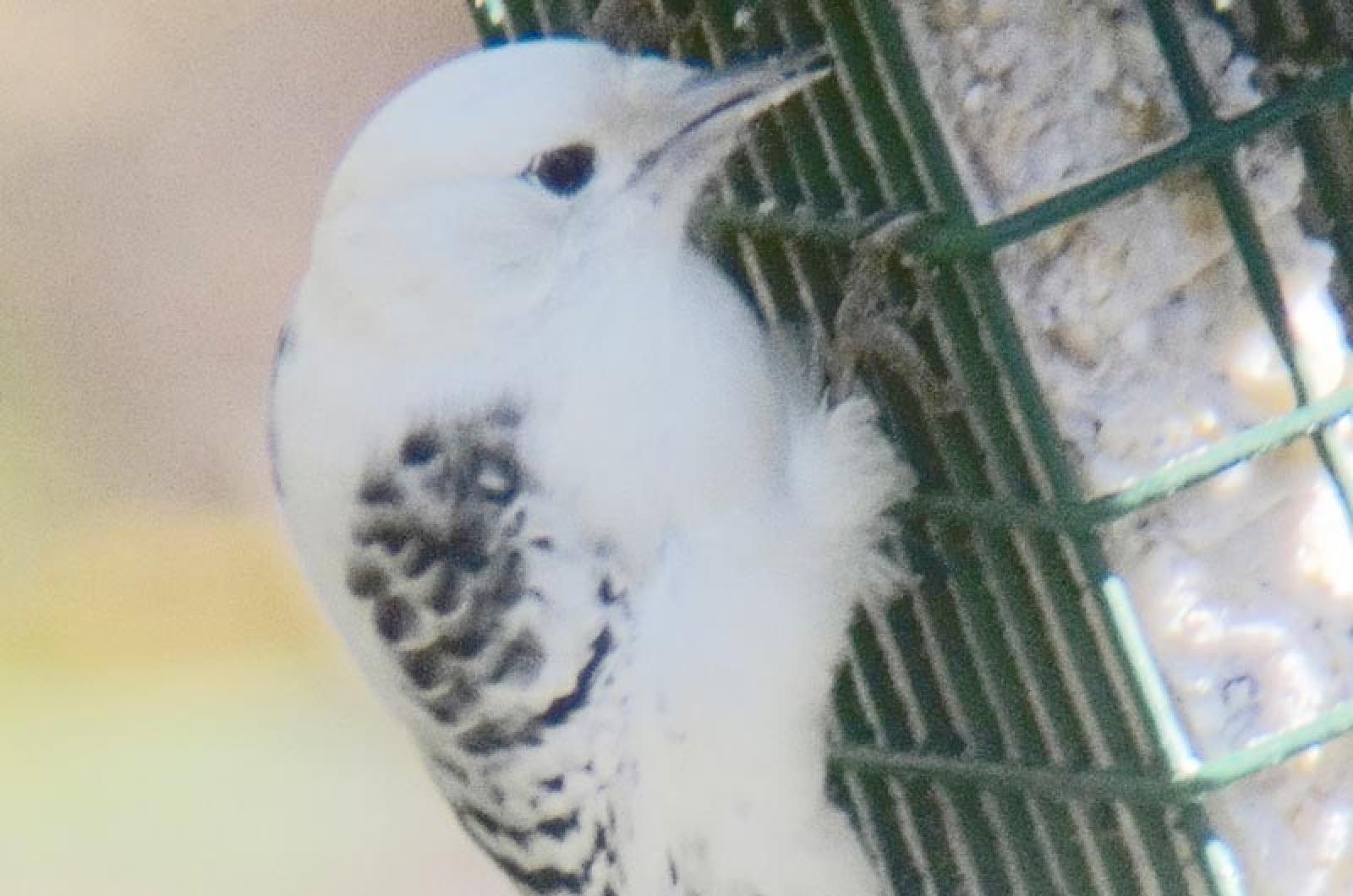
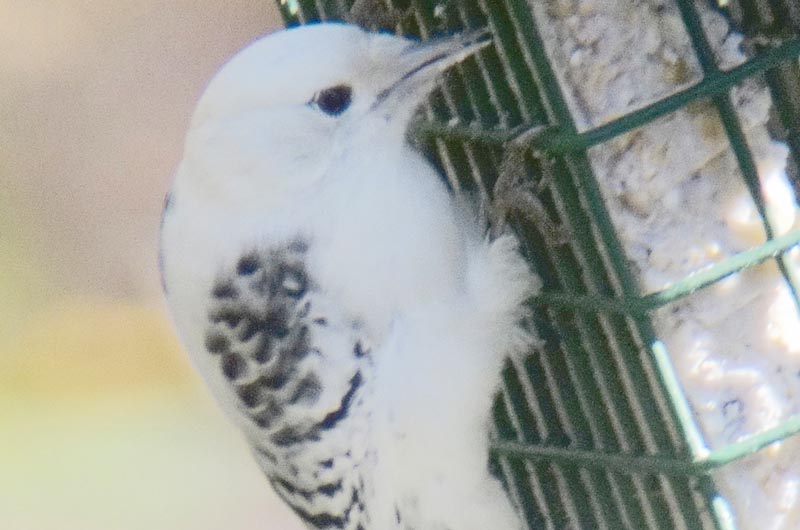
An odd and mostly white downy woodpecker seen by Dick Clark of Oak Bluffs last week at his feeder speaks to both statements. It refutes Hibbard with its whiteness and aligns with Chesterton’s appreciation.
Leucistic birds have colored eyes, beaks and feet.
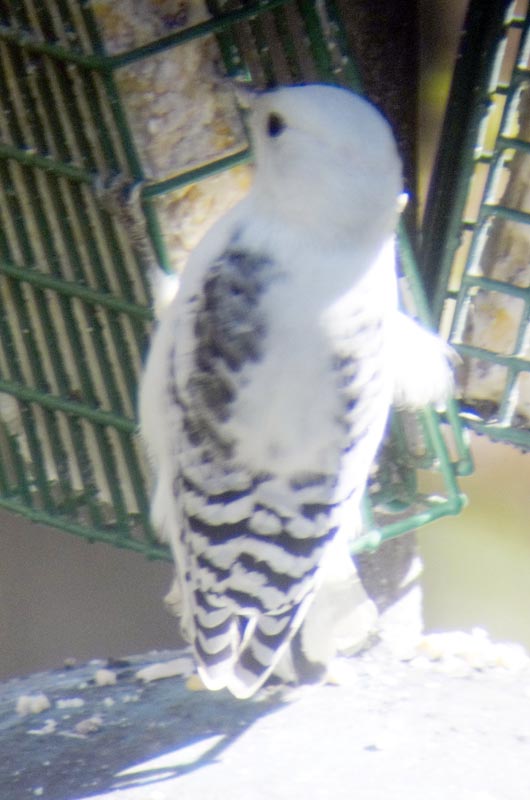
Leucistic birds have colored eyes, beaks and feet.
The strangely colored (or lack of color) bird is leucistic, which is a condition in animals that is characterized by an obvious lack of pigmentation. The woodpecker’s white feathers were bright as newly fallen snow, delighting and intriguing local birders and spawning a discussion of leucism versus albinism in birds.
In the case of the downy woodpecker, it was a clear example of leucism and not albinism. With some black pigmentation in its back and tail, the downy showed a bit of its true colors, though most of its feathers were white. That limited pigmentation and its dark eyes were the giveaway that it was leucistic rather than a true albino.
Albino birds are defined by the complete absence of color caused by a mutation in their genes that doesn’t allow for the production of melanin, which produces pigment in animals. True albino birds don’t have any color and that characteristic is inclusive of their beaks and feet. Albinos have pink eyes, only showing the hint of color because their blood vessels show through. With this affliction also comes impaired vision.
Leucistic birds have colored eyes, beaks and feet. Their production of melanin is interrupted or reduced, but not absent, so they can have patches of white mixed in with their colored feathers or appear piebald. This disorder, however, can weaken feathers and make them more prone to wear, which can sometimes affect their flight abilities.
Both conditions can allow birds to become easy prey, as they stand out in their environment. Another problem is that albino birds seem to have trouble finding a mate.
Other studies show that there may be survival advantages to these conditions, since their prey may not recognize them for what they are, due to their lack of or unusual coloring. In the case of other animals besides birds, albinism can even enhance their chances of survival — from human hunters, at least — since 13 states have laws on the books that prohibit the killing of albino creatures.
Statistics on the frequency of leucism are hard to find, as it may be merely a footnote in specialized literature on certain species; however, albinism has been more studied. There have been at least 300 species of animals, including fish, frog, snakes, deer, bluebirds, raccoons and turtles, among others, that have been observed with this condition. For mammals, albinism is estimated to occur once in every 10,000 births. In catfish, it is one in 20,000, and for birds the odds are once per 1,764 birds.
These special animals have been seen through history as both holy and fearsome. One recent example of them promoting affection instead of fear comes from students at the University of Texas who believe that seeing albino squirrels will bring them luck on their exams.
Thus, the Albino Squirrel Preservation Society was created to protect the campus’s albino squirrel population. The group has flourished and now has chapters throughout the country! Their motto, “In the constant pursuit of albino squirrel rights,” says it all.
So, while we will never be sure if those albino squirrels bring good luck, we do know that whether they are albino, leucistic or otherwise colored, they definitely brighten our world.
Suzan Bellincampi is director of the Felix Neck Wildlife Sanctuary in Edgartown, and author of Martha’s Vineyard: A Field Guide to Island Nature.
Comments
There are yang-white
tom hodgson wtThere are yang-white leucistic squirrels, and there are yin-black melanistic squirrels, too... In Falmouth there are several populations of the melanistic ones.
I have a downy woodpecker
catherine brittingham newtown square, pa 19073I have a downy woodpecker almost all white it is pecking and for 2 seasons pecking at my cedar siding. costing a lot of money for repair. don't know how to deter it.
Apparently we have a
Theresa Hoffman Saint Joe OndianaApparently we have a leicistic hairy woodpecker hanging around at my feeder. It is so cool to see a new type of bird after 16 years of feeding!
I had a leucistic Hairy
Martha Thomason Flah staff, AZI had a leucistic Hairy Woodpecker at my hummingbird feeder 2 weeks ago, mid June. It was supper cool!
They also love suet.they like
MarshaThey also love suet.they like the apple, nut, peanut butter.
Saw this bird once this past
Beverly Kleikamp HermansvilleSaw this bird once this past week in my yard! Now I know what it is. Thanks!
Today (5/15/23) I saw a
Linda Stolfa Ronkonkoma, Long Island, N.Y.Today (5/15/23) I saw a leucistic downy woodpecker at my bird feeder for the first time. When I saw it I couldn’t imagine what I was looking at, until I googled it. The encounter was brief because my sprinkler chased it away. Now I sit watching my feeder intently waiting for a species that I’ll probably never see again. The brief glimpse that I captured will remain in my minds eye for a long time. It was beautiful!!
One of these visited my
Kathy Ball Roseville, MinnesotaOne of these visited my feeder yesterday for some black oil sunflower seed. It was accompanied by two normally colored downy woodpeckers. It was a gorgeous bird!
Add new comment