

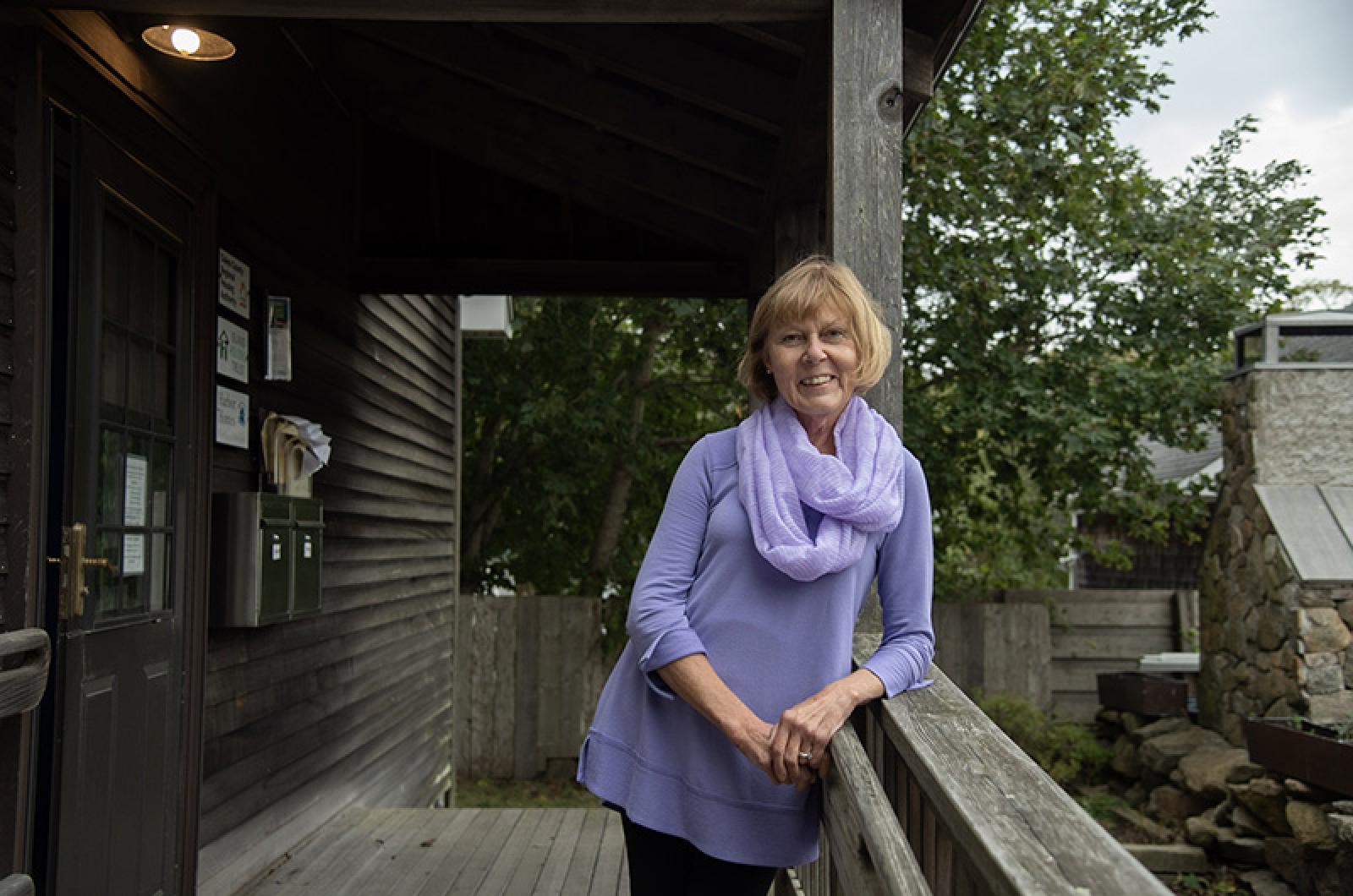
A rapidly growing philanthropic effort to address homelessness on the Island this winter awarded Harbor Homes of Martha’s Vineyard grants totaling $100,000.
Harbor Homes of Martha’s Vineyard has received grants totaling $100,000 to help house the Island’s critically homeless population this winter and plan for the future — the latest donations in a rapidly growing philanthropic effort to address homelessness on the Island.
In a press release Thursday, director of Harbor Homes Karen Tewhey said three donors stepped forward to fill funding gaps after learning that the pandemic had forced the shutdown of Houses of Grace, the Vineyard’s only winter shelter program.
The press release names the donors as the Martha’s Vineyard Bank Charitable Foundation, the Eugene and Carol Ludwig Family Foundation and the Hutchins Family Foundation.
The nonprofit Harbor Homes, which serves as the Island’s homelessness prevention program, will use $75,000 of the money to house individuals and families from November through March, the press release states. The other $25,000 will go toward developing a long-term plan to address homelessness on the Island.
The $100,000 is in addition to a $150,000 grant that Martha’s Vineyard Hospital has already pledged to provide help for low-income individuals or families who are homeless.
In an interview with the Gazette Thursday, Ms. Tewhey thanked the donors, saying that the money would ensure homelessness advocates had the money to secure space, pay staff and purchase supplies for critically homeless individuals — and would help house others in hotels on the Island. Harbor Homes, the Martha’s Vineyard Hospital, Dukes County and the Houses of Grace are partners in the effort, she said.
Ms. Tewhey said in estimating what would be required to address the need that the closure of the Houses of Grace program created, she determined there were about 15 people who normally used the shelter program and about 14 other medically fragile individuals and elders — including one family — that would need housing in hotels. The combined funding would likely cover those costs, she said.
“We did develop a preliminary budget that looked at two different housing opportunities, or sheltering opportunities for individuals this winter,” Ms. Tewhey said. “We’re hoping that the funding is adequate. It is incredibly generous.”
Founded five years ago in conjunction with three Island churches — St. Andrew’s, the Good Shepherd Parish and the Federated Church in Edgartown — the Houses of Grace shelter program spawned from a more informal patchwork of religious organizations that provided social services to the Island’s homeless population. The nighttime shelter operated from Jan. 1 through March 31 and rotated among the churches, seven days per week.
A daytime warming shelter run by Rebecca Jamieson also operated during the coldest months of the year.
But the shelter program was forced to shut down on March 12 — perhaps permanently — as churches could no longer house the program due to the pandemic, and finding other space proved challenging. Homelessness advocates, led by Ms Tewhey, have worked tirelessly to piece together a solution for the coming winter.
Harbor Homes also received about $33,000 in state funding earlier this year to help pay for hotel rooms for three homeless individuals from now until possibly June, which comes in addition to the pledged amounts.
“It’s very validating to everybody on the Island who has been working on homeless prevention, to finally have recognition that this is such a significant community crisis,” Ms. Tewhey said. “And then to have $25,000 earmarked for long-term solutions is also incredibly exciting.”
The Martha’s Vineyard Bank Charitable Foundation previously gave $12,000 as the shelter closed at the outset of the pandemic to help with homelessness. Bank CEO James Anthony said he saw this money as an extension of that effort.
“We’ve known about the issue for a while now, in that sense that the need to really support the homeless shifted in the face of the coronavirus pandemic,” Mr. Anthony said. “And so as we were looking toward the colder months of the fall and winter, seeing the same situation, we decided it was an important thing to get out in front of.”
The bank overall has given about $800,000 toward pandemic relief measures since mid-March, Mr. Anthony said. He emphasized the dual nature of this particular donation.
“It’s both short-term need, and both long-term planning, and I think that’s critically important,” he said.
For those responsible for securing housing for the homeless, hurdles remain. At a meeting Wednesday, Dukes County commissioners discussed the difficulty of finding suitable space for a shelter.
Ms. Tewhey said while the funding will help secure hotel rooms for some individuals, others will need shelter space — which has not yet been identified.
“The biggest barrier to our moving this forward is finding space,” Ms. Tewhey said. “There is a team of people making calls to landlords, driving around towns to storefronts that have rental signs in them. We are contacting churches, nonprofits and town managers, so we’re trying to be as creative and thorough as we can.”
Several religious and charitable organizations have offered spaces for shelters, she said, but have not yet received formal approval. She added that “incredible progress” has been made to find volunteers and paid staff for the program — which became an issue with the onset of the pandemic, as many volunteers were high risk individuals.
The new funding provides enough money to pay staff and rent space, if needed.
In 2017, Ms. Tewhey, then the homelessness prevention coordinator for Dukes County, was awarded an $80,000 Housing and Urban Development grant to house five critically homeless individuals on the Island. But the grant, which would have provided yearly funding in perpetuity, had to be forfeited because organizations couldn’t find the appropriate space.
Ms. Tewhey said she has had flashbacks about that grant this year, but believed that a solution to the space issue was within reach — and she was thankful about how far homelessness advocacy on the Island had come in one short month, when it appeared as though a population of Islanders would be without a warm place to stay this winter.
“It was going to affect the emergency room at the hospital, it was going to affect having a fire in the woods. It affects the police department having to deal with people with mental health issues. It is much more cost effective and compassionate and sensible to come up with a solution to housing these 15 individuals,” she said.
“This is a problem that has to be addressed, and solved.”
Comments
Ms. Tewhey has slowly been
Dean Rosenthal EdgartownMs. Tewhey has slowly been increasing funding although the numbers of homeless on the Island have remained stable. Harbor Homes is a project now in its 4th year of planning, I believe to house 4-5 homeless individuals, but I may be wrong about those numbers - hopefully it is more and I welcome to stand corrected. I have advocated for an extension of shelters from November to April, but the details to make happen are much harder than the inspiration. The words of advice I had for her back then was that she had to find “Island solutions” for the homeless of MV, that “off-Island solutions” she was expert at having recently moved to the Island in 2015 would not work or at least not work best at first. It seems now that the money is coming in - the Island is more understood by her and I’m thinking that after 4 years and her having with the County created a paid position for her hard work, we can continue to see results - ones that go beyond good funding and are transitive to making sure the homeless have a food over their heads. It is HARD. But she can do it, the progress is slow, and when we gauge by the homeless having options and not by funding achieved (which is the whole point) things are slowly moving along. We can have 10 million dollars is grants but if the homeless don’t have options and are simply statistics for HUD to analyze and to offer committees and newspapers than the work is functionally a complete failure. They must have options - that is the point. I believe those deeply involved, as I once was, can do it. It is possible.
Why can't the liquor stores
Charlie Callahan So Boston/EdgartownWhy can't the liquor stores have donation jugs on the counter. They are raking in the dough and the well to do drinkers could throw a couple bucks in along with their $100 orders of booze
Harbor Homes also wants to
karen tewhey oak bluffsHarbor Homes also wants to acknowledge the generosity and support of the United Methodist Society. They offered a $50,000 matching grant program this summer that resulted in an additional $100,000 for our organization.
There is much to be
Marjorie Mason ChilmarkThere is much to be encouraged by as MV awakens to the ever growing visibility of our unhoused and in crisis neighbors. There are true hero’s working every hour to show all of us what is needed and how we can help.
Unfortunately, at this time , there are still NO SPACES available to set up multiple temporary emergency winter shelters for many of the participants of the Houses of Grace winter shelter program. This is not for lack of seeking and negotiating creatively with those who have stepped up, per say. It is not a failure of planning, funds or manpower.
What is missing is more will to offer space and unite in problem solving. Every empty space on the island near a town and bus route really could be considered. There are too many ‘good’ excuses when the problem is not getting solved.
In Falmouth there is a winter program called Belonging to Each other that found 2 landlords willing to accept modest rent to hours 6-8 vulnerable men in one house and same for a women’s house with professional oversight. This program is in its 4 th successful year even in a pandemic. The need to space people further apart adds to the challenge and need for more houses. Still,
might not 2 -4 landlords on MV find this model works for them? Harbor Homes and HOG partnership hopes the answer is yes. We are here to make this happen.
Add new comment