

With Hunting Season Set to Begin, Deer Donation Program Will Repeat
When deer hunting season on Martha’s Vineyard begins Oct. 5, so will the venison donation program. Coordinated by Island Grown Initiative, the agricultural society and the tick-borne illness prevention program, the system allows hunters to donate surplus meat that will go to feed hungry Islanders.
When deer hunting season on Martha’s Vineyard begins Oct. 5, so will the Island’s increasingly popular venison donation program.
Coordinated by Island Grown Initiative in partnership with the Martha’s Vineyard Agricultural Society and the MV Tick-Borne Illness Prevention Program, the system allows hunters to donate surplus meat that will go to feed hungry Islanders.
Last year, according to an announcement from the three nonprofits, hunters donated 22 deer, providing 600 pounds of venison that was distributed through the Island Food Pantry and other food equity services.
“It’s a lot of food going back into the community,” said agricultural society president Brian Athearn.
“The way things are going this year, there’s a lot of people who are going to be hungry, and we have a renewable source of meat that’s healthy and good for you,” he said.
What made the program successful last season, Mr. Athearn said, was a per-deer subsidy that encourages hunters to return to the woods after meeting their own needs for venison.
This year, the tick-borne illness prevention program is again offering $100 for each eligible female deer donated during the bow and arrow and black powder hunting seasons.
“It’s not a bounty,” Mr. Athearn also said. “It’s a subsidy to incentivize hunters to be able to go back out and spend more time getting food for the community.”
In addition to the cost of taking off work to hunt, Mr. Athearn said, hunters have expenses such as arrows and tree stands, which the subsidy helps to offset.
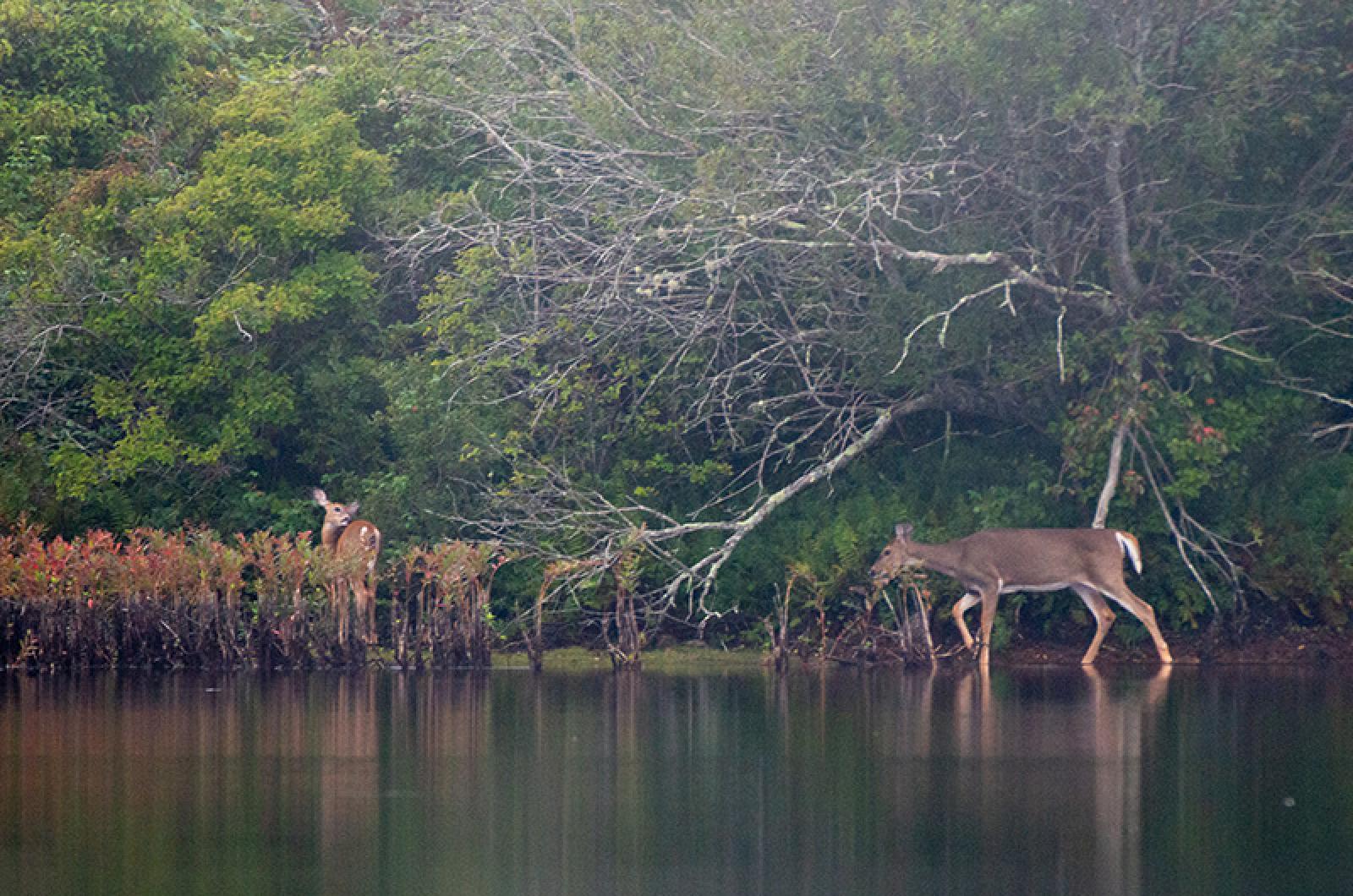
Beyond providing more food to the community, the donation program also aims to help reduce the deer herd, which is a vector for ticks and the diseases they carry.
Hunters who donate deer are waived the $50 fee ($20 for agricultural society members) to hang the carcasses in the society’s community deer cooler in West Tisbury, according to the announcement.
Mr. Athearn said based on the number of deer he’s seen this summer — many with young — there should be good hunting both this season and next year, when the fawns are grown.
“I have never seen so many deer [in the summer], and we had a banner year last year,” he said.
Deer hunting dates for Martha’s Vineyard are set and regulated by the Massachusetts Division of Fisheries and Wildlife. The seasons are as follows:
Archery, Oct. 5-Nov. 28.
Shotgun, Nov. 30-Dec. 12.
Primitive firearms, Dec. 14-31.
Woodland walkers are encouraged to wear blaze orange or brightly colored outer clothing during these dates, and the DFW advises hunters on its website that more people may be out walking in wooded areas due to Covid-19.
To join the Martha’s Vineyard Agricultural Society, or to learn more about the community deer cooler and donation program, visit marthasvineyardagriculturalsociety.org.
Comments
Here I am again, urging all
Mr. B ChilmarkHere I am again, urging all hunters to take as many deer as possible so that we may reduce the transportation of ticks. There are simply too many deer on the island. Ask the driver who has hit one, ask the people who have had/still have Lyme Disease: As nice as that photo looks, those deer are bringing tick-borne diseases to your yard.
They should allow the hunters
Charlie Callahan So Boston /EdgartownThey should allow the hunters to take more deer than ever. I don't hunt,but anything that helps those in need is a great idea
One way to help is to give
Brian Athearn West tksburyOne way to help is to give hunters permission to hunt. Call me and I can coordinate respectful, Avid hunters to hunt your land. Mostly bow and arrow
Brian. 508-962-2477
Does it concern you at all
ShellattheBeachDoes it concern you at all that bowhunters wound but don’t kill the deer they hit more than 50% of the time? A study by the Texas Parks & Wildlife Department found that for every deer killed outright by a bowhunter, at least one more escapes to suffer and die slowly. A member of the Maine BowHunters Alliance also determined that 50% of animals who are shot with crossbows are wounded but not killed. An article in Bowhunter Magazine titled “Bow Wounding Losses THE BIG MYTH” stated, “It is disquieting to know that we probably wound one deer for every animal harvested.” DEFINITELY welcome bowhunters onto your land if you and your kids enjoy watching sweet deer suffer.
Bow & Arrow hunters should be
Marina Lent EdgartownBow & Arrow hunters should be allowed to use tracker-dogs to find the wounded animal. This is what the relationship of humans and dogs has been about for tens of thousands of years. Dogs need jobs. I like bow&arrow because the hunter has to be close enough to see what s/he is shooting at.
These numbers are WAY off.
Joe C West TisburyThese numbers are WAY off. Does it concern you that over 200 deer/vehicle collisions occur on Island roads every year. Those are just the ones called in to the communications center, so that number is actually significantly higher.
Island deer populations reach up to 55 deer per square mile. State Biologist targets for MV are between 6 and 8 deer per square mile for a healthy herd. When the acorn crops are scarce, their preferred food source goes WAY down, causing them to travel more and spread more ticks. If they can’t supplement their diet with other sources of nutrition, they starve, become diseased, suffer, and die.
I’m not one to anthropomorphize, but if was a deer, I would much rather be hit with an arrow and die within seconds or minutes rather than being smashed by a vehicle and spending the rest of my life with with broken ribs and extremities, or suffer from malnutrition or disease. As an avid bow hunter, I’ve personally witnessed it on the island many times over, and it is NOT a pretty sight. Imagine if the 1,000 deer harvested each year were allowed to populate? Each doe bearing 2-3 young and those young bearing 2-3 young after a couple of seasons?
If you have any compassion for these animals, I compel you to open your mind a little more to embrace and support the hunting community on the Island. I can’t help but wonder how many people think that the meat they buy from the grocery store is supplied from animals that don’t have any feelings....
if a hunter takes money for a
paul brewer edgartownif a hunter takes money for a deer that is selling venison and is illegal if you re
ad ma. hunting laws
The deer are hyper abundant
Tim Boland West TisburyThe deer are hyper abundant and negatively impacting our local flora. The density of deer per square mile, coupled with low acorn production last year, led to incredible browse this past winter and all through this season. This year the extensive and prolonged drought has them browsing our gardens and natural areas at a rate I have not witnessed in 18 years. When deer are at these unsustainable levels, they diminish biodiversity, from invertebrates(insects)that use plants for nectar and food as part of their lifecycle to migrating bird populations that feed on those insects. Local plant extinction is on the rise, and with it, correspondingly, co-dependent insects and animals.
Add new comment