


The Edgartown Lighthouse stands at the gateway to the Edgartown harbor, a symbol of hope and refuge.
The Edgartown Lighthouse stands at the gateway to the Edgartown harbor, a symbol of hope and refuge. Like all historic and cultural sites, it provides us with a sense of identity and connects us through time.
As an Island community, many such sites are by the shore and are at risk from sea level rise, flooding and erosion. Some can be protected, at least for a time, like the Gay Head Light which was moved four years ago. Others are at risk for possible loss as seas rise and storms grow more intense.
About a third of the Martha’s Vineyard Camp Meeting Association lies in the 100-year floodplain. Vulnerable cottages could be raised above the flood elevation but that might diminish their charm and historical significance. If they are not raised they may flood. What a conundrum. Either way the land will be wet. A 2018 Union of Concerned Scientists report on sea level rise and real estate noted that “even if living spaces stay dry, if the access roads, surrounding land, and key infrastructure are flooded, home values and tourism would be adversely affected.” The Camp Ground board of directors is reviewing options.
Island lighthouses, the fishing village at Menemsha, Memorial Wharf in Edgartown are other areas of concern. The town of Edgartown is planning to raise the wharf, similar to what was done recently with the Edgartown Yacht Club and the Vose family boathouse.
The Vineyard Trust owns and maintains several vulnerable buildings on the Edgartown waterfront, including the Old Sculpin Gallery, formerly a whale oil factory and boat builder’s shed, the Norton boathouse and Osborne Wharf. The Flying Horses Carousel, also owned by the Trust, is also in the floodplain.
The Vineyard Trust is currently working with the town of Edgartown on adaptation planning. Last year the town received a Massachusetts Municipal Vulnerability Preparedness Program action grant for an infrastructure vulnerability assessment.
Aside from raising structures and managed retreat, what are the options for preserving historic structures? In 2016 the Newport Restoration Foundation in Rhode Island organized a Keeping History Above Water Conference. Options discussed included allowing water to flow though threatened structures, turning basements into cisterns, installing building-sized flotation systems, and even re-plumbing entire neighborhoods to direct storm water and high tides out of the way.
But more than just structures, including many historic homes located on the waterfront, are in harm’s way.
Several sites on the African-American Heritage Trail of Martha’s Vineyard are vulnerable to sea level rise. They include a site commemorating the rescue of fugitive Randall Burton at Menemsha, and another site honoring the life of Rebecca Martin at the Old Marine Cemetery in Oak Bluffs. How do we commemorate historic sites that disappear?
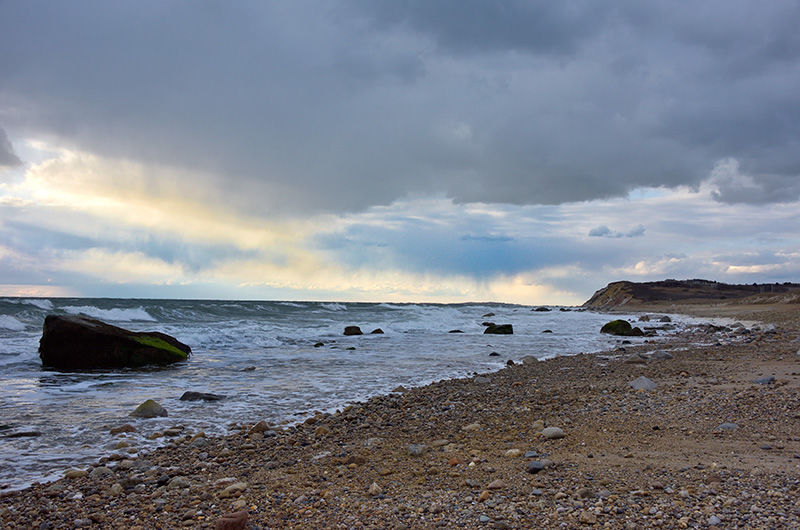
Other valued natural land forms are expected to change dramatically in the face of erosion and battering from strong storms.
The Gay Head Cliffs, a historic site that holds great cultural significance for the Wampanoag Tribe of Gay Head (Aquinnah), are eroding are eroding by about a foot a year, according to the Martha’s Vineyard Commission. The rate is expected to rise as storm surges increase. Old traditions of collecting the cliff clay, climbing the cliffs and taking clay baths have long been prohibited.
Inkwell Beach in Oak Bluffs is akin to a community center for generations of African Americans. Backed by a concrete seawall, as the sea rises and beach nourishment becomes untenable, the Inkwell and other Oak Bluffs beaches that abut seawalls could be facing the autumn of their lives.
All these Island at-risk historic structures and sites could be identified, possibly using Community Preservation Act (CPA) funds. Provincetown, a sister coastal community at the tip of Cape Cod, has set a precedent by using CPA funds to protect some of the town’s 500-plus registered historic buildings.
Not only do historic and cultural sites connect us to our past, they also have economic value. The Island exudes a sense of timelessness. Lighthouses, clay cliffs, old whaling homes and Camp Ground cottages are as much of a draw as the beaches and coastal ponds.
Protecting our history and culture may not be a top priority on the climate agenda, but it is a critical bridge to the future. It deserves attention. This is our place, physically, socially and emotionally, and how we got here matters.
Liz Durkee lives in Oak Bluffs.
Comments
I could not agree more Liz
Lisa Vanderhoop AquinnahI could not agree more Liz and so eloquently expressed.
The writer apparently has
BS Oak BluffsThe writer apparently has little knowledge of the Edgartown lighthouse. It was originally surrounded by water sticking out into the harbor. Is she suggesting sea level is decreasing in Edgartown harbor? If so what climate actions are we taking to protect our ferry landings from the lowering sea level? Will the VH and OB terminals have to be relocated further out to sea? Shall we plan on the inevitable paving of the area now traversed by the Chappy ferry? I wholeheartedly agree we are heading to a climate EMERGENCY when the sand bars connect us to Falmouth Heights and who knows what kind of riff raff will invade our virgin shores. There goes " our place, physically, socially and emotionally". We must, I implore you, we must ban plastic straws to save ourselves and our island!
Liz writes on an important
Jacob EdgartownLiz writes on an important topic - cultural resources, and how they define MV.
Threats to cultural resources by rising seas, erosion and storms, or even the thought police - if the leaders of today depart in their thinking of what mattered in the past. Take heed on all accounts.
It's gonna take a lot more
David OBIt's gonna take a lot more than banning plastic straws. It's gonna take a complete revamping of how we humans find and use energy - or we will become extinct. We need to become a net zero island, state, country, world. And the sooner the better. And frankly, in my opinion, every effort not directed to this end, is wasted, and hastens our extinction.
I agree with many of the
Colleen Kydd-Sumberg ConnecticutI agree with many of the points raised in Liz’s article about saving important and historic sites from sea level rise, but I also agree that humans need to do a complete 360 on how we treat the environment. Changes start at the grassroots level, but local and federal levels also need to be involved.
Well said Liz.
Steve Mckenna BarnstableWell said Liz.
Add new comment