


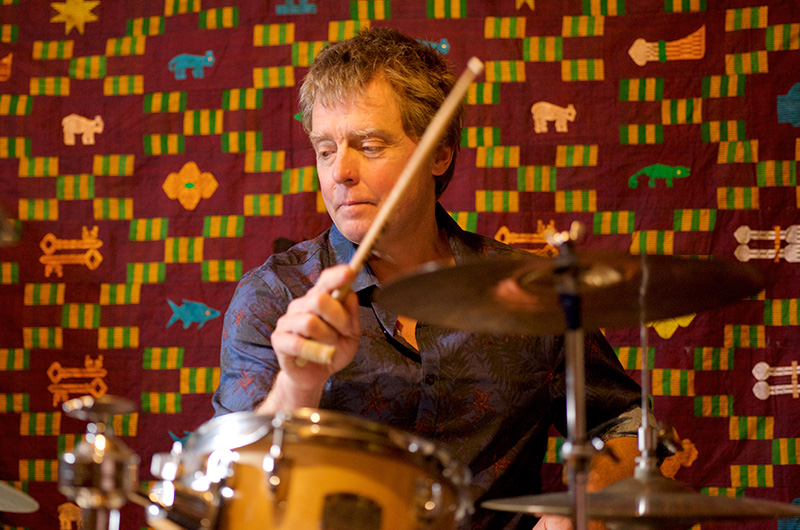
When Rick Bausman left the Vineyard last Friday to board a flight to Haiti, he took with him a printer, a laptop, a duffel bag full of instruments and his traveling drum. When he touched down in Port-au-Prince, he was due to set off on his latest mission.
When Rick Bausman left the Vineyard last Friday to board a flight to Haiti, he took with him a printer, a laptop, a duffel bag full of instruments and his traveling drum. When he touched down in Port-au-Prince, he was due to set off across the country on his latest mission: to build a series of cultural education centers in the historically oppressed Caribbean nation.

Rhythm instruments are tools of the trade for Mr. Bausman.
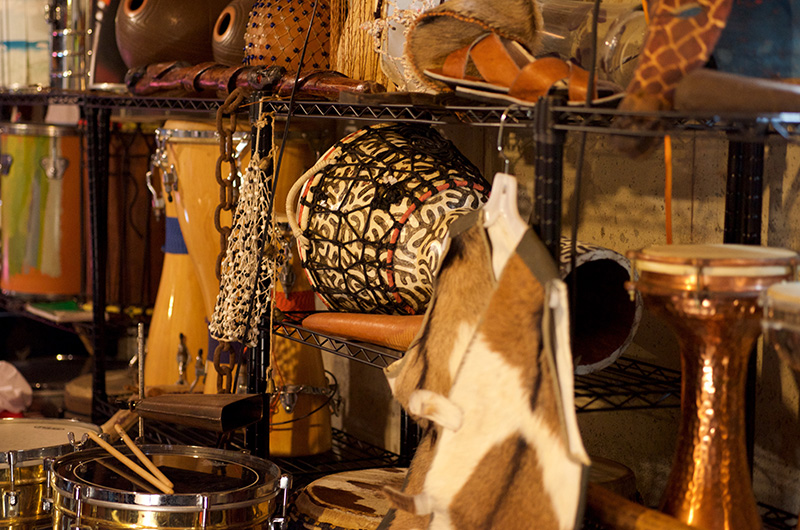
Rhythm instruments are tools of the trade for Mr. Bausman.
For Mr. Bausman, the journey toward this project may have begun when his parents gave him his first drum set to stop him from banging on their pots and pans as a small child. It may have begun in his 20s, when he decided to dive deeply into the polyrhythmic style and culture of Haitian drumming. Or it may have begun in the 1980s, when he came to Martha’s Vineyard as a volunteer for Camp Jabberwocky, realizing he had a gift for helping others through music.
But his diverse set of ambitions found solid footing three years ago, he said, when Pam and Nat Benjamin of Vineyard Haven invited him to Ile-a-Vache, a small Haitian island with a population about the size of the off-season Vineyard, to teach local children how to drum.
“I had been studying Haitian drumming for 30 years and had never been there myself,” Mr. Bausman said, looking through the window of his Edgartown home, where the view of a dreary winter afternoon contrasted starkly with interior walls decorated with colorful Haitian art and hand-painted drums. “It really all just went from there,” he said.
Mr. Bausman was eager to explore the impoverished country and test his skills with local musicians. But he soon realized the rapidly evolving musical culture had lost the intricacies of the traditional style he had learned in New York city so many years before. Going full circle, he began teaching Haitians the roots of their own musical culture, while learning a new style from the locals.
He also saw firsthand the pervasive influence of oppression that is rooted in the country’s colonial history. He saw an agricultural society that had collapsed, pushing people from the rural highlands and into the city slums. He saw deforestation. He saw starvation. And he saw a glut of NGOs that he said have only perpetuated a dependency on foreign aid.
Mr. Bausman felt a call to help bring a change to the country. Change will require a groundswell of support from Haitians themselves, he said, but it could start with something as simple as a drum. “The problem is that dependency has developed on the aid, and sometimes that aid, over a long period of time, it backfires,” he said. “You can feel the anger and frustration when you’re there. But change has to come from the people, not government or NGOs.”
“I fit into the thousand-piece jigsaw puzzle in my own way.”
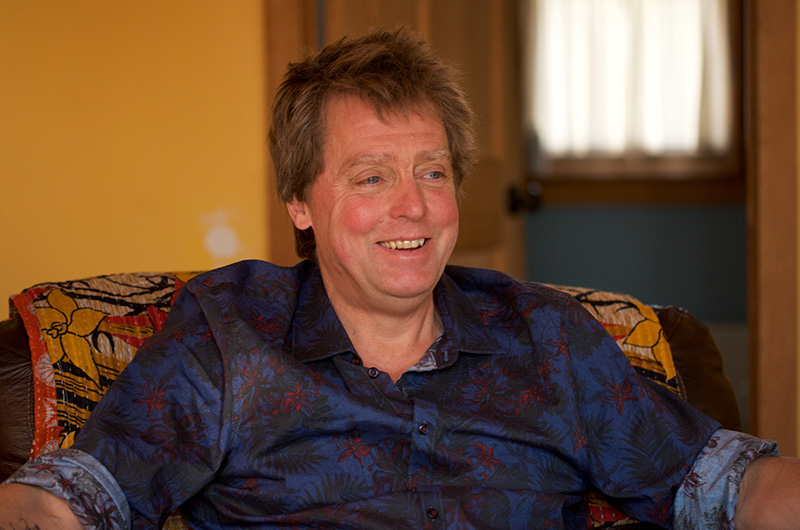
“I fit into the thousand-piece jigsaw puzzle in my own way.”
He continued: “I want to start something based in Haiti’s deep culture, sense of community and spirituality to change the country from the inside out. Until you can address the problems from the inside, the problems aren’t going to stop.”
Mr. Bausman began to envision taking his cultural exchange a step further by building centers that can function as educational hubs for Haitian culture. The goal, he said, is to create jobs, give people the means to study their own culture and create lasting, sustainable change in the country, from the ground up.
“We can’t pull people out of the slums, but if we can build one or two cultural centers, staff them, provide work for people to build it . . . drummers can teach classes, there can be ceremony, and classes in metal works and different types of art,” he said. “All of this represents . . . a revitalization of national pride. Ideally, everything else will follow.”
He sees the project as an extension of his nonprofit organization, Rhythm of Life, but he has had trouble raising funds. One reason, he said, is a stigma surrounding the Vodou religion. The stigma can be traced to the early 19th century revolution, when Haitians united around Vodou to overthrow the French government. Though the revolution was successful, the colonial response to demonize the culture has had an effect that lingers today.
“It made sense,” Mr. Bausman said. “Imagine being a French soldier, hearing the sound of drums way off in the hills. It was the sound of the people that were coming for you, coming to kill you.”
Mr. Bausman said he believes a cultural institution where people can engage with their own history and musical tradition is a vital step in another revolution within Haiti. This time, though, it would be carried out with drums as a force for peace instead of violence.
In Haiti, meanwhile, strife continues, with police violence this week forcing the cancellation of carnival festivities that traditionally mark the start of the Easter season.
Still far away from that on the Vineyard, Mr. Bausman said last week he doesn’t think cultural centers will solve all the problems in Haiti, but he thinks of it as a starting place.
“I’m there to help, I’m not trying to save Haiti,” he said. “I fit into the thousand-piece jigsaw puzzle in my own way, a lot of other stuff has to happen. But I still think we should help . . . This is the only way I know how.”
Comments
That's a wonderful plan. The
ValThat's a wonderful plan. The people of Haiti are so full of life. Bringing a culture center. In any town there would be just giving them the ability to bring out the creative style.
Great job. Great inspiration.
Jean Jeune Cambridge MaGreat job. Great inspiration. Keep up the good work. God blessings.
Haiti can move forward we
Frantz resille 8695 s taylor ln tucson az 85736Haiti can move forward we must find a cure for the cancer of 62 years
I think the culture center
Chelyne Christian North Miami Beach, FLI think the culture center will be a very good thing for Haiti especially the kids that have hope to become a musician one day. My prayers will be with you .
It may not be the answer to
Blair Harrison Upstate N.YIt may not be the answer to all the problems but the arts are a civilizring influence in people's life's.The Arts and culture go along way to socialize people.And that is the most important thing of all.I wish more people would realize that.
Thanks for sharing this
Eustache Jean Louis Avon, MassachusettsThanks for sharing this wonderful article.Honestly,it challenges and reinforces my existing conviction to also do my part.
Thank you for Choosing Haiti
Gertrude D Haverstraw NyThank you for Choosing Haiti as much needed I know God is always working directing and leading good people w good hearts and intentions toward that country your plan will bring hope joy & smiles on the kids faces .Haiti has great history and determination but strugle since we fought and gained our freedom and been under harsful cituations as punishment since because as a black nation we stood out and for that we being punished for years and some work hard till today to make sure we stay on the ground but God watches and he will rise Haiti again.thank you again you are a true example of people who cares for the abandoned forgoten and mistreated.
Great Idea! Music is life
Charlevagne Charlemagne NYCGreat Idea! Music is life
This is Awesome. Thank you
Michou Palm CoastThis is Awesome. Thank you for thinking of our Brethrens. This is encouraging. May the Lord bless and protect you.
Mr Bausman. I salute you. The
Caroline seignon Tampa FlMr Bausman. I salute you. The Culrure Center will be great. Drumming in Haiti,will bring not only socialization, joy in the heart of Haitian people & more esteem for the culture.Very inspiring.
I think it's a good idea ,
Polo HaitiI think it's a good idea , art can't really help them out because most of them are artists . But like you said ,the change not gonna come from NGO, nor gvnt , it got to come within themself
Thank you for investing in
Anne-Marie Elmont, new yorkThank you for investing in Haiti,its people and the culture. The vast population strives for a decent life which every human being fairly deserves.Wishing you much success and God's blessings all the way.
I respectfully question Mr.
Dale McCarvey FalmouthI respectfully question Mr. Bausman's assertion that a fear of voodoo has stymied fundraising efforts. I think a more likely factor is the uneasiness people feel with sending money to a country with such an entrenched history of corruption and waste. Haitian charity has often been seen as a "down the rathole" situation. Unfortunately, this perception is likely to be a greater obstacle to fundraising than a fear of drumbeats. That said, his efforts are completely commendable and noble.
Hi Dale,
Rick Bausman MV and HaitiHi Dale,
Thanks for your kind words. You are correct in your observation of how money can be mishandled in Haiti. The Milocan Project does not give money to the Haitian Government. We accept contributions as a 501c3 and the money goes DIRECTLY into the work we are doing. However, to be clear, my main collaborating group in Haiti is the Haitian National Confederation of Vodou (KNVA). They are a very large organization that we are working with to run cultural excursions and develop the community centers. Because of the long standing gross mischaracterization and general misunderstandig regarding Haiyian Vodou, I have been told flat out that people are uncomfortable giving money. One of our main missions is to rectify centuries of injustice by setting the record straight on exactly what Vodou is and does and how it is a very powerful edifice for creating lasting change in Haiti and improving quality of life for all Haitians.
Add new comment