

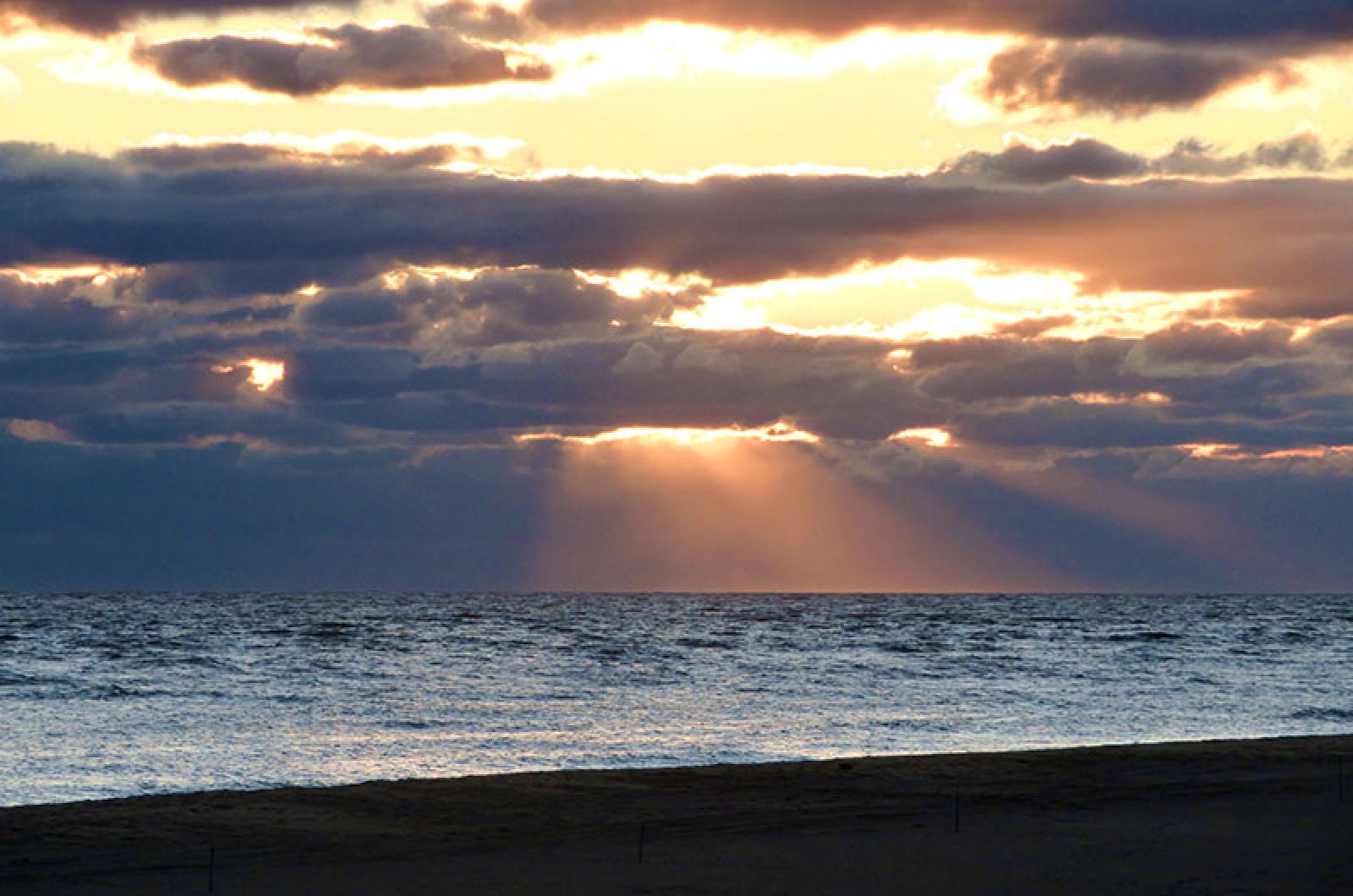
Inhabiting Chappaquiddick for the month of January, at the southern end of the island near Wasque Point, is a study in solitude.
Inhabiting Chappaquiddick for the month of January, at the southern end of the island near Wasque Point, is a study in solitude. There are beautiful dawn and dusk sunrise-sunset slow dances, bumpy dirt roads, waltzing winds and of course constantly changing ocean motion. For a winter visitor reworking a book on Muskeget island seven miles to the east, it was also a study of unexpected human interactions that made it even more special.
When I crossed on the Chappy ferry for the first time on Jan. 2, my used Land Rover was filled not only with clothes, computer and paperwork, but cross country skis, ice skates and, given the late duck season, a 12-gauge shotgun, decoys and my Boykin spaniel companion Hershey.
The setting induced productive early morning writing and healthy beach walks, hikes and mini adventures most afternoons. Having Edgartown artist Dana Gaines as my island host, and Tim Leland, a former colleague at the Boston Globe, as Chappy acquaintances certainly helped.
The light snow that fell on Jan. 7 prompted one highlight of my visit. There was just enough crusted snow to allow cross-country skiing along Wasque Point and Poucha Pond beaches. I’ve skied in lots of different conditions, including for miles on the frozen Ipswich River where I live, but never on a flat beach with breaking waves beside me. It was like horseback riding on the beach, a memorable experience. Even more so when I encountered a single, plump gray seal pup alone on the snow. The small creature was well camouflaged, almost pure white. I wanted a picture but my iPhone was too cold to function. Then out of the blue, two well-cloaked beach walkers, the first people I had seen all day, appeared. Claudia Tolay and her friend were happy to use her camera for the photo I coveted.
The same small snowfall also prompted my first visit to Mytoi, the Japanese garden near the Dike Bridge. I lived in Japan for six years earlier in my life, and the garden seemed hauntingly Oriental in the snow. My footsteps were the first and only ones visible on the garden paths that day. Only on Chappaquiddick could I encounter such contrary snow scenes.
A week later, Jan. 14, light fog blanketed the island instead of snow. I let Hershey out to do her business at about 10 that night. But she didn’t return to the door, and didn’t return. I called and called some more, but the fog was stifling the sound of my voice. I drove around the dirt roads of Wasque Reservation, no dog in sight.
Hershey didn’t come to the door the next morning either. No stray dog had been seen by the driver of the little yellow bus school bus on Poucha Road, or by the ferryman. The Edgartown animal control officer had no news. By mid-morning, discouraged and driving back to my camp, the only other car on the road showed, and the driver waved and stopped. Lynn Martynka had found my dog near Chappy’s little fire station. Hershey was excited and exhausted. (I later tracked her route, two-plus miles from my camp.) It turned out that Lynn knew my name from a book talk she had attended about Muskeget several years earlier, and she lives in one of a very few houses on Chappy’s remote Muskeget Road.
A couple of days later, Jan. 18, it was windy and cold. In the afternoon, I decided to venture out on Cape Pogue’s sand trails in my 4X4. I deflated the tires and set off. Less than a mile along, my computer-controlled suspension dropped and the undercarriage started plowing sand until I was truly stuck.
It was mid afternoon. No other trucks or four-wheelers were out that day. I had no shovel, like the proverbial canoe without a paddle. I dug by hand with a very small board I found, as Hershey watched. No joy at all. So I trekked back to the Dike Bridge and beyond, hoping to find someone who might help. There was a car at the first house on the right in the woods, inhabited I learned later, by the elderly Dr. Dale Carter. She was reading when I knocked on her window. Fortunately, her strapping son was visiting from New Hampshire and was more than happy to help.
We found three shovels and set out and started digging and digging and digging some more. Almost an hour later we could see a slice of air between the sand and the vehicle suspension and the tires began to take. A little more digging and the Rover was clear enough in low/low to extract itself and nudge slowly ahead, turn around and move gently back to harder ground near the bridge.
The thirty-something was the star of the Cape Pogue day. We talked a lot about guns and politics and families while digging, but we never exchanged names. When I dropped him by his house, he wouldn’t take any reward, even beer, for his efforts, and was adamant about it. I headed straight to Edgartown for an evening meal. “Sounds very serendipitous” the ferryman said. He nailed it.
Some of my January Chappy expeditions, while fun and fulfilling, were less notable. I went hunting early and late, saw plenty of buffleheads and a few mergansers, but few prized black ducks. I only had a good shot at one, which easily escaped unscathed.
Many days I made use of the Chappy ferry. No waiting in the winter, almost prosaically routine, but always good for a couple of minutes on the water for a trip that was always over before I wanted it to be. In fact I realize, that is exactly how I felt about my winter month on Chappaquiddick.
Crocker Snow Jr., a journalist and writer, has authored nonfiction books about Muskeget, Nantaska and a youth book The Mouse That Owns an Island. He lives in Ipswich.
Comments
Great article - my copy of
Jack M. FloridaGreat article - my copy of the author’s book on Muskeget is a valued part of my “library”! Thanks so much for bringing Chappy alive during this winter season. Can’t wait for my return in Spring !
Thanks for the morning
Margaret Vero BeachThanks for the morning refreshment! God gave you a gift.
Thirty something?!I guess I
James Chappy/New HampshireThirty something?!I guess I appreciate the age drop but trust me,am a bit older,I have earned me grey hairs!I will say Chappy and New Hampshire the same attitude when one is out in the sticks,folks willing to help one another out whether they know them or not and all we ask is when one has a chance to return the favor
I spent a couple of days and
Kib Bramhall West TisburyI spent a couple of days and nights on on Muskeget in 1947 and 1953 at "Camp Rocus Lineatus", a sea gull inhabited cabin that was otherwise abandoned. We flew from the Katama airport with Steve Gentle, who ran ads in the Gazette that boasted "the best Bass and Blue-fishing you ever had for only $10.00 per person." He flew us in his Amphibian Sea Bee. We caught so many bass on the first trip that Steve had to make two trips to bring them back to the Vineyard. The 2nd time we were skunked. Seals were numerous back then, but nothing like now.
Always wondered if that
Kib Bramhall West TisburyAlways wondered if that Muskeget camp belonged to you.
I’ve never been to Chappy in
Phil Madison, WII’ve never been to Chappy in the winter but your essay inspires me to try it. On the other hand, I enjoyed what I have come to regard as my most “perfect day” on East Beach. I took my bike across on the ferry and rode to the bridge. I traversed the water out to the beach and I was, literally, the only person out there on that glorious mid-August day in the late 80s. I spent the day reading and walking and (occasionally) napping. As I liked out across the calm water toward a The Sound I remarked that I hoped the day would never end. Of course, the shadows began to elongate and I made my way back to Edgartown around 7:00 PM, hungry and slimy from multiple applications of sunblock. The memory is exceedingly vivid for me nearly 35 years later and it is one I intend to cherish forever. PJ
A good writer, writing well.
Buzz OBrien Kansas CityA good writer, writing well. Chappy in the winter, "priceless".
Add new comment