


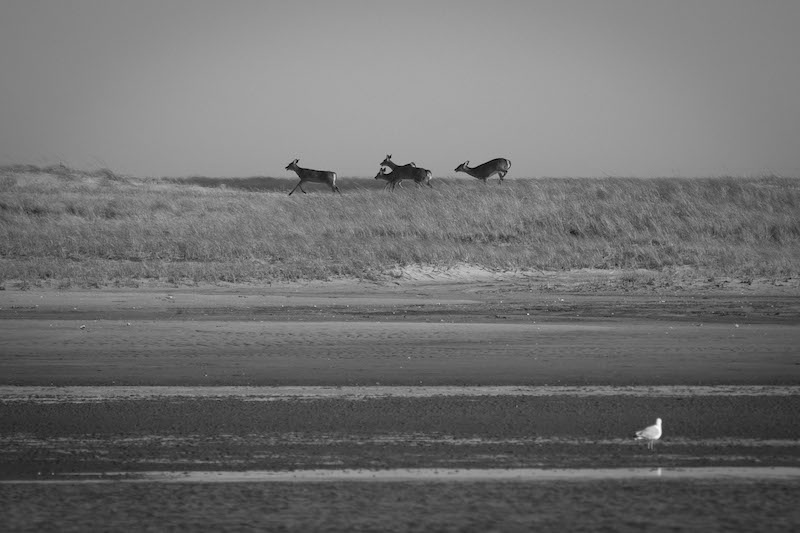
As deer hunting season nears an end, some Island hunters are raising concerns about the health of the herd this year, reporting they are finding deer that appear to be malnourished and struggling.</p>
As deer hunting season nears an end, some Martha’s Vineyard hunters are raising concerns about the health of the herd this year, reporting they are finding deer that appear to be malnourished and struggling.
Joe Capece and Brian Athearn, president and vice president respectively of the Martha’s Vineyard Hunt Club, said they decided to examine the stomach contents of deer after finding a number of animals that appeared bloated, weak and in some cases lethargic.
What they found were deer with bellies full of grass,
“When you open the stomach contents up, it’s all bright green,” Mr. Athearn said, speaking of 10 deer he had examined.
He speculated that the reason is a shortage of acorns, which are a nutritional staple of the deer diet. Without acorns, the deer are forced to search for other food, such as leaves and grass.
“I spend a lot time in the woods, and the acorn crop this year is slim to none,” said Mr. Capece. “All they’re eating is grass and other forage with almost no nutrition in them.”
Though they were at first surprised, the two veteran hunters said they have since discovered that other hunters are reporting similar observations. It appears to be mostly young deer that are affected, they also said.
David Stainbrook, a deer biologist for the state Department of Fish and Wildlife, said he has heard the concerns but is hesitant to draw conclusions.
“Deer typically do not prefer to eat most grasses because as a browser rather than a grazer, they have a hard time digesting [grass],” he told the Gazette in an email. “If the deer habitat on the Vineyard allowed for higher deer numbers because of the consistent annual acorn mast, then a year of no acorns would lead to less resources for the deer and potentially increased nutritional stress.”
The two-week shotgun season ended Dec. 14. Bow season opened in early October. Antique firearms season is under way now and will end Dec. 31.
No official numbers are available yet on the total number of deer taken .
In the first week of shotgun season, 201 deer were tagged compared with 173 during the same period last year.
Longtime Island hunter Nelson Sigelman said he also has seen deer that appear to be in poor health. But he said the cyclical nature of acorn booms and busts is nothing new, and that last year was a banner year for acorns on the Island. “We had five successive years where the woods have just been carpeted with acorns. Now there are none,” Mr. Sigelman said.
“I found one deer last week that was just emaciated. It had this hollow body and seemed to be in terrible shape,” he said. “They are looking anywhere they can for nourishment. If we have a harsh winter, I wouldn’t be surprised if a number of deer die from starvation or weakness associated with poor nutrition.”
With growing concern about the high rates of tick-borne illness on the Vineyard, there has been extra attention focused on deer hunting season this year. An incentive program for bow hunters is in its first year, with hunters being paid $100 for every doe taken after the first two. Restricted to archery hunting, the program is being coordinated by the Island Grown Initiative, which has facilitated hanging and butchering and the distribution of free venison to the Island Food Pantry.
Meanwhile, after a number of fawns were found with a mysterious paralysis early this month, state biologists are investigating the cause.
Bret Stearns, director of natural resources for the Wampanoag Tribe of Gay Head (Aquinnah), said his check-in station off Black Brook Road in Aquinnah tagged roughly 80 deer in the first week of the season, an average number. Mr. Stearns said the deer he has seen are strong and healthy for their age, and he hasn’t documented any notable concerns.
Mr. Athearn added that he too has seen strong, healthy deer mixed in with those that are struggling.
“Members of the hunt club have had a record year in terms of our harvest,” he said, speaking anecdotally. “All I know is the herd is plentiful, but there is very little for them to eat.”
Comments
I'm sure the deer in Katama
Facts not fiction edgI'm sure the deer in Katama are in good shape and tasty. They devasted my vegetable garden this summer and ate everything.
7 young dear in my yard
ed chilmark7 young dear in my yard yesterday eating grass and seeds at my bird feeder.
Acorns production was low
Tim Boland West TisburyAcorn production was low this year, and signs of it were evident during the Spring season when the male catkins (flowers) of oaks (Quercus species) were not shedding their normal abundance of yellow pollen. The female flowers were present as normal, but the pollen (spread by wind primarily, rarely insects) was not as prolific. There are 450 species of oaks worldwide, six found on the Vineyard. The mast phenomenon is well documented and appears in all oak ecosystems. A complex set of both environmental factors and the tree's internal energy reserves regulate acorn production. In and around my home near the state forest, the deer are eating everything from the pumpkins on my porch to the native Arrowood I planted. To learn more about oaks, I can recommend this website, https://www.internationaloaksociety.org/. Happy Holidays!
A great deal of attention has
Nelson Sigelman VINEYARD HAVENA great deal of attention has been focused on the Island deer herd. That is understandable. Deer are highly visible and a key link in the spread of tick-borne disease. Overlooked is the Island's native brook trout, a fish that clings to survival despite obsolete dams and failed culverts (http://mvmagazine.com/news/2018/09/01/down-river). It would be a shame if at the same time that money and effort is being expended to whittle away the Island deer herd, brook trout descended from ice age arrivals continue to disappear from Island streams.
Could not agree more! remove
Steve FalmouthCould not agree more! remove the dams and stand back and watch the magic! Just look to the multiple success stories in the Buzzards bay watershed. Not just trout, but herring, eels, stripers..
What about releasing Guinea
Bob EdgartownWhat about releasing Guinea hens in the forest as they love ticks?
?
Steve Falmouth?
Maybe extend deer season..
Matt Child of GayheadMaybe extend deer season...give hunters nuisance permits...your deer per acre numbers are out of control.
Allow hunting thruout the
Charlie Callahan So Boston/EdgartownAllow hunting thruout the winter. It' more humane they die from a slug than to starve to death in the cold which is what happens to most of them. It doesn't take a Rhoades scholar to figure out if you have more houses than ever, less food for the animals and more animals than ever a lot of them are going to die. Most of these deer we see in the winter are starving to death
I have about 25 oaks around
Ken Edg.I have about 25 oaks around the house, not one acorn this year. I was wondering why.
any animal population, when
Steve Falmouthany animal population, when overcrowded, will not be healthy
So, to be clear, is the ‘down
AM 02539So, to be clear, is the ‘down’ acorn year a sign of potential lasting issues, or a typical (if infrequent) occurrence?
Add new comment