

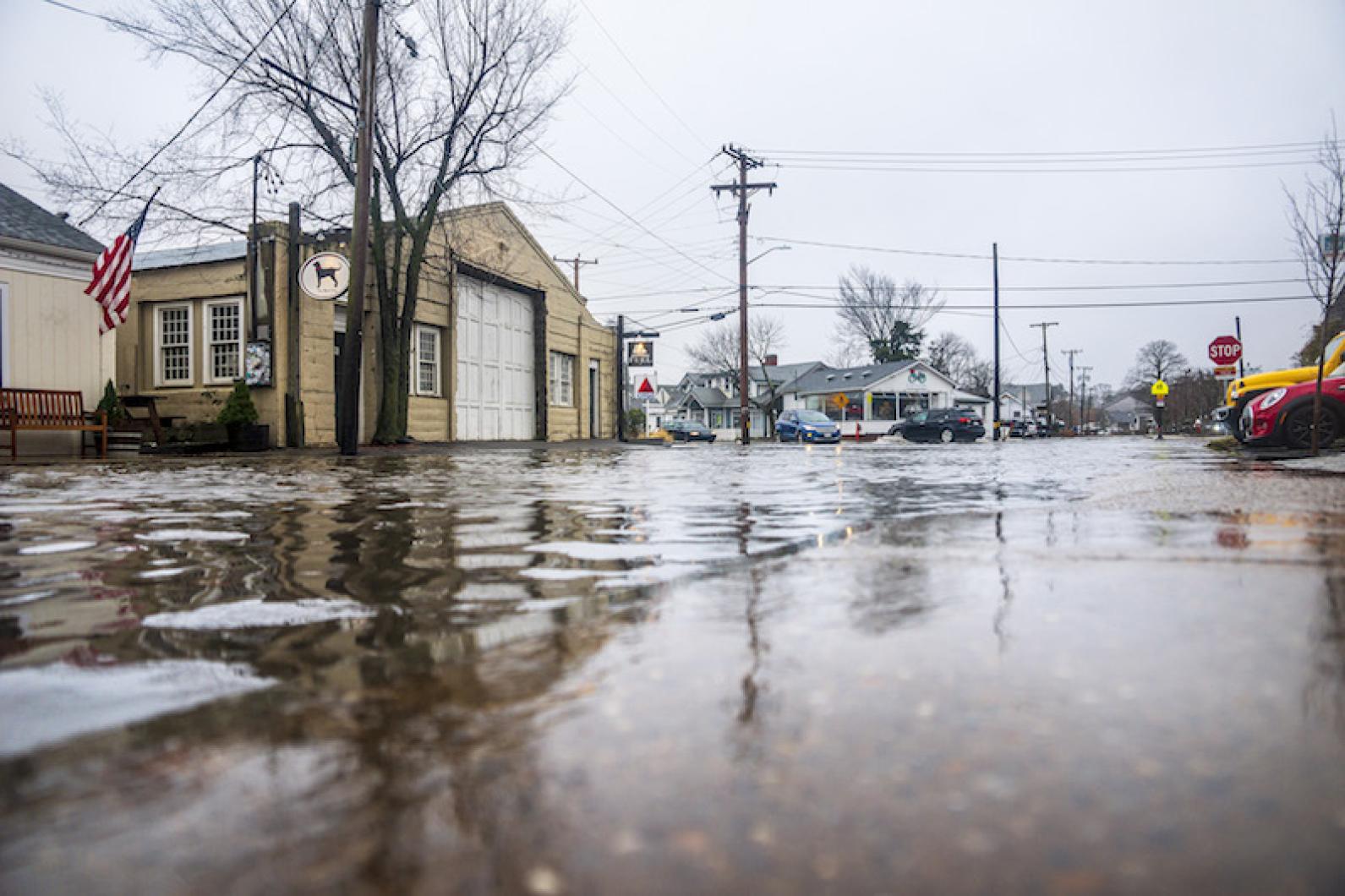
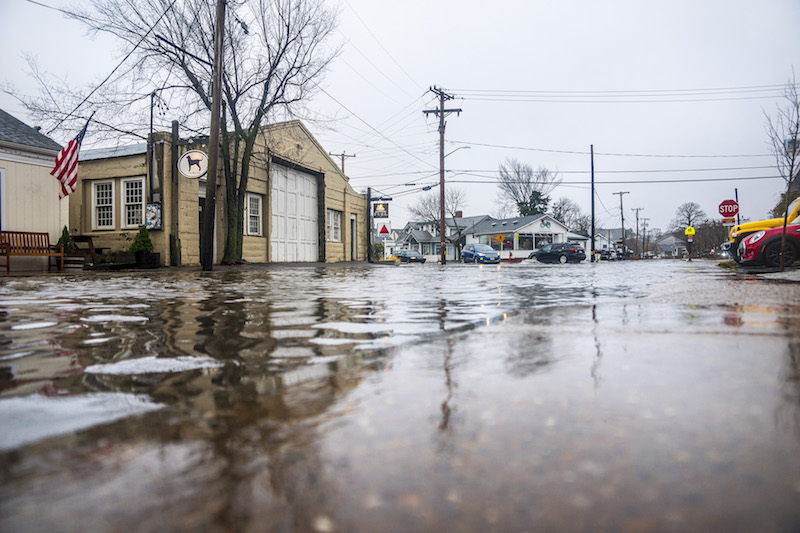
Islanders need to get ready now for the effects of global climate change, Oak Bluffs conservation agent Liz Durkee told an attentive audience at the town library Saturday afternoon. “The seas are going to rise. We are an Island community,” Ms. Durkee said.
Islanders need to get ready now for the effects of global climate change, Oak Bluffs conservation agent Liz Durkee told an attentive audience at the town library Saturday afternoon.
“The seas are going to rise. We are an Island community. We have to retreat from the coast,” Ms. Durkee said.

Lucy Vincent Beach in Chilmark on a storm-tossed Sunday.
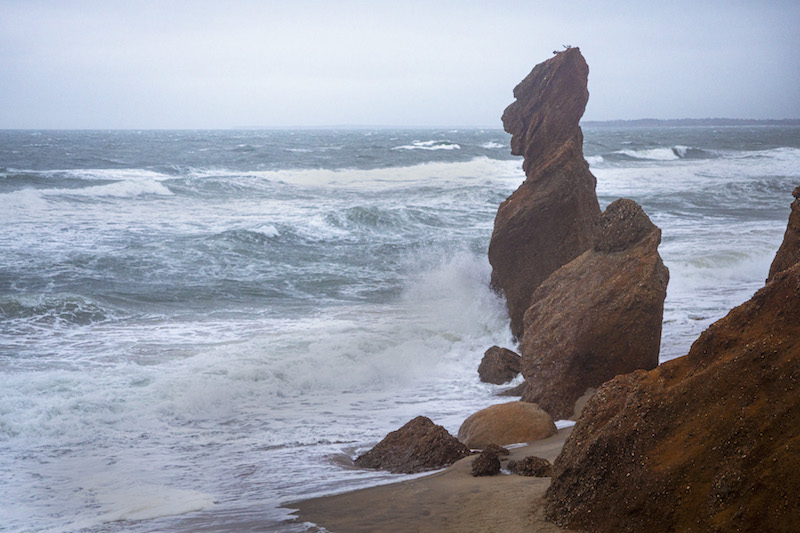
Lucy Vincent Beach in Chilmark on a storm-tossed Sunday.
“It’s really important that the whole community start talking about these issues.”
Titled Adapt to the Impact: Climate Change Adaptation on Martha’s Vineyard, the talk was the second in a series presented by the Island Climate Action Network, a broad-based education and advocacy group that has organized around climate change this fall. More than 50 people attended.
Ms. Durkee has studied and written extensively about climate change, with a focus on adaptation. Using slides, maps and narrative, she painted a picture of Martha’s Vineyard increasingly under water as seas rise and intense storms become more frequent. She described some of the Island’s most vulnerable places, including the Martha’s Vineyard Hospital, which would be cut off in the event of a severe hurricane.
“If we get a category three hurricane, there’s no access to the hospital,” Ms. Durkee said, displaying a flood map showing the hospital’s access roads overwhelmed by a storm surge.
“Chappy Point, with a three to five-foot sea level rise, would be under water,” as would the Edgartown waterfront, she said. Aquinnah would be completely cut off if the Hariph’s Creek Bridge were flooded out.
“A one-foot sea level rise by 2040 is the lowest possible scenario,” Ms. Durkee said, with global climate change also causing flooding, erosion, acidifying ocean waters and damage to fisheries and aquaculture, among a long list of other effects.
“We are way overdue for a big hurricane,” Ms. Durkee told the audience. “The damage will be catastrophic and it will be devastating.”
She urged Islanders to take action now by responding in two ways: mitigating causes and adapting to the impacts.
She described mitigation as not only moving away from fossil fuels but also moving toward renewable energy and land use practices, such as no-till farming and protecting forests, which captures carbon in the soil and prevents it from being released as carbon dioxide into the atmosphere.
Adaptation, Ms. Durkee said, is reducing a community’s vulnerabilities to climate change, including salt marsh restoration and retreating from the coastline.
In addition to reducing fossil fuels and moving to higher land, Ms. Durkee recommended Islanders join or start their town’s Community Emergency Response Training, a FEMA program that teaches lay people to provide basic emergency services in their neighborhoods following a disaster.
The climate action network is working to place a nonbinding referendum on all six 2020 town meeting warrants that commits the Vineyard to 100 per cent energy sustainbility by 2040.
In the next presentation, set for Dec. 3 from 4 to 5 p.m. at the West Tisbury Library, Rob Hanneman will speak about the 100 per cent sustainability goal.
Mr. Hanneman is chairman of the Vineyard Sustainable Energy Committee, which represents all the Island towns’ energy committees. He will repeat his talk at the Oak Bluffs library Dec. 14 from 2:30 to 3:30 p.m.
Climate action chairman Kate Warner also announced Saturday that Philip Duffy, who heads the Woods Hole Research Center, will make a presentation to the Martha’s Vineyard Commission on Dec. 12 from 7 to 8 p.m. at the Katharine Cornell Theatre in Vineyard Haven.
Comments
South Beach will be washed
Skate Sharpener Smith HollowSouth Beach will be washed away pretty soon.
Good news is South beach will
Bob EdgartownGood news is South beach will still be there just in a different place. It has been washing away since I came here 40 years ago when I first heard of the bunker stories. We will all do are part but Mother Nature has the final say. I grew up with don't fool with Mother Nature should that be changed to gender neutral now!!
Just sold our home and built
Tisbury voter Vineyard haven maJust sold our home and built on higher ground,,.what I'm hearing is we only have 11 years to go...I'm sure children hearing this will have some issues in coming years ,hope we as adults keep children out of politics of this and we can handle this like grown adults.
It is amazing how much of
MarieIt is amazing how much of South Beach has washed away. There is very little beach. Does the state replenish or do they just let nature take its course?
A blacktop road or path can be seen where the beach has eroded. Possibly from the WWII military use?
Clearly sea level is rising,
Bob OBClearly sea level is rising, but “A one-foot sea level rise by 2040 is the lowest possible scenario,” is an opinion, not a fact. And a bizarre one at that. According to NOAA sea level is rising at 1/8"/year. This would be roughly 2.75 inches by 2040. Outrageous predictions, such as the one quoted in this article, make is more difficult to have a reasonable conversation about a real problem. Fear mongering does not help.
A projection is not an
Carol formerly ChilmarkA projection is not an opinion. Projecting sea level rise is an educated, calculated guess - considerably better than "an opinion." That's why we listen to weather forecasts, right?
South Beach has been
DBar17 02539South Beach has been gradually disappearing since the 60's. This does not make me happy, but the reality is that you're correct. south Beach will continue to erode, Herring Creek Road will be underwater and the adjacent trophy homes will have uncomfortable beachfront. 25 years until these events are reality.
If climate change will
BS Oak BluffsIf climate change will increasingly produce more "intense and frequent storms" why are we "way overdue for a big hurricane"? We've been talking about global warming for over 30 years now, shouldn't we have had the "big one" by now? If the seas are going to rise by a foot in the next 11 years why have they only risen a tiny fraction of that over the last 30 years? After 30 years of these dire predictions why have virtually none of them materialized?
You will need a dingy just to
John EdgartownYou will need a dinghy just to get through 5 Corners
The irony here of course is
Irony Consultant Global OfficesThe irony here of course is that the current anti environment anti global trade economy crushing administration will inadvertently solve this problem. Carbon output is highly correlated to booming industry. They are going to “fix” that problem. Greenhouse gases emissions will fall off a cliff when nobody can afford to drive or heat, when nobody can afford to buy products from fossil fuel burning factories, fly trans-continental...etc. The global container shipping grinds to a halt when all products are out of reach. You could reverse half a foot of sea level rise just by emptying all the world’s container ships, and get another three inches by scuttling them. (I estimated the displacement of all the world’s cargo ships using a free app, so that may be off). Anyhow, if we keep attacking this problem from both ends, we will certainly solve it. Plan and prepare and reduce and reuse get my vote, but the supposed enemy of the environment may well end up reversing climate change more effectively. Their approach just has more collateral damage.
Add new comment