

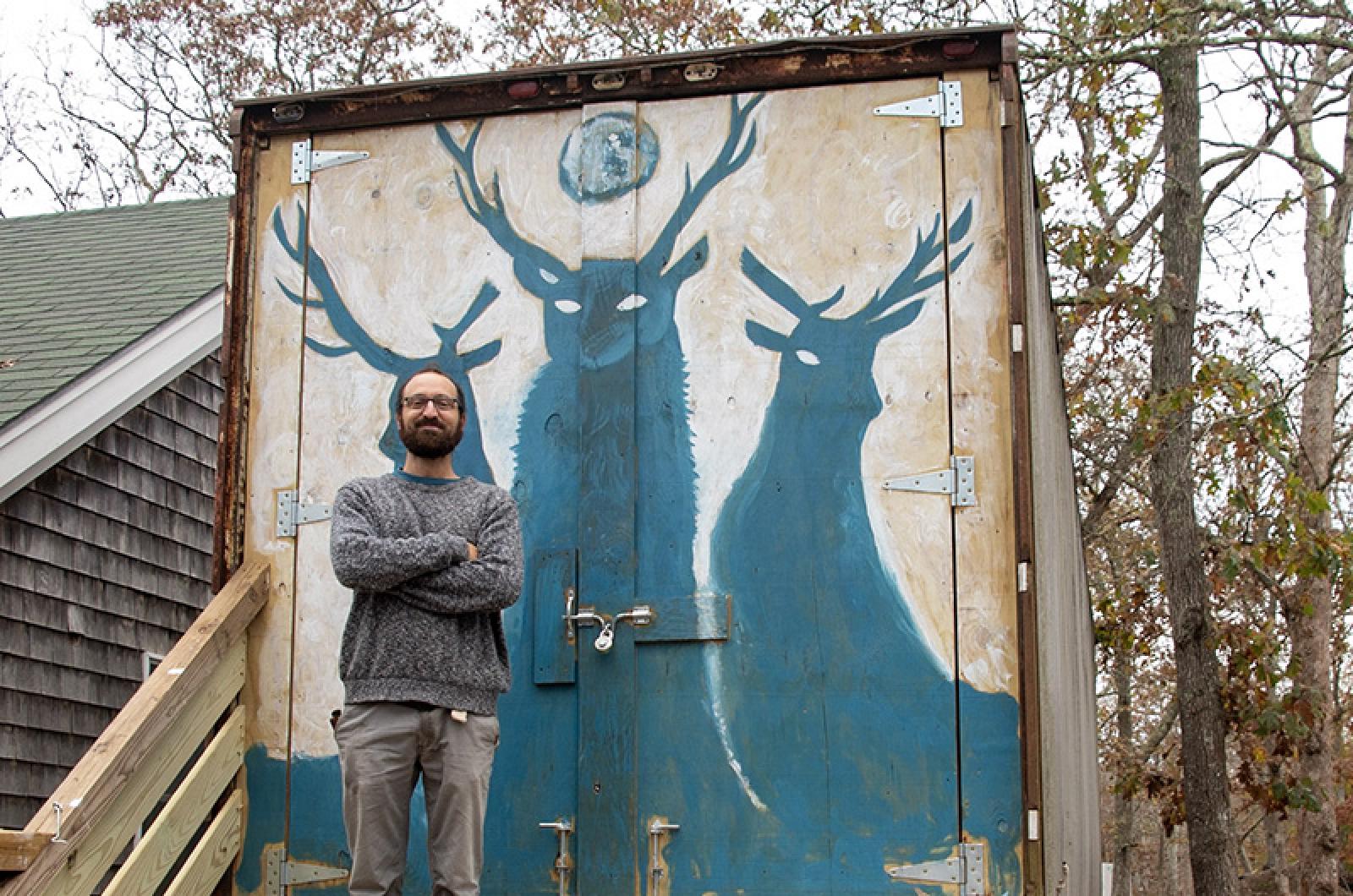
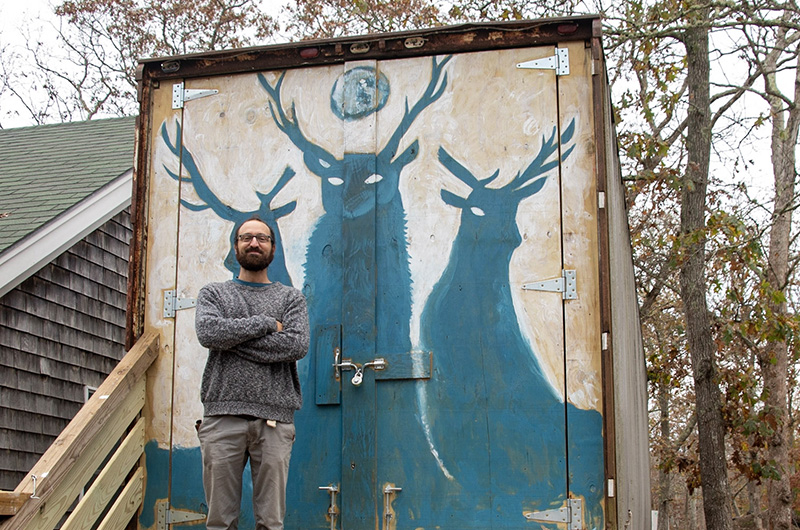
In an effort to cull the deer population, reduce tick-borne illness and provide meat to those in need, a number of Island organizations have joined forces.
Ned Casey has hunted deer on the Island for 46 years. Through those years he has seen many changes, including in access to hunting areas and the deer herd. But this season he said the deer hunting community has experienced one of the most notable shifts in recent memory.
In effort to cull the burgeoning deer population, reduce tick-borne illness and provide meat to those in need, a number of Island organizations have joined forces to offer hunters a $100 subsidy for each tagged doe after their first two and provide an incentive for donating deer, once they have filled their own freezers.
A nine-point buck taken by Dan Vanlandingham came into the community cooler this week.
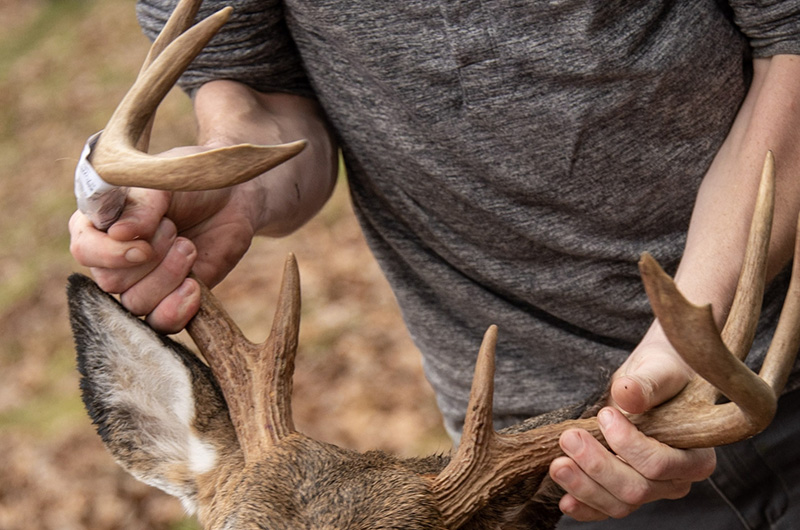
A nine-point buck taken by Dan Vanlandingham came into the community cooler this week.
The subsidy is intended to offset the cost of hunting and the time hunters are taking to do what is being considered by many a public service.
It is the first time a monetary incentive has been offered to hunters on the
Island. It has been met with both enthusiasm from eager hunters and skepticism from others who put themselves in the camp of traditional game hunters, who by definition operate outside the realm of profit.
The subsidy program is only being offered to residents of Martha’s Vineyard and is restricted to bow hunting, which runs from Oct. 7 through the end of shotgun season on Dec. 14. Funding of up to $35,000 — which would cover a take of 350 does — has been provided by an anonymous donor.
As of Tuesday, 23 hunters have registered for the program and 50 deer have been tagged and hung in the community storage cooler built this season near the Agricultural Hall in West Tisbury. Seven of the deer have been donated to Island Grown Initiative for venison distribution in the community.
Massachusetts hunters are limited to two bucks per season, but there is no limit to the number of does a hunter can take. Last week, Mr. Casey pulled his truck into the Agricultural Society parking lot to collect one of his deer hanging in the community storage cooler. He said that in the 1970s, if you were able to take one deer per season you would be considered lucky. This year he has already taken four does and one buck.
Mr. Casey praised the subsidy program and said it is well thought out.
“It’s a continuum from the moment you walk into the woods with your bow,” he said.
Marc Macfarlane, the newly hired manager of the community cooler, who is on call from 8 a.m. to 8 p.m. to unlock the cooler and assist hunters with their deer, explained the process.
He said once a deer is hunted and field dressed, it can be brought to the community cooler where it is hung for up to 14 days. There are strict sanitary guidelines for dressing deer before they are brought to the cooler.
If the deer is donated, IGI transports the animal to Jefferson Munroe at The Larder in Vineyard Haven, where the meat is butchered and then distributed through the Island Food Pantry and other community food outlets.
The seven deer that have been donated have yielded over 200 pounds of venison cuts, about 800 meals, Mr. Macfarlane said.
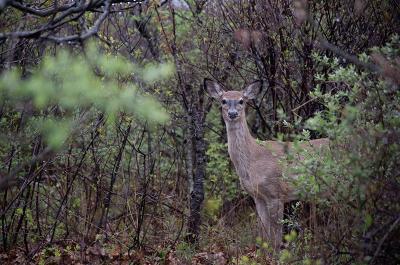
Deer herd Islandwide is believed to be at an all-time high.
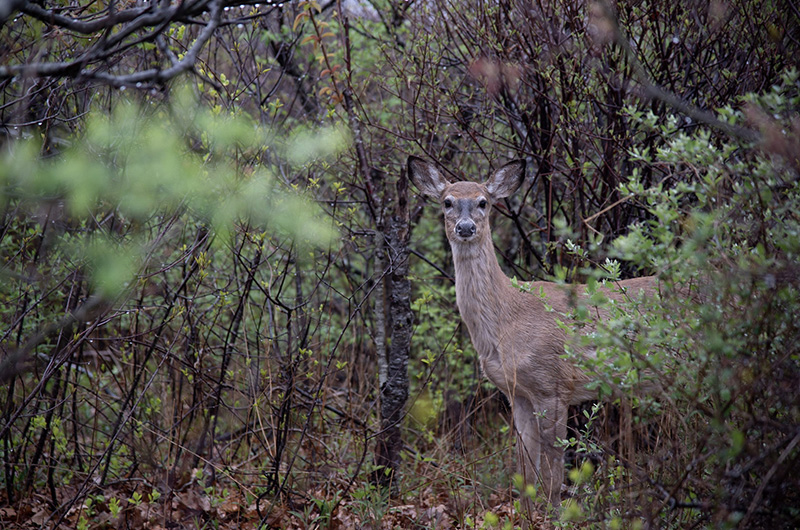
Deer herd Islandwide is believed to be at an all-time high.
The subsidy is both helpful for Islanders who need protein and may not be able to afford it, and integral to controlling the deer population, organizers say.
Brian Athearn, president of the Agricultural Society and a hunter himself, compared deer on the Island to fish in a tank.
“If you have too many fish in a tank, the fish suffer. Right now [the deer] are suffering.” he said. “There’s a lot of competition for food . . . Now they’re going after farms, shrubs and into residential areas.”
There are no available hard numbers for the size of the deer herd on the Vineyard, but Mr. Athearn said state estimates put the number in the range of 5,000 to 6,000 — well over the statewide management goal of six to 18 per square mile, and likely closer to 40 deer per square mile.
Mr. Casey said the deer browse line is beginning to rise, meaning that the deer have eaten ground plants and are moving onto higher trees and shrubs that usually function as winter reserves for the animals. He said this shows the deer are under more pressure in their search for food.
Each year hunters on the Island take between 800 to 900 deer during bow and shotgun the season. Mr. Athearn said if the subsidy program could increase the number to 2,000 deer, it would put a “healthy dent in the population.”
But not all hunters are enthused about the subsidy program.
“While I appreciate the multi-pronged effort to support deer hunters, particularly the creation of a community cooler, I’m uneasy with the notion of paying hunters,” said longtime Island hunter Nelson Sigelman.
“It’s like anonymously buying death. That’s what I don’t like about it,” said Alley Moore, a respected deer hunter on the Island. “I grew up in the culture that game animals were not for sale, there was no money in it . . . That is closer to market hunting.”
Market hunting has a long history of pushing populations close to extinction, such as bison and seals in the late 19th and early 20th centuries. Market hunting is illegal in the United States.
And while a subsidy is not the same as market hunting, some hunters worry that a monetary subsidy could spur illegal hunting practices such as poaching or jacking deer.
Mr. Sigelman said $100 is not a big incentive to break the law, considering the penalties, but he also noted the limited presence of environmental police on the Island has long been a problem in enforcing hunting laws.
Mr. Athearn cautioned that the program is in its first year, and said it will be carefully evaluated.
“This is a pilot year, training-wheels-on, type of program,” he said. “At the end of the season we are going to see what kind of information we can glean from this . . . and have a discussion on what we are going to do next year.”
Comments
I think we need to bring back
Bob EdgartownI think we need to bring back market hunting on Seals if that will get the population down. Something needs to be done with the exploding Seal population as well. We all know what is happening over on the Cape with Sharks and we are not far behind if something is not done with the food supply for sharks.
Perhaps I am mis
Resident MVPerhaps I am mis-extrapolating your point but if you don’t want to be bitten by sharks, you simply don’t go in the water. This program seeks to reduce one of the most predominant vectors for tick borne illness. Ticks are somewhat avoidable. However, I still need to walk from my house to the car and take my dog out. I don’t need to swim in the ocean.
Resident, MV: We manage
Jk KatamaResident, MV: We manage animal populations across the globe. Nothing new here re how our societies interact with animals. We raise animals for food sources, use animals for all sorts of products. We don’t allow animals to do whatever they want in our environment. That is the reality of our societies. If you’re looking for no management of animals then your only option is to move to the jungle/ environments where animals are not managed. A manageable seal population would enable humans to more safely enjoy the ocean. We don’t allow cougars to run wild through Boston or Bears to run down Main St in Edgartown.
Jk, I would have to disagree
Island BornJk, I would have to disagree with your reasoning on this. Assuming that indeed cougars exist in Boston, or that Bears on the Vineyard (they don't by the way), this argument is invalid. Our cities and towns are man-made; as in WE have carved these habitations out of nature, thus we need to limit things within these habitations for the greater good. We are not living underwater (yet), or have an ABSOLUTE need to take part in recreational water activities where there is a very well known (and documented) shark population. The places on the cape you are referring too are only a few spots. These have been studied, documented and very publicly advertised over the last few years. Simply choose another beach or area to conduct your water activities. Just because you feel like taking a dip where there is a SPECIFIC heightened danger of sharks, does not mean you get to start killing off seals. I like to go kayaking in a specific spot that has too many gulls that like to dive-bomb my head. Does this give me the right to demand we start killing off more gulls so I can kayak there? Absolutely not! I simply find another spot and respect mother nature.
This is great news - keep up
John west tisburyThis is great news - keep up the great work on this wonderful program!
The operative words for me
Posy Bass ChappyThe operative words for me are; deer are the tick’s reproductive host. Ticks have a specific life cycle which culminates with males mating with feeding females on the deer. Number of deer have a direct effect on the number of ticks. Some years ago, Monhegan Island in Maine completely eliminated their deer herd. Result? No deer no deer ticks! MV looks to reduce the herd.
Congrats to those who found a
James Hornblower Concord, MACongrats to those who found a way to provide a healthy food source to those in need while also reducing tick borne diseases.
James, I agree with your
Lorraine EdgartownJames, I agree with your comment. I grew up eating game and it is superb food. Many people cannot hunt, expense, time, compromised physically etc., and to have a first class type of protein available is wonderful. Let us keep this up. I am doing all I can to mitigate the tick population but with people planting huge hedges, not using tick tubes, and not doing all that can be done, we will continue to have a tick problem. Let us all co-operate.
I think this is an innovative
Gabrielle West TisburyI think this is an innovative and forward looking program..
Good job!
I have long urged this sort
Mr. B ChilmarkI have long urged this sort of approach, but let's wait to see if there is any meaningful effect on the end-of-year figures.
Is this available to all
Philip watson NorthfieldIs this available to all licensed hunters or just island residents
A friend recently gave us a
Some Guy MVA friend recently gave us a few pounds of venison he harvested. I like to consider myself a good cook with diverse tastes and an open mind. I must admit, I was oddly sketched out by this meat...it wasn’t in my comfort zone. Fortunately, I know myself to be an ass sometimes and won’t cut myself a break for one second when I realize I need to grow up a bit. We cooked that venison with good care and attention, as we do most everything we cook. First bite for me was like a poorly raised five year old being forced to try Brussels Sprouts. I couldn’t help myself for my crinkled nose and pessimism. Fortunately, I am not five and knew I should give this a chance. It was delicious. And flavorful like few things really are. Good like the way chef celebrities fetishize a peach (Sorry Alice Waters). Try local venison. It is an abundant resource that tastes awesome.
I support the new deer
Celia Imrey EdgartownI support the new deer initiative because I'm in favor of reducing the tick population within nature's own life cycles instead of by spraying pesticides.
It makes the best jerky you
Charlie Callahan So Boston/EdgartownIt makes the best jerky you can imagine. 1/2 cup cider vinegar,red pepper flakes,cup brown sugar,teaspoon garlic powder,teaspoon liquid smoke,1 can of beer,2 tbs soy sauce. 10 lbs venison sliced thin. It dries to about a third of it's weigtTaste the marinade and if it tastes good,then the deer will taste good, add anything else you like.Marinate 24hrs and then dehydrate it.Never had venison in Southie,but here there is an unreal supply of it
Add new comment