

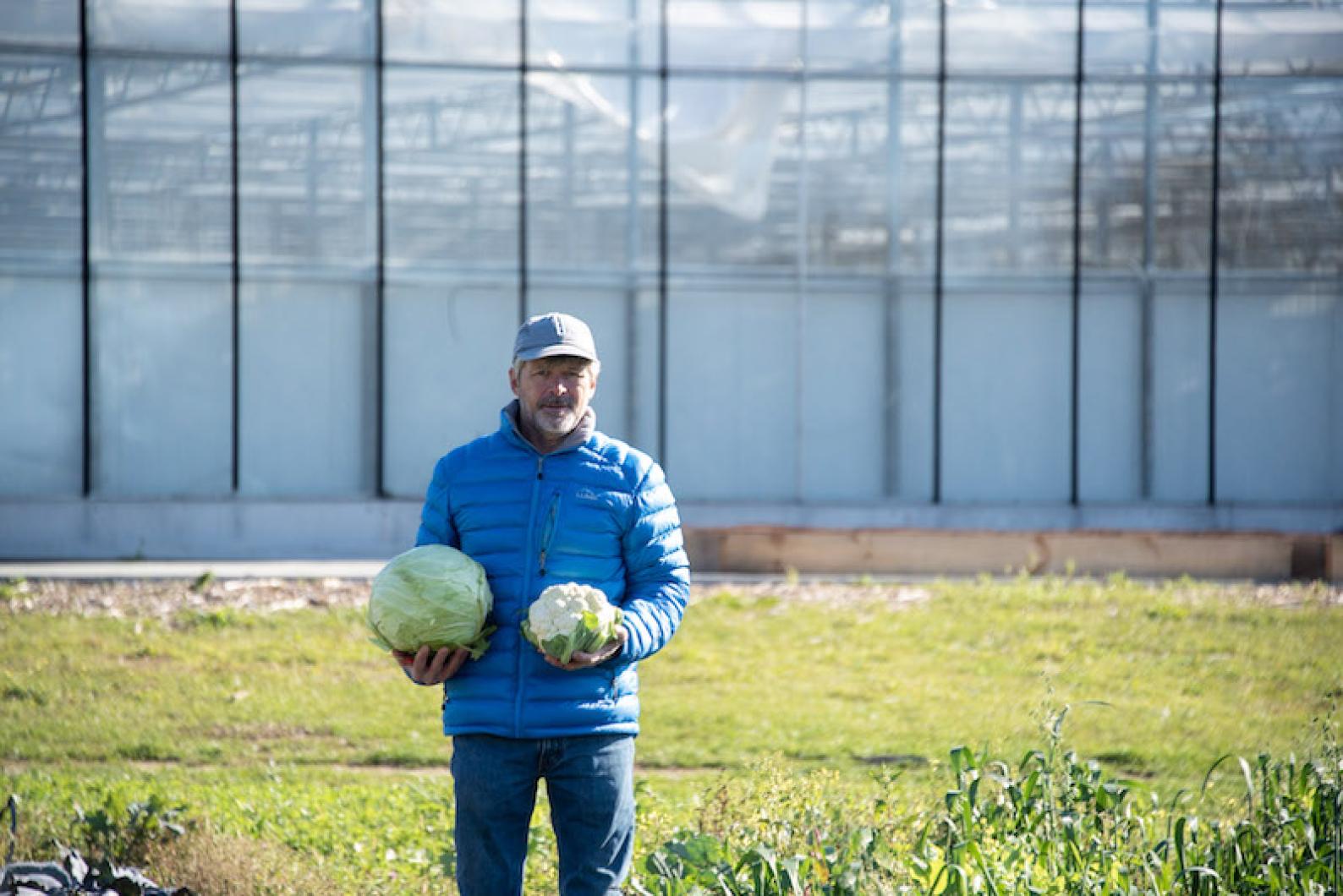
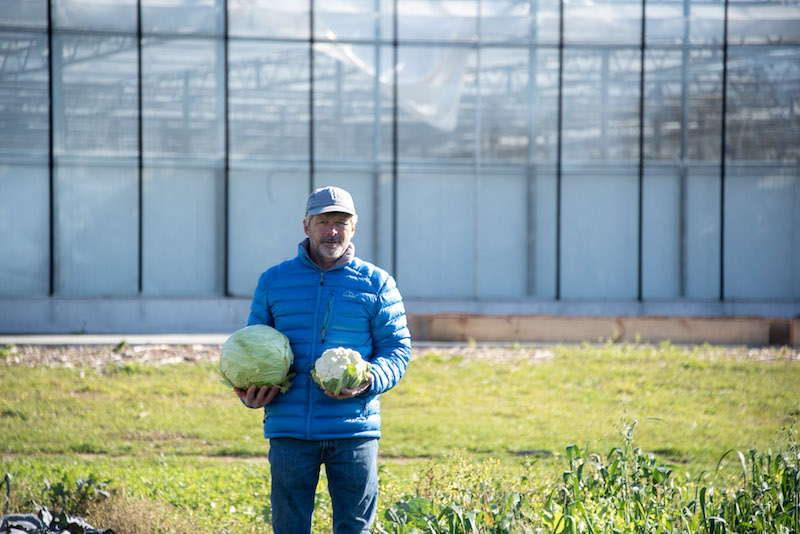
The time-honored tractor is giving way to different equipment on the land Andrew Woodruff tends today, at Island Grown Initiative’s Thimble Farm in Vineyard Haven.
Just a few years ago, you might have found Andrew Woodruff behind the wheel of a heavy-treaded tractor, tilling soil and plowing down cover crops on his Whippoorwill Farm in West Tisbury.
But the time-honored tractor is giving way to different equipment on the land Mr. Woodruff tends today, at Island Grown Initiative’s Thimble Farm in Vineyard Haven.
Regenerative agriculture captures carbon in the soil.
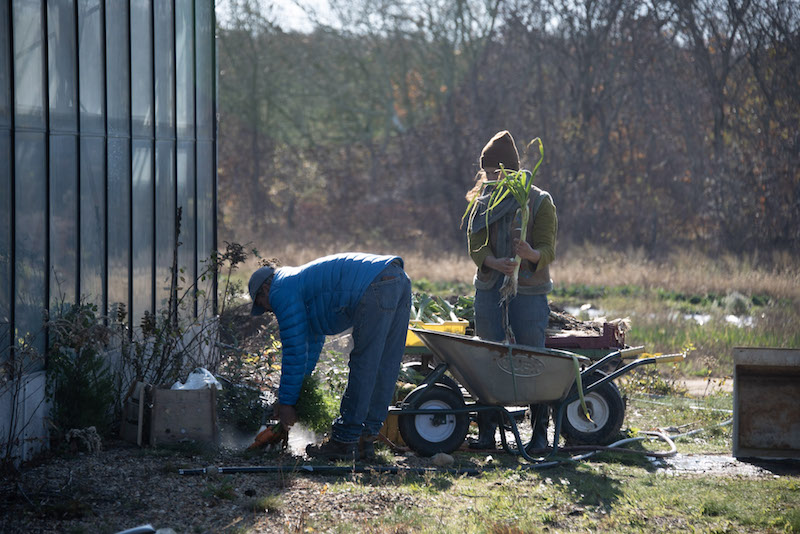
Regenerative agriculture captures carbon in the soil.
“The tarp is the tool of choice on the farm now,” Mr. Woodruff said this week. “Not the tractor, but the tarp.”
Mr. Woodruff is about three years into a project to rebuild Thimble Farm’s vegetable fields using the techniques of regenerative agriculture, an increasingly popular way of farming based on pre-industrial methods.
Instead of finishing up a cover crop by plowing it into the soil with a tractor, regenerative farmers like Mr. Woodruff use huge tarps to smother the plants in place with their roots still in the ground.
These tools are so important that Island Grown applied for, and received this week, a grant from the Permanent Endowment from Martha’s Vineyard to buy tarps for the farm.
“It eliminates you doing tillage,” Mr. Woodruff said, helping to achieve the first principle of regenerative agriculture: reducing disturbance of the soil, in order to preserve organic matter and prevent carbon from escaping into the atmosphere.
Soil is a complex topic, Mr. Woodruff said. “There’s a lot of new science out there about soil biology, and I’m still very much in the early phases of the learning curve.”
But when it comes to reducing soil disturbance, he said, “it’s all about the carbon.”
Industrial agriculture began emphasizing big tilling machinery and chemical fertilizers in the 1940s, Mr. Woodruff said.
“That led to the destruction of soil structure. Today we have two per cent, if we’re lucky three per cent organic material in the soil, whereas we originally had six to eight per cent,” he said.
Meanwhile, “60 per cent of the carbon worldwide has probably gone into the atmosphere,” lost to erosion or released in the farming process, Mr. Woodruff said.
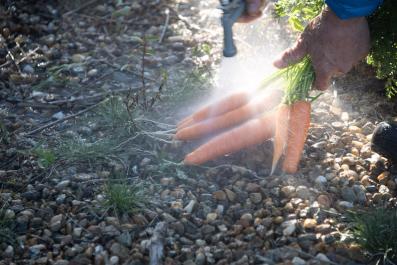
The project is turning out healthy crops of vegetables.
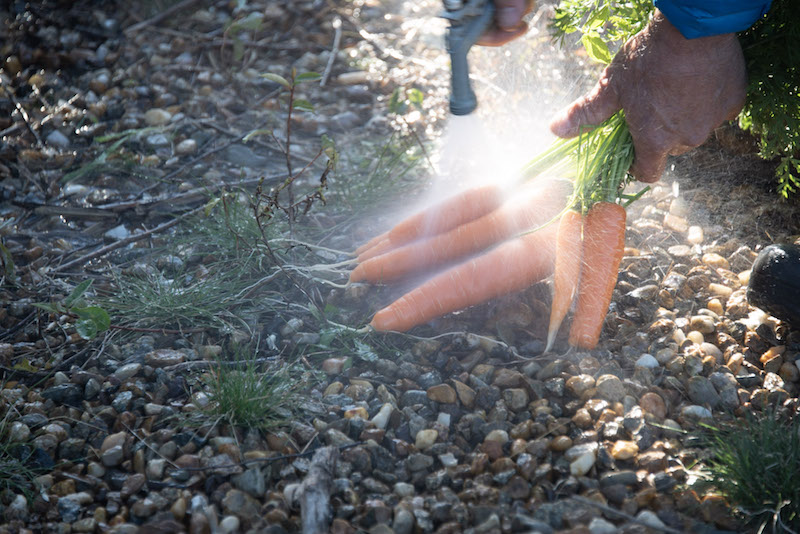
The project is turning out healthy crops of vegetables.
“We’re at a really pivotal point, I believe, in terms of the health of the planet and where we are in terms of producing food,” he said.
“There’s a lot of emphasis worldwide now on trying to figure out how to get carbon out of the atmosphere and back into the soil so that it can support healthier growing systems for agriculture.”
It was his own search for a healthier way to farm that led Mr. Woodruff to Bryan O’Hara’s Tobacco Road Farm in Connecticut a few years ago.
“It’s a little garden of Eden,” he said of the small farm that uses no-till and low-till methods to produce “the most amazing [farm] food that I’ve ever seen in my life,” Mr. Woodruff said.
“I knew that could happen here on this farm, so I started to do these practices here as a lessee and also on my own farm [Whipporwill Farm in West Tisbury] on a small-scale parcel to get familiar with the systems.”
In 2019, Mr. Woodruff began partnering with Island Grown to transition an initial eight acres to regenerative growing, including two and a half acres in production this year.
“I began reducing tillage three years ago on this land,” Mr. Woodruff said. “I’m seeing the changes in the soil structure in the few years of less tillage and more cover crops.”
The soil is less compacted, taking on a desirable granular consistency, the longtime farmer said as he walked among rows of beets, carrots, brassicas and other cool-season crops destined for Thimble Farm’s winter CSA program.
There are more earthworms. “We’re getting definitely healthier results in crop production,” Mr. Woodruff said. “This broccoli, for instance, is really some of the best broccoli I’ve ever grown.”
He also experimented with planting a small patch of sorghum grass, sunhemp and buckwheat seeds as a cover crop, then covering the seeds with three inches of wood chips.
The seeds sprouted through the chips and became the healthiest crop on the farm, Mr. Woodruff said. He’s planning to use wood chips on a larger area next year.

Mr. Woodruff emphasizes crop diversity and rotation.
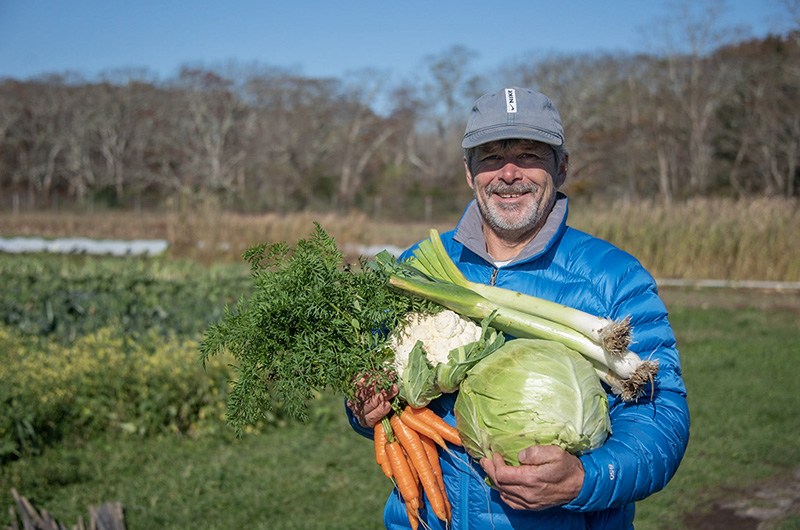
Mr. Woodruff emphasizes crop diversity and rotation.
“I believe that might be one of the fastest ways to get the soil moving toward no-till,” he said, noting that the wood chips inoculate the soil with beneficial mycorrhizae. After the cover crops are cut down or smothered, new seeds will be planted through the decaying material of the old.
“In between all that, you can add more compost, add more wood chips,” Mr. Woodruff said.
Along with reducing soil disturbance, he is following the four other key principles of regenerative agriculture: keeping living roots in the soil year round, covering the soil with a protective layer of mulch or decaying organic matter, bringing in animals to graze as part of the crop rotation and planting a wide variety of crops.
“It’s really important to have diversity in your crops and rotations and the species of plants you grow,” Mr. Woodruff said. “Just like a forest that has multiple species growing in it, you want your farm to be the same.”
A cover crop, for instance, should be grown from a mixture of different seeds, like the sorghum-sunhemp-buckwheat mix.
“It creates more diversity in the biology of the soil and it protects the health of the soil,” he said.
The regenerative fields at Thimble Farm are still a work in progress, he said.
“This transition is a very slow process. It will take probably five more years to get to the point where we’re doing really minimal disturbance of the soil.”
He concluded:
“That’s one of the challenging parts.
“It takes a little bit of courage and some time to figure out to do it.”
Comments
Very interesting story. I
Home Gardener MVVery interesting story. I might have to try this myself in my small garden. And either Mr. Woodruff is an extremely small man or that cabbage he is holding is HUGE.
Nobody has worked as hard as
patrick brown Vineyard HavenNobody has worked as hard as Andrew in service to the land. I happen to know first hand.
Google Charles Dowding in the
Craig Nash EdinburghGoogle Charles Dowding in the UK as he is one of our leading experts on No dig gardening
Glad you have started the no
Betsy Houle Coventry CT/West TisburyGlad you have started the no-till.....I know Bryan O"Hara as we are vendors at the same Farmers Market here in CT. Another farm/Brown Farm, in Scotland CT is also a no-till....vegetables and fruit are delicious.
This is excellent. What I've
Bonnie bright OklahomaThis is excellent. What I've been watching is a culmination of no-till methods that equate to the Back to Eden results for which the video was somewhat misinforming leading to many others' failures. If you look closely, Paul prefers fine wood chips that are already decomposing at top dressing over high quality compost. He might have started with basic wood chips, but he has refined his method and upon closer inspection, one notices that compost or almost finished compost is the keystone to the effectiveness of the Back to Eden Method.
Charles Dowding with decades of experience and strict diligence combines no dig with aesthetics a beautiful small market garden, Homeacres, in the UK. He labors with copious amounts of compost from various sources, and uses compost as a mulch up to 6" deep for a new bed with recooperating compost applies at 1 to 2 inches per year. He rarely needs digs. The large amounts of compost likens to a jump start to a back to eden garden.
Richard Perkins has a large regenerative permaculture farm in Europe and reveals how to implement no dig on a large scale along with for-profit livestock use permaculture methods.
There are several other medium and larger scale no-dig farmers coming into play that can be seen on youtube.
There's more than one way to skin a cat, but the keystone of all methods appear to be copious amounts of compost atop the garden beds along with no dig or low dig to maintain soil structure, microbial networks and organic material beneath the soil.
I started out with Charles Dowding's method. For me, beginning was tedious and requires patience, the amount of compost to produce his final result is impossible for me, but what I have begun is growing more abundantly than I ever experienced.
Though I only just started, I'm sold. I have bare soil in parts of my yard where I need to provide mulch. There are no weeds, because I have no dug in about 11 months.
I hope to bring in some trials and testings with different weed suppressing methods and mulches in the future.
That's my boy!! :)
Nthalie Woodruff Oak BluffsThat's my boy!! :)
Add new comment