


So symptomatic of his life, it seems there’s not been much notice this year of the 200th anniversary of the birth of one of America’s greatest authors, Herman Melville.
So symptomatic of his life, it seems there’s not been much notice this year of the 200th anniversary of the birth of one of America’s greatest authors, Herman Melville. There has already been much hoopla over this year’s 200th anniversary of the birth of Walt Whitman. And they’ve whooped it up across the pond in celebration of the mutual bicentenary of the introduction into the royal world of Queen Victoria and Prince Albert.
But when August 1 came and went, no one around me raised a glass or hoisted a sail for the man who gave us Moby-Dick, that great American bible of a novel. And here of all places there should have been a red carpet party. Two characters in Moby-Dick — Tashtego and Flask — hail from the Vineyard. We know Melville set foot here after the publication of his masterpiece in 1851, even if only for a visit.
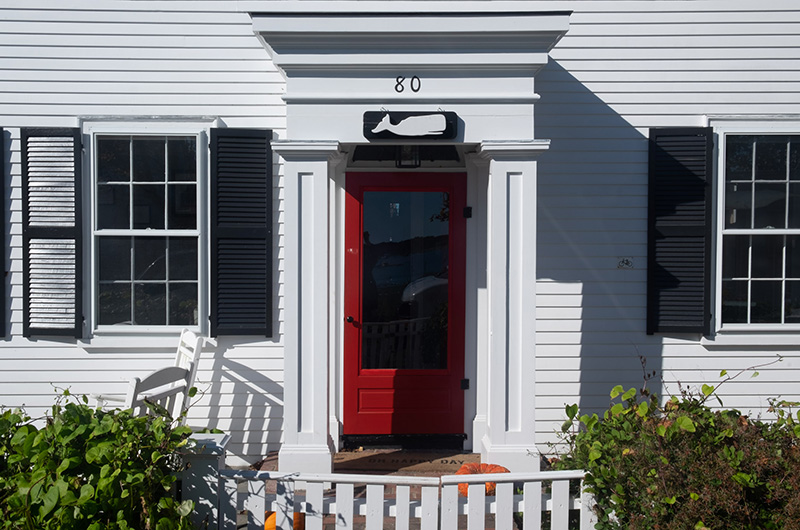
And then there’s that house at 80 South Water street in Edgartown. The very house where for three decades actress Patricia Neal lived and died belonged in the mid-19th century to whaling captain Valentine Pease, the alleged model of Melville’s Captain Ahab. In 1908, the house was purchased by Melville’s daughter, Frances and her husband Henry B. Thomas. They occupied the house for three decades. After Frances’s death in 1938, her daughter, Frances Thomas Osborne, took over the house, buying out her sisters. She died in 1980 and is buried in Lambert’s Cove.
Although his first two books, Typee and Omoo, gave him a modest reputation, Melville couldn’t make a living as a writer. Moby-Dick landed with the thud of — dare I say it? — a beached whale. The novel seemed to be out of the mainstream. The reading public was not accustomed to a world view that postulated man was born without some spiritual purpose, that he was the captain of his fate, set out on a sea without a divine plan. This was a Homeric tale of a godless journey in which a clash of forces of nature settles nothing, not even a score.
When two more books didn’t make enough of a splash, he resolved himself to a career as a customs inspector on the New York docks to care for his wife and four children. During his last decades, he attempted to exorcise his demons of depression by writing poetry.
In 1891 he died in an obscurity reminiscent of his character, Bartleby the Scrivener. Subtitled A Story of Wall Street, this long short story took an early literary approach to existentialism and the absurd. It focuses on a law clerk who chooses a path of passive resistance by cordially refusing one task after another (“I would prefer not to”) until he ends up in a dead letter office.
What triggered my thinking about Melville was an article in the latest Columbia University magazine taking a look back at Melville’s 100th birthday festivities. Actually, there weren’t any, but in 1919 the seeds were sown for the flowering of his reputation. To commemorate the 100th birthday, Columbia professor Carl Van Doren, who also happened to be the literary editor of the Nation, hired Raymond Weaver, a Columbia colleague in the English department, to rebuild Melville’s profile. With passionate detective work, Mr. Weaver got sucked into a vortex that led to the mounting of Melville on an American pedestal. His research resulted in the 1921 biography, Herman Melville: Mariner and Mystic. The author was not only salvaged from the literary deep but also polished and glorified.
Analyzing Moby-Dick in his book and in the Nation, Mr. Weaver expounded on how what turned off a 19th-century audience would turn on a 20th-century one. Ahead of his time, Melville developed his own style that branched into what was later known as stream of consciousness. He wrote, Mr. Weaver noted, against convention in bringing up sex and the tragedy of fanaticism. He saw how his country could flex its muscle beyond its borders, becoming just as vengeful as Ahab. Most likely he was the first American author to put in print the hypothesis that the universe may be a big joke.
In his rescue operation, Mr. Weaver also found a buried treasure. While visiting the New Jersey home of granddaughter Eleanor Melville Metcalf, sister of Frances Osborne, he was shown a trunk of Melville’s papers. Among them he discovered a finished but unpublished novel “unmatched among Melville’s works in lucidity and inward peace.” This was Billy Budd, a different kind of sea tale involving good and evil, justice and injustice. Today it joins its creator’s other works in the American canon.
Melville was a true original, something he would be proud to be considered. In an essay appraising his friend Nathaniel Hawthorne, he wrote: “It is better to fail in originality, than to succeed in imitation.”
If I’ve now lifted you into a partying mood, let me remind you this year is also the 200th birthday of George Eliot, James Russell Lowell, John Ruskin, Clara Schumann, Jacques Offenbach, Gustave Courbet, Julia Ward Howe, Abner Doubleday and Christopher Latham Sholes, the man who invented the QWERTY keyboard, which allowed me to write this column. Party on!
Arnie Reisman and his wife, Paula Lyons, regularly appear on the weekly NPR comedy quiz show, Says You! He also writes for the Huffington Post.
Comments
Excellent. Just excellent.
Jack AquinnahExcellent. Just excellent.
Mr. Reisman, your own
Georgia Morris Vineyard HavenMr. Reisman, your own "passionate detective work," (like Mr Weaver's) have illuminated us once again. Your commentaries are a wonder.
Thanks for the informative
Michael Mason Norman St. Paul, MNThanks for the informative article.
Thank you Arnie for a great
Marc Brown TisburyThank you Arnie for a great read and the reminder.
Loved this Arnie!
Arnie Oak BluffsLoved this Arnie!
Love the Vineyard and loved
Bev OConnell Wilmington MALove the Vineyard and loved this piece. Well written!
Well done Arnie!
Karen H Ward BostonWell done Arnie!
Melville's 200th birthday may
Susan Larsen Chilmark, MAMelville's 200th birthday may have gone unnoticed on the Vineyard but there were and continue to be grand celebrations around the globe. Nantucket is hosting one of many Moby-Dick reading marathons Saturday 11/16 and Sunday 11/17, with Nat Philbrick reading the first iconic chapter. Sign up! If you want to celebrate Melville's bicentennial and join in the global celebrations, read "his masterpiece!
Our inattentiveness to
skip OBOur inattentiveness to Melville's Vinetyard connections are all the more ironic in view of Amos Smalley, the Wampanoag from Gay Head, who actually did kill a white sperm whale in 1902 aboard the Platina. Thanks Arnie - and happy belated Mr. Melville!
There must have been some
A. Griffith Ivor-Campbell Bristol RIThere must have been some kind of stardust filtering down on our world 200 hundred years ago! Moby Dick remains one of my favorite novels and I do not mind picking it up to read a couple of favorite chapters now and then.
Thank you. I manage Edgartown
Mathew Tombers Edgartown, MAThank you. I manage Edgartown Books and this is a great thing to know, which I didn't and timely as I just sold a copy of "Moby Dick."
I remember this house as
Dave Achelis NYCI remember this house as Patricia Neil's residence...
❤❤❤
Lisa Foster Los Angeles❤❤❤
An interesting new book, Ahab
Johanna Kobran Brookline, MAAn interesting new book, Ahab’s Return, or The Last Voyage, by Jeff Ford (s former Professor of English at Brookdale , the college where I was Excutive VP) very interesting read. It’s a fantasy novel. Jeff is an excellent short story writer as well.
Moby Dick was my companion
Andrea Rabinowitz Seattle WashingtonMoby Dick was my companion while waiting for my husband to do his cardiac exercises in a nearby hospital. Now that he is gone that book reminds me of him and the conversations we had about Ahab and his pals.
H. Thomas Osborne, Melville's
Judith Tankard EdgartownH. Thomas Osborne, Melville's great-grandson, owned our house at 16 School Street 1962-1966
I learned 2 things about him
Margot lane MenemshaI learned 2 things about him recently: that the “white whale” was inspired by the wintry view out his window of My. Greylock & that he once walked from S.F. to Mexico!
And wasn't the harpooner,
Dave Tenenbaum Aquinnah/WisconsinAnd wasn't the harpooner, Queeg Queeg, a Wampanoag native of Cuttyhunk, our island neighbor?
Still time to put on a George
Bob EdgartownStill time to put on a George Eliot party also know as a Mary Ann Evans bash as her birthday is November 22!!!
Melville's granddaughter,
Will Ambrose Murrells Inlet, SCMelville's granddaughter, Frances Osborne, traded the 80 S. Water Street House, for a larger house further up S. Water Street. My parents bought that house in the early 1960s and sold it in 1982. For many years, my grandmother migrated seasonally between her Winter Street house and the S. Water street house.
Add new comment