

<p>Three offshore wind developers, including Vineyard Wind, have submitted bids to build the state’s second offshore wind farm — even as the first one remains mired in permitting issues.</p>
Three offshore wind developers, including Vineyard Wind, have submitted bids to build the state’s second offshore wind farm — even as the first one remains mired in permitting issues.
The companies, Mayflower Wind, Bay State Wind and Vineyard Wind, were authorized to submit confidential bids to the state Department of Energy Resources on August 23, with public versions of the bids due on August 30. The bids were released to the public in early September.
Vineyard Wind won the right to build the state’s first offshore wind farm 14 miles south of Martha’s Vineyard in 2017, beating out Bay State Wind and Deepwater Wind (the latter was responsible for the Block Island wind farm).
Wind lease areas.
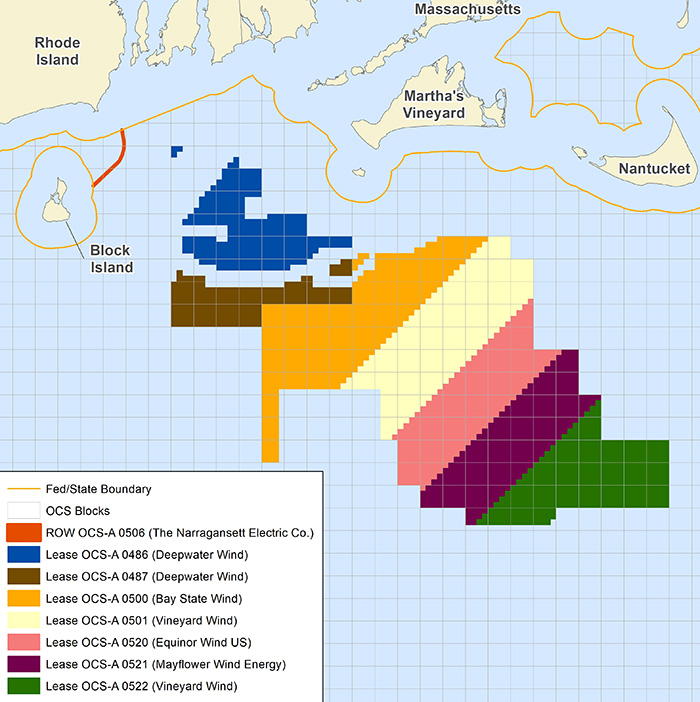
Wind lease areas.
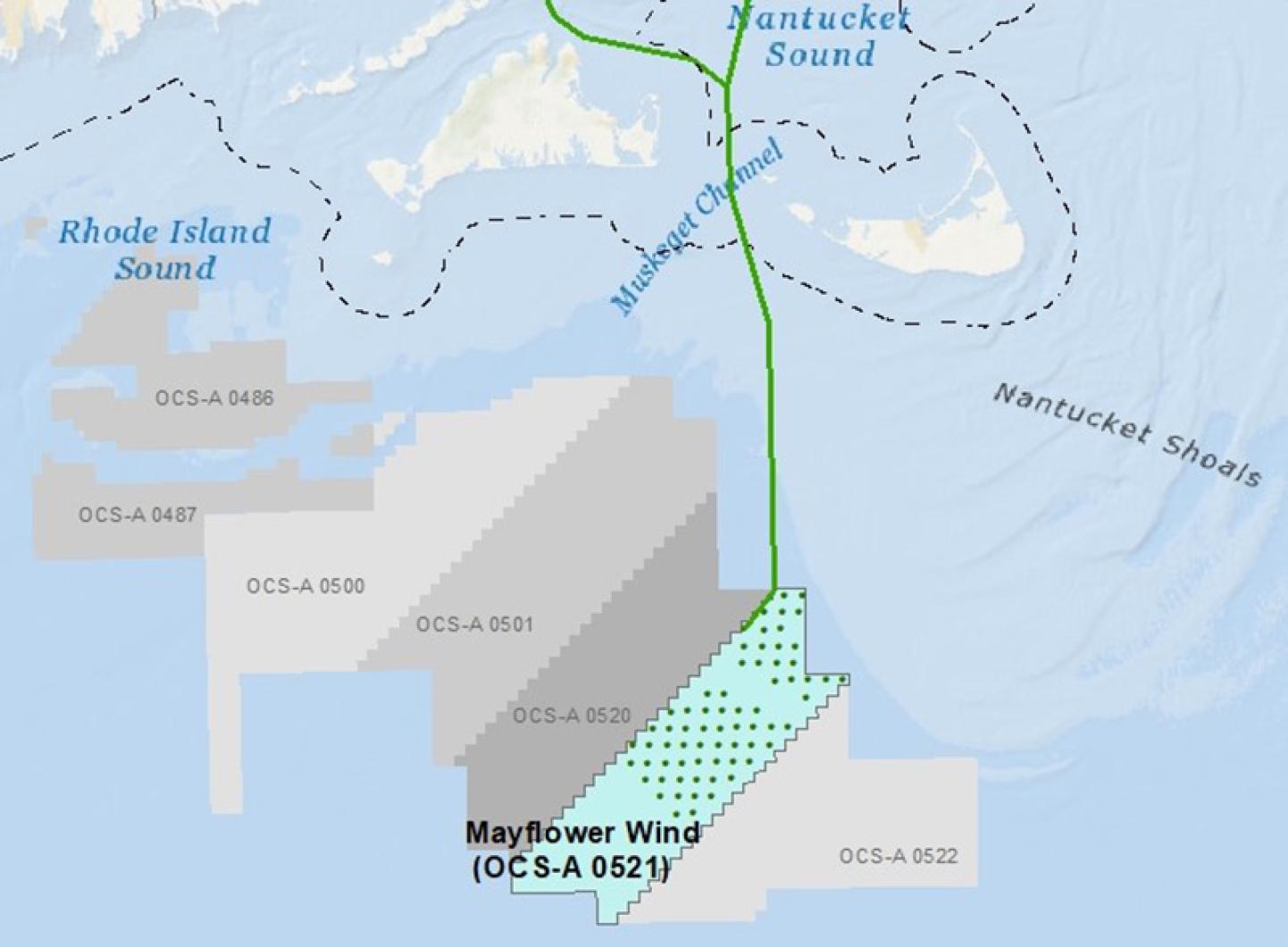
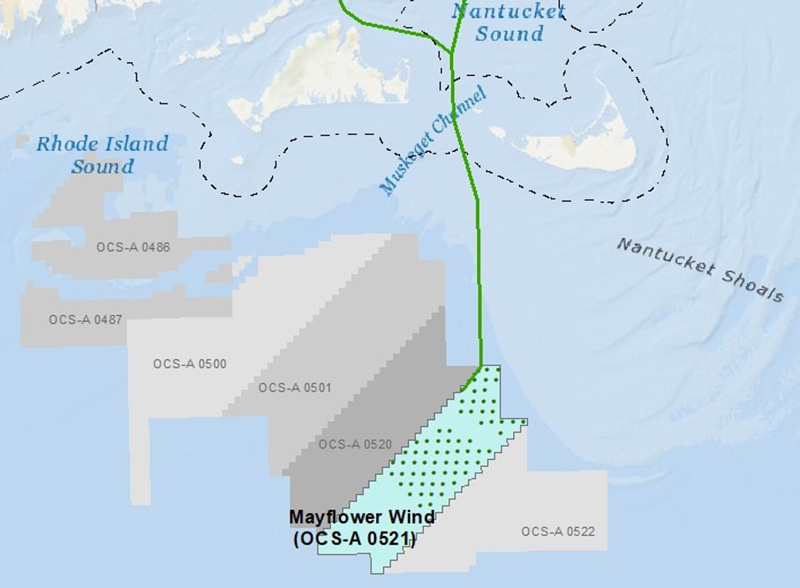
Soon after, the federal government auctioned off three other wind lease areas in the waters just south of the Vineyard. Those auctions were completed in 2018, with each area going for approximately $135 million to Vineyard Wind, Mayflower Wind and the Norwegian company Equinor. There are now five companies with federal offshore wind leases in Massachusetts.
This most recent request for proposals from the state would allow the chosen bidder, either Mayflower, Bay State or Vineyard Wind, to negotiate an energy pricing contract with the DOER and public utility companies. Due to the high price of construction, it is necessary for the companies to sign a utility contract before turbines are installed.
The race to build offshore wind in Massachusetts began in earnest in 2016 when Gov. Charlie Baker signed energy legislation allowing for the procurement of approximately 1,600 megawatts of offshore wind energy generation by the state. Vineyard Wind’s first project accounts for 800 of those megawatts; the winner of the most recent bidding process will account for the rest.
Each bidder was required to submit proposals for a 400-megawatt wind farm in their respective lease area, with the state charging the companies a $500,000 non-refundable bid fee for each pricing proposal. The companies submitted a combined nine different pricing proposals, six of them representing 800-megawatt farms, earning the state nearly $5 million. Because details in the public versions of the bids are redacted, the offered pricing options are not yet available.
The Mayflower Wind proposal appears to include an offshore cable that would run east of Martha’s Vineyard, connecting the turbines to the mainland at Cape Cod. Language in the proposal also makes the claim that all three of the 800-megawatt proposals “would provide the commonwealth with the lowest price yet for U.S. offshore wind.”
Bay State’s lease area is at the far northwest end of the federal lease region, making it unclear how it would connect to the mainland. Vineyard Wind did not include a map with their proposal, although its lease area is adjacent to Mayflower’s. Neither company made pricing claims in the public versions of their bids.
Over the next two months, the DOER and utility companies will analyze the bids. Winning projects are due to be selected for negotiation on Nov. 8. Contracts will then be negotiated and executed by Dec. 13, with long-term contracts going to the state Department of Public Utilities for final approval in late January.
All three companies are joint, 50-50 energy partnerships between renewable investment ventures and energy companies. Vineyard Wind’s partnership is between Avangrid Renewables and the Danish company Copenhagen Infrastructure Projects. Bay State Wind combines the Massachusetts-based energy company Eversource and another Danish company called Orsted. Mayflower Wind is a partnership between Royal Dutch Shell and EDP renewables.
Vineyard Wind was set to move forward with phase one of its proposed $2.8 billion, 84-turbine project earlier this year, but has since hit permitting snags on multiple fronts that will delay construction on the project until at least early 2020.
In July, the Edgartown conservation commission denied the project after hearing concerns from local fishermen. The state Department of Environmental Protection has since issued a superseding order of conditions for the but the concom will appeal, possibly pointing to longer delays.
Meanwhile, the federal government has delayed Vineyard Wind’s environmental impact statement indefinitely on the grounds that the government now plans to examine the cumulative impacts of all offshore wind energy projects along the Eastern seaboard. The EIS is a necessary federal permitting step for offshore wind projects.
Katie Gronendyke, a spokesman for the state office energy and environmental affairs, said in a written statement that wind energy projects are an important facet of the Baker administration’s push toward reducing greenhouse emissions.
“These proposals will be carefully reviewed to ensure that the energy procured is in the best interest of the commonwealth, provides economic development, and is ultimately cost-effective for ratepayers across the state,” the statement said.
Comments
How can the statehouse and
Helen ParkerHow can the statehouse and purported environmentalists back the 800MW Vineyard Wind (“VW”) project, let alone send out RFPs for more? The first VW 800MW phase alone would be larger than any offshore wind installation in the world, with turbines larger than any yet installed anywhere: 84 turbines as tall as the Boston skyline, pile-driven into the ocean floor smack in the middle of NARWhale core habitat.
See The Fishermen’s Meeting. Edgartown. 6.27.19 on youtube.
How do whales communicate? Navigate? Find food? Avoid ship strikes? via infrasound - which travels many hundreds of miles underwater. The unexplained spike of 17 NARWhale deaths in 2017? Could it be a consequence of the Block Island 30MW offshore wind array which went online in June 2016, right in the path of their following spring migration?
Turbines send out infrasound. The larger they are, the greater the infrasound.
FYI: Adding Wind into the energy portfolio increases fossil fuel use, CO2 emissions and energy cost, proven by real world data from around the world. But back to the whales, because we’ve lost at least another 8 [or ~2%] of the critically endangered species this summer alone.
See minute 2:22 where VW dances with how “the Endangered Species folks” and National Heritage determined that, ‘This isn’t a taking and we don’t need a permit.’
Similarly, …unprecedented infrasound broadcast across the NARWhale core habitat – for the life of the project – gets a blessing from the MA Endangered Species and National Heritage Programs, the Conservation Law Foundation, National Resource Defense Council, and the National Wildlife Federation (minute 23:10).
The Edgartown Conservation Commission denied the VW cable permit, but the MA Energy Facilities Siting Board has been given the option to violate our constitutional “Home Rule” provision, which ‘grants to the people of every city and town the right of self-governance in local matters.’ Under the super-permit requested (hearing date 10/15-16/19), there would be no right of appeal from man or beast.
So goes the whales So goes
David Moriarty Planet earthSo goes the whales So goes the humans?
This "Fake it and Take it in Massachusetts"failed energy program has got end.
Charlie Baker is no friend of the Cape an Islands.
Sounds dramatic. Not sure how
Mike WTSounds dramatic. Not sure how wind turbines increase fossil fuel use, and CO2 emissions, those comments seem dubious. Ignorant provocation. Scare tactics for the uninformed.
Inform us please. What do you
Marie Jane Boston MAInform us please. What do you know that we do not? What of what has been shared scares you? While you determine what you would like to say and simply put, INDUSTRIAL WIND TURBINES NEED BACK UP .. That is not a scare tactic; that is a simple overlooked and never shared FACT. The wind industry and the energy politicians and the industrial wind turbine agenda supporters are long on climate change facts and short on industrial wind turbine harms onshore/offshore to health, human well being, wildlife, the environment.
Go away, do it somewhere it
Mark EdgartownGo away, do it somewhere it won’t look like a dystopian mess. And for all the haters, absolutely not in my back yard.
Vineyard Wind as climate
Barbara Durkin Northboro, MAVineyard Wind as climate action shifts wealth by design, (just ask Al Gore).
Our monetary wealth transferred to Vineyard Wind will benefit Spain, Italy, Denmark, China & the Netherlands where Vineyard Wind’s supply chain would exist, along with manufacturing jobs funded by U.S. citizens.
Energy security is undermined by
offshore wind that contributed to Britain’s recent Blackout.
FINANCIAL TIMES
Utilities
August 16, 2019 7:06 pm by David Sheppard in London and Nathalie Thomas in Edinburgh
‘National Grid electricity blackout report points to failure at wind farm’
‘Initial probe raises the possibility that chaos was caused by new plant’
“Orsted acknowledged on Friday that a “technical fault” had meant that the wind farm “rapidly de-loaded”...”
https://www.google.com/amp/s/amp.ft.com/content/8b738eac-c024-11e9-89e2…
Britain’s, “unprecedented power outage, with hospitals, airports, rail and road networks – as well as towns and cities across England and Wales – left without electricity.”
Renewable energy needs to be
T Bone Oak BluffsRenewable energy needs to be part of our future. The NIMBY arguments are out in full force. I'm quite excited with the expectation we'll see the first wind farm go live soon.
Full speed ahead on wind
Carol formerly ChilmarkFull speed ahead on wind power! Mass. is so far behind the rest of the US in renewable energy (wind & solar), it's embarrassing, it's like the Alabama of New England. Texas, California, WA & OR are way, way ahead of us! There is NO TIME to waste, we're already bequeathing an absolute hellscape to the kids. Lord, you'd think anyone living on this Island might be a little less clueless about climate change (read much?). sheesh
it's not a marginal niche
Adam Wilson Oak Bluffsit's not a marginal niche industry the way Cape Wind was 10-12 years ago. Companies building off shore wind farms utilize global energy technology which now supplies energy to millions of people on three continents.
Add new comment