


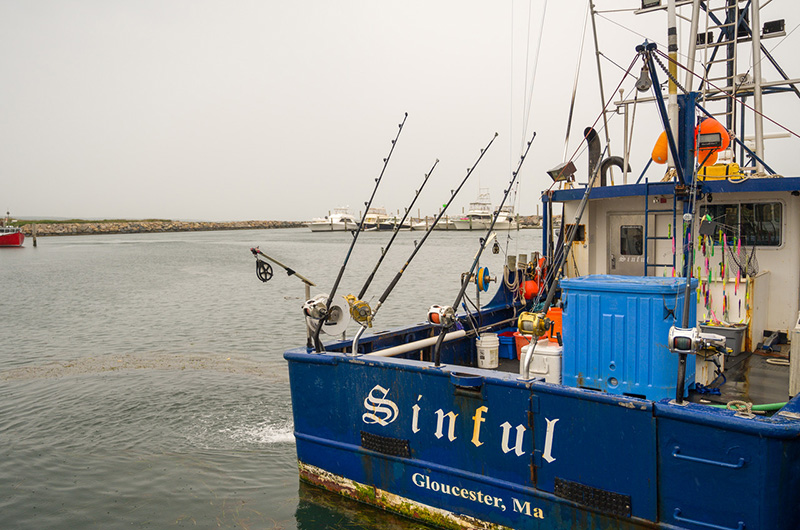
The quiet demise of the tuna industry was in evidence last week when the 278-metric ton seasonal quota was reached early. Market prices were reported to have plummeted to a record-breaking low.
Carl Coppenrath can remember the days when it seemed bluefin tuna fishermen could walk on water.
In the heyday of the 1980s, the market was so flush in Menemsha that fishermen could literally walk across a harbor packed with a fleet of commercial vessels lined up at the end of the day to sell their catch for top dollar.
The mystique and allure of catching the torpedo-shaped fish that can weigh over 1,400 pounds brought glory and the prospects of such wealth that it awoke the romantic reimagination of the old whaling days of the Island. So much so that it spawned the popular cable TV series Wicked Tuna and lit up social media with photos and boastful tales of the trophy fish.
“It’s like an addiction . . . the thrill of hauling one of those things in,” Mr. Coppenrath said. “It really is. It hooks you more than drugs, alcohol or anything. I’ve lobstered, scalloped, groundfished. Nothing compares.”
But Cape and Island fishermen like Mr. Coppenrath agree that the heyday of the commercial tuna industry has long since passed. And many fishermen have moved into more reliable, and perhaps less exciting, markets.
The quiet demise of the tuna industry was in evidence last week when the 278-metric ton seasonal quota was reached early. Market prices were reported to have plummeted to a record-breaking low.
Rory O’Donnell, sales and purchasing manager at Red’s Best, one of the largest wholesale distributors of fish in Massachusetts, said he was paying an average of $4 per pound for bluefin tuna this season, which began in June and normally would have run until the end of August. Last year he paid an average of $7 per pound, $7.50 the year before that, and so on back to the 1980s, when it was worth upwards of $15 per pound.
“It’s just the market in motion,” he said. “Prices are at a significant low because of an increase in competition . . . an increase in farmed fish from other parts of the world that have spilled over from the Japanese market . . . and a higher quantity of fish because of [the fact that] the stock is strong.”
He said while wholesale market prices are low, retail prices have remained well above $20 per pound. The economic anomaly is due to lower quality fish in local waters, which have less meat and fat content when dressed, and also the increased cost of icing and transporting the fish, he said.
Dr. Molly Lutcavage, director of the Large Pelagics Research Center in Gloucester, said the poor quality of the fish is directly related to the biological history.
“If a bluefin has just come all the way from the Gulf of Mexico and hasn’t fed well . . . or if they have just depleted all their fat storage through spawning . . . you can expect a lower market-quality fish,” she said.
Alex Friedman, a bluefin tuna fishermen from Edgartown who has turned to the more sustainable and steady trade of oyster farming, used his cell phone this week to host an impromptu conference call with three former tuna fishermen, who all spoke about the complex factors that have caused the downturn of the once-profitable market. Among other things, they cited more competition due to an open access fishery, with commercial licenses available for less than $30, and tight federal regulations and quotas that leave local fishermen unable to compete in international, less regulated markets. But they were also concerned about the misrepresentation of the tuna industry by reality TV shows and social media.
“It represents the insecurity of the entire industry,” Mr. Coppenrath said. “Nobody is taking any photos with a load of their scallops.”
Now approaching retirement, he spoke of the early days of catching bluefins, which at the time were called horse mackerel. Growing up in Green Harbor in the 1960s, he frequented Vineyard waters on charter vessels when bluefins were only caught for sport.
“We would bring them in, take pictures and dump them at the valve to rot or sell them for five cents a pound to be ground up for cat food,” he said. “At the time there wasn’t any market for them.”
Due to demand from Japan, the bluefin market exploded in the late 1970s, peaking in the 1980s and early 1990s. When Mr. Coppenrath pulled his 30-foot Vineyard Hawk, Anne-Ellen, into the Menemsha or Oak Bluffs harbor, he could easily unload the fish to one of many eager buyers.
But the value of the fish then, coupled with unsustainable fishing practices such as purse seine, longlining and a high quota, led to the collapse of the fishery and a subsequent increase in regulations to deter overfishing.
Brad McHale, fishery management specialist with the National Marine Fisheries Service, said by the early 2000s regulatory measures reached an all-time high and the quota reached an all-time low. But he said there were signs of the eventual demise of the industry long before significant regulations were enacted.
“Currently the bluefin tuna stock, or western Atlantic bluefin tuna stock, is not subject to overfishing,” Mr. McHale said. “We are seeing a very strong abundance of the fish.”
Against a backdrop of increasing stocks, the quota has progressively increased in the past few years. But Mr. McHale acknowledged that increased competition has stopped fishermen from reaping the potential benefits of an increased quota.
He concluded: “It is very difficult to have the government micromanage the market. That is for fishermen and dealers to figure out.”
Mr. Coppenrath is now helping to spearhead a collaborative movement among fishermen, markets, researchers and government regulatory agencies.
Three years ago he launched an organization called the Superfish Tracking Research Partnership. The mission, he said, is to demonstrate why an increased awareness of the bluefin tuna industry is important for conservation, health, the economy and the environment.
It is a fight he is not giving up any time soon. And when the quota reopens on Sept. 1, he will be back out on the water.
“I couldn’t walk away, nobody is doing anything for the industry,” he said. “To get up in the morning and go and catch a bluefin tuna, it’s a sexy thing. That’s why people want to do it. But what’s happening now, there’s nothing sexy about it.”
Corrected from an earlier version which misspelled the last name of Dr. Molly Lutcavage. Her title is director of Large Pelagics Research Center in Gloucester.
Comments
Still
Dave Marciano GloucesterStill
Living in the 80s is the biggest part of the problem with the market. Yes back then Asia was the market and we had the only game in town . Those days are gone it’s a global game with he Asian market. But thinking outside the box is what is need in my opinion. Rather than dwell on a past that’s not coming back. We have a fully rebuilt resource and the problem is consumers. We need more of them. One of the answers for the industry could be created that market demand with the US consumer. The charter fleet in the areas where giants are caught arm to “ get it “ thru have not problem advertising to come with them. Come have chance of a lifetime come catch a “ wicked Tuna “ and the trips sell. A true blessing in the middle of 5 years of closer for the recreational cod fishery. A fishery that built the charter fleets. ( and also have a open access permit ). So what to do. Think about how well people and the demand for “ Maine “ lobster. What s great marketing campaign that was But are all “ Maine lobsters truly caught is Maine ? Or is it actually a multi state fishery. Think of the marketing potential for a fishery that is already be recognized in 171 countries. 440 million homes Hmmmmm. If there were only a way to get the word out about the wonderful delicious food source giant tins can be Bit that is hard. There is only one market that is Asia. And it’s bed. There since the 80s makes no sense at all to use the social media and tv awareness to promote s highly valuable seafood product like the charter fleet has done successfully or the lobster industry successfully did with Maine lobsters. It’s best to keep news of that product quiet tell no one and that should be s great business model to sell lots. Fishermen and fish buyer have survive 400 years in this country being able and willing to adapt and change. It’s mentioned at a time there was no market they were caught and left to rot. So I guess finding a new market and using world wide notoriety that’s already in place makes no sense at all
well said Dave!!! i truly
bob new jerseywell said Dave!!! i truly enjoy wicked tuna!!! thanks for the truth!!!
Well put Dave. Bluefin stocks
Greg Mayer Outer Banks NCWell put Dave. Bluefin stocks in the Western Atlantic have rebounded to levels you and I have probably never seen in our lives. The resource is fine, but the fishermen suffer. At one time, fishermen could count on making a living catching bluefin. Prices were good, the demand was strong, and a few fish could make a man’s season. Today, supply is at an all time high, farm raised bluefin are being harvested in every corner of the globe, and wild caught tuna just don’t command the prices they used to. What’s a fisherman to do? Adapt to the current market. I make a living on the water 12 months a year. Commercial fishing pays my bills for a couple of months, and charter fishing keeps me going the rest of the year. We have created a huge audience for the fishery, one would think that a market for the product would be a logical next step. Wild caught bluefin, by US rod and reel fishermen should be selling at a premium in our domestic markets. Instead, we compete with cheap imported seafood ( nearly 90% of our seafood is imported) from countries with very little regulation and limited concern for sustainable fishing practices. We have a premium product at our fingertips that needs to be marketed to the domestic consumer.
With the rebounding Atlantic
John Clark LouisianaWith the rebounding Atlantic Bluefin population and the market for these fish being so low, the remaining popularity of the TV series and an aggressive advertising campaign should be able to create a recreational sport fishery for these fish. I'm sure there are a lot of recreational fishermen that would really enjoy tangling with one of these beasts myself included. My home, on the Gulf of Mexico, has seen the red snapper Fishery exploited by the commercial fishing boats. For years this red snapper Fishery has been handed to the commercial fisherman with the recreational fisherman getting the leftovers. In my opinion The Taking of a game fish to sell at the market for profit has & will continue to be a problem due to greed. These fish that swim in public waters are for everyone to enjoy not just those who want to harvest their meat for sale at the markets. I understand that there are generations of fisherman who have sold these fish to provide for their families but a commercial fisherman is no more entitled to a determined amount of fish than a recreational fishermen. As an avid lifelong recreational fishermen I understand the need for limits to catches to preserve the resource but I also believe that the commercial fishery is more of a detriment to the resource than the recreational Fishery. In my opinion, history has shown that the exploitation of a wildlife or fish resource for monetary gain by sales of meat or fur has only ended in failure.
So, in your opinion,
Greg Mayer Outer Banks, NCSo, in your opinion, commercial fishing is bad and unsustainable? Commercial catches are 100% accounted for and quotas are set based on these numbers. Recreational catches are extrapolated from voluntary surveys and the true impact is grossly underrated. I own and operate a charter business, and healthy fish stocks keep me in business. You want to preserve the resource? Then stop fishing. If you want to utilize the resource, report 100% of your interactions, and get all of your friends to do the same, then you will see the true impact of fishing. Only then can fishery management accurately assess the resource. How do you suppose the general public can enjoy a resource like the red snapper you refer to without commercial fishermen? A consumer who can not afford to travel to the coast, charter a boat, and go fishing can always get to a fish market and enjoy fresh fish, provided by a commercial fisherman.
Words of wisdom from a wise
Pat Marie MassachusettsWords of wisdom from a wise fisherman!
Dave, have you spoken to Carl
Rich Antonino PlymouthDave, have you spoken to Carl Safina? He seems very negative about the fishery. If The Monterey Bay Aquarium signed off on bluefin tuna, Whole Foods would buy every fish caught domestically. Correct?
Good news for blue fin tuna.
Steve FalmouthGood news for blue fin tuna. Time for catch and release or just leave them alone
There is nothing at all being
Carl Coppenrath Cape and islandThere is nothing at all being done or has been done from the TV stars so called promoting the product especially if the script says they are worth what they aren’t . As US fishermen we have fought tooth and nail for the public resource to not be an endangered species, 5 times in USA 1 in Canada and 1 Cites listing . The industry did this with there own resources ( $ , aerial surveys , boats ) Ask Carl Safina Bill Fox Where did all these blue fin came from if they were so endangered . This is a complex issue especially when science is at its all time low , yet we use outdated science methods and technology , management. I could never understand how there is a recreational fishery that is designed around pre-Spawned sizes , With no accountability under such a so called endangered species, yet we have Accountability for every single blue fin tuna that we harvest as commercially sold . Each fish gets a unique # never to be repeated. We have no idea what numbers that the recreational fishers retain . In my experience 90% of recreational fishers can’t tell the difference between a yellowfin and Bluefin yet they may have ten baby Bluefin tuna on deck under the assumption they are yellowfin but we know what we have to the lb with commercial sales . The USA is a net importer of Bluefin , often from countries with little to no regulation/ conservation ethic . There are currently so many Bluefin in our waters because of conservation minded management, it’s sad that as the fish stocks have rebounded the sacrificing commercial fishermen has not . The time for Boston Bluefin marketing and branding campaign and to educate the consumer on local sustainably caught Boston Bluefin . I am glad that there is good dialogue going for this public resource.
Corrections: My name and
Dr Molly Lutcavage Gloucester MaCorrections: My name and affiliation- Lutcavage, and I direct the Large Pelagics Research Center.
I was incorrectly quoted and did Not state that bluefin were spawning in the Gulf of Maine, but rather, offset, across the Slope Sea, as my colleagues and I published in the journal PNAS.
Maine made farming lobsters a
Steve MaineMaine made farming lobsters a twist on lobstering the public is just beginning to understand. As for tuna, the sensationalism by virtue of Wicked Tuna with fictitious prices set at the dock, hooting and hollering over a 240# fish, etc etc, is exploitation to serve a boat in need of a bailout a la Bollyhood. Cheap, low budget, high margin reality TV. The resultant taking of fish by googans is your local comeuppance. As for the fishery for the 800 #s, herring depletion and commercial industry lobbying for seigners, I'd guess. As for economics, no matter how inconvenient to a rod and reel, the market will meet demand by any means possible and price will follow.
Add new comment