


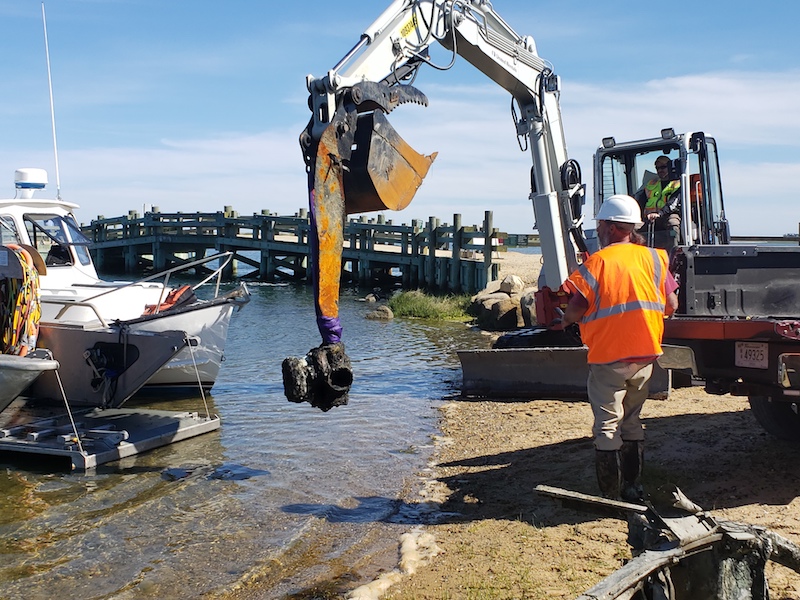
<p>A team of munitions surveyors from the U.S. Army Corps of Engineers has confirmed the discovery of a World War II-vintage Helldiver buried off Chappaquiddick.
A team of munitions surveyors from the U.S. Army Corps of Engineers has confirmed the discovery of a World War II-vintage Curtiss SB2C-4E Helldiver buried off the western shore of Chappaquiddick’s Little Neck, after pulling up more than 1,300 artifacts early this summer.
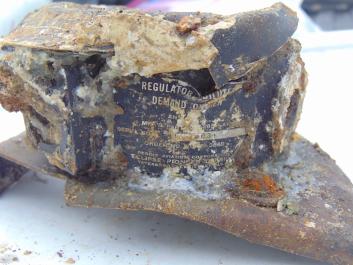
Oxygen regulator from the aircraft.
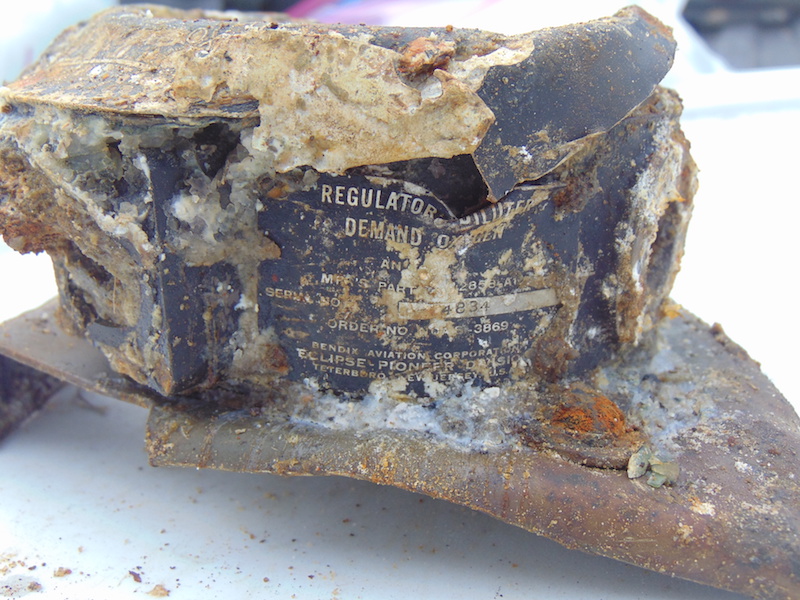
Oxygen regulator from the aircraft.
The artifacts include what surveyors believe to be human remains from a plane that crashed in Cape Pogue Pond while conducting a dive-bomb exercise in the 1940s.
The surprise discovery began in early spring, when members of a Corps remedial action team pulled up a rusted airplane propeller blade and Browning .30 caliber machine gun near the end of a three-year ordnance and munitions removal project in the former World War II-era practice bombing site.
In May and June, the Corps halted ordnance removal and subcontracted a barge and a team of expert divers to survey and sift through thousands of cubic feet of pond bottom in an effort to identify any artifacts related to the unanticipated — and historic — naval aviation finding.
Although rusted metallic scraps from the crash were the most likely remnants to be pulled from the Helldiver, researchers also quietly cautioned about the potential for finding osseous material from the bodies of the ill-fated plane’s fliers.
Three months later, after an operation that was conducted with a secrecy that in some ways mirrored the original dive bomb operation itself, the Corps discoveries have come to the surface. They include 1,312 pieces of a once-forgotten World War II-era plane and the partial remnants of what surveyors believe to be its human operators — chilling artifacts from a ghost story that has rested untouched and untold on the bottom of the Cape Pogue sea floor for the past seven decades.
“I can confirm that we have recovered what we believe to be human remains,” Army Corps project manager Carol Charette told the Gazette in a telephone interview Wednesday. “And we believe it is associated with the aircraft.”
The remains have been sent to the Boston Medical Examiner’s office for further examination and potential identification, while some 200 other artifacts from the Helldiver were shipped to the Texas A & M Research and Conservation Laboratory, she said. Those artifacts included another Browning .30 caliber machine gun, two more propellers, landing gear, retract cylinders, an aircraft oxygen regulator and more. About 100 items have been slated for conservation and 109 for x-rays and further evaluation. Three are slated for research, Ms. Charette said.
Eventually all the conserved items will be curated at the Naval History and Heritage Command and available for loan to museums throughout the country.
Ms. Charette said that while the team found no materials that would identify the fliers or their particular plane such as wallets, tags or watches, she did say there were numerous items discovered that may have belonged to the men who they believe perished inside the plane
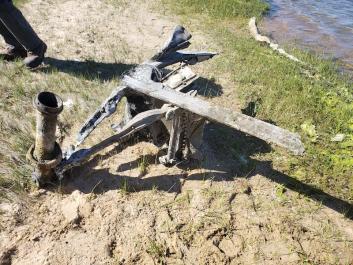
Airplane strut.
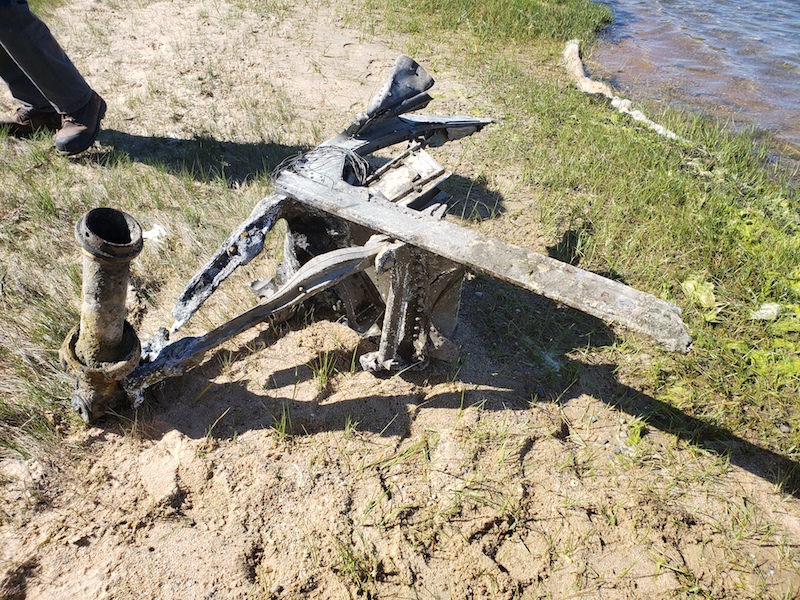
Airplane strut.
“We found some things that we put into the personal effects category,” Ms. Charette said. “It might have been some material, that might have been part of a uniform. Portions of leather . . . or equipment someone might have on them as opposed to the actual aircraft itself.”
Identification of the fliers will have to wait until the medical examiners finish their work, she said. But the plane fits the description of an SB2C Helldiver that went down in the icy waters of Cape Pogue Bay in Feb. of 1946, killing both its 20-year-old pilot and signaller, ensign Cecil M. Richards, and aviation radioman second class William Robert Garrett. The Gazette wrote a story about the crash and the aftermath when the plane was being brought out of the water, and Army Corps researchers had searched the newspaper’s archives for information after their initial discovery.
According to Ms. Charette, the Corps was only able to retrieve fragments of the plane from the area just west of Little Neck in Cape Pogue, potentially suggesting that its cockpit had been previously taken out of the water.
“We know the type of plane it was,” she said. “Whether or not it was the plane associated with the two individuals [Ensign Richards and Radioman Garrett] . . . is yet to be determined.”
Ms. Charette said nothing retrieved from the site could determine the cause of the crash or provide other clues as to its circumstances. She said a Providence-based naval expert consulted for the project, Larry Webster, determined from the condition of many of the artifacts that a fire occurred on the plane, either during or after the ensuing crash. The SB2C was one of the most common aircraft used during World War II, and also one of its least reliable. Seven other SB2C’s have been fully restored after excavation from prior crashes.
“This plane had to hit very hard,” Ms. Charette said. “Everything else was just small, mangled fragments. And it possibly might have just been the remnants of a plane. There’s no way to know.”
The Army Corps also retrieved four munitions from the crash site, as well as a dash-mounted navigation compass that contained radium, which the Corps disposed of as low-level radioactive waste through a licensed waste disposal facility.
Potentially dangerous munitions were the reason the Army Corps decided to excavate the plane in the first place. Over the entire three-year process that has now concluded, the ordnance removal team removed more than 20,000 undetonated bombs from Cape Pogue and the surrounding land, including 3,835 of what they term munitions and explosives of concern. A total of 194 demolition events using explosives were performed to destroy those items.
The entire munitions removal project cost more than $16 million.

Recovery effort was conducted from a barge at Cape Pogue Pond early this summer.
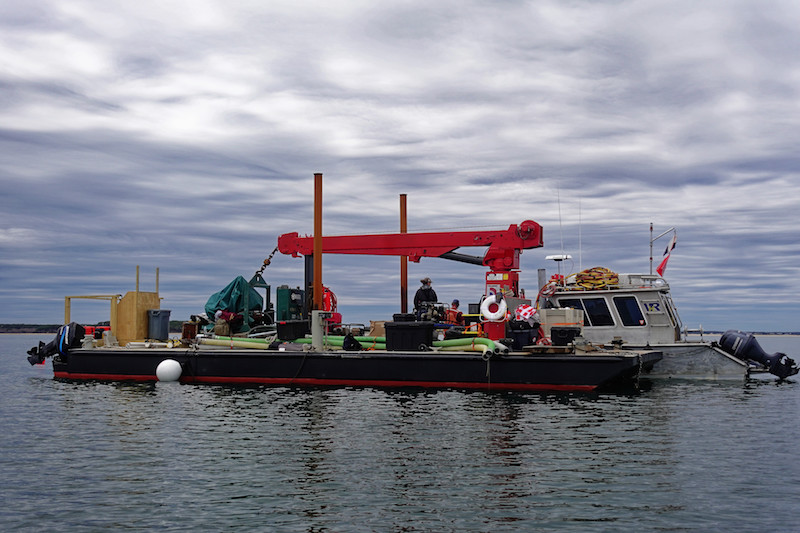
Recovery effort was conducted from a barge at Cape Pogue Pond early this summer.
But the one artifact that the Army Corps didn’t want to destroy has captured most of its attention this summer. The plane removal alone cost nearly $2 million, as well as painstaking time, effort and sensitivity.
When the propeller and machine gun were discovered last year, archaeological surveyors used advanced geolocating technology to determine the possible location and orientation of the aircraft. After receiving permission from the Navy to conduct the excavation, they spent months laying out a 25-square-foot area for the cockpit.
It didn’t take long to find the remains.
“What happens in a diagram and planning process is different from what happens in the field,” Ms. Charette said. “In the first or maybe second day of excavating the aircraft . . . we found what we believed to be a human remain. So at that point we resorted to a vacuuming and sifting operation.”
Former-military and USO-trained divers from VRHabilis, the small business contracted for the operation, spent the next two months hand digging 14 feet below the pond surface with a metal detector and vacuum-like suction device. The divers would shoot the material to a boat on the surface while an archaeologist sorted through it with a quarter-inch, silt-screen sifter. They worked their way out in concentric circles from the determined center of the “anomaly” until outlying ordnance grew scarce. All the work was performed from a barge owned by Chappaquiddick Ferry captain Erik Gilley, and monitored with head-mounted camera equipment.
And while the work by the Army Corps at Cape Pogue is over, ending an expensive and exacting three-year process that brought to the surface a piece of history otherwise lost to the sea, the mystery about how it got there, and who was inside it, remains.
“My mission ended when I transferred everything over to the [medical examiner’s office],” Ms. Charette said. “They have to do their thing now.”
Comments
Look at the cost to recover
An Aviator Up IslandLook at the cost to recover this plane...over $1.2 million. You can buy the same plane fully restored and ready to fly today for that price. So wasteful.
What a pathetic response to a
Paulli D EdgartownWhat a pathetic response to a great story about brave men in training, and finding history on our island.
The aircraft needed to be
Jared Boston/ChappyThe aircraft needed to be recovered anyways in order to clear the area of unexploded ordnance. The extra cost was due to recovering the remains of the fallen airmen. Whenever possible, the US military does what is necessary to recover remains of fallen soldiers, sailors, and airmen. We still have recovery teams in Vietnam recovering our dead. It is the right thing to do.
Amen to that, Jared!
Chuck Haberlein Falls Church, VirginiaAmen to that, Jared!
I was captivated reading this
Peter West TisburyI was captivated reading this story. While the costs of the efforts did not escape my notice, not for an instant did the money trouble me. I couldn't help putting myself in the place of the deceased crewmen's families who must long for answers. This is the type of effort that defines us as a people. Nemo resideo.
I see your point, but another
An Aviator Up IslandI see your point, but another reader pointed out this entire project was more than $14 million. We also have to consider the cost to the living as well, many social programs are greatly needed right now that will prevent suffering. Please don't spend $14 million if I crash my plane to find me, please spend that money on those that are alive that need it. Now, if there was truly un-exploded ordinance, that has value cost to retrieve to protect the living, but 14 million seems like a scam.
You really should carefully
Jared Boston/ChappyYou really should carefully re-read the article. This project was not started to recover the aircraft and crewmen's remains. This project was started to remove unexploded ordnance (UXO). In the process, they found the aircraft and the remains. Once they found the aircraft, it had to be removed to complete the UXO remediation. The vast majority of the project cost was for finding and removing the UXO -- it is a painstaking manual process.
Yes, they did find and remove a great deal of UXO. From the article:
"The ordnance removal team removed more than 20,000 undetonated bombs from Cape Pogue and the surrounding land, including 3,835 of what they term munitions and explosives of concern. A total of 194 demolition events using explosives were performed to destroy those items."
If government hadn't spent that money to find and remove the UXO and someone was injured by it, I suspect you would have been one of the first to criticize the government for not remediating the UXO.
The uxo has been there for
Steve FalmouthThe uxo has been there for almost 80 years and has never hurt one person in that time. They could have been left in place and saved us all millions of dollars that could have been spent elaewhere
It is always about money used
Ed Oak Harbor, WAIt is always about money used in any project, usually a government funded one, that could be better applied to assisting the the poor, the homeless or the children. Millions have already been spent on these endeavors and we still have poor, homeless and hungry. Nothing improves. Sometimes we have to spend money on worthwhile or necessary projects. But it makes for sympathetic reading if we are always denigrating the effort in favor of helping the poor, needy or children, an everlasting process.
Who cares what it cost,when
charlie callahan so boston/edgartownWho cares what it cost,when they believed 2 flyers might be in that plane. If you served you would know how important it is to bring your brothers home,whatever the cost.
These were two young kids
charlie callahan so boston/edgartownThese were two young kids training to defend America,not some businessman drinking wine and out to impress his girlfriend with his fancy plane. No expense should be spared to find any items related to these kids
Add new comment