


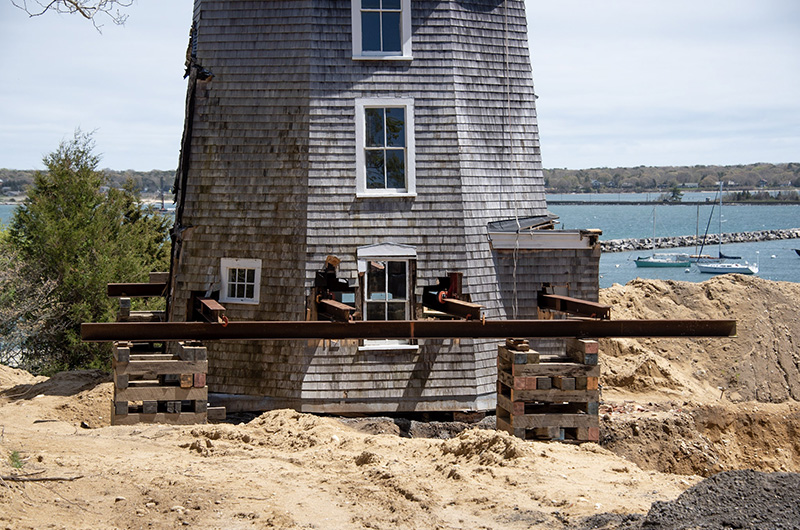
<p>The demolition of a house believed to be one of the oldest homes in Vineyard Haven has stirred shock and confusion.</p>
The demolition of a historic house that was believed to be one of the oldest homes in Vineyard Haven has stirred shock and confusion among town leaders, Island residents and the Martha’s Vineyard Commission in course of the past week.
Iconic structure was familiar sight from the harborfront.
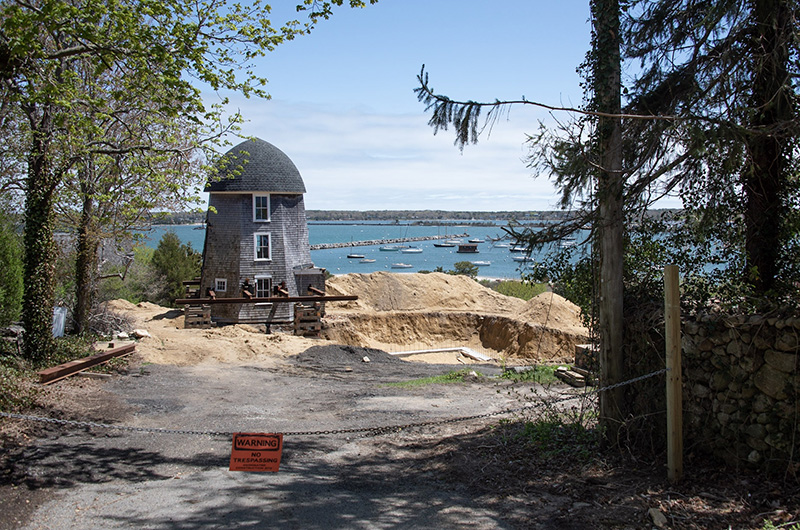
Iconic structure was familiar sight from the harborfront.
At the end of Mill House Way in Vineyard Haven, all that remains of the eponymous property is the mill tower. Once a part of a sprawling historic house, the tower stands alongside a gaping hole in the ground. The project was referred to the Martha’s Vineyard Commission by the Tisbury building inspector for review after the fact.
“This is a major deal. This is a historic house,” MVC executive director Adam Turner told commissioners at their regular meeting last week. “Revolutionary war activities happened in this location, and then somebody went around our regulations to demolish it.”
Mr. Turner said the demolition will be reviewed in the coming weeks. Building inspector Ken Barwick took responsibility for his role in the misstep.
Parts of the house were built before 1900. Referral to the commission is required for the demolition of any building more than 100 years old. Building permits were issued for an extensive renovation project last fall. The exact circumstances of the demolition — including the nature of communication between the town, the builders and the owner — are still unclear.
Mr. Barwick could not clearly identify the date of demolition. Initially he said he believed it happened during the last weekend of April. But after further review of his own records, he said he believed the house was partially demolished without his knowledge between April 11 and April 12. Mr. Barwick said
he never gave permission for an exterior demolition, and that he issued an order to halt construction as soon as he could after hearing that the house had been razed.
Tisbury fire chief John Schilling confirmed that he notified Mr. Barwick of the demolition by text message on April 11.
“I didn’t feel very good about it I can tell you that,” Mr. Barwick said, describing his reaction upon seeing the site of the demolition. “I still have the same knot in my stomach as I had when I first saw it.”
He made a development of regional impact (DRI) referral to the Martha’s Vineyard Commission on April 23, according to commission records.

The exact circumstances of the demolition remain unclear.
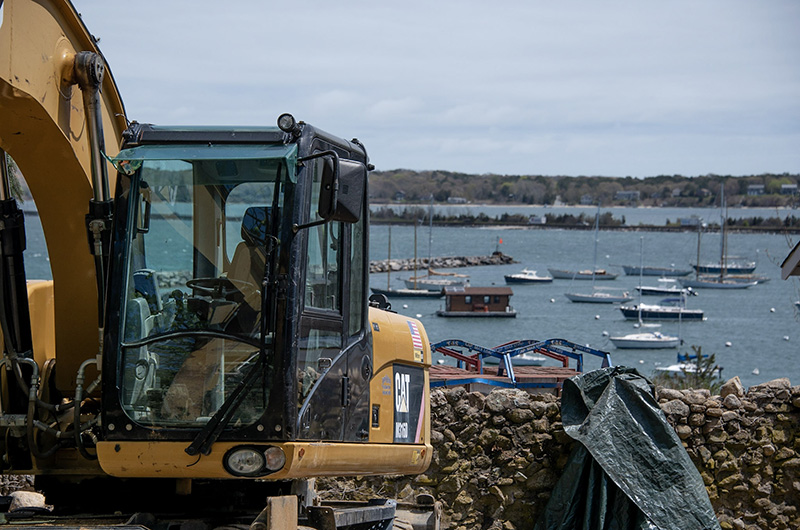
The exact circumstances of the demolition remain unclear.
The house is owned by Lise Revers of Weston, who bought it in late 2017 for $3.8 million according to assessors’ records. The builder for the project is Peter Rosbeck; the architect is Patrick Ahearn.
Mr. Rosbeck did not respond to requests seeking comment.
In an email to the Gazette Monday, Mr. Ahearn said the contractor intended to lift the house to install a basement beneath it, but was concerned that the house would collapse after the interior was gutted.
“Upon stripping out the interior the builder was concerned that the portion of the house that was to remain would collapse if lifted to install the new approved basement and foundation,” Mr. Ahearn wrote. He said Mr. Barwick was consulted and concluded that the part of the building that was gutted was not salvageable.
“The work under construction is being built exactly as instructed by Kenny Barwick the building inspector and is in accordance of the architects plans,” Mr. Ahearn said in the email.
The house was an amalgamation of several different historic parts. The Massachusetts cultural resource information system database dates parts of the house to 1750 and lists the original owner as Mrs. Joseph Merry. A subsequent owner, Grafton Luce, bought what was then a cottage and had his mother’s house moved from Lake Tashmoo and attached to it. The iconic mill was moved and attached to the house in the late 1800s by Gen. Asa B. Carey.
In 1955, the American playwright Lillian Hellman bought the house and owned it until 1961. The purchase was noted in the Vineyard Gazette. Renovations and alterations on the house continued throughout the 20th century.
Mr. Barwick issued a building permit on Nov. 14 of last year, allowing an estimated $2.7 million in “renovations . . . to include to demolish portions of dwelling interior and exterior per plans and description only,” within six months. He told the Gazette he did not refer the plans to the commission at the time because he did not believe there would be a significant demolition to the exterior of the building. He also said the plans were mostly to renovate areas of the house other than the exterior of the iconic mill.
“They didn’t touch the mill. I was very specific in don’t touch the mill, just leave it where it is, and that’s what they did,” Mr. Barwick said. He said the interior of the house was in disrepair and many parts were structurally unsound.
Speaking with the Gazette on Wednesday, Mr. Barwick took responsibility for his decision not to refer the project to the commission at the outset.
“It was my call,” the 34-year town inspector said. “The department made the call. I’m the department head. I’m responsible, and I am here to take whatever action, if you will, that needs to be taken, and I will follow the process to its end.”
In an email to the Gazette Monday, Ms. Revers said she planned to renovate the house in the original style with her architect and builder.
“There has been a lot of miscommunication about the project and as the owner of the house, I can tell you that I am confused about what has happened as well and extremely upset about the situation,” she wrote.
Harold Chapdelaine, chairman of the Tisbury historical commission, said depending on the extent of the structural issues, the house may have been eventually demolished even if it had gone through proper regulatory reviews. But he said there would have been advance opportunity to properly catalog the history.
“Not so much the human history, but the type of millwork: doors, windows, the things we could have worked with to replicate or compliment,” he said. “The type of moldings, the window sills. There’s so much unique historical work done on the houses where particular craftsmen had signature designs, and when they’re gone, they’re gone.”
Ms. Revers, who also bought the house next door at 21 Mill House Way for $962,250 in January 2018, said her plan still is to rebuild the Mill House to emulate the original.
“That was my intent from the beginning and I had looked forward to accolades from the community for restoring this beautiful property that had been completely abandoned for many years,” she said.
Mr. Turner said he had received many concerned calls and emails about the house. Mr. Chapdelaine said his board will work in concert with the MVC to make recommendations. Tisbury selectmen could also add comments, he said. Mr. Chapdelaine echoed a sense of the house’s significance.
“It is one of the oldest homes in Tisbury,” he said. “Or it was one of the oldest homes in Tisbury.”
Comments
Is there anyone who thinks
Mike EdgartownIs there anyone who thinks one of the Island's largest contractors and its pre-eminent architect/purveyor of McMansions didn't plan for exactly this outcome? Given the age and unique composition of this building, was it genuinely a surprise that gutting the interior so compromised the structural integrity of the shell that the plan to lift it had to be abandoned, and the house destroyed instead? The explanations by those involved are like a burlesque of Claude Rains in Casablanca, closing Rick's Café Américain because he's "shocked, shocked to find that gambling is going on in here" -- while pocketing the winnings from his own bet. As others commenting have observed, there are too many past instances where it proved expedient to ignore the rules and pay the slap on the wrist fine. An old sage warned me that some people think they can spit in your face and tell you it's raining. Listen up, MVC.
The decision to replace a
RFG Katama & HoustonThe decision to replace a structure is a difficult one. The Katama airport hangar provides a study in form vs functionality. Certainly, the hangar is historical (perhaps not as historical as a pre-revolutionary house; but it would be someday if allowed to remain); yet the voters of Edgartown and supporters of the airport have decided to replace it with a new hangar. Should the replacement adhere to the original footprint and form? Should it be devoid of current technology?
One could also ponder the impact of the architectural changes in Edgartown over the past 30 years, largely wrought by the architect in question. With few exceptions, he has built upon a heritage of interesting Edgartown architecture, creating housing that maintains the sensitivity of 19th-century while incorporating current technology and amenities. I have been coming to Edgartown for 50+ years and the changes in Edgartown over the past 2-3 decades delight my senses.
I am struck by the efforts made to preserve the yellow house at the intersection of S Water St and Dunham Rd. It too was an old house with many defects, but at its core it was solid; this appears not to be the case in the current situation. Far better to levy the fine (if appropriate), move on and build a replacement that resembles the one destroyed and will bring joy to its owners and neighbors for the next 250 years.
The mill house was not a dump
Kathleen Tilton ChilmarkThe mill house was not a dump as one comment said, it ‘never “looked like crap” either. It was quirky yes, but always taken care of.
Not a fan edg.commented on PatrickAhearn. I agree with you. His houses are the same, all crammed in on a tiny lot. Uses up as much of the property as possible. Some of us don’t like that look and as tax paying, voting Americans we are allowed to express those views.
Ahearn built a house in that area a while back, the owner was concerned about blocking a neighbors view, he told her to build in front of them.
What you do if you owned the
AEB North CarolinaWhat you do if you owned the property?
I do not personally know
here we go again edgI do not personally know Ahearn or Rosbeck but as a long time resident of Edgartown their projects *along with many other builders and architects* have contributed to the revitalization and asthetic upgrades of many dumps in town. You can walk down almost every street in downtown edgartown, and remember some dump with zero historical significance rotted, leaning, peeling paint detracting from the charm of the neighborhoods and basically a blight. Fortunately some wealthy seasonal resident bought the dump from someone who most likely inherited it and let it fall into disrepair, which was unfair to the abutters and the other towns people. I'd suggest that any of those who object to these demolitions put their money up, buy the dump and try and renovate it. Then you can write a book and tell structural engineers how you managed to make rotten wood and crumbling foundations miraculously as strong as steel beams and poured concrete foundations. Just because something is old does not mean its historic, or worth preserving.
The fact that the building
Shane McGovern EdgartownThe fact that the building may or may not been failing isn't the issue here. Building is a process, part of that process is review by local boards and applications for permits. The builder disregarded the process here and should face consequences. If not, why do we even have building inspectors, MVC, historical commission, ect? They probably would of green lighted everything anyways but we will never know because the process wasn't followed.
The gazette doesn't like when
charlie callahan so boston/edgartownThe gazette doesn't like when you criticize some well off people. But those SPECIAL PEOPLE seem to skirt the rules somehow,and some shmo in a historic area wants to put up a fence and the HISTORIC PEOPLE make it look like the poor slob is trying to move the state house and yet there are gigantic mansions that have been built in sensitive areas that wouldn't fit in anywhere, but somehow they were permitted and built. Makes you wonder if we have a good old boy network on this island,looks like it doesn't it
Add new comment