


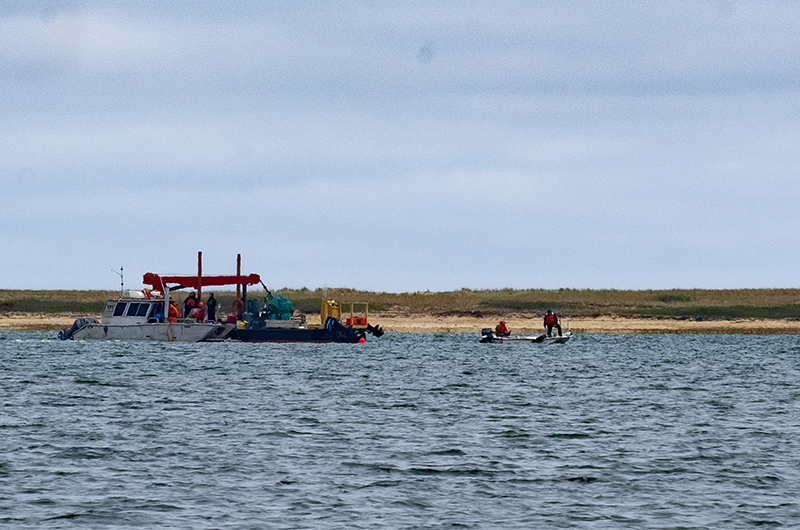
<p>Researchers believe they have found fragments from a World War II-era bomber plane that crash-landed in the frigid waters off Chappaquiddick during a doomed practice dive in the winter of 1946.</p>
Researchers from the U.S. Army Corps of Engineers believe they have found fragments from a World War II-era bomber plane that crash-landed in the frigid waters off Chappaquiddick during a doomed practice dive in the winter of 1946.
The discovery comes after the Corps unearthed a rusted, five-foot propeller and a Browning .30 caliber machine gun while conducting extensive munitions and undetonated ordnance extraction from Little Neck at Cape Pogue. The area was used as a practice bombing site during World War II.
The mysterious sea floor discovery prompted a two-year goose chase to identify the fragments. Using articles from the Vineyard Gazette archives, researchers ultimately concluded that the fragments likely came from a Curtiss SB2C Helldiver that plunged into the pond in February of 1946, killing both its pilot and radioman. Positive identification will not be known until the plane is brought up.

Barge owned by Erik Gilley will be used for salvage effort.
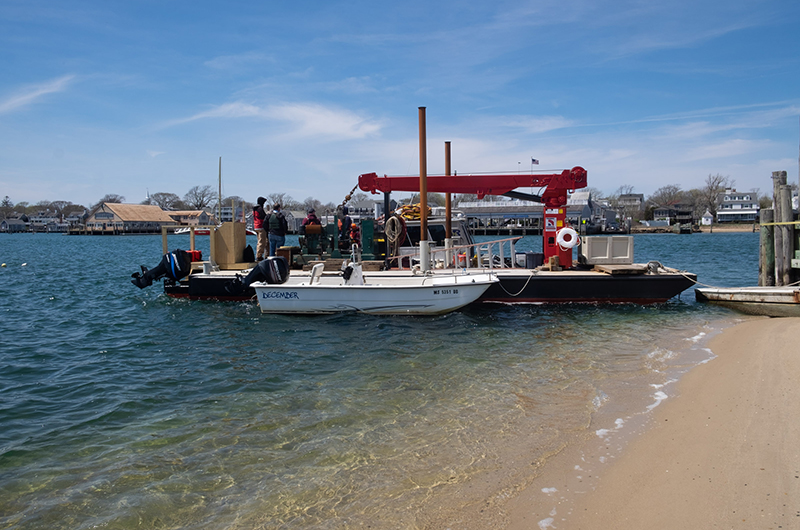
Barge owned by Erik Gilley will be used for salvage effort.
Now over the course of the next month, expert munitions divers plan to extract the plane, bringing to the surface a piece of Vineyard history that has rested unnoticed — and untouched — on the Cape Pogue sea floor for the past 73 years.
“It’s astounding,” said Chris Kennedy, the Vineyard stewardship manager for the Trustees of Reservations, which owns most of Cape Pogue and is working with the Army Corps on the excavation. “It’s like, you turn over one rock, and you get more information. And then you turn over another one, and you get this. It’s fascinating.”
Approximately three years ago, the Army Corps cleared some 60 acres of land and began surveys to determine the location of old ordnance in and around Cape Pogue. Although it was common knowledge that the Navy used Little Neck — a barren, sandy finger of Chappaquiddick’s eastern seashore — as a practice target site during and after the war, most Islanders had no idea that ordnance buried deep in the sand and sea floor three quarters of a century later was potentially dangerous.
“People called them Chappy doorstops,” Mr. Kennedy said. “I was tipped off to them about 10 years ago when I came across two kids playing out here, and they had two of these small practice bombs and they were beating them on rocks to knock the rust off. So I started asking questions, like are these safe? And the answer was, hell no.”
In the last three years, the Army Corps has extracted more than 20,000 practice bombs dropped on Little Neck and the surrounding waters between 1944 and 1947, with the munitions ranging in size from three to 100 pounds. There are 24 bombs left to remove, and also something much larger and more mysterious.
“As part of their underwater recovery work [the Army Corps] came across several artifacts that didn’t ring true,” Mr. Kennedy said. “The first thing was an airplane propeller, and shortly thereafter, a .30-caliber machine gun, and not many fishermen carry those anymore.”
With the knowledge that there was potentially a plane lying beneath the surface — and the possibility of human remains inside of it — the Corps halted the munitions work and sent the plane fragments to an expert at the Quonset Naval Air Museum. The expert identified the fragments as part of the Curtiss Helldiver, a World War II-era carrier-based bomber notorious for its difficult handling and crash-prone early flight models.
Meanwhile, researchers began to scour the records. Initially there were no Naval records of a plane going down in Cape Pogue between 1944 and 1947. Mr. Kennedy consulted with Edgartown journalist and historian Tom Dunlop, and decided to dig further in the Gazette’s newspaper archives. Assisted by librarian Hilary Wall, researchers found an account from a Feb. 22, 1946 article that two 20-year-old U.S. Naval reserves from the Quonset Naval Air Station — ensign Cecil M. Richards and aviation radioman second class William Robert Garrett — had crashed their plane while conducting a test dive just west of Little Neck in Cape Pogue.
Old Gazette clippings aided in research.
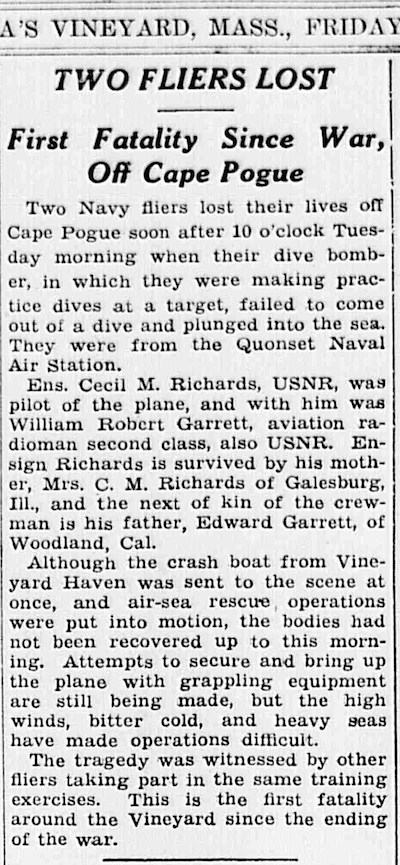
Old Gazette clippings aided in research.
“Two Navy fliers lost their lives off Cape Pogue soon after 10 o’clock on Tuesday morning when their dive bomber, in which they were making practice dives at a target, failed to come out of a dive and plunged into the sea,” the story said. “ . . . The tragedy was witnessed by other fliers taking part in the same training exercises. This is the first fatality around the Vineyard since the end of the war.”
Newspaper accounts reported that high winds, bitter cold and rough seas hampered recovery efforts, forcing rescuers to mark the location where the plane went down with a buoy. The buoy too was lost. In a follow-up story on March 1, 1946, the Gazette reported that two Vineyarders, Bob Morgan and Steve Gentle, had seen the wreck while flying over the bay in Mr. Gentle’s plane.
“[T]he ill-fated plane . . . was brought out of the water with its grim burden, both flyers still strapped to their seats,” the story said in part.
During World War II, Martha’s Vineyard served as an ideal staging ground for testing bombers and rockets, because its remote seashore mimicked Islands in Japan and the north Pacific. The test flights led to more than 20 plane crashes between 1944 and 1947, and the deaths of at least 40 men stationed at the Martha’s Vineyard Naval Auxiliary Air Station. Vineyarders, privy to the crashes but not wanting to jeopardize the lives of pilots who trained at Little Neck, gave everything for the war effort, including a tacit silence about the testing that happened in their own backyards. The quietude, combined with a warehouse fire in the 1950s, could be part of the reason for the lack of Naval records and other detailed information about the 1946 crash.
“The Island did a wonderful job of keeping confidentiality,” Mr. Kennedy said. “People knew, that if there was a crash, we don’t say anything. Loose lips sink ships.”
Publicly available records show that Ensign Richards and Radioman Garrett have gravestones in Illinois and California respectively, although it is unknown whether their remains are interred at the sites.
Even with the tentative identification of the plane, questions surrounding the passengers — and the plane itself — remain submerged. Several melted aluminum pieces of the aircraft extracted during preliminary discovery indicate that there was a fire during the crash.
“We don’t know what’s in the plane. We don’t know whether the machine guns were outfitted with active rounds. There’ll be a lot more we know at the end of this project than we know now,” Mr. Kennedy said.
The Army Corps plans to use a 30-foot barge outfitted with a crane to extract the plane and its component parts. The barge is owned by Erik Gilley, maintenance manager for the Chappaquiddick ferry. Military-trained divers from VRHabilis, a company the Army Corps has subcontracted to remove the plane, will have high-tech cameras affixed to their helmets so that munitions experts on the barge can instruct them on extraction procedure, from the cockpit to the engine. It’s an arduous, painstaking and careful process, but a necessary one.
The Curtiss Helldiver was capable of carrying over 2,000 pounds of munitions. Those could be in the plane as well.
Mr. Kennedy knows there are seven decades of history waiting on the Cape Pogue sea floor. He also knows one wrong move could blow it all to smithereens.
“And that is why we have to take it out,” Mr. Kennedy said. “While we still can.”
Comments
I was a child during summers
Eric Hartell Chatham MAI was a child during summers on North Neck, Chappaquiddick during the 1940s and remember the practice bombing activity well, particularly the nighttime practice bombings done with the aid of parachute-suspended flares. The parachutes, made of the mysterious new fabric called nylon, were in great demand, and members of our family and those of neighbors would swim out into Cape Pogue Bay during night maneuvers to retrieve them as highly prized "fortunes of war." Other such prized recoveries included the classically shaped bomb shells themselves, which, as I recall, were set up in outside seating areas at nearby homes, filled with sand, and used as ashtrays. Another instance clearly remembered these 75 years or so later was when my father was carrying some trash out of our home and was literally buzzed by a Hellcat or Corsair pilot in training, coming within 20 very noisy feet or so of the ground over John Oliver's Point at alarming speed. (The trash got picked up and dealt with MUCH later in the day!) I remember being told by adults that Martha's Vineyard Airport was selected for this activity because the shorter runways could be made up to resemble those of aircraft carriers.
It would have been nice if
James Kozak Vineyard HavenIt would have been nice if this article gave a final word on whether the bodies of the deceased airmen were recovered, or whether they are presumably still within the crashed airplane.
The story does state, "[T]he
David East ChopThe story does state, "[T]he ill-fated plane...was brought out of the water with its grim burden, both flyers strapped to their seats...".
It is my understanding that
Tom DunlopIt is my understanding that those in charge of the recovery do not yet know whether remains of the crew, or personal effects, are still present. The divers may discover this in the coming days, or they may not. This is why such care is being taken as the wreck is surveyed and salvage begins.
This is fascinating - well
Nate FThis is fascinating - well done Mr. Asimow.
This story is amazing and
Caty morris Litchfield, NHThis story is amazing and years in the making. The barge being used has an incredible story behind it. My brother Erik Gilley owns it and restored it from sinking. Thank you for this story!
I guess I have the same
Bill Lammon SD WWII Living History Group - Camp Tacoma WWII MuseumI guess I have the same questions because the article contradicts itself. First it says human remains of the crew may still be inside the airplane. Then later it talks of the article written when the crash happened about the plane being brought up with the deceased crew still strapped in their seats. So yes, it does need clarification. Are either of the crew listed as official MIAs? The club I belong to does a lot of research to assist family members of WWII veterans. Maybe we should start researching this.
It may well be that parts of
Chuck Haberlein Falls Church, VirginiaIt may well be that parts of bodies were recovered in 1946, while other parts remained amid the wreckage. In a forceful impact like this airplane crash, most of that plane and its occupants will be extremely fragmented. Only relatively solid and heavy items, like the machine gun mentioned in the article, will be relatively intact.
The story reads to me as if
Bruce Gordon Milton, MAThe story reads to me as if there are two different planes. One recovered after a Feb 22 1946 crash and one recently discovered and yet to be recovered. Maybe Mr Asimow can clarify.
There is only one plane. A
Catherine A El Segundo, CAThere is only one plane. A newspaper story from 1946 said the plane and crewmembers were recovered, but that story seems questionable because parts of the plane are being found now. So there is uncertainty about what's actually still there.
Always loved the lure of
Kathy Madzelan Baltimore, Md.Always loved the lure of Chappy and this adds to the mystique.
Fantastic story!
Mr. Kennedy said. “The first
skip OBMr. Kennedy said. “The first thing was an airplane propeller, and shortly thereafter, a .30-caliber machine gun, and not many fishermen carry those anymore.” Priceless :-)
Just remember, if it belonged
Charles Rau KansasJust remember, if it belonged to the NAVY, they still own it and will claim it. You should get permission from them.
Please don't tell me that
Pj Carr Chelsea, MAPlease don't tell me that Pogue will be closed to us surf fishermen.
The Navy's policy is horribly
Mike SThe Navy's policy is horribly outdated. Recover the plane. Let the Navy come after you. If they do, expose them for an aggressive outdated policy.
Where have you recovered Navy
Jack AWhere have you recovered Navy aircraft from, I take it you did not have a good experience?
Let the Navy do it's job. If
charlie callahan so boston/edgartownLet the Navy do it's job. If there are brave young Americans still in it no one has any right to go near it.If they have to close it down the Pogue then close it down.Those were brave young kids training to fight for freedom, they deserve some respect.
Charlie Callahan, you are so
Lorraine EdgartownCharlie Callahan, you are so right. I have had ancestors in every war in this United States. Our service people deserve our respect.
I'm old enough to clearly
John ChilmarkI'm old enough to clearly remember Naval aircraft making staffing and bombing runs at large billboard targets set up on the beach separating the ocean and Great Tisbury Pond. For years after the war, we would gather scores of those small iron bomblets which weighed about three pounds. Their hollow cores had contained flares which left a smoke trail as they were dropped, helping to tell if they had hit their targets or not. When we found them, the cores were filled with sand or the soaked remains of the flare. We thought nothing of reaming out the cores with screwdrivers.
We never picked up the larger practice bombs as they were generally mangled.
This project is not an
Arnold RThis project is not an individual looting a plane, it is a federal undertaking by the USACE of course they would be consulting with other federal agencies. Most of these training planes went down with their crew that is why the Navy has regulations now protecting them from coming up left and right. As others have mentioned those who have fallen deserve our respect and their wrecks should be treated as grave sites.
Imagine what’s still on and
Phil Southcoast Ma.Imagine what’s still on and around No-mans Isle.
I am a USAF veteran. I used
John Penney Westport, Ct.I am a USAF veteran. I used to work at the bomb and gunnery range located Ie Shima, Okinawa, Japan, from '79-'80. Ie Shima was the last island to be captured by the Allies during the battle for Okinawa in WW2. Part of what remained was the original coral runway that was built by the Japanese military and Ernie Pyle's grave site and memorial. I do know this, bomb and gunnery ranges, once they are deactivated must be cleared of all ordinance that can be found. You just don't know, after years of use what has been expended (blown up) or what is still intact. Bombs and/or ammunition that sits around too long (even in an armory)can become very unstable and dangerous over time. While stationed at Castle AFB, in California, I witnessed a SAC bombing exercise,in the 1970's which scored B-52 accuracy in dropping live ordinance (the real thing) but with the added benefit of getting rid of ordinance that had been left over from the Vietnam conflict. If you add elements like salt water into the mix and that "shelf life" for munitions becomes even shorter. Marker bombs (like BDU's)housed the equivalent of a 10 gauge shotgun shell to explode the marker smoke which shows where the shell actually hit the ground. Trust me, you don't want one of those things to be handled by a novice who doesn't know what it is. I understand the need for respecting a war time burial sight but the Army Corps of Engineers is right in clearing this sight of all possible ordinance and debris, even if it means disturbing the war dead. Besides, if remains can be recovered then they can be interred with honors. The need for safety demands this. This entire area should be cleaned, if you want it to be returned to safe, civilian use.
My dad flew with vb6 and
Scott Ferguson La selva beach CaliforniaMy dad flew with vb6 and found the sob 2nd class as the sb2c Helldiver was known to crews to be a good aircraft fast had 2 20mm and 2000 pound payload. He sank a IJN DD with 8 x 5 inch rockets equivalent to a cruiser broadside on combat air patrol it was him or them and went on to be a naval test pilot.
I was a diver on the project.
3531I was a diver on the project. It was a really awesome experience we did recover bones from the pilot and radioman.
Add new comment