


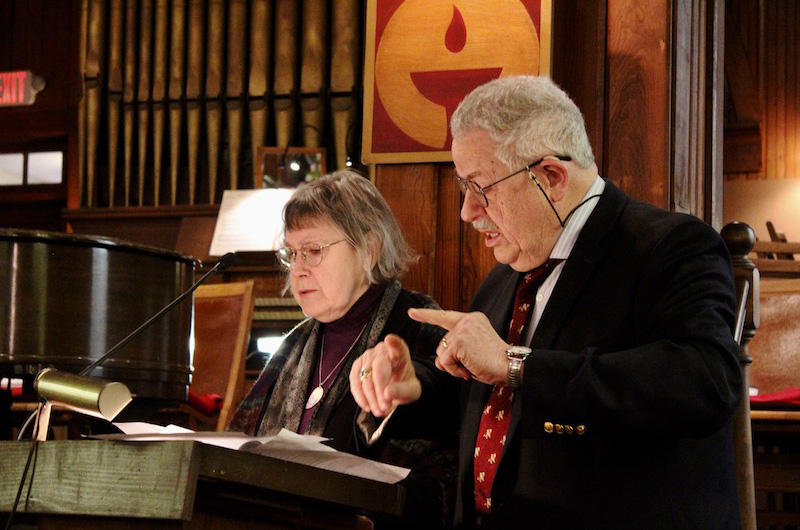
<p>David Martin, former educator and administrator at Gallaudet, visited Vineyard Haven on Sunday to talk about the legacy of the Martha’s Vineyard deaf community of the 18th and 19th centuries.
By the middle of the 19th century, nearly all up-Island settlers had become bilingual in spoken English and Martha’s Vineyard sign language. So much so that years later, elders couldn’t recall who from their upbringing had been deaf and who had been hearing. Due to a recessive gene and an isolated gene pool, at the time, one in 25 Chilmarkers was deaf. One in four people in Squibnocket was deaf.
At around the same time in Washington D.C., a new university was founded for the education of the deaf. It would become known as Gallaudet University, named after the pioneering educator Thomas Hopkins Gallaudet. Both the history of the Martha’s Vineyard deaf community and the new university would change the way people with deafness were thought of, and the opportunities they were afforded.
David Martin, former educator and administrator at Gallaudet, visited Vineyard Haven on Sunday to talk about the legacy of the Martha’s Vineyard deaf community of the 18th and 19th centuries. Mr. Martin, who now lives in Marstons Mills, was a featured speaker at the Unitarian Universalist Society of Martha’s Vineyard.
“This is not just about deafness,” he said. “What can we all take away from this from the point of view of general human rights?”
By 1952, the last known descendant of the Chilmark deaf community had died. But Gallaudet University students continue to study the phenomenon of inclusion that took place on Martha’s Vineyard through Nora Ellen Groce’s book Everyone Here Spoke Sign Language.
“On the mainland profound deafness is regarded as a true handicap, but I suggest that a handicap is defined by the community in which it appears,” Ms. Groce writes in her landmark work of historical ethnography and oral history.
Immigrants from Kent County, England settled on the Cape and the Island in the late 1600s, carrying with them the recessive gene that would result in the births of multiple deaf children and the development of an inclusive sign language used by the entire community.
“It was a community where deaf people and hearing people could go back and forth,” Mr. Martin said. “That is why this particular book is held up as what could be an ideal environment for deaf people.”
Mr. Martin gave a brief history of Western attitudes toward deafness, attitudes that assumed that the deaf lacked the same learning abilities as the hearing. He said, from Aristotle’s assertion that, “The ears are the organs of instruction,” in the fourth century BC to a rejection of sign language that lasted until the 1800s, people without hearing have only recently gained abilities to fulfill their potential. He said lip reading, sometimes with hands bound behind one’s back, was considered the only appropriate means of communication with the deaf in much of the West until the 19th century.
On the Island though, the community simply did not see deafness as a peculiarity.
“We have to recall with pride how Martha’s Vineyard was an ideal world, and is a model for how we can replicate that idea elsewhere and in different environments in different ways,” Mr. Martin said.
Mr. Martin, who is hearing, pioneered a program at Gallaudet University to teach deaf education students to teach hearing children, a unique challenge prompted by changes in teaching requirements that delayed specialization. In order to specialize in teaching deaf students, educators had to first get more general education training. He said Gallaudet teaching interns were accompanied by sign language interpreters to classrooms, and hearing children quickly adjusted to new modes of communication.
“When I called the principals, they said, you want to do what?” Mr. Martin recalled with a smile. “By the second year, they were calling me.”
He said Ms. Groce’s Everyone Here Spoke Sign Language was required reading for students training to become teachers of deaf children.
“Martha’s Vineyard comes to the attention of every graduate student in deaf education at Gallaudet University,” he said. He said it was an example of a community where each individual was committed to inclusion. “It’s not just a legal matter, but it’s also a matter of attitude. And that can’t be put in the law,” he said.
By coincidence, the Vineyard connection expanded beyond Mr. Martin’s talk. Island musician Molly Sturges, who was filling in for the regular accompanist at the Sunday service, is a direct descendant of Thomas Hopkins Gallaudet.
Mr. Martin included excerpts from Ms. Groce’s work and from Catherine Rush’s new play, Chilmark. His talk was embedded in the society’s typical service, and spiritual selections reflected the themes. Ms. Sturges performed work by Beethoven, who had lost his hearing entirely by age 46, and a more contemporary deaf musician, Mandy Harvey. The three selected hymns, Morning Has Broken, Morning Hangs a Signal and Morning So Fair To See were all about the dawn.
“Metaphorically I think that we have a new day. The morning has broken in many ways in terms of the opportunities for people who have special characteristics,” Mr. Martin said.
Comments
Terrific article. thank you.
B A Hiller S. CA, Bethany Bch, DE Edgartown, MATerrific article. thank you. Remember the book"Vineyard Voices" & Eric Cottle's family, deaf parents..... I recall a number of excellent VG aritcles about/early generations of Up-Island families.
thank you.
I studied American Sign
Rachel Carroll Downingtown. PAI studied American Sign Language for 4 years at Penn State as an undergrad and 2 additional years in a program geared toward Interpreter training. In both schools (with programs of study designed for hearing students,) “Everyone Here Spoke Sign Language” was a part of the syllabus. I learned about MV as a Deaf community years before I ever visited
Great artical however, I am
bob burg North ReadingGreat artical however, I am so upset about the casino to be built in Aquina/Gay Head.It is going to "forever" ruin the Island. Can nothing be done to stop it?
Pure greed is how I see it. The impact will made for more traffic on the island & Woods Hole, trash,the ferry is still not reliable.Not to say public safty issues.
So sad to see this might happen.
Does anyone know of a public
Paul O'Hanlon Pittsburgh, PADoes anyone know of a public school system in the U.S. that requires ASL instruction in their elementary schools? We could effectively end the disabling consequences of deafness in one generation - while teaching our children a second language opening up new employment and career opportunities for all children. Any models out there?
In response to your good
David Martin Cape Cod, Mass.In response to your good question about whether any elementary school requires ASL communication, there are a number of elementary classrooms where individual deaf children have been integrated and a sign-language interpreter is provided--it happens that if the teacher is encouraging(and many are), the hearing children do learn some sign language without it being required, so that they can communicate sometimes with the deaf child(ren) who is/are in the classroom; but that is not a formal requirement, nor would the regular teacher necessarily know sign language. Your idea is a worthy one and one which in an ideal world would be provided regularly. I, too, would be interested to know if indeed such ASL classrooms do exist in the way that you are hoping.--David Martin,Ph.D.
It is a pleasure read a
Cristina Menezes Belo Horizonte/Minas Gerais/BrazilDear Sr. David
It is a pleasure read a recent note about Martha´s Vineyard. I´m from Brazil and I´m studing in orther to write my tesis for my Ph.D.
I would like to know, if possible, if you, mr. David, remember some signs that came from MV and if you observed that these signs were incorporated to the oficial ASL during your time working with deaf people.
Hope hearing from you as soon as possible.
My best regards,
Cristina Menezes
Teacher, researcher and Interpreter of Brazilian Sign Language.
Add new comment