

<p>Vineyard Wind is set to go before the Martha’s Vineyard Commission for a public hearing next week, offering a more detailed view of the giant renewable energy project.</p>
Vineyard Wind, which plans to build the nation’s first large-scale offshore wind farm just south of the Vineyard, is set to go before the Martha’s Vineyard Commission for a public hearing next week, offering a more detailed view of the giant renewable energy project.
The proposed 84-turbine, 800-megawatt wind farm is expected to be built in federal waters on the outer continental shelf some 14 miles south of Wasque point. The project still needs to clear some 30 federal, tribal, state and local regulatory hurdles — among them the commission, which has jurisdiction over two underwater cables that will run from the offshore turbines through Edgartown waters. The cables will ultimately transmit electricity generated from the turbines to a switching station in Barnstable. At their closest point, the proposed cables will run approximately 1.2 miles from the Edgartown shoreline.
“We’re looking at 13 miles or so of cables in Vineyard waters,” said MVC development of regional impact coordinator Paul Foley at a recent pre-public hearing review before the commission’s land use planning committee.
The entire length of the export cables will measure between 43 and 50 miles, extending from the turbines to the point of landfall at Covell’s Beach on the Cape.
“It’s a big project,” Mr. Foley said.
The public hearing begins at 7 p.m. next Thursday, Feb. 21, at the commission office in Oak Bluffs.
Vineyard Wind is a New Bedford-based company formed from a partnership between Avangrid Renewables and the Danish company Copenhagen Infrastructure Partners. Both have been previously involved in renewable energy projects. To date the partnership has successfully acquired two leases in federal waters totaling some 200,000 acres. In the most recent acquisition in a federal auction December, Vineyard Wind was one of three successful bidders who agreed to pay $135 million for an offshore lease block.
Under sea cable is slated to run past the eastern shore of Chappaquiddick.
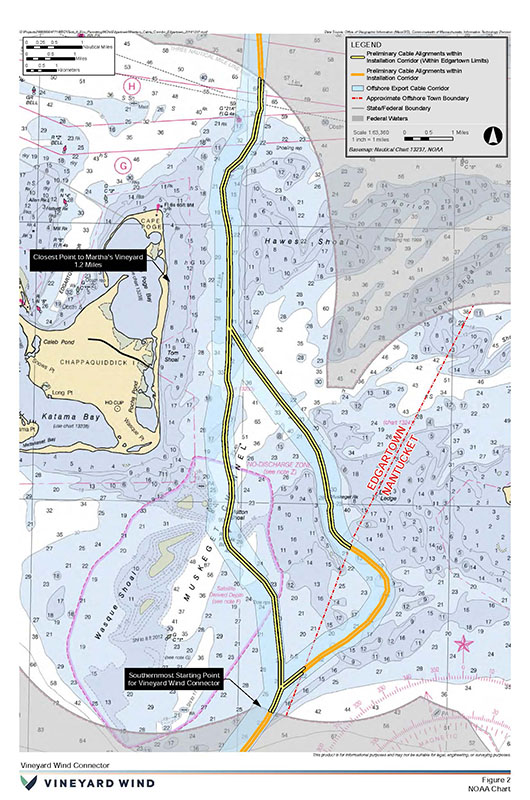
Under sea cable is slated to run past the eastern shore of Chappaquiddick.
Wind developers have six years to test conditions, develop a construction plan and clear a gauntlet of regulatory hurdles. Vineyard Wind has a partnership agreement with the Island-based energy cooperative Vineyard Power, which hopes to eventually convert the Island to 100 per cent renewable energy.
“That’s our ultimate goal,” Vineyard Power president Richard Andre told commissioners at the recent LUPC meeting.
The two 220-kV electromagnetic under sea cables would run north from the wind farm through Muskeget Channel and onto the Cape. Diagrams submitted to the commission show the cables would run parallel to the easternmost edge of Chappaquiddick, a little over one mile from shore.
Each cable will be approximately 10 inches in diameter and contain three copper or aluminum conductors arranged in a triangle shape. The metal would be encapsulated by polyethylene insulation. A cross section sample was presented at the LUPC meeting.
To install the cables, Vineyard Wind plans to use a hydro-plow or jet plow that will dig a trench approximately one metre wide in the benthic layer of the sea floor. The cable will be laid into the trench from an above-water barge, moving at approximately 150 to 200 metres per hour, burying the cable five to eight feet beneath the stable part of
the sea bed. The cables will lie about 100 feet apart. Vineyard Wind said it may have to dredge what are called “sand waves” within the cable corridor to permanently bury the cables. The cables may also need to be weighted with a concrete mattress to keep them in place in certain spots, a process called armoring.
Muskeget Channel is shallow and notoriously prone to shoaling in the strong currents that run through the area. “That area can be nasty,” commissioner Richard Toole said at the LUPC meeting. “One day you have an island, the next you don’t.”
Rachel Pachter, president of permitting affairs for Vineyard Wind, agreed.
“Muskeget Channel potentially has challenges,” she said. “We’re shifting the sand waves to the side to get to that stable part of the seabed.”
Vineyard Wind estimates the installation process for the portion of the cable running through Edgartown waters would take less than two weeks. The entire cable-laying process is expected to take a couple of months, barring inclement weather and mechanical setbacks.
Because the cables must run for some 40-odd miles, representatives from Vineyard Wind said there would have to be at least two splices along the route. If one of the splices happens to occur within Edgartown waters, the project could take longer than the estimated two weeks.
A draft environmental impact statement on the Vineyard Wind project was released in December by the federal Bureau of Ocean Energy Management (BOEM). Among other things the report describes impacts on benthic resources at the bottom of the ocean from the cable-laying work. While the report concludes there would be moderate short-term impacts from the removal and relocation of silt and sediment, it notes that the project would only affect a small sliver of the vast ocean floor.
“Despite unavoidable mortality, damage, or displacement of invertebrate organisms, the area affected by the construction footprint would be just 0.5 per cent of the wind development area [394 acres]. BOEM does not expect population-level impacts on benthic species,” the report says.
BOEM hosted a public hearing on the draft EIS Tuesday night at the Martha’s Vineyard Hebrew Center. The 500-page report details the environmental impacts of every facet of the project, from turbines to export cables to onshore facilities. While it concludes that most short-term impacts from the development are minor, including impacts on marine mammals, sea turtles, benthic habitat, tourism and recreation, it says the turbines would have moderate to major long-term impacts on some commercial fishing locations.
Public comment on the report runs until Feb. 22.
At the LUPC meeting, spokesmen for Vineyard Wind touted the company’s commitment to reducing both its own and the state’s environmental footprint. They said the route they chose from the wind farm to the Cape was sited to avoid eelgrass beds and core habitat for North Atlantic right whales. Last month the company signed an agreement with three conservation groups to protect the right whales, ensuring that construction would be curtailed when whales were in the region, that vessels would restrict their speed, and that construction crews would dampen noise to protect the communication patterns of large marine mammals.
In January, an aggregation of 100 of the critically endangered whales was spotted by the National Oceanic and Atmospheric Administration just east of Vineyard Wind’s current lease holdings.
While the draft EIS notes limited concern for the short-term impacts of the cables on sea floor habitats, more mystery surrounds the long-term effects of the cables. Ms. Pachter said the cables have a life span of more than 30 years, similar to the wind farm itself, and are required to have a decommissioning fund that will support their removal or replacement in three decades. But little is known about the potential effects of 220 kilo-volts of electricity coursing beneath the ocean floor. The BOEM report concludes that while many marine species would detect the electric and or magnetic fields emanating from the cables, the effects would ultimately be small.
“BOEM anticipates that, by burying cables and containing them in grounded metallic shielding, the impacts of EMF should be minor on finfish, invertebrates and essential fish habitat,” the report says.
“We’ve got to get ready,” Mr. Toole said at the LUPC meeting. “All of these questions are going to come up at the public hearing.”
Comments
Are we saying goodbye to our
SaveOurFish ChappyAre we saying goodbye to our local economy with this project? "The turbines would have moderate to major long-term impacts on some commercial fishing locations." Furthermore, "little is known about the potential effects of 220 kilo-volts of electricity coursing beneath the ocean floor." So we don't really know the full impact that this project will have on some of our important island assets in the long term, being commercial and recreational fishing off of Chappy? In addition to the full impact it will have on our wildlife? What about the migratory species? Chappy is known for some of the most abundant wildlife on the Island. Will these cables have an impact on these specific populations? Concrete answers (...not "educated" guesses drafted by lawyers who are being paid to write this very EIS report...) must be provided to these questions before this project goes any further! The inherent biases in this process must be uncovered and broadcast to our community; we must protect our Island's natural beauty!
We do need to do something to
Mike Jacobs ChilmarkWe do need to do something to preserve our local economy, because climate change from fossil fuel use is going to harm both the life in the ocean and the harbor facilities we depend on. The Fourth US Climate Assessment released less than 90 days ago says in the most blunt and detailed way that present emission rates are causing climate changes for this century unlike at any time in the last 50 million years. Global sea level rise is predicted to increase another 10 inches by 2050 and Antarctic ice sheet instability could create a sea level rise of 8 feet by 2100. Northeast U.S. coasts have higher sea level rise.
As for fishing, we know oceans are becoming more acidic as they absorb more than 25% of the CO2 emitted from human activities. Potential negative impacts to marine ecosystems start with interfering with skeletons and shells of plankton and shellfish, and go up the food chain.
You asked about local impacts and thinking about the long-term, and the failure to build offshore wind will ensure we will have major impacts at our waterfront and on our fish stocks.
If you fully read my comment,
SaveOurFish ChappyIf you fully read my comment, you’ll see I acknowledge climate change is real. I agree we need to do something about the issue. However, I don’t think wind power is the solution for an island community that depends on fishing as a large component of its economy (recreational, tourists, and commercial). There are better options of renewable energy with more practicable solutions for our community that won’t have as big of an impact on our local economy. Solar is a perfect example, it is much cheaper than offshore wind and it won’t negatively impact some of our most precious assets being our fish and avian wildlife which attracts a large number of tourists each year. The contemplated project here is bloated in terms of its costs, wind energy is inefficient, and as others have said below there a number of special interests at play. The climate change argument isn’t the issue here. The issue is finding the right solution for our community. Wind has a lot of shortcomings, and has specific negative impacts on our economy and environment. Solar may be a better (and cheaper) option.
Commercial Fisherman can only
Steve FalmouthCommercial Fisherman can only blame themselves for destruction if our fisheries
I believe Eversource has four
WashAbhorred EdgartownI believe Eversource has four undersea power cables running to MV and has had that for many years. Nantucket must have something similar.
I don’t see concrete answers
Edward EdgartownI don’t see concrete answers with regards to the damage this may cause.
I do see 135 million dollars for a lease.
Unfortunately money wins once again.
Undersea cables are not a new
B. Practical vineyard havenUndersea cables are not a new item. Miles of them exist already. The Nursey areas created by the Windmill structures have proven themselves already in other man-made undersea fabrications. Keeping the draggers from ripping up the sea bottom and destroying everything is just one more added benefit of the project.
B. Practical is correct: How
Jan Galkowski Westwood, MAB. Practical is correct: How do you think all the residents of Martha's Vineyard and Nantucket get their power already?
What happens when a 'fault'
here we go again edgWhat happens when a 'fault' in the cable 'leaks' electricity into the surrounding waters? (history has shown that the cables connecting the Island to the mainland DO fail, in much calmer waters!) What happens when/if the project fails and there is no financially responsible party to remove the windmills that will ultimately corrode and or fall down in a hurricane? There should be a requirement for a 'performance bond' backed by a financially sound institution (insurance company) that will cover these expenses if this pipe dream does not produce any viable cash flow and fails.
Meanwhile, the carbon burns,
Sanity AquinnahMeanwhile, the carbon burns, the ocean and atmosphere heat up, the intense hurricanes drive higher seas against the Vineyard and every other NE coastal location. Global warming is a true national emergency. Wind turbines 14 miles offshore seem a small price to pay to get a significant chunk of green electricity.
There goes all the good
Skate Sharpener Smith HollowThere goes all the good fishing off East Beach
These are massive underwater
Carl M Oak Bluffs, MAThese are massive underwater high voltage power lines. Have you ever seen the above ground wires on towers? Try this - stand under those wires with a small fluorescent bulb (like you see in a ceiling light fixture) in your hand. It lights up when you wave it - because of the intense magnetic fields coming from the wires. Imagine what that will do to fish, sharks, and other marine life that use magnetic fields for hunting and navigation.
Goodbye Stripers and Blues in Wasque!
Sorry. Wrong. Try again.
Jimmy AqSorry. Wrong. Try again.
Oh great. How many sea gulls
Jane EdgartownOh great. How many sea gulls and terns and whatever will be decapitated? Another government subsidized boondoggle because the so-called 84-turbine, 800-megawatt wind farm cannot sustain itself without huge subsidies from taxpayers.
And, these "public hearings" are a joke. The project has ALREADY been decided at the top -- public hearings are simply a regulatory mandate without consequence.
Go play in someone else's backyard.
Yeah! NIMBY! Let's build some
Jimmy AqYeah! NIMBY! Let's build some more coal plants! Genius!
And what is the environmental
David OBAnd what is the environmental cost of NOT doing this project? Global warming, ocean rise and warming, more and worse storms, forest fires and mudslides, increased electric costs and eventually no electricity at all because of petroleum depletion? All of which are already happening! If it affects the fish at all (which I doubt), they'll just move to the other 99.7% of their habitat. And where do you think we get our electricity now? That's right, underwater cables, which carry a lot of current. And our fisheries are already being affected by ocean warming - witness the increased Albies (a generally warmer-water fish) caught in last year's derby - and fisherman are saying they are seeing a lot more other warm-water fish in their nets, as well. This project will actually BENEFIT our island environment! We're talking about the eventual extinction of life on earth here, not just a couple fewer fish off Chappy, if many of these projects don't get built. And If this and others do not get built, I hope you are happy, not too many years from now, when you are cold and dark in your island homes - assuming anyone still lives here.
Wind turbines provide
Wind Watcher MVWind turbines provide intermittent power and thus unfortunately will not be able to replace fossil fuel consumption. The cost of ocean based wind power is incredibly expensive, and will cause electricity costs to rise, not fall. This is a huge construction project and the costs outweigh the oversold benefits by far.
Windwatcher, you are
Carol formerly ChilmarkWindwatcher, you are surprisingly poorly informed on this. Wind power provides almost 10% of the electricity used by 40 million - yes, 40 MILLION - Californians. Storage is not an issue, of course, because that is why we have grid managers (as we do with any form of electricity generation) that manage the grid to balance supply with demand.
Carol,
Wind Watcher MVCarol,
10% generated does not mean 10% utilized. It also does not mean that an equivalent amount of another fuel was displaced. Storage is definite an issue- ask any grid operator.
This cable is a Trojan Horse
Senge EdgaetownThis cable is a Trojan Horse and makes a hookup for wind farms between the Vineyard and the Cape very attractive. Remember the proposed massive towers in plain view of State Beach. A key to most power projects is a connection to the grid. Be careful.
Key basics to understand here
Wind Watcher MVKey basics to understand here:
1) there is no storage on the grid, therefore no way to store energy produced by wind turbines to use when needed.
2) The grid is balanced moment by moment, based on consumer demand. Electricity generated by turbines is generated randomly depending on the wind, and has no relation to demand. Sometimes it's possible to use some of the energy. Sometimes it's not possible to utilize the energy. This is not sustained, predictable or dependable power that would allow other plants to be shut down.
3) Erecting wind turbines will not result in fossil fuel burning plants being shut down - in fact they may necessitate new gas fired plants to be constructed on the NE ISO to help balance the intermittent load.
4)This is a huge construction project with a lot of special interests at play. Bear in mind what Senge says above.
Wind watcher seems to be one
UsishsisWind watcher seems to be one of the few people here who actually understands how little wind turbines will help, if at all. Keep preaching.
I will start by saying I am
Not Well Informed MVI will start by saying I am not well informed on this subject, yet, while you seem to have some interesting points. I get the intermittent concept, but are batteries or other alternatives (I read one proposal was to pump water uphill to a reservoir when power was on and releasing through turbines when power was needed...sounded inefficient but it did convert intermittent to on demand) able to counteract this issue? Is the proposed eversource battery on edgvh road a solution to the intermittent supply problem? What are the downsides? Thanks for your well informed input!
There are a few important
Wind Watcher MVThere are a few important things to consider here. The amount of battery storage needed to balance this project would be astronomical - I’m not sure a battery storage facility of this size currently
exists.
The cable for this power is not coming to Martha’s Vineyard, it’s going to the mainland, so the facility that is being proposed on the island won’t be directly connected. It is also nowhere near the size that would be required.
At the end of the day, the wind farm developers are international energy companies and the way these projects are financed, they get paid regardless of whether the energy from the wind installation is used or not. Therefore they do not have a financial incentive to come up with a storage solution that from their perspective would only ballon the costs for the project.
Pumped water is really the only viable way to capture and store energy from grid connected wind turbines. In Denmark, they pay Norway to offtake excess energy from wind turbines by pumping water. Norway then sells it back to them during peak hours. As you mentioned, it’s not necessarily efficient, especially from a cost perspective. It also relies on proximity to a place that has the capacity to do this, which is easier said than done. Norway has huge fjords. And again, wind developers get paid regardless of whether or not the energy gets used so there is not a financial incentive to create a secondary project. Energy from the offshore wind project will already cost 2 to 3 times the current rate we pay per kWh.
Wind Watcher is well informed
Lorraine EdgartownWind Watcher is well informed. Everything wind watcher has written is fact. Not pie in the sky dazzle stuff. Storage is the big bug a boo and the incredible cost of wind energy is debilitating. We already pay approx 2-3 times per kilowatt hour for electricity on M V compared to mainland. What we pay makes electric vehicles expensive to run on our island and that applies to cars, trucks, construction equipment, buses...etc.....enthusiasm for the wind technology should not cloud our judgment.
Lorraine, what you’re saying
EV Owner TisburyLorraine, what you’re saying is not true. I have owned two electric cars on the island in the last 5 years and while you’re right we pay higher electric rates we also have higher gas prices. When comparing a 30mpg car cost per mile vs. an EV the EV comes out to be about 1/2 of the price. And you don’t have to worry about oil changes either. Ask anyone who owns an electric car on the island and they will tell you the same. Also you’re completely wrong about the price of wind energy. It is very cost competitive and the offshore wind farm will actually save ratepayers money. Global warming stinks and so does misinformation.
You are not paying 2 - 3
WashAbhorred EdgartownYou are not paying 2 - 3 times the energy costs as the mainland. Not even close. The Vineyard is roughly .25 per KWH and that's about what is being paid throughout Massachusetts. I'm talking distribution and generation. There may be a few cents difference, but that's about it. Gas, however, is another story where a gallon on MV is roughly $1.00 more than in America.
A couple of points you may
Understanding the facts Martha's VineyardA couple of points you may want to consider.
1. Eversource is converting the diesel generators on the Vineyard to Battery units for storage and demand "smoothing". Smart grid technology will overcome the intermittent nature of some renewable generation. https://microgridknowledge.com/energy-storage-marthas-vineyard/
2. Offshore wind is predicted by the Stanford Univ. Solutions Project which looked at how each State may provide renewables - Mass will need to provide 55% through offshore wind, 13% onshore wind, and 30% by a combination of solar. http://thesolutionsproject.org/infographic/#
3. Vineyard Wind achieves a "stunningly low" LCOE of $65-$85/MWh. This is partly due to an ideal location, which has high average wind speeds and a shallow sea floor. And means less cost to rate payers. https://macleanenergy.files.wordpress.com/2018/08/doer-83c-filing-lette…
4. BOEM is "blown away" by the rapid increase in offshore wind leases. totaling $473 million to date. This shows that the industry is rapidly expanding to meet new demand for renewable energy.
Rebuttal:
Wind Watcher MVRebuttal:
1) The cable from the turbines aren’t coming to the island. That facility isn’t smoothing intermittency. Also, people should get educated about “smart grid” technology. A grid is poles and wires, nothing more, nothing less. Smart grid technology isn’t going to solve the problem unless people are only interested in using their appliances when the wind blows.
2.) The fact that Stanford University said MA needs wind power to meet their Renewable Energy Portfolio means nothing. The Renewable Energy Portfolio requires that states create a certain percentage of generation from nenewable sources. Sounds great if you think that is actually displacing fossil fuels. Unfortunately, it doesn’t displace the fossil fuels. Much of it is redundant energy that can’t be used.
3)The cost you cite of $65-85 per Mwh is three times what we currently pay.
4) BOEM being “blown away” has nothing to do with anything. These are hugely subsidized big money projects. There have been prospectors out here for years waiting to cash in.
Is it just me or is this
Cap. Pease ChappyIs it just me or is this cable going to plow right through the bar at the hooter?! I think our charter fishermen should weigh in on this. Being a member of vineyard power I am deeply concerned about the impact of this cable in its proposed location and its impact on our local fishing lifestyle.
It’s just you
Steve FalmouthIt’s just you
It’s not just him. I agree.
SaveOurFish ChappyIt’s not just him. I agree. Read the other comments, there is strong opposition to this project overall and the placement of the cable as well.
I am curious will the Island
West Tisbury Resident All IslandI am curious will the Island residents directly benefit from any reduction in their electric bills?
E V Owner, thank you for your
Lorraine EdgartownE V Owner, thank you for your comments. Is there a center on the island to recycle the car batteries? As I read about electric vehicles, I see that other countries are having a situation with recycling the batteries. Just a question....
Add new comment