


A plan for 34 market-rate homes on 54 wooded acres off Meetinghouse Way in Edgartown is set for review early next year.
A plan by a group of off-Island real estate developers for 34 market-rate homes on 54 wooded acres off Meetinghouse Way in Edgartown is set for review by the Martha’s Vineyard Commission early next year.
The plan, which cleared a pre-public hearing review before the MVC last month, is the largest subdivision in years to be reviewed by the commission. The developers are a limited liability company called Meeting House Way LLC. Principals are Douglas K. Anderson and Richard G. Matthews, both with addresses in Salt Lake City, Utah. Mr. Anderson has a background in general contracting and development, including for big box retail and golf and ski resorts, according to a Bloomberg profile that appears online.
Mr. Matthews was formerly associated with Upcal Construction and the Ragged Mountain ski resort, both located in Nevada.
Land records show they bought the property in June 2017 for $6.6 million.
The seller was Jan. W. Whiting, a Weymouth attorney acting as a special master for the probate court. The property was assessed at $2.4 million at the time of the sale.
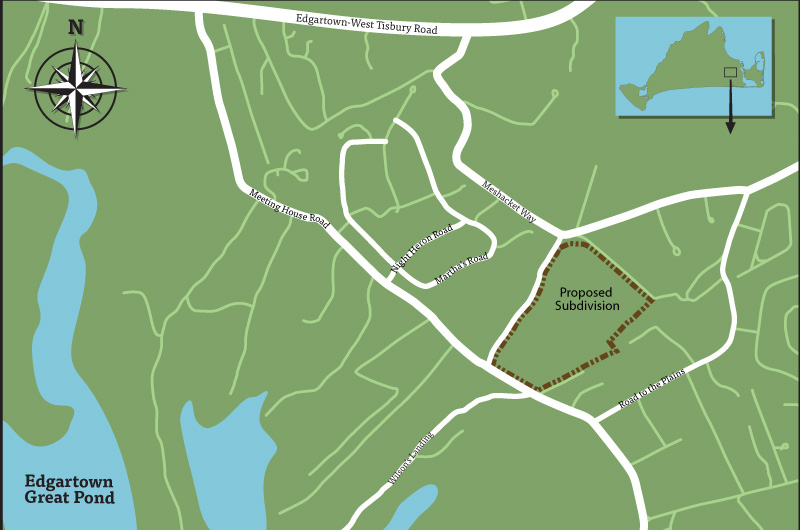
The land is partially wooded and lies between Meetinghouse Way and Meshacket Road, not far from the Island Grove subdivision and also near Wilson’s landing at Turkeyland Cove on the Edgartown Great Pond. The property is bordered on two sides by protected ancient ways: Swimming Place Path and Pease’s Point Way. About 17 acres of the land cannot be developed because it is designated as priority habitat for the rare imperial moth under the state Natural Heritage and Endangered Species Program.
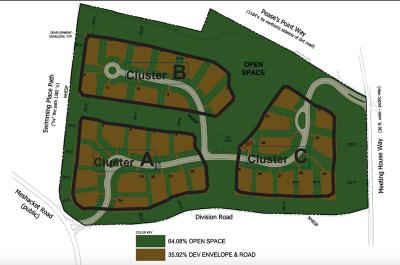
Cluster plan is largest subdivision in years to come before MVC.
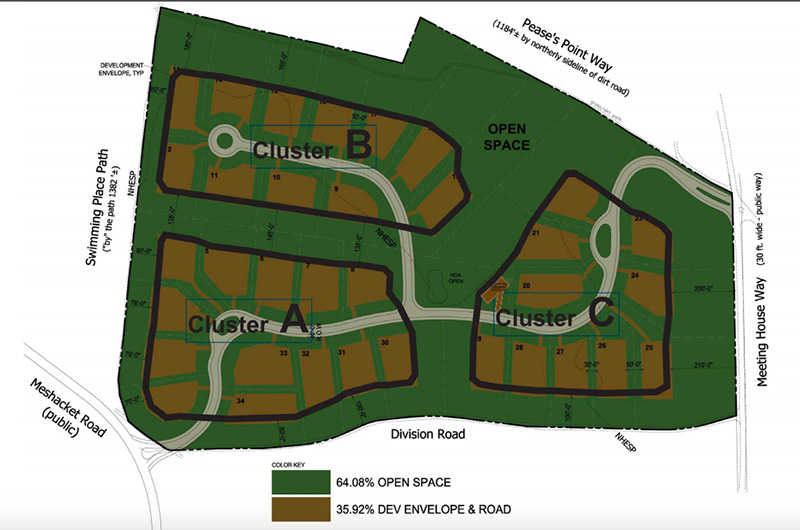
Cluster plan is largest subdivision in years to come before MVC.
The definitive (form C) plan was filed with the Edgartown planning board in May and referred to the commission as a development of regional impact (DRI).
Called Meeting House Place, the plan as currently drawn calls for three clusters, each containing between 10 and 13 buildable lots. Cluster A is nestled into the northwest corner of the development off Meshacket Road, with Clusters B and C flanking it on its southern and eastern sides. The plan calls for two entrances, one off Meshacket Road and the other off Meetinghouse Way.
Lots vary in size from one to 2.68 acres, with development envelopes that range from a fifth of an acre to a little over a half-acre, leaving about 65 per cent of the original 54 acres as open space. The average lot size is 1.55 acres. Minimum zoning in the area is half-acre lots.
Homes will be limited to a maximum of seven bedrooms and 6,300 square feet of living space, not including stairwells, porches and below-grade basements, according to the plan. No guest houses will be allowed, but guest rooms above garages will be permitted and not included in the 6,300-square-foot living space maximum.
During a pre-public hearing review on Nov. 19, members of the commission’s land use planning subcommittee expressed concern about the development’s proposed affordable housing contribution. A commission policy requires residential real estate developments to contribute either 20 per cent of the assessed value of the property or 10 per cent of the proposed lots toward affordable housing.
Meeting House Place developers are proposing to give money rather than lots. Calculated on 20 per cent of the property’s assessed $2.4 million value at the time of the sale, the contribution would total $490,000.
“For a 34-lot development, 490K seems like a pretty cheesy contribution,” said commissioner Fred Hancock at the meeting. “If we are looking at the benefits and detriments of a project, we have 34 market-rate lots, and the affordable housing is getting the fuzzy end of the lollipop there.”
Civil engineer Douglas Hoehn and Island attorney Sean Murphy, who represent the developers, replied that they did not write the commission’s rules.
“We didn’t choose an assessed value,” Mr. Murphy said. “The appraised value might be quite different than the assessed value.”
MVC affordable housing director Christine Flynn said she has asked the applicant to consider providing the lots rather than money.
“It is going to come up [at the public hearing],” Mr. Hancock said. “As somebody voting on this . . . I would have a hard time approving this with this kind of contribution.”
The developers plan to connect the project to town water and sewer, although the infrastructure is not yet in place. According to the project’s Environmental Notification Form, the subdivision will connect with a public water and sewer main 60 feet north of the parcel beneath Meshacket Road.
Commissioners also expressed concern about increasing the load on Edgartown’s overburdened water and sewage treatment systems.
“We have low-flow everything,” said
MVC water and resource manager Sheri Caseau.
Mr. Murphy promised that the developers would have a statement from the town water department before the public hearing planned for Jan. 24.
Meanwhile, the development group has also bought more land bordering the property proposed for subdivision. In February 2018 Boston Equity RE and MV Estates Inc. purchased land along Meetinghouse Way. Boston Equity bought an 8.46 acre-lot from ADEC Meeting House Way LLC for $1.28 million, while MV Estates Inc. bought a smaller plot for $114,000.
Both entities list Douglas K. Anderson and Richard G. Matthews as principals. As a result, there are currently six lots totaling 62.82 acres owned by the same group of developers. A seventh lot just west of the other properties totaling 17.26 acres is owned by ADEC Meeting House Way LLC, but has been granted an easement for water, sewer and electric utility access to the other lots.
Meeting House Way, once a two-mile long dirt road, was repaved and widened last winter. Mike Mauro, the commission’s transportation program manager, said at the pre-public hearing review that the development would not cause a significant increase in traffic on the road.
The DRI review is expected to test the muscle of the regional planning commission, which has unique powers to review development but has seen few large subdivision plans since the 1980s and 1990s, when such plans were commonplace.
“Before my time,” said DRI coordinator Paul Foley. “We haven’t had any subdivisions of this size since I started here, which was 15 years ago.”
Comments
Don't know what all this
Mack Vineyard HavenDon't know what all this naysaying is about... I for one look forward to more crews commuting from the mainland to build these houses, more landscaping trucks hauling ass through Edgartown streets to spray poison on their non-native plantings, and more rude, clueless line-cutters in Morning Glory. Yes, let's keep that already low tax base down! Sounds like a win.
I hope this project gets
Susan Oak BluffsI hope this project gets serious scrutiny. For one thing, why was this large parcel approved for 50 lots of sewer access in 2014 before they even applied with the planning board? And why does the next door parcel still owned by ADEC still have sewer permits for 13 more lots. Maybe the Boston Globe spot light team should take a look at who's involved in all this.
This seems very strange. Why
Steve EdgartownThis seems very strange. Why did these guys get approval for sewer access before they even started the project? And who the h*ll is ADEC?
Wait a minute. Thirty four 7
Ken Edg.Wait a minute. Thirty four 7 bedroom homes. Im waiting to hear if Edgartown even has septic capacity for these. I heard somewhere that homes off the Edgartown Vineyard Haven road might get sewered to save Segegontacket pond. Last thing we need is new homes clogging up the works.
Do we need this in order for
JayF EdgartownDo we need this in order for some developer to make a bunch of money? Anyone consider the wildlife including the deer population? We're taking away their habitat only to enrich some out-of-towners. Development is not necessarily a good thing.
The private landowner pays
here we go again edgThe private landowner pays taxes. If you wanted a deer habitat, you should buy the land if the developer is willing to sell it. Is your concern that the moths and deer that got displaced with the hundreds of homes crammed into Island Grove now become the responsibility of this private land owner? You seem to have a real problem with 'out-of-towners'. Who do you think greases the wheels of the local economy? the locals? keep dreaming. don't bite the hand that feeds you
A lot of people WHINING here
charlie callahan so boston/edgartownA lot of people WHINING here are probably typical of a lot of the moaners on the vineyard. A lot of them probably already built their mega house on a postage stamp lot,that never should have been approved and now when someone wants to put a large size house on a big lot, they are complaining about overbuilding, but it's OK that a lot of them probably way overbuilt. It's typical ,I got mine and You shouldn't have yours
The majority owner of this
Island resident EdgartownThe majority owner of this giant scale project resides in Utah. That means almost 100 million in sales money from 34 lots will flow to Utah. I prefer 15 lots and the funds stay here on the island
The answer to this plan
Carol Lampson formerly ChilmarkThe answer to this plan should be no. Just no. Build your subdivision in New Jersey.
Add new comment