


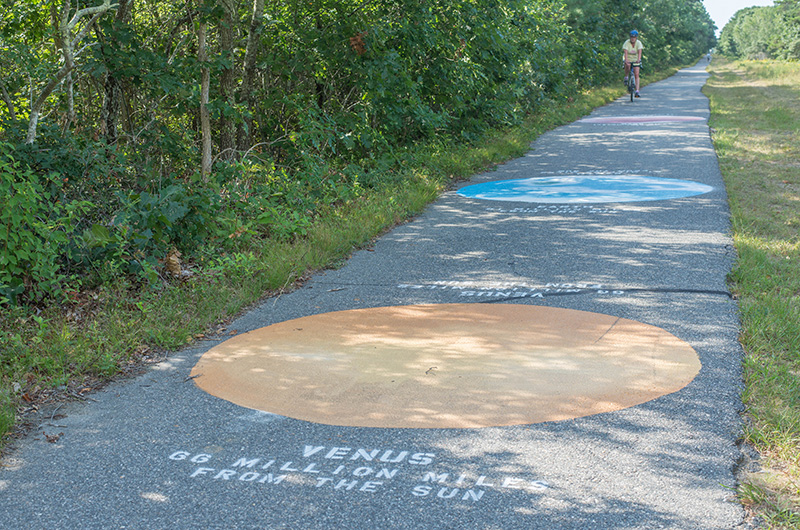
Every morning for more than two years my malamute and I strolled the solar system.
Every morning for more than two years my malamute and I strolled the solar system. Neptune, we learned, is 2.77 billion miles from the sun. Uranus, the next planet in line if we headed toward the sun, is 1.71 billion miles from the heart of our solar system. Next-door neighbors 1.06 billion miles apart? These numbers were too large for my earth-bound mind to grasp, so I set out to pace the distance from one planet to the other. Do you have any idea how hard it is to count that high while walking with your dog on the bike path? I lost my place whenever I greeted someone passing in the opposite direction, or when Trav had to sniff the bushes or snatch a tennis ball that some other dog had left behind. When at last I counted 285 and 288 paces on two successive trips between Uranus and Neptune, I knew I was in the ball park.
Then I counted paces from Uranus to Saturn: 272. To my surprise, it was almost as far from Uranus to Saturn as it was from Neptune to Uranus. I could have figured this out from doing the math with the figures stenciled on the pavement, but walking made it easier to grasp. Saturn, at 839 million miles from the sun, is roughly as far from the sun as it is from its outer neighbor.
On our late afternoon and evening walks, Trav and I often started from the other end. Between the innermost planets — Mercury at 29 million miles from the sun, Venus at 66 million, Earth at 91 million, and Mars at 127 million — each stride covered about 4 million miles. Walking briskly, I averaged a little under 3.5 million. Yes, I did know that if I were outbound from the sun the planets wouldn’t line up as neatly as they did on the bike path. Some of them would be way off in the woods somewhere. Nor do they move in neat concentric circles.
Still, the distances were impressive. And Earth didn’t seem like the center of the universe either.
The solar system was a combined art and science project of West Tisbury School fifth graders in the spring of 2016. When it was still a work in progress, their teacher told me that they’d gotten permission from the state. She added that the bike path was due to be resurfaced soon.
Soon didn’t happen for almost two and a half years. This fall Trav and I got to monitor the meticulous repair of our multiply fractured bike path around the state forest.
The early harbingers included mysterious marks on the asphalt, orange or pink ribbons attached to sticks with numbers written on them, and orange enclosures at irregular intervals. The latter, I was told, were to protect sensitive plants. Then men and machines appeared. Trav wooed at the machines — malamutes rarely bark, but they often
woo, and sometimes howl — and several of the men were pleased to make Trav’s acquaintance.
The many horizontal cracks across the bike path, which made for a bumpy ride for any wheeled vehicle, were excavated into little trenches, refilled with dirt, paved over and graded. The planet Mercury (29 million miles from the sun) had from the beginning been bisected by a crack. Now it had a wide asphalt belt across its middle. The gray bike path was striped with dark belts where the cracks had been.
Then in the almost-last step in the process, the entire bike path was resurfaced with a thick layer of black asphalt. The dark stripes disappeared — and so did the planets.
I miss the planets. I miss striding from Earth to Mars to Jupiter and beyond, noting the immense distances between them and trying to imagine the vastness of whole galaxies.
I’m hoping that next spring, or maybe the spring after that, West Tisbury School fifth graders will recreate the solar system on the bike path. And who knows? Maybe other stretches of pristine asphalt will lend themselves to creative projects. Until then — I remember that it was about 288 paces from Uranus to Neptune but barely 11 from Earth to Mars. That helps me keep things in perspective.
Susanna Sturgis lives in West Tisbury.
Comments
Key point: "Still, the
Bill Blinn Worthington, OhioKey point: "Still, the distances were impressive. And Earth didn’t seem like the center of the universe either."
I too will miss the planets
Thom Wilson West TisburyI too will miss the planets although as a bicycle rider and an occasional rollerblader the new surface is a real treat. Anyone know if they plan to do the remaining sections next year? In particular the section from the "T" intersection to the north parking lot on Barnes Road is pretty bad.
Lovely commentary on a
Nancy Williamsburg VALovely commentary on a creative use of an asphalt path. I hope the solar system comes back too.
Hello Susanna! I am the
Sue Miller Oak BluffsHello Susanna! I am the teacher from West Tisbury who created this project! I am so touched by your article! This made my day! We are already planning on recreating the solar system in the spring and my current class is very excited about the project. Thank you for writing this article.
You have made my day! So
Susanna J. Sturgis West TisburyYou have made my day! So happy to hear this. (I think we met briefly when you were putting the final touches on the stenciling not far from the sun.)
Sue. I am so very glad to
David Whitmon Oak BluffsSue. I am so very glad to hear of your plans to recreate the solar system. I had been meaning to touch basis with Chris Bruno, Superintendent of the State Forest about the solar system. If I can be of help, let me know.
Have you gone onto Google Satellite Maps? The Solar System that you and your incredible students created is still quite visible from orbit around Earth.
Thank you Sue
Nancy Irvington NYThank you Sue
That is awesome
We can’t wait to see it this summer!
Sue Miller--so delighted to
Marcia WTSue Miller--so delighted to hear that the planets will return! They were so beautifully created--and have also helped to alter my state on those tough runs.
Our 7 year old grandson was a
Nancy Noble Gardner Oak BluffsOur 7 year old grandson was a big fan. Likewise my husband and myself! Glad to hear the solar systems will return. Wonderful article. Thank you.
Great story about the walk.
Margaret Emerson ChilmarkGreat story about the walk. Almost makes me
wish I had a dog!
Just back from our yearly
Deborah Gainey Gainesville, FLJust back from our yearly trip to the Cape and the Vineyard and wish I'd known about this solar system walk! We have one here in Gainesville and I am always fascinated by the distances between planets (and the empty Pluto plinth!). I don't have a dog, but next year I'll plan on "walking" my husband! Thank you in advance to Sue Miller and her students!
This wonderful project brings
Burton Thomas Syracuse, NYThis wonderful project brings regret (that I didn't experience it) and memories of a high school freshman science project in 1960. I modeled the planets proportionately (Earth was made from a golf ball and Mars a marble), which were relatively spaced apart, albeit extremely truncated, in a long school corridor. If memory serves (questionable), the proportional distance between my Earth and Mars should have been four miles rather than just a few inches in the confines of the corridor. This was a revelation for my space and science fiction addled teenage brain. I hope the Vineyard project can be recreated so that more children (and adults) can experience the miracle and immensity of the solar system and our insignificant place within it.
Add new comment