



There are now 327 students in English language learning (ELL) programs in the Island public schools.
When Leah Palmer started her job as director of English language learning programs for the office of the Vineyard schools superintendent in 2012, 73 Island students needed support for learning English.
Today that number has more than quadrupled. There are now 327 students in English language learning (ELL) programs in the Island public schools, making up more than 15 per cent of the student body, five per cent higher than the state average. On Martha’s Vineyard, most ELL students speak Brazilian Portuguese as their first language.
“It’s huge growth in numbers and programs,” Ms. Palmer said. “We have 12 teachers now. When I started, we had five.”
The school census for the current school year was conducted Oct. 1, and numbers show growth in ELL programs almost across the board. Ms. Palmer said the academic pace in Massachusetts is accelerated, and it can be difficult to keep up.
“We move fast in school and it’s very rigorous and to be able to give time to develop English language skills — it means they’re missing out on instruction.”

Ms. Palmer said that most Island ELL students grew up speaking Brazilian Portuguese at home in the U.S. She said students who begin ELL classes in kindergarten typically graduate from the program proficient in English by the fourth grade. Students in the program after fourth grade are often newcomers.
She said it has taken a lot to keep up with growth in the last few years.
“When a program grows this fast, staffing it is a challenge. Matching the student needs with our staff has been hard,” Ms. Palmer said.
Edgartown added a third English learning teacher this year to support the school’s 78 English learning students. Oak Bluffs is looking to hire a third teacher for its 82 students in the program. The Tisbury school added a third teacher last September. At the high school, principal Sara Dingledy said she is looking to hire a third English language teacher to support the 73 students learning English there and to provide additional interpretive services.
Since 2016, general education teachers with one or more students who need English support in their classrooms are required to train for a so-called Sheltered English Immersion Endorsement on their license. Training for that endorsement helps teachers make lessons more accessible to students who don’t speak English by modifying their language, explaining the way they are using language, and identifying key words, Ms. Palmer said.
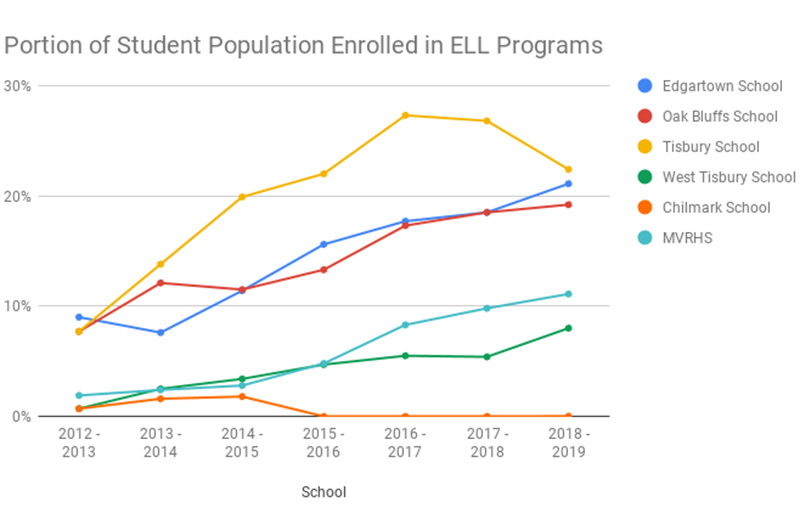
At the Edgartown School, the percentage of students in ELL programs has continued to climb since 2013, topping out this year at 21 per cent.
“With any growing group within the general population, you have to adjust,” said Edgartown principal John Stevens. He said in addition to ELL teachers, the school has a full-time interpreter tasked with communicating with Brazilian-Portuguese speaking parents and translating school documents.
“When there is an event at school and we are inviting families, we want to make sure interpreter is there,” Mr. Stevens said. “It permeates all aspects of the school.”
As with other public schools, students who speak a language other than English at home are screened when they enroll in the Edgartown School and rated on the state-approved English
proficiency scale of one to five. Level ones and twos are the least proficient, and are required to have two 45-minute sessions of English language support per day. Mr. Stevens said scheduling those sessions for students in different grades, proficiency levels, and course schedules is a challenge.
“Do you pull them out [of class]? Do you push the [ELL] teachers into the classroom? The coordination of that creates an incredible amount of detail to look at and satisfy in terms of scheduling,” he said.
Oak Bluffs School principal Megan Farrell echoed the challenge of scheduling. The Oak Bluffs School has seen increases in its ELL population every year since 2012. Currently, more than 19 per cent of the student body is in the program, up from just 7.7 per cent six years ago.
“We’ve added additional teachers to our staff, and we are also engaged in imaging learning software which is an individualized learning tool to help with English acquisition,” Ms. Farrell said.
The Oak Bluffs School employs an interpreter to communicate with Portuguese-speaking families and Ms. Farrell plans to hire a third ELL teacher for the 2020 school year. This year, 82 students are enrolled in the program.
At the Tisbury School, three ELL teachers support 65 students. In 2016, enrollment peaked and more than 27 per cent of students were in the program. This year, 22 per cent of the student body participates, up from 7.7 per cent in 2012.
The Martha’s Vineyard Public Charter School has 12 children enrolled in its ELL program.
The trend is not confined to down-Island elementary schools.
“It definitely started with down-Island schools, but it has moved to all the Island schools,” Vineyard schools superintendent Dr. Matthew D’Andrea said.
The West Tisbury School houses English language learning programs for the up-Island regional school district. Two ELL teachers support 28 students there, and eight per cent of the school population participates in the program.
At the regional high school, 11 per cent of the population recieves ELL support. In 2012, the number was less than two per cent.
“We are going to be talking with school committee soon about the need to expand staffing to support our ESL population,” principal Sara Dingledy said in an email.
Liz Bradley has taught English development for grades six through eight at the Tisbury School for five years. She said she and other teachers use multiple approaches to support students learning English.
“We can support them with modifications in testing and in the amount of reading materials they need to cover,” she said. “We can group them differently or change the pacing of their work.”
She said classes go beyond studying English itself.
“When you’re teaching language . . . it’s boring to just talk about grammar,” Ms. Bradley said. “We talk about literature and science and the weather.” She co-teaches an alternative math class with a math teacher and a bilingual assistant teacher. She said students in that class are picking up elements of math and English at once.
Mr. D’Andrea said he is pleased with how the school system has adapted. “We want to respond appropriately to the needs of the Island and these students as they come here,” he said. “I want our schools to be able to provide them with the education necessary to learn a language, but also to be academically proficient.”
Comments
I love the fact that our
Robert TisburyI love the fact that our schools are adapting to the needs of ALL people in our community! Kudos
I think something more worth
Matt EdgartownI think something more worth looking into is the complete lack of programs or social groups/meetings on the island which aim at assimilating the Brazilian adult community and/or helping bridge the divide between Americans and Brazilians. I think it's not outlandish to say a Brazilian can easily go through their life here on the Vineyard without speaking English or engaging with Americans. That being said many do, and this is why children enter the school with little English skills. Even after almost 20 years of Brazilians moving here there still seems to be a very real feeling of us vs them between Americans and Brazilians here on the island. Although it's improved considerably since then there still is a very long way to go.
I am by no means anti
DownislanderI am by no means anti immigration, but at some point, we have to ask ourselves this tough question: How much of a school’s budget can be spent on teaching the english language to immigrant students before other programs start to suffer? In a small community like this, There’s only so much money to go around. Again, I’m not against legal immigrants coming here, but how long can we sustain this?
My thoughts, exactly. My
Margaret Kennedy Vero BeachMy thoughts, exactly. My grandparents were Italian immigrants. My mother was taught English by her older sister BEFORE she entered school. Wouldn't it make sense to establish a English language program for preschoolers, elementary and teens outside of the school? Just a thought. Probably complicated.
Am I missing something? What
John Gault Oak BluffsAm I missing something? What happen to knowing your ABC and numbers and having Documentation showing the child had all proper vaccinations to make sure they are safe and not carrying any diseases or viruses. Does this occur? It seems it does not, it will until the school's get an outbreak of the Polio Virus that is now making a come back across America. Please post so we can get an answer, the Gazette seems to have policy of being not posting honest questions that are not PC.
You might have missed those
Nate Wink Oak BluffsYou might have missed those valuable ABCs and english lessons while school based on your writing. Do a quick search for me John and read that the current outbreak is not in fact polio but is AFM which they do not know the cause or have vaccinations for. It's not Polio. You can check out the https://www.mass.gov/service-details/school-immunizations to see school immunization rates. All school require documentation of vaccinations or exemptions to attend, otherwise you can not. Your untrue unchecked arguments are a thinly veiled front for the racist rhetoric that plagues this country.
Yes! I agree Nate, thank you
Adam LangYes! I agree Nate, thank you
Serious question: is there an
Charlie TisburySerious question: is there an accurate way to quantify the amount of taxes the parents of the ELL students pay?
Gosh, I don't know. I do
Carol LampsonGosh, I don't know. I do know that I pay a lot more income tax from my little middle class job than the average billionaire, who pays zero. So maybe we can start that quantification at the top of the asset pile & work our way down?
Not true. The top 1400
BS Oak BluffsNot true. The top 1400 wealthiest Americans ( many billionaires) pay more in taxes than the bottom 70 million. I'd say they are paying their fair share. If you still disagree then work harder, become rich and save yourself all those taxes!
I really doubt that you pay
Paulli D EdgartownI really doubt that you pay more in taxes than a billionaire. Your percentage of tax may be higher, but the total dollars As a percentage of income would guess are not. The media is not transparent on this debate.
Do a little research on who
Thomas EdgartownDo a little research on who pays the most taxes in our country. You guessed it, the rich pay most of our taxes.
Makes a lot more sense to me.
GailMakes a lot more sense to me.
Our islands schools are
McLane ChilmarkOur islands schools are being over run just like our borders and I am fed up. I hate my taxes going for this!
I wonder what percentage of
Public Trust all IslandI wonder what percentage of these non English speaking student's families actually are legal immigrants and pay taxes? Is it fair for Island residents to foot the bill for educating non residents or those that don't contribute taxes? As long as there is legal immigration and contribution of taxes, then we should all be treated fairly and equally, no complaints. If not, you have created a charitable situation without choice of the charitable givers.
Our taxes shouldn't be spent
charlie callahan so boston/edgartownOur taxes shouldn't be spent teaching these kids to speak English. Our great granparents had to take English courses and if they didn't learn the language, they went nowhere. We have to help these kids, but a lot of their parents never learn English and that's their own fault. How can they have drivers licenses if they can't read English.
The basic question is the
Paulli D EdgartownThe basic question is the cost, and what we are spending to provide these programs versus building maintenance, and other programs for our islanders, and citizens and legal immigration. Raising taxes is not the answer. Hard questions but real ones that need to be addressed. Going to 12 teachers at what salary and benefits each? There is a cost and our island community has limited resources.
Let ignorance and a lack of
Ella Mathieson TisburyLet ignorance and a lack of compassion be gone from our community. So what if taxes are being spent to educate Gods children? That’s what tax money is for, and if we need to raise taxes, so be it.
Add new comment