


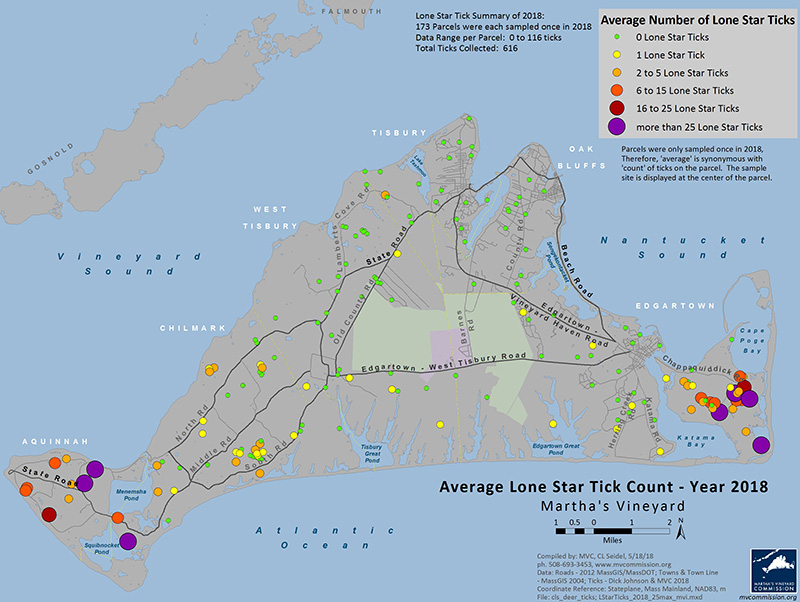
A post-summer report says tick populations are up, especially the newest species of disease-carrying arachnid to invade Martha’s Vineyard: the lone star tick.</p>
Yard surveys are up but so are tick populations, especially the newest species of disease-carrying arachnid to invade Martha’s Vineyard: the lone star tick.
This is the post-summer report from the Martha’s Vineyard Tick-Borne Illness Prevention Program which has been working for the past three years to both study and stem the growing number of ticks that pose an increasingly pernicious public health threat on the Island.
“Lone star ticks are the story of the summer,” Island biologist Richard Johnson told the Gazette in a recent interview. “We’re finding them in big numbers now.”
Mr. Johnson leads the tick-borne illness prevention program which is backed by the Island boards of health, administered through the county and funded through donations, including from summer yard surveys.
With the help of two summer interns, some 200 yard surveys were done, twice the number from the year before, Mr. Johnson said. The surveys and other field work helped compile data for updated tick maps prepared by the Martha’s Vineyard Commission. A new map published at the end of the summer (and accompanying this story) documents the growing number of lone star ticks, a southern species that just two years ago was found only in isolated pockets of Chappaquiddick and Aquinnah. Now lone star ticks have spread to many other areas, Mr. Johnson confirmed.
“There are only a few places in Oak Bluffs and Vineyard Haven where we are not finding them,” he said.
About 200 yard surveys were done, twice the number from the year before.
About 200 yard surveys were done, twice the number from the year before.
Lone star ticks are capable of transmitting a variety of bacterial illnesses during the adult stage. Even in the larval stage the ticks can include a painful bite that causes prolonged itching and irritation. Mr. Johnson, who offers a brief primer on lone star ticks in a commentary in today’s edition, said that while the habits of the lone star need more study, it is known that they feed on deer during all three stages of their life cycle, adding even more urgency to recent efforts to reduce the deer herd on Martha’s Vineyard.
Those efforts have also seen some progress.
The Island Grown Initiative announced last week that for the second year it will help sponsor a venison donation program in which hunters donate deer and the meat is distributed free in the community.
Plans are in the works to set up a permanent cooler on Martha’s Vineyard Agricultural Society property in West Tisbury that would allow hunters who register to hang their deer, encouraging more take and more venison donations.
An interim cooler is available at the Island Grown Initiative Farm Hub in Vineyard Haven while the permanent cooler is completed, IGI executive director Rebecca Haag said.
“IGI is thrilled again to participate and help manage the deer donation program,” she said. “The program was well received last year and we hope to have significantly more venison available for Island residents this year.”
As was the case last year, donated venison will be distributed to Islanders in need and through the Island Food Pantry.
The deer archery season began Monday and has been extended by two weeks this year. It runs for eight weeks and is followed by a two-week shotgun season and a primitive firearms season. Deer hunting ends in December.
Meanwhile, Mr. Johnson said educational outreach remains ongoing. He plans to spend more time in the off season this year encouraging private landowners to open up their property to hunters.
“So much of this is going to depend on the cooperation of private property owners,” he said. “It’s not the deer in the state forest that are making people sick . . . it’s private property.” He said he plans to focus on neighborhood and homeowner associations and also general education about bow and arrow hunting.
Anyone interested in reducing deer and ticks on their property can contact Richard Johnson at [email protected] or 508-693-1893. The Island boards of health have an educational website (mvboh.org/tbi.html) that contains detailed information about ticks and tick-borne illnesses. Tax-deductible donations to the tick-borne illness reduction program can be made through the Permanent Endowment of Martha’s Vineyard and mailed to Richard Johnson, 10 Tori Lane, Vineyard Haven, MA 02568.
Comments
While I applaud these efforts
Gabrielle whitcombe West TisburyWhile I applaud these efforts, especially reducing the deer population, I wonder when Lyme and other tick borne diseases are going to be recognized as the critical, high public health crisis it is and follow with significant funds for treatment and research.
Gabrielle
Richard Johnson Oak BluffsGabrielle
I agree, tick borne-illnesses are a serious problem and getting worse but there is very little federal money being committed to address the problem. I have been told the CDC will not copmmit $$ because the tick diseases are not contagious and therefore not likely to becoem a major epidemic. Don't know if it is true but tahts the explanation I heard.
I am simply appalled at
V Oak BluffsI am simply appalled at killing all the deer and promoting it as some sort of permanent way to resolve the issue.
From a New York Times article:
“One theme is the role of deer in determining tick abundance. In the first 15 years after Lyme disease was discovered in coastal New England, several studies showed that many adult ticks feed on deer, and researchers surmised that deer were critical to the tick life cycle. When researchers eradicated deer from New England islands, tick populations crashed.
The key to the Lyme disease problem seemed at hand. Unfortunately, nature has a way of being more complex than first thought. One complication is that adult black-legged ticks feed on raccoons, skunks, opossums, and other medium-sized mammals. When deer are scarce, ticks don’t necessarily become scarce, because they have alternative hosts. Indeed, several recent studies (e.g., Jordan and Schulze, 2005; Ostfeld et al., 2006; Jordan et al., 2007 — see citations below) on mainland sites in New York and New Jersey found no correlation between deer and ticks.
Second, ticks and Lyme disease are rare or absent in parts of the United States (the Southeast, most of the Midwest) where deer are abundant.
Third, ticks are only dangerous if they are infected, and deer play no role in infecting ticks. Ticks become infected with the Lyme disease bacterium by feeding on small mammals such as white-footed mice, chipmunks, and shrews. And mice play the additional role of increasing tick survival — they are at the opposite extreme from opossums, which kill the vast majority of ticks they encounter. When our group compared the importance of deer, mice, and climate in determining the number of infected ticks over 13 years in southeastern New York State, mice were the winners hands down.”
While I can agree with much
Mr. B ChilmarkWhile I can agree with much/all of what you say, you may be missing a key point here when it comes to a mass culling of the herd on the island: imbalance. I want to get the deer population to a size appropriate to the island's available land. Some estimates indicate a present population of five times the ideal size. Yes, there probably would be a precipitous drop in tick-borne illnesses in the short term, but what's wrong with that? The point is that there are just too, too many deer on the island.
You should read the comments
Ned Block New YorkYou should read the comments on that NY Times article. Sam Telford says this: "Actual intervention studies have clearly demonstrated that reducing deer (not “eradicating” deer) reduces tick density. There has been no study wherein mice have been reduced with a demonstration that tick density has diminished as a result. Empirically, deer reduction is a proven method that needs to be considered as a complement to other modes in an integrated pest management approach that includes habitat modification and education.
(I am an epidemiologist at the Tufts vet school who has focused on aspects of Lyme disease biology for 25 years and who undertook one of the deer reduction experiments.)"
Look at https://roomfordebate.blogs.nytimes.com/2009/07/29/are-deer-the-culprit…
Now if can just feel
Susan of OB WH CTNow if can just feel confident that the ticks could be killed by SKUNKS, our primary Vineyard pets, like the opossum --- that would be magic!
V
Richard Johnson Oak BluffsV
Thank you for presenting some of the counter arguments against reducing deer density as a way to reduce tick-borne illnesses. It is always good to hear the scientific evidence and arguments from both sides. I agree with much of what you said, however it is important to be aware that the opinions expressed by Dr. Ostfield and others from the Cary Center are very much in the minority among those battling tick borne illnesses.
I also believe there are some flaws in your case. The comments from Mr. B and Ned Block do a good job addressing some of these issues, so I will focus elsewhere. One important point is the distinction between mainland and Islands. Deer reduction or eradication have only proven effective on Islands and penninsulas with limited access so that deer from outside the area cannot move in to replenish the population.
Monhegan Island is the best example, deer were eradicated and now it is very difficult to find a deer tick. In another study on a pennisula in Connecticut with limited access both ticks and tick borne illnesses decreased. The Vineyard is much larger than Monhegan Island or other areas where deer reduction has proven successful in reducing ticks, it is an Island with limited opportunities for additional deer to get here. At 100 square miles it presents significant challenges but challenges I believe we can overcome if we devote sufficent resources and are persistent.
While deer do not have to be eradicated to reduce the incidence of tick borne illnesses (and that is not my goal for the Vineyard) they do have to be reduced below some threshold before we will see a significant decrease in ticks and tick borne illnesses. The mainland studies I am familiar with reduced the populations from very high density (close to 100 deer per square mile) to 30 to 40 per square mile; densities similar to that currently exisitng on the Vineyard. As we are all aware, these densities of deer are quite capapble of supporting abundant tick populations and maintaining tick borne illnesses.
Three final points:
While adult deer ticks may feed on other hosts, mating takes place on deer where the females go to get the blood meal they need to produce eggs.I do not know of any evidence that they are common enough on racoons or skunks for enough males and females to find each other and mate and lay enough eggs to maintain the population. If you have any scientific evidence for this, I would greatly appreciate knowing about it.
The second point is more subtle. It does appear that the density of white footed mice affects the number of ticks carrying Lyme disease (and the number of acorns determines the number of mice), so deer tick numbers do vary from year to y. However, the range within which this fluctuation occur is very high. It is the difference between a bad year for ticks and a very bad, terrible no good year. In other words, even when the tick population and number of infected ticks on the Vineyard is relatively low, it is still dangerously high. So in a low year maybe only X number of people will get a tick borne-illness while in a bad year more than X will be infected. My point is that on the Vineyard there are so many ticks that even the number of people who will be infected in a "low" tick year is unacceptably high. The numbers have to be reduced well below the currently naturally occurring low points to solve this problem.
Finally, lone star ticks rarely feed on mice or other small mammals but all three life stages do feed on deer. Even if we could magically make the estimate 400,00 or 500,000 white footed mice disappear, this would not impact the lone star ticks, which are rapidly becoming as much or more of a problem than deer ticks
Thank you to all who have taken the time to read this, it is difficult problem with no simple solution However I continue to believe that continuing education and a significant reduction in the number of deer, particularly in residential areas, is our best chance to significantly reduce the scourge of tick borne illnesses we are experiencing
Mice carry ticks as well. As
Chappy Person ChappyMice carry ticks as well. As a public health issue, do as they do in Florida. Spray overhead.. Not popular, but better than getting the disease.
Last year the deer population
Tom West TisburyLast year the deer population was culled by almost 800 individuals which may be a record number. This year there are more deer than I've ever seen before. Twins are everywhere. It would seem that the more you cull, the more deer you get. Mice indeed are the culprits but no one talks about exterminating them, because we know that it is impossible. Clearly, much more scientific work is necessary.
Just an FYI, lone star ticks
Gabrielle West TisburyJust an FYI, lone star ticks are far more agressive and can carry tularemia.If you have a tick bite that develops into a sore,see the doctor.
Why are there more ticks on
James B. Riley EdgartownWhy are there more ticks on Chappy and in Aquinnah than the other places? Do ticks prefer the moors? Or are these places lacking a key predator? Perhaps these places have fewer wild turkeys. I've read conflicting reports as to whether turkeys eat ticks, but I have strong suspicion that they do.
James
Richard Johnson Oak BluffsJames
Lone star ticks are carried to the Island by ground feeding birds, so it makes sense that more birds carrying lone star ticks arrive at Aquinnah from the Elizabeth Islands, Long Island and other points south where the ticks are already common. As for Chappy, I assume that a lot of migrating birds are stopping on Cape Poge, which is where the Chappy infestation seems to have begun. Once the lone star ticks become relatively common they can be spread by our "local" birds and probably deer.
We don't know enough about the turkeys. While they will eat ticks, lone star ticks also feed on the turkeys (in the mid-west lone star ticks are also called turkey ticks because they are so common on turkeys. My guess is that turkeys are a net contributor to the number of lone star ticks, i.e feeding on turkeys contributes to more ticks than they eat. This needs more research so we can understand the role of turkeys in maintainig or spreading (or maybe reducing ) lone star ticks. As an aside, there is a growing movement to release bob white quail in the hopes that they will reduce ticks. Lone star ticks will also feed on quail, I fear that releasing quail may actuaslly contribute to the problem rather than help solve it.
A major difference between
Ellen L ChilmarkA major difference between deer and smaller mammals is that deer can roam far and wide. They're like a public transit system for the tick population.
Hand wringing, howling,
Tom Allen TisburyHand wringing, howling, finger pointing and inaction- clearly this must be the smartest solution because the island has persisted in it for decades regarding the tick issue.
Add new comment