

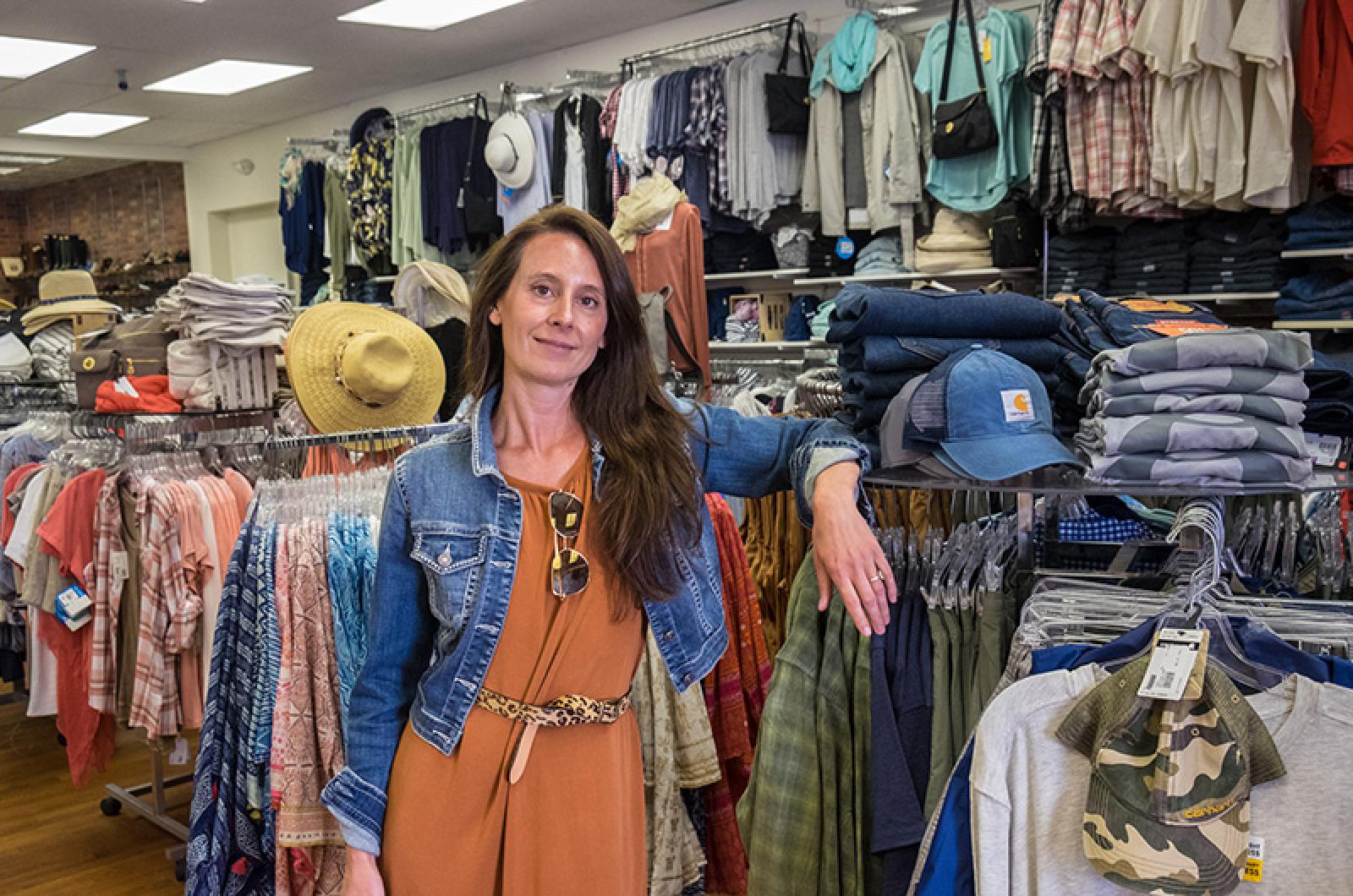
The summer labor shortage on the Vineyard is nothing new, but this year many business owners feel it is worse than ever.
By Memorial Day, Erin Tiernan, part-owner of Eastaway and Basics, two retail stores located on Circuit avenue in Oak Bluffs, usually has nearly 100 job applications for open positions. This year she has six.
“It’s a crisis,” Ms. Tiernan said. “I’ve had to work full-time on the floor, along with our two other owners, to keep the store open.”
The summer labor shortage on the Vineyard is nothing new, but this year many business owners feel it is worse than ever. The ubiquity of Help Wanted signs all over the Island underscores this sentiment.

CB Stark manager and Tisbury Business Association Sarah York.

CB Stark manager and Tisbury Business Association Sarah York.
New restrictions on foreign worker visas play a large part as does inadequate affordable housing opportunities for college students and other seasonal employees.
Vineyard businesses, like Ms. Tiernan’s, depend on foreign seasonal workers to staff their shops during the busy summer months. These workers come to the Vineyard on either J-1 student visas, which the United States issues to non-immigrant students to promote cultural exchange, or H-2B visas. The H-2B visas are part of a non-immigrant program that permits American employers to temporarily hire foreign workers.
The Federal Government allocates 66,000 H-2B visas per year nationwide; 33,000 for the winter season and 33,000 for the summer. In past years, returning H-2B workers didn’t count against the cap, and Island businesses, familiar with system, always filed early to guarantee they could get the requisite visas for summer staff. But that all changed in 2017, when policy shifted and returning workers began to count against the 33,000-person seasonal cap, increasing demand for visas nation-wide and forcing the government to resort to a lottery system for selection.
In the words of Nancy Gardella, executive director for the Martha’s Vineyard Chamber of Commerce, this “hamstrings” Island employers.
One of those employers is Mike McCourt, manager of Murdick’s Fudge, with locations in Edgartown, Vineyard Haven, and Oak Bluffs.
“The lottery system is a joke,” he said. “What we’d do in previous years was make sure our applications were in as soon as possible, and that would ensure that our chances [to get visas] were much greater.”
In 2018, however, the rest of the country caught up to the Vineyard. U.S. Citizenship and Immigration Services received approximately 86,000 petitions within the first five days that visa applications opened. Mr. McCourt described it as a “mad scramble.” He filed his applications January 1. Six months later, Mr. McCourt still has “Now Hiring” signs on his windows.
Even employers lucky enough to find summer workers have struggled to find housing for those employees. This is a perennial concern that faces seasonal labor on the Island.

Employee shortage is sour taste for Mike McCourt of Murdick's Fudge.

Employee shortage is sour taste for Mike McCourt of Murdick's Fudge.
“It’s a systemic problem,” said Sarah York, who serves as the president of the Tisbury Business Association and manager of CB Stark Jewelers in Vineyard Haven.
“I just hired someone two weeks ago and she called me yesterday and said her housing didn’t work out so she can’t take the job.”
Rising real estate prices on the Island have also affected the ability to hire and retain American students, once a reliable source of labor during the summer season.
“Ten to 15 years ago you could come to the Island with four or five friends, rent a house, work, make money, and leave,” Ms. York said. “You can’t do that anymore.”
Some employers are fortunate enough to have the space to provide employees with summer housing. Sean Fritich, general manager of Shirt Tales in Edgartown, said the business currently houses five J-1 employees in an apartment above the storefront at a discounted rent. Tony Breth, who manages four different small businesses in Vineyard Haven, says that they are able to offer some of their employees housing at a small property on Beach Road.
But most local business owners can not provide such amenities — a reality that forces seasonal workers to find accommodations by whatever means necessary.
“There have been times with terrible examples of overcrowding, people putting three bunk beds in a room . . . and that’s outrageous,” Ms. Gardella said. “But I think that there are lots of options for seasonal housing that would not put any particular burden on communities. However, communities have to agree that they’re open to that.”
According to Christine Flynn, the economic development and affordable housing director for the Martha’s Vineyard Commission, all six towns on the Island identified seasonal housing as a need. In 2016, the Dukes Country workforce increased by 3,436 during the peak summer months of July and August in comparison to the average monthly employment of 8,843.

Changes to H-2B visa program have made difficult situation worse.

Changes to H-2B visa program have made difficult situation worse.
Although many proposed projects in past years have fizzled, including dormitory-style housing at the airport, the commission has worked with the town of Oak Bluffs in redrafting some of the zoning bylaws to allow for above-the-shop housing.
For example, The Lampost redesigned the top two floors of their building to allow for seasonal workforce housing.
Susan Phillips, a life-long Island resident and owner of Phillips Hardware in Oak Bluffs, also wants to add housing on the second floor of her store. Finding employees this year has been so difficult that she’s had to bring her husband out of retirement to help around the shop. But rebuilding is expensive and time-consuming, especially for a retail business that can’t afford to miss an opportunity to stay open.
The affordable housing crisis, combined with the lottery system for visa allocation, makes many summer workers feel as if the odds are stacked against them. On Tuesday, there was some good news on the summer employment front when the Department of Homeland Security released another 15,000 H-2B visas, available on a lottery system. While this makes some Vineyard employers optimistic, others don’t want their livelihood to depend on games of chance.
“There were 81,000 visas applied for . . . and they only allocate 33,000,” said Mr. McCourt, referring to the original amount of visas issued. “That leaves 15,000 visa spots for 48,000 visa applications. The chances are less than 30 per cent of getting a part of the 15,000. It’s a roll of the dice.”
Comments
The article highlights two
Robert Russo CTThe article highlights two struggles for island employers: lack of Visas and lack of housing. But then states the following:
Rising real estate prices on the Island have also affected the ability to hire and retain American students, once a reliable source of labor during the summer season.
“Ten to 15 years ago you could come to the Island with four or five friends, rent a house, work, make money, and leave,” Ms. York said. “You can’t do that anymore.”
Why is it that the foreign workers prior to the visa reduction were able to team up, rent a house, work, and leave but the Americans cannot? Can you connect the dots for me?
The short answer is that
James Young VINEYARD HAVEN, MAThe short answer is that American students are so predominantly unemployable that business owners can't afford to take a chance on them. Lack of work ethic, addiction to cell phones, and general undependabilty combine in most young people to tar their entire generation with the same brush in the eyes of business owners.
When I went to college 30
Bob OBWhen I went to college 30 years ago the semester started after Labor Day. Today, colleges and high schools are starting semesters in the second and third weeks of August. Visa folks can stay through the busy summer season (which has become even longer with an extended "shoulder" season), while college/HS kids need to bail for school.
A big reason is the season on
Maria Black EdgartownA big reason is the season on the island has been extended over the years. Most businesses open in April or May and close in October. Most adults are looing for year-round employement-not seasonal work. When you have low unemployment (like we do now) there are ample jobs that provide year round work, so they aren't applying. As far as hiring College students, they aren't available until the end of May and most leave the second or third week of August. (High school students have even less availability and are legally restricted from working certain hours and doing certain jobs). There are some businesses who will hire them to help with the summer crush (like restaurants) but for most seasonal businesses, we need people who can commit for the full time.
Id work fulltime but again
Dee Stewart BostonId work fulltime but again its not the job they made it impossible for normal people to live on that island. We're not all millionaires.
All ‘this talk,just pay
Bob ObAll ‘this talk,just pay proper wages and everything will be fine,Americans will work ,just not for nothing,get with it people
Right On Bob !!
Bob Mac Vinyard SoundRight On Bob !!
Exactly.
Anne VHExactly.
I don't remember these
Margaret Vero Beach, FLI don't remember these problems as a 17/18 year old living on the Cape in 1978. Plenty of work and we didn't need housing because we lived with our parents. My children were born and raised on Cape Cod. They never had trouble finding jobs as teens and college students in the 1990's and 2000's. I have heard many teens today complaining about low wages. But they don't want to WORK. They want to make big money without earning it.
Want to fix the 'shortage'?
deshandra brown EdgWant to fix the 'shortage'? Pay a fair wage. Relying upon foreigners with H2-B visas, who work for less than US Citizens is nothing but a subsidy. Greedy businesses who routinely gouge get zero sympathy. Judging by the prices charged here for goods and services, there's plenty of flexibility to pay a fair wage to your employees.
Totally 100 % agree. So true!
Kara Peters Oak Bluffs/birthplaceTotally 100 % agree. So true!
So what's a fair "Island"
Bob OBSo what's a fair "Island" wage? And even with that wage how can you afford to rent a place in the summer so you can go to work? Your magic wage wand doesn't address the housing issue.
No one on this Island should
Bob EdgartownNo one on this Island should be paid less than $15.00 an hour. And a trades person who is charged out at $75-120.00 an hour should be paid at least $35.00 an hour. No question the greed of the owners comes into play here.
Amen
Margaret Vero BeachAmen
there is plenty of unemployed
rob the roofer new jerseythere is plenty of unemployed workers on the island. if a fair wage is payed i'm sure you'll have no problem finding help.
Huh? There are plenty of
WashAbhorred EdgartownHuh? There are plenty of unemployed people, but they won't work because the pay isn't high enough? How much are they being paid to be unemployed?
11×40= $440. Unemployment
John11×40= $440. Unemployment pays $650 a week. To attract workers you have to pay them.
Like everything else in the
Otto ChilmarkLike everything else in the world, the labor market is ruled by supply and demand. The dark secret of Island labor is that foreign workers are willing to work for lower wages than native born workers. As long as there is a supply of workers willing to work for low wages, wages will remain low. If the supply of foreign wokers is restricted, i.e. fewer H2B visas, business owners will have to compete for workers and pay higher wages. God forbid.
I 100% agree with this. Very
Kara Peters Oak Bluffs/birthplaceI 100% agree with this. Very true.
How much should employers pay
Erik Albert Oak BluffsHow much should employers pay in your opinion?
Its Econ 101 - in a market
Bob Colonial Vineyard HavenIts Econ 101 - in a market economy employers raise the wage level until the job is filled. The actual wage depends on the job. It's only when the Vineyard brings in temporary guest workers under the J1 and seasonal visa that the free market has been tampered with. Remove the subsidized worker programs - go back to a free market and wages will rise.
So true Otto! Hopefully the
Margaret Vero BeachSo true Otto! Hopefully the business owners are reading this.
Why not use locals as
Nancy New YorkWhy not use locals as employees? Hey don't need housing and could surely use the money for college too. I always wondered why most MV businesses didn't do that.
Have you run this idea by
James Young Vineyard HavenHave you run this idea by island business owners? If you do, you will find that island kids, and the American student-aged generation in general, are unemployable because, put simply, they don't know how to work.
Nancy- American high school
Kelly Hess EdgartownNancy- American high school kids are available to work in July and August. College kids are available for May through the third week in August. The season on MV in April - October. J1's are here for 5-6 months. That is why. As far a fair wage, I do not know any business owner (at least in the service industry) that pays J1's less than American's. That's absurd.
I agree with Ms. Hess about
June Wessman MVI agree with Ms. Hess about the hourly wages in the service industry being them same for J-1 and non J-1 students as that has been my experience in multiple seasonal service jobs on this Island. But even if the hourly wage is the same the J-1 students cost the employer less (about 7-8%) because the employer doesn't have to contribute to Medicare, social security or federal unemployment taxes.
Once again business owners
Bob Colonial Vineyard HavenOnce again business owners are complaining about the lack of a workforce comprised of imported workers who will work for substandard wages.
It's time to rethink the Vineyard model that caters to rich summer folks and tourists - if a business can't make it by paying livable MV wages then they should't be in business.
Last year in the Wall Street Journal - Winnetu resort was complaining they couldn't find J1 workers to hire at 12/hour to clean their $1700 a night hotel rooms.
The best outcome for the Vineyard is if the entire J1 and seasonal visa programs are ended. When we stop having an artificially subsidized workforce there will be a settling down across the board of housing and real estate prices.
Stories like this one seem to
Robert Skydell NicaraguaStories like this one seem to bring out responses from people who are clearly not and never have been employers on MV. The notion that this is a 'fair wage' issue is simply not credible. But it does imply that many of the island youth would rather not work at all than work for wages not to their liking. That seems like a luxury which may account for the fact that in my last five years of business I only had 2 job inquiries by American kids. Back in the olden days when I was young person looking for a summer job we didn't ask what the pay was until after we were hired, not before! We also didn't spend our time at work chatting with our friends on our cellphones.
Like several other comments posted by employers, I have found there are numerous challenges that local/American young workers present when they join the workforce. The fact that there were many hundreds (yes, hundreds) of foreign workers on the Island each summer speaks more to that issue than substandard wages.
Well it is as simple as
Ted EdgartownIt is as simple as recognizing the difference in currency exchanges as well as the needs of students. Foreign students come to the island hoping to make as much as possible May-September before going back go school. In Eastern Europe for example, where many visa applicants originate, the cost of education is lower and the exchange rate is favorable. It makes it worth it. In the US, students take out loans, making the need to work a minimum wage job for less financial impact, far less necessary.
Bravo Bob, perfectly said.
Linda West TisburyBravo Bob, perfectly said.
Wanna solve the problem? Stop
DD BostonWanna solve the problem? Stop the million dollar pricetags on houses then people would be able to work and live on the island. 5-10 million dollar pricetags on houses? is a joke.
The people who own those
Brian Smith Oak BluffsThe people who own those expensive homes pay 80% of the real estate taxes thus lowering the tax burden on islanders. They also employ island caretakers, landscapers, house cleaners, carpenters, and plumbers. They spend a ton of money in our restaurants, shops and theaters. They also paid for our new hospital once again saving taxpayers money. These people are what drives our economy, not hinders it. It's true that if we could somehow make the island less desirable and drive people away real estate values would plummet making homes more affordable. But no home is affordable when you are unemployed.
I always get a chuckle when a
deshandra brown EdgI always get a chuckle when a business owner whines about paying a fair wage, while perfectly content to grossly overcharge for institutional quality food. Please keep your $20 burgers and $30 rubber chicken sandwiches. American kids aren't about to be slave labor so you can pocket a 'multiple 6 figure income' for 3 months of business (and then take a 9 month vacation in the Caribbean!). If a business owner wants a captive audience of summer employees, its their responsibility to find housing as many responsible employers have done. They certainly make sufficient profits gouging the tourists for their mediocre goods and services with Madison Ave prices. Its simple economics, which most business owners 'don't get'. Its called 'supply and demand'. Pay adequate wages, you will get workers. Be a skin-flint and rely upon the limited supply of foreigners available. Of course there IS a solution, but the snobs won't like it. Run a fast boat on a convenient schedule to New Bedford, pay the travel, and you will have a surplus of employees.
These issues will not be
MeghanThese issues will not be resolved easily. I have worked on the island as both a 'seasonal' and 'year-round' employee and I am an American student. Please don't assume that all locals or Americans spend all day on their phones, many are willing to work! If they are on their phone, kindly tell them that work is not the place.
Even working for businesses that pay an appropriate wage, maintaining a comfortable lifestyle on the island is difficult. The cost of gas is at least $1 more than off-island, groceries and rent are at double and finding a (safe) place that rents on a monthly basis is tricky. If that person is a student, its even more difficult as the cost of college is 260% higher than it was in 1980. Working on MV is a great experience. Not many places you can get off work and go to the beach and enjoy the uniqueness of the island.
Many businesses fly to
EH TisburyMany businesses fly to foreign countries and hire J-1s.
Why not hire citizens from Puerto Rico? No J-1 required. Or from one of the many other US states with a bad economy?
People are acting like the options are “college students” or “J-1” but that is a false dichotomy.
Sorry- using a general name
Employer TisburySorry- using a general name to avoid a scalding. I own a business and the hard reality is that the work ethic among American youth has degraded to the point of liability. You hire the work ethic, not the nationality, but sadly that means hiring foreign.
Sounds like the government
Ken Edg.Sounds like the government fixed the housing shortage here. Less j1 visas.
I will add the voice of a
nancy edgartownI will add the voice of a parent of American teenagers who have housing for the summer, ride buses and bikes, are hard working, NOT cell phone or otherwise addicted, will work for minimum wage and can not get hired for two reasons; One is that they need to leave in mid August for school and employers won't hire them- they do not/can not adapt to the widespread reality that people leave for school. The Island seems to have fewer people then as SO many families leave. But still employers say no, they need someone to stay till Labor Day so they have unfilled positions in June, July and half of August. The second reason is that many employers want the foreign workers who are hostage to the "company store" housing they offer. We have seen it first hand. We will be on Island next week and my kids will be knocking on doors - anyone want to hire them?
I am surprised by the
Caitlin Hawke VHI am surprised by the fixation on youth in the hunt for workers. MV could become a model community turning to older workers (55+) for many of these jobs. Older adults often need supplemental income, and the connectivity and reduction of isolation makes working very good for health at later ages. I'd advocate for an all out campaign to recruit this demographic -- with employers willing to understand some physical limitations that come with older age. Quick and cost-free fixes include employers introducing more flexibility, adding job sharing, shortening shifts. The upside is obvious on both ends. Why are these workers completely invisible and tossed out? Many already have their own housing. It would also be good for younger workers to blend with older people. This is called a win-win-win.
I agree with the New Bedford
Not Bad New BedfordI agree with the New Bedford fast ferry solution and have since the service began. It's not the total solution but it is absolutely a great tool to have in the workforce basket.
This is a complex situation.
Lorraine EdgartownThis is a complex situation. Not one issue. Real estate prices reflect desirable locations and as a free people we may live where we choose to live. There are problems with young American workers, I see it fairly often. This reflects society as a whole. Hence, we now have this situation on this lovely and desirable and (overcrowded?) island.
Add new comment