


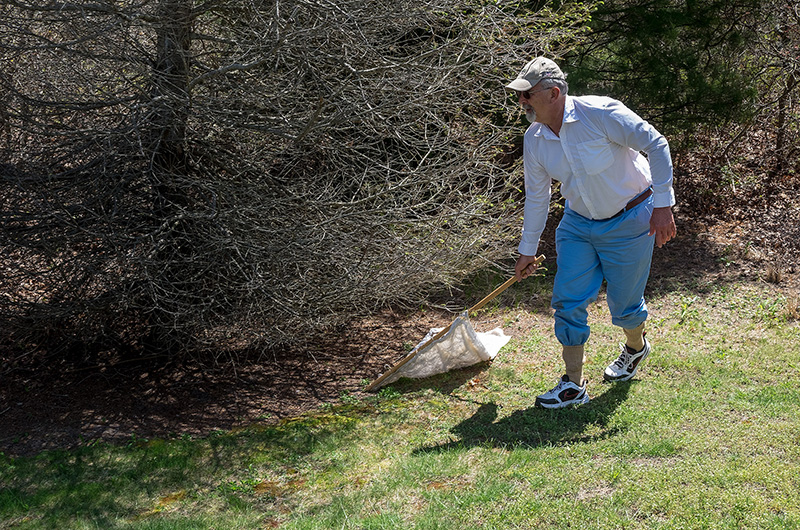
The county will take over the tick-borne illness prevention program led by Island biologist Richard Johnson.
With the persistent threat of tick-borne illness on the Island, including debilitating Lyme disease, this is the season for vigilance when it comes to ticks. They come in all shapes and sizes, including Lyme-carrying deer ticks hardly larger than the period on this sentence. Lone star ticks, a southern species with a painful bite recently identified here, are also spreading across the Island.
Two new developments, one on the Vineyard and one in Boston, may help combat the growing threat. The man at the center of both is Richard Johnson, the Island biologist who has almost singlehandedly led the Martha’s Vineyard Tick-Borne Illness Prevention program in recent years. The program offers yard surveys and educational outreach, among other things. Funding came initially from a hospital mini-grant and later shifted to donations.
Now the program is shifting again in an effort to provide Mr. Johnson with some much-needed assistance. This week the Edgartown board of health and Dukes County Commission signed a memorandum of understanding that transfers administration of the tick-borne illness program to the county. The memorandum outlines its purpose as improving access to services that lower the risk of tick-borne illness and tick habitat management. It runs for one year and will renew each year unless it is amended. It also establishes a fund for collecting donations and grants through the Permanent Endowment of Martha’s Vineyard, a community fund.
The changes will allow Mr. Johnson to have a small office space and hire summer workers to assist with the growing workload.
“The county is the logical place,” Mr. Johnson said in an interview this week. “This way I’ll be able to hire a couple of people to help . . . we can do a lot more [yard] surveys.”
Edgartown health agent Matt Poole, who is also part of the tick-borne illness prevention initiative, agreed.
“Basically we’re finding a permanent home for the tick program,” he said. “This makes it more official.”

Dr. Sam Telford (left) and Mr. Johnson spoke this week at the Vineyard Haven Library, which is sponsoring a three-part summer series on ticks.
Dr. Sam Telford (left) and Mr. Johnson spoke this week at the Vineyard Haven Library, which is sponsoring a three-part summer series on ticks.
Another recent development is a plan by Massachusetts Fish and Wildlife to start the deer archery season two weeks earlier in areas of eastern Massachusetts, including on the Vineyard. The proposal to extend the season to eight weeks before Thanksgiving has been approved by the Fish and Wildlife board, and still needs approval by Gov. Charlie Baker.
Mr. Johnson wrote a letter to the board in April voicing support for the plan. Fish and Wildlife spokesman Marion Larson said this week that the initiative is in fact a coincidental attempt to align the New England archery season with other areas of the U.S. “We’re not looking at this as addressing the deer population management issue,” she said. “Ticks are not really our realm of expertise.” Nevertheless, Mr. Johnson said it will help boost the wide-ranging effort on Island to increase the harvest of deer, whose population is at an all-time high. Mr. Johnson and other leaders in the program have long argued that lowering the deer population is one of the most effective tools for reducing the incidence of tick-borne illnesses. An informal survey of 118 Island hunters last year found 80 per cent supported an earlier start to the archery season. “We have focused much of our effort on education, however, to be truly successful we believe we also need to reduce the number of deer on the Island, currently estimated to be as high as 40 deer per square mile of suitable habitat,” Mr. Johnson wrote in the letter to Fish and Wildlife.
He is also working with Island property owners in an effort to open up more land to hunting.
The efforts have seen small but encouraging results. Mr. Johnson said 704 deer were harvested on the Island last year, an increase from the average of 650 in the few years before that. Also last year, a pilot venison donation program coordinated by the Island Grown Initiative allowed for venison to be distributed through the Island food pantry. Mr. Johnson said he is hoping to continue the program this year.
Mr. Johnson announced the signing of the memorandum during a tick informational session in the Vineyard Haven Public Library on Tuesday. The talk kicked off a spring and summer series on ticks and tick-borne diseases.
The room was packed with residents of all ages. Dr. Sam Telford, a parasitologist and expert on tick-borne diseases, and Dr. Michael Jacobs, a retired Island internist, answered questions that ran the gamut from natural remedies for tick bites to whether ticks can fall from trees. They also discussed how to identify tick bites and protect yourself.
“There’s no such thing as summer flu on Martha’s Vineyard,” said Dr. Jacobs. “It’s a tick-borne illness.”
Mr. Telford gave a thorough review of all 11 tick-borne illnesses with cases in Massachusetts, including Rocky Mountain spotted fever, Lyme disease and others.
“I’m getting afraid to leave the building,” someone from the crowd joked.
But Mr. Johnson said people shouldn’t be terrified of the outdoors. Instead he urged the group to stay vigilant by spraying permethrin on clothing and consistently checking for ticks after any activities outside.
“This is not a tick Armageddon,” the biologist said. “We don’t want to make everyone so nervous that you can no longer enjoy yourself. You can stay safe.”
A second talk on June 19 will feature a presentation by AP science students at the Martha’s Vineyard Regional High School, who have set up a molecular biology lab to test deer ticks for infection. A third talk on July 12 will be a panel discussion at the Katharine Cornell Theatre about an innovative initiative led by an MIT scientist that involves possible genetic engineering in mice.
Comments
Where can I send a donation?
Brian Vineyard HavenWhere can I send a donation?
Would it be a good start to
deshandra brown EdgIt would be a good start to begin with the white footed mice in order to control ticks. If there was a concerted effort to use permethrin treated cotton balls, easily put in used cardboard toilet paper rolls or paper towel rolls it would be a good start. Much less expensive than the commercially available 'tick tubes'. This along with the deer reduction would be a logical way to confront this health issue. It would be a good project and its a win win for every property owner to participate.
I am told that cotton balls
john hauck chilmarkI am told that cotton balls soaked with lice shampoo is just as effective and less expensive. Place in cardboard tubes the same way.
Happy to learn of this group.
Meg AquinnahHappy to learn of this group.
Hope the task force has a mix of experts: biologists, ecologists and home owners.
Aside from vigilance and the deer purge plans need to include acute interventions:
1. Clear paths and make them wide.
2. Use of Permethrin. It kills ticks in early larval stage when they attach to mince. That’s the fastest way to rid your property. Use it judiciously but use it.
If you live on Aquinnah expect to find a range of ticks.
Sorry to disappoint.. organics don’t work. They may be a deterrent for some flying insects but not ticks. And the CDC data back up this claim.
Happy to donate my time or money to this cause. Please post a follow up link.
Where does one place the
Fern Vaughan EdgartownWhere does one place the cardboard tubes?
A couple of chickens will rid
Matthew Whritenour AquiinnahA couple of chickens will rid most properties of ticks, without the risk brought by dangerous chemicals. Hens are quiet for the most part and you have the benefit of free eggs!
Good morning,
Pedro D'Orléans-Juste Sherbrooke University Medical SchoolGood morning,
Albeit I am not a parasitologist, I have been working for several years with US colleagues interested in tropical parasite infections.
It may be worthwile considering an alternative to the genetically engineered mice to be dissiminated in one of your remote islands. Basically, it may be more cost effective (i.e time, $$, environment) to genetically modify the tick (now that its genome is known) and spread non fertile subjects in the wild during their sexual reproduction phase. This will have a dramatic effect on the tick population without altering the genome of a mammal species.
There is plenty of literature on that topic.
Regards
Pedro
[email protected]
Add new comment