


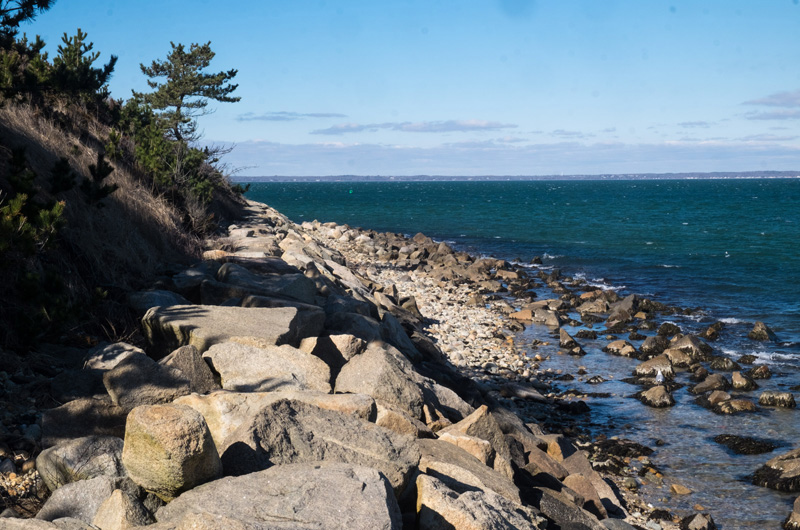
The report that parts of East Chop Drive have been deemed unsafe is sad news.</p>
The report from an engineering consulting firm that parts of East Chop Drive have been deemed unsafe, possibly even for pedestrians, is sad news. Some of my happiest early memories are of walking there.
In the 1890s, my great-grandfather, Jean Baptiste Meras, came to the Vineyard to teach French at the Martha’s Vineyard Summer Institute. Soon he built a red-shingled house he called Mon Repos on Arlington avenue in the Highlands near the institute, which by then had some 700 students from 35 states and was known for its (new at the time) Berlitz language program.
I spent my earliest Island summers in the house next door to Mon Repos. That house was Sans Souci, owned by Madame Chatelaine, another teacher at the institute. Both houses were a three-minute walk through the woods to the bluffs — not counting stops at blueberry and huckleberry patches en route.
In those days, I would run next door to my great-grandfather’s after supper in search of my grandmother, who was his daughter in law, and her mother. My French great-grandfather and French grandfather, my American-born grandmother and my German-born great-grandmother summered together in Mon Repos — all looked after by my American-born aunt.
In what I now know was a typical European after-supper tradition, the two grandmothers and I would walk to the bluffs. There we would settle on a green bench and listen to the Vineyard Sound waters lapping on the rocks below. Whenever we had friends or family leaving on a steamship, we would also hurry down to the green bench at the top of the bluffs to wave a farewell white handkerchief to the departing guests. Now of course I doubt that even from the top deck of the venerable Naushon my little white handkerchief could be seen. But then I was sure that it was. There was plenty of room in those days too to skip along the blufftop on the grass.
By the time I was six, we stopped summering on Arlington avenue. My father had bought his own house — the turreted former Baptist Reception House on Monroe avenue not far from the East Chop Tennis Club. Though it was a slightly longer walk from the bluffs than Arlington avenue had been, it was within sound of a clanging bell buoy and the West Chop foghorn, and was closer to the East Chop Lighthouse. And we had no need for a pretentious French sign like Mon Repos or Sans Souci. The house came with a big black sign with gold lettering on it that informed the neighbors that our home had once been the Baptist reception house. It had been moved from the Baptist Camp Meeting Grounds that once were behind today’s Ocean View Restaurant. But the Baptists had failed to attract the high number of camp meeting attendees that the Methodists had, and their camp ground had not prospered.
We had a collie and a white cat with black spots and a withered ear. They substituted for my grandmother and great-grandmother on evening strolls. The collie, Jock, reveled in chasing rabbits that hid in wild rose patches near and on top of the bluffs. Domino, the cat, followed us on our walks, but disdainfully watched Jock’s awkward attempts at rabbit-catching. She knew much better how to creep up on the rabbits as they hopped in the woods close to our house. My brother John, a fisherman and sailor, always insisted that Domino had a withered ear because she had climbed down the bluffs and eaten what remained in scallop shells fishermen had hurled over the bluffs. (I never believed that that was the reason for Domino’s withered ear, but a Gay Head fisherman told me, and Everett Poole of the Chilmark Chandlery in Menemsha confirmed, that John may have been right. The slime in tossed scallop shells can wither animals’ ears if they eat it.)
In any case, the blufftop continued to be my favorite place for strolls. It was favorite place too for watching the lighthouse flash its warning beam to boat skippers heading into Vineyard Haven harbor.
Later when I was a teenager, the blufftop was the perfect spot to go with a male companion to watch the moonlight over the water The road was also a fine place for bicycling in those days. And when my brother and his friends, Steve Chamberlain and Jack Hathaway, went on all-day sails in our catboat Ted, the blufftop had another use. It was the place where my Colorado-born mother would nervously stand at day’s end, hoping to see the Ted sailing home. Admittedly $15 to $20 million is a sizable sum to shore up the bluffs, but after all they have given Oak Bluffs its name — and aren’t they a scenic landmark worth trying to save?
Comments
Phyllis Meras
David Whitmon Oak BluffsPhyllis Meras
Thank so very much for writing this, for sharing this with us all.
Your words, your writings are as painting as I envisioned those days of your childhood.
Save The Bluffs
Again Thank You.
David Whitmon
Oak Bluffs
Yes,
Rex West TisburyYes,
and thank you, Phyllis, for deepening the sense of place.
My grandparents on my mother’s side rented there only once in the 1970s, and that contributes to my sense of nostalgia for the Bluffs. I recall scurrying down the steep bank with my young uncle on an old path that soon later was closed off.
Preserving the elevations at East Chop Drive for walking and non-motorized public transportation paths would be invaluable community assets for generations to come.
In summer 1960, I too walked
Peter Becker Port Angeles,WashingtonIn summer 1960, I too walked the East Chop bluffs from July 15 to September 15.... and drove tourists as a tour driver for the old Westley House Hotel. These many years later as an oceanographer who's degree from Old Dominion University put me in contact with NC State, I understand that the hardening helped destroy the bluffs.. see: https://www.ccee.ncsu.edu/people/overton . She is a woman who knows as much or more than my professor who she also studied under!
Peter Becker Ph.D.
The bluffs will be there. It
Realist MVThe bluffs will be there. It is only a question of where, give or take a few hundred feet. I am not convinced the taxpayers of OB should foot the bill to protect the homes of some very fortunate people just to provide an historically and geographically consistent path. Let the bluffs settle, find a new path for walking, jogging, cycling along them. Or let the beneficiaries of this civil project pay for most of it, and let the vast majority of oak bluffs tax payers fill in the rest, appropriate to the value gained by a quick walk by. A pleasant memory is not worth displacing our less fortunate residents...we are talking about serious money here...thousands for each real taxpayer...many of whom don't have it. You build on an eroding bluff, you get the joy of a cliff top view. When it is threatened, you want every last teacher, nurse, bartender and other low wage earner to pool resources to pay to keep you on the bluff? You were born lucky but not that lucky. Let the bluff find its natural place.
Myopic --- dear Realist --
Susan of OB West Hartford, CTMyopic --- dear Realist -- the bluff is a geological need, not one for protection of the "very fortunate". It is serious money -- but if you look at the impact of "Nature" on the dunes on our precious beaches and the bluffs....we can let nature take it's course, or try to do something. Enough of the low wager earner and "real" taxpayers......I pay taxes, I don't send kids to the schools. Born lucky -- or lucky to still be breathing/walking.
You may not send your kids to
Realist MVYou may not send your kids to schools in OB, but you were given the right to a free education, and it was paid for by a lot of people who didn't have kids in school at that time. It is the oldest argument of second home owners, and it isn't hard to understand why. It is true, the schools are about a third of the budget, and people like you without kids in schools don't get a penny for a third of your tax dollars. Schools benefit a community broadly, at least the year around residents, and that is why you'll never see tax bills adjusted by household for use. Although that has been proposed by "pull the ladder up" republicans for decades. Incidentally, I don't have kids in school, but I always support spending on schools. My point is that a major project like this benefits everybody, from taxpayers who live on the bluff to taxpayers who don't, and day trippers and all the others who tour East Chop. But, it does not benefit them broadly or even close to equally, unlike education, and it is common for a town to charge those who benefit disproportionately from a project a significant chunk of the bill. Think sewers and roads..."betterments." The relative value to a bluff homeowner vs the value to a pedestrian is extraordinary. 1000 to 1? 10000 to 1? The tax bill should reflect that. This is something of a low wage earner populist response (though not of the Trump variety of populism). I'll pay taxes for other people's kids all day long. I'm not interested in saving some luxury second homes unless they pay a lot more to do it. Those are just my values. We are all lucky to be here breathing and walking. I'm for funding schools and public projects that benefit year-round residents, and supporting boutique projects to the degree appropriate to the benefit gained by common residents. Charge a betterment, raise some charity money (they got a couple million to bring back a movie theater), or let the bluff re-settle and find its proper place in our ever shifting geography.
The best part of this
Page RogersThe best part of this remembernace for me was the sharing of the sailing adventures of my “Uncle” Jack Hathaway in The Ted: to which I would add, that Phylllis Meras’ mother was not the only anxious presence pacing the bluffs. Further inshore and overlooking Oak Bluffs harbor was Jack’s mother: Harriet Hathaway, and grandmother Susan Cummins watching from their perch on the “elbow” of Spruce Avenue. And yes, there is a lovely bench there as well. Thank you Phyllis!
Add new comment