


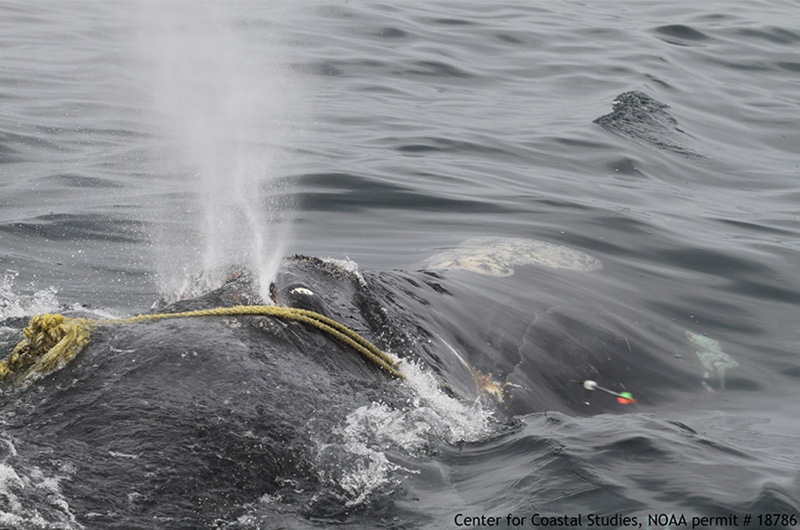
<p>Rescuers have been working to free an entangled female North Atlantic right whale, one of the many that have made their seasonal arrival in waters south of the Vineyard and in Cape Cod Bay to feed.</p>
Rescuers have been working to free an entangled female North Atlantic right whale, one of the many that have made their seasonal arrival in waters south of the Vineyard and in Cape Cod Bay to feed.
The mature female, a great-grandmother known to be a prolific breeder, was seen last week off Stellwagen Bank with rope tightly wrapped around her upper jaw and over the top of her blow hole, according to the Center for Coastal Studies in Provincetown.
Named Kleenex, the whale was seen by the Northeastern Fisheries Science Center’s aerial survey team from the air on April 12. The Center for Coastal Studies marine animal entanglement response team responded and began trying to free the whale using a cutting arrow fired from the deck of a boat.
The center said in a press release that the arrow damaged and should weaken the rope, causing it to deteriorate over time and fall off the whale. The whale will continue to be monitored, the center said. As of Tuesday she had not been seen since the rescue effort.
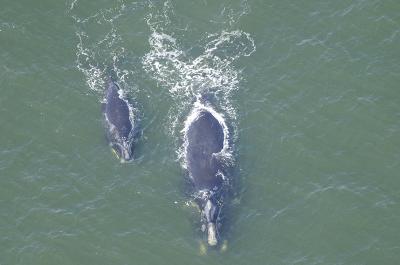
Kleenex swims with her last calf in waters off Georgia in 2009.
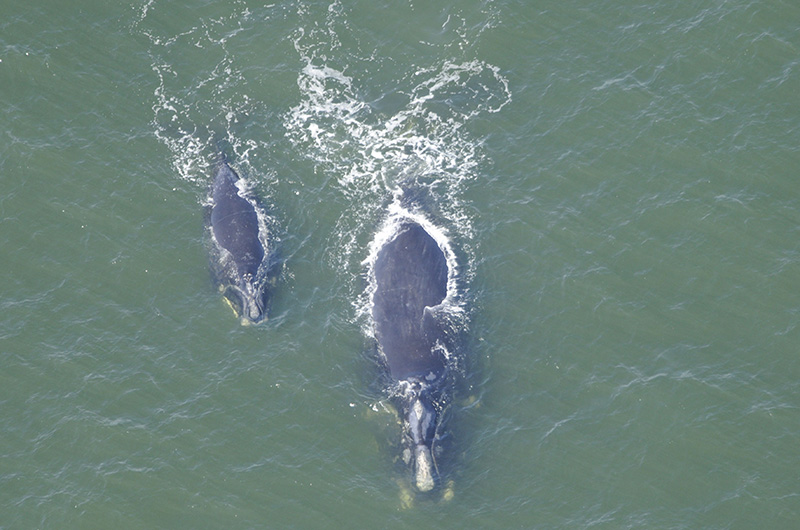
Kleenex swims with her last calf in waters off Georgia in 2009.
The Center for Coastal Studies said the whale is in poor condition and has been entangled for about three years
April is prime time for right whales to arrive in Cape Cod Bay and surrounding areas, where they feed on copepods.
Scientists say the health of mature breeding females is critical to the small, dangerously declining population of right whales, which now numbers about 435. Last year 17 whales died, and so far this year researchers have yet to find a single calf born.
Kleenex is a “superstar mother of the North Atlantic right whale population,” New England Aquarium spokesman Tony LaCasse said in a press release this week. Right whales are identified by unique patterns of callosities on their heads.
In the past Kleenex has been identified as a successful mother, he said, an anomaly for a species that gives birth every three years and in which female whales have to be healthy to bear and nurse 15-foot-long babies.
Scientists first photographed the female in 1977; she was with a calf at the time. Female whales reach sexual maturity at about nine years of age, making Kleenex around 50 today.
Since 1977 she has had seven more calves, putting her in the top six of right whale mothers with the most offspring. She is a great-grandmother now, directly responsible for about 22 right whale descendants, Mr. LaCasse said, of which 20 are still alive.
Scott Landry, the director of the physical response team, said the loss of a breeding female and her future calves can have a severe effect on the entire population. “This is exactly the individual we are desperate to help,” he said in a press release.
North Atlantic right whales are among the most endangered marine animals, and scientists estimate the species could go extinct in the next 20 years.
Fishing gear entanglement has been cited as a prime threat to right whales, which feed close to shore and near surface. When not immediately fatal, entanglement causes the whales to lose weight and expend extra energy as they drag the gear. When female whales lose weight, they do not reproduce.
Scientists are working to develop so-called ropeless fishing technology, which would help prevent entanglements in snow crab and lobster pots and other gear. Meanwhile, the whale population continues to wane.
“For more than a half a century, Kleenex has defied the odds of survival and been a pillar of the right whale’s modest recovery,” Mr. LaCasse said in the release. “Let’s hope that she sheds the entangling gear.”
The arrival of right whales occurred off the Cape and Islands early this spring. An aggregation of eight whales was seen 20 miles south of Nantucket in late March, according to NOAA fisheries. A map of recent sightings shows individual whales were seen directly south of the Vineyard as recently as last week.
A temporary voluntary vessel speed restriction zone was in place south of Nantucket for several weeks in late March and early April, ending on April 12. The temporary speed restrictions are put in place where groups of right whales are seen on a consistent basis. Mariners are asked to either avoid the area or travel at 10 knots or less when the restrictions are in place.
Comments
Enough. Enough! What does
Carol formerly ChilmarkEnough. Enough! What does it take to get the attention of elected officials to regulate what is acceptable fishing gear? We can give tax credits to cover the cost of replacing said gear. We don't allow dynamite fishing, right? We shouldn't allow fishing with gear that's drowning right whales, either. This is awful.
Most of these whales are
Rose Writes CanadaMost of these whales are gravely ill and once they get entangled it's like dead leaves caught in a sewer grate.
And I hate to say it, there were about 100 whales that died. We are only hearing about the ones that washed ashore. Their population is at about 350 (at best).
I alerted the NOAA April 2017 about Wolbachia most likely being the root cause of North Atlantic right whale mortality. They (and others) have completely ignored the study literature I sent them.
Note: Any baleen whales will be susceptible and I understand they often suffer abrasions around their mouths (which could be the source of entry for Wolbachia). Secondary predation and co-ingestion are other means of infection.
Wolbachia is a reproductive parasite. It can live outside of a cell for (at least) 1 week with no decrease in viability. It can also be grown in human lung cells at 37 degrees C (normal body temp). These whales have a body temp. very close to ours.
Also, N.A. right whales are highly promiscuous. And, whales have also suffered West Nile virus and St. Louis encephalitis virus. Zika is supported over 97 percent within that phylogenetic clade. I highly suspect Zika is the phage that is enabling Wolbachia to infect vertebrates (including humans). But other viruses could too.
I wrote to the pathologist, Dr. Daoust, who led the necropsies in Canada. His response (also used twice in their official report): An infectious cause "cannot be ruled out, but is unlikely". Imagine if we said that to a woman that might be pregnant, LOL.
I have a petition (has ~ 963 supporters now) to demand these whales are tested for Wolbachia because azithromycin might save them from extinction. My (our) latest petition update: https://www.change.org/p/investigate-north-atlantic-right-whale-deaths-…
Free Kleenex !
BFFree Kleenex !
Why cant the coast guard drop
Ken Edg.Why cant the coast guard drop a couple divers down there to cut that rope off.
...because the Coast Guard
Carl H Tisbury...because the Coast Guard doesn't have trained divers for that. You're probably thinking of the movies.
NOAA and several aquariums and other research organizations have trained disentanglement teams. It is a lot harder and more dangerous than it looks, and the stakes are high (one slip with a cutting tool could kill the whale).
The experts are working on it.
Add new comment