

<p>Shotgun hunting season began Monday, and the weigh station was busy this week with hunters, biologists collecting ticks, and a new deer donation program.</p>
The Monday after Thanksgiving is a day Chris Calabrese waits for all year. This year, as, usual, he was out bright and early on a cold, clear Vineyard day for the opening of shotgun deer hunting season.
“It wasn’t too shabby, can’t complain,” Mr. Calabrese said with a broad smile. “It was a little nippy standing there but besides that, not too shabby.”

Hunters congregate at check-in station during first week of shotgun season.
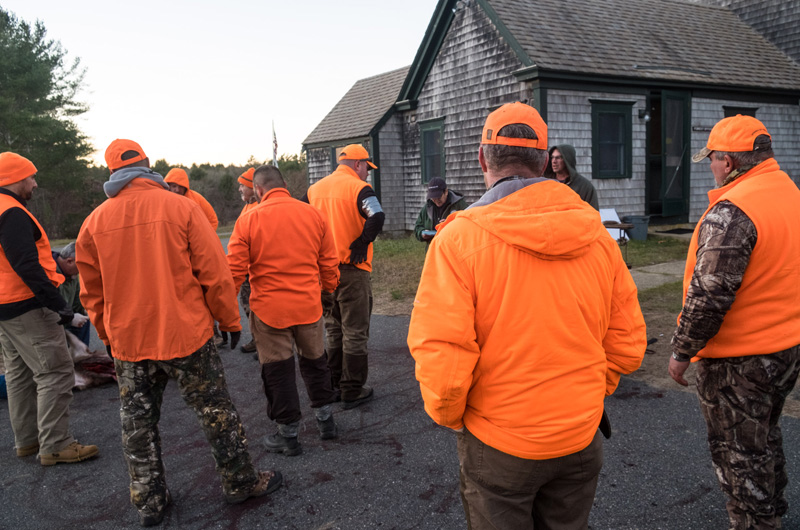
Hunters congregate at check-in station during first week of shotgun season.
He was standing at the official weigh-in station at Manuel Correllus State Forest headquarters with 10 or so other hunters. They were there to weigh and report deer to be tagged by the Massachusetts Division of Conservation and Recreation.
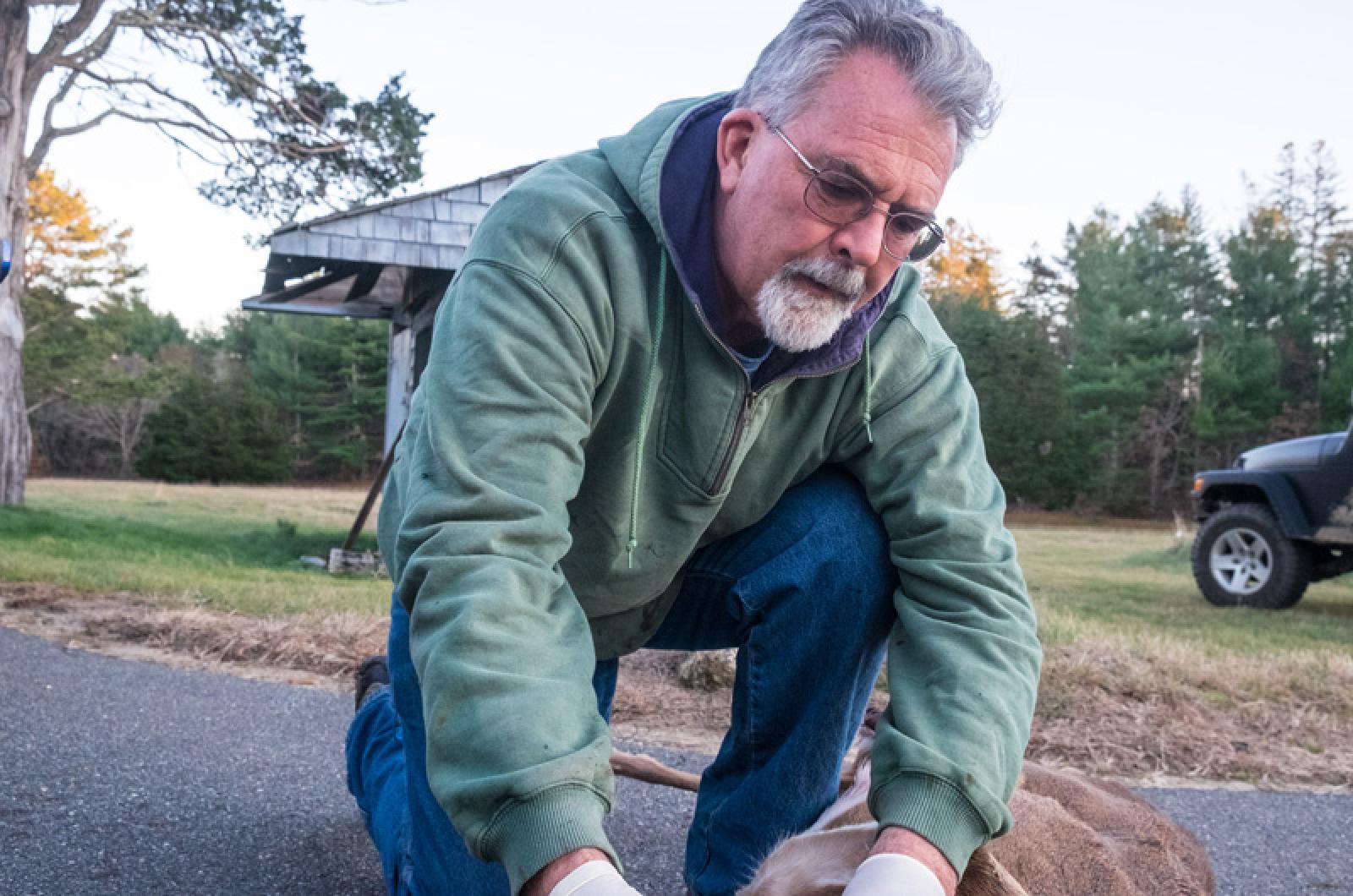
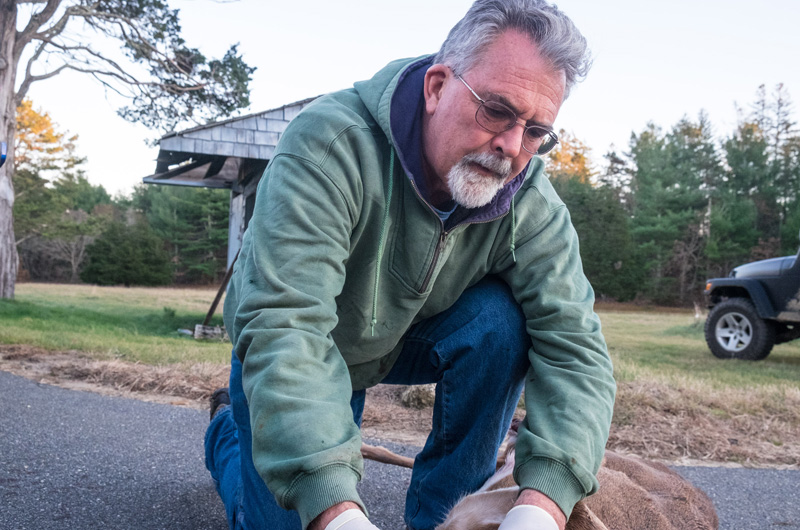
Mr. Calabrese has just weighed in a five-point, 113 pound buck.
“He came running across the opening in scrub oak,” said Mr. Calabrese. “I saw him bounding, I saw antlers, tail, antlers, tail, antlers, tail. Then he stopped right in the opening, 30 yards.”
Mr. Calabrese usually hunts lobster, and says when he’s not on the water, he’s in the woods.
“Being outside, harvesting my own food, don’t have to worry about it being all processed, it’s nice, very nice,” he said. “I work on a lobster boat, I got a lot of free time, I get out in the woods quite a bit.”
As always, state agencies and Island police departments urge caution during the annual shotgun season, which began on Nov. 27, and ends on Dec. 9, with the exception of Sundays, when hunting is illegal in Massachusetts. Hunting can begin a half-hour before sunrise. Sunrise is about 6:50 a.m. this time of year. The hunting day ends a half-hour after sunset, about 4:13 p.m. this time of year.
By regulation, hunters must wear 500 square inches of hunter’s orange clothing, and non-hunters walking in the woods are strongly urged to wear orange, too. Hunting is not allowed within 500 feet of a dwelling in use, unless the hunter has the permission of the owner, or 150 feet of a roadway.

Farm Hub director Matthew Dix awaits donation of venison for new collaborative effort this year.
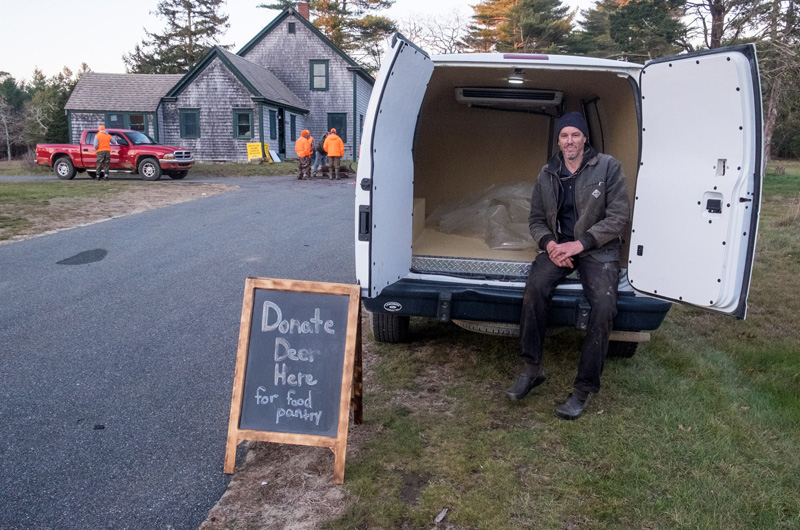
Farm Hub director Matthew Dix awaits donation of venison for new collaborative effort this year.
At the weigh-in station, Island biologist Dick Johnson collected ticks from the deer brought in for tagging, sliding the tiny insects into a glass tube. They will be shipped to the Tufts University Cummings School of Veterinary Medicine to be analyzed for any new trends in tick-borne diseases.
Mr. Johnson says this early in the hunting season is too soon to determine any trends in the number of ticks.
“It seems like a fairly typical year, not as bad as some I’ve seen, worse than some others,” said Mr. Johnson. “I heard earlier a lot of bow hunters were saying there were a heck of a lot of ticks on the deer, but that happens, they’re out more. October is when the deer ticks are out really strong. It’s getting a little cold for them now. This is pretty borderline. If it gets any colder than this they won’t be active, they’ll drop down and hide out in the leaf litter.”
The 2017 hunting season marks the beginning of a new collaboration between town boards of health, the Island Grown Initiative (IGI), and the Island Food Pantry.
After taking as many deer as they want or need, hunters are encouraged to take additional deer and donate the meat to the food pantry. IGI and the boards of health will transport the harvested deer to The Larder at the end of each week, where the meat will be safely processed.
The first goal of the new program is to reduce the deer population, and tick-borne disease. Deer play a critical role in the life cycle of infected ticks. The second goal is to provide Island families in need with venison, a very high protein, lean meat.
IGI executive director Rebecca Haag was also at the weigh-in station Monday, handing out flyers and talking to hunters about donating deer. A truck will be staged at the weigh-in station each day from 4 p.m. to 6 p.m. to accept donated deer.
“We know that the first week or so there will be a lot of people who are going to process their own meat, use it for their family and friends,” said Ms. Haag. “But part of this is to encourage them to take additional deer so we can reduce the deer population, and the deer tick problem. Once they’ve fed their family or given it to their friends, come donate your deer, we’ll pay for the processing, we’re going to donate it to the Island Food Pantry. We’ve developed some recipes for the use of the meat, We’re going to add 20 per cent pork to the ground deer, and distribute it through that system and get it to the people in need. It’s a great source of protein for those families.” Costs of the food pantry deer donation program are being paid for by an anonymous donor.
In Dukes County, hunters are allowed to take two antlered deer (with horns longer than three inches) each year. Effectively, they can take as many antlerless deer as they have permits for. Antlerless permits cost $5 each.
A separate program that would have would have subsidized the processing of deer for hunters who take additional deer didn’t quite get off the ground this year, according to Edgartown board of health agent Matt Poole, but he said local officials will try again next season.
He said he is pleased that the food pantry donation program is up and running, and already receiving deer to be processed.
“It’s a trial, and it’s a bit of a public education process to allow people to learn about this opportunity, hunters all the way through to the consumer,” said Mr. Poole. “It’s a seed. The goal is absolutely to increase the harvest, but we’re going to increase the harvest through a good system. We’re probably going to have to refine it, but we’re pretty happy with what we have in place. We’re creating the Vineyard model, trying to lead by positive example. Hopefully, we’ll have something that can handle more volume next year.”
For more information on donating deer to the food pantry, call Island Grown Initiative at 508-687-9062.
Comments
I Don't understand all the
Judie WTI Don't understand all the glee, over killing these beautiful animals,breaking up their family units, like the slaughter of Elephants in Africa.I found a blood trail from a wounded deer on the bike path that had run across the road trying to escape,leaving a trail of blood across the path and on the leaves on both sides of it, probably to die a slow painful death in the woods.None of this has anything to do with Lyme disease,or providing food for the elderly.Gun shots along the ancient way ,where there are homes not 20 feet from the trail,with family pets and farm animals.All for the thrill of the kill.I just don't get it.
Judie..I agree with you. If
Faith Lubitz Northampton MAJudie..I agree with you. If the deer ticks were causing Lyme..the deer would be sick, too. They are mammals, not that different from us. Lyme is being caused by something more sinister, like man-made pesticides or other chemicals.
Lyme disease is a bacterial
Carla CooperLyme disease is a bacterial infection transmitted by being bitten by an infected tick. It takes 5 seconds to Google it.
Deer cannot acquire lyme.
Dan OBDeer cannot acquire lyme. They are immune to the bacteria.
It is in no way acceptable
Brad CambridgeIt is in no way acceptable for dear to be presumably injured by gunfire and left for dead. Hunters should be sure that have a shot that will kill in a quick manner. That being said with no common predator on the island the population simply has to be managed. Your love for deer is noble, but care for human lives is more important. Unkempt populations of dear leave drivers susceptible to major accidents. The spread of Lyme via dear is also a major concern, but could not be eradicated strictly by hunting deer - making the research so necessary.
Would it be easier to
Dana Nunes VHWould it be easier to understand if they were less “beautiful?” This is New England and like so many other places, hunting is a tradition here, whether it’s for deer, bluefish, lobster or scallops. Most people are carnivores, to one degree or another and I find more admirable the ones who acquire by hunting/foraging their own food as opposed to ones who will happily dine on pre-packaged food, the origins of which are unknown to them (and they would probably like to keep it that way). It’s a fact that there are just too many deer on this island. Driving from VH to Chilmark earlier this week we saw two lying by the roadside, the result of collisions with cars and there’s likely not a day that goes by without at least one incident. It’s possible that this may be what caused the blood trail you witnessed. I can understand that you “don’t get it,” but this is someone else’s choice, different from yours. Try to see it with a unjaundiced eye.
Where does your meat come
Dan ObWhere does your meat come from?
Without predators the deer
Brad EdgartownWithout predators the deer population has no way of remaining in balance. Perhaps you’d rather bring back coyotes and wolves to keep the deer population in check. But then those family pets and farm animals would also fall prey.
Very thoughtful program
Joel KatamaVery thoughtful program across the board. Many thanks to all involved for this.
90% of the time a hunter
Bill Ct.90% of the time a hunter shoots a deer it is normal that the animal runs a distance before it expires. It's just the way it is. I'm sure if it was shot by a hunter it's normal there was a blood trail and the hunter followed it to collect the animal. Nothing out of the ordinary for anybody that's familiar with deer hunting.
Add new comment