


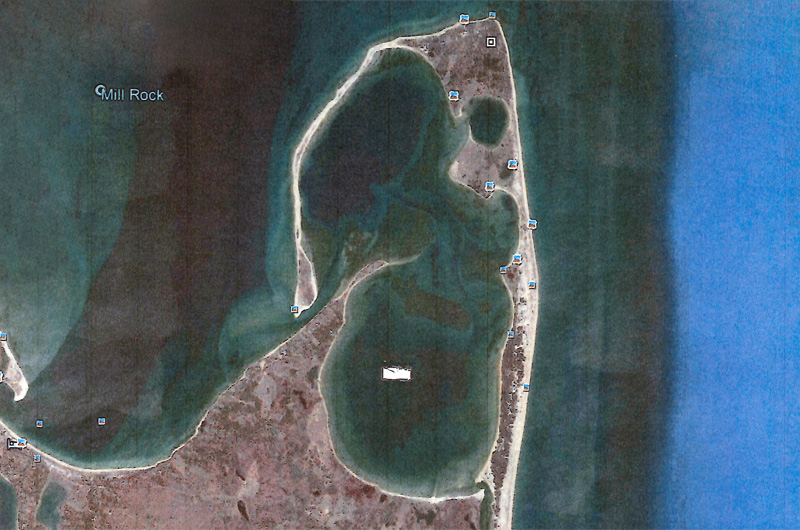
<p>The Edgartown shellfish committee delayed a formal decision on a plan to open Cape Pogue Pond for oyster farms, with tension over protecting a pristine pond and competing interests.</p>
The Edgartown shellfish committee has delayed a formal decision on a plan to open up Cape Pogue Pond for oyster farms, following a public hearing this week that saw tension over protecting one of the most pristine ponds on the Vineyard and competing interests among commercial shellfishermen and a new breed of oyster farmers.
In September, Edgartown resident Noah Scheffer applied for a one-acre oyster lease in the south end of Cape Pogue Pond, a vast saltwater embayment that lies off the extreme northeastern end of Edgartown. After discussion with selectmen, the shellfish committee decided to create a broader plan for eight one-acre lots to bring to a public hearing process. The new lease area would have to be approved by the shellfish committee, selectmen and the state.
About 30 people gathered at the Edgartown library this week for a hearing about the proposal.

Bay scalloping at Cape Pogue, a pristine saltwater embayment.
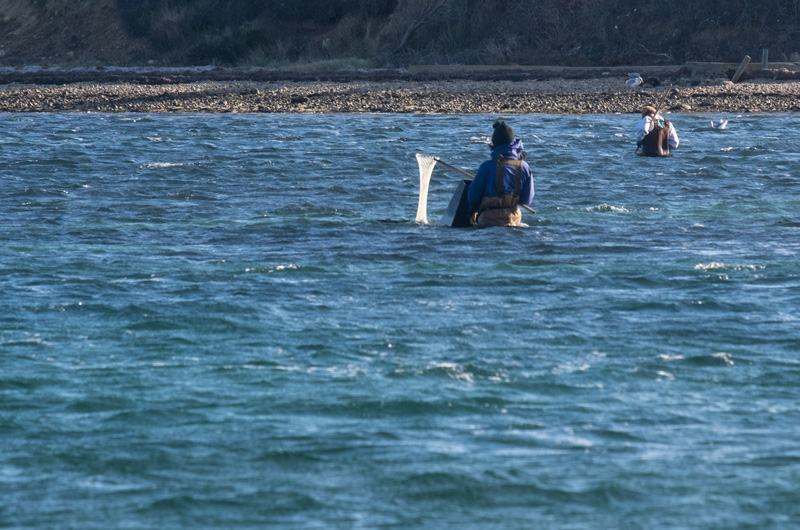
Bay scalloping at Cape Pogue, a pristine saltwater embayment.
“I would like to be able to fish the water that isn’t really being used,” Mr. Scheffer told the committee. “I know I could make a good living, and other people could also make a good living right there.”
His wife Lauren said the oyster lease would allow their family to stay on the Island. The couple is expecting a baby in two weeks.
“This isn’t just about our family. It’s about potentially eight families that will have sustainability on the Island. I grew up here. Noah grew up here . . . we hope our son some day will want to be an oysterman,” she said. “It’s about adding jobs to the town, being able to create more revenue and about keeping an Island tradition alive that seems to be dying.”
Oyster farming is a growing industry on the Vineyard, and Edgartown has long been a pioneer in the effort, first leasing lots in Katama Bay in the late 1990s as the troubled fishing industry began its downwar spiral. According to state records, more than three million American oysters were harvested in Edgartown in 2016 at a value of almost $1.8 million. Edgartown is the fourth most productive oyster aquaculture area in the state.
But Katama Bay is now maxed out with a dozen oyster leases and a waiting list for open spots. Town leaders recently expanded oyster farming to Eel Pond, although the area is exposed to Nantucket Sound, making access difficult during rough weather.

Shellfish committee continued public hearing for two weeks.

Shellfish committee continued public hearing for two weeks.
Cape Pogue Pond, surrounded by hundreds of acres of unspoiled conservation land and barrier beach, is also historically rich with natural shellfish resources and at one time saw more bay scallop landings than anywhere in the state. Bay scalloping remains strong in the pond, although the landings have declined in recent years as they have around the Island. Some parts of the pond are also used by commercial conch fishermen.
Edgartown shellfish constable Paul Bagnall said this week that several aspects of the Cape Pogue proposal have yet to be determined, including whether lots would be awarded to those on the wait list for Katama Bay leases. It would take at least a year or so to get operations underway if approval is granted, the constable said. At the meeting Tuesday he said the proposed expansion would not require additional staff for his department.
But commercial fishermen and Chappaquiddick residents sounded an alarm about expanding oyster farms to Cape Pogue Pond.
“A lot of people make their living there scalloping,” said Donny Benefit, a commercial fisherman who said he fishes for conch in that part of the pond. “I make a living there in the spring right where they want to put these oyster grants . . . this is probably one of the best spots on Cape Pogue.”
Between Katama Bay and Cape Pogue, the town would be “taking bottom area from the rest of the town for 18 people,” he said. “Giving licenses and taking money away from me. You guys gotta think about it.” Chappaquidick resident Ann Floyd urged further research on the issue, given the long history of protecting Cape Pogue Pond. “We’ve done our best to preserve that pond in as pristine a condition as possible,” she said.
“I understand them wanting to succeed on the Island and everything but I love the pond,” said Debbie Manley Smith, a commercial scalloper. “I think it should be left alone. It’s a beautiful pond, we all make money from it . . . it just needs to be left alone. It’s one of the last places we have.”
Others debated the health of the pond and whether oyster farms, with fixed rafts and cages in the water, would be a benefit or detriment.
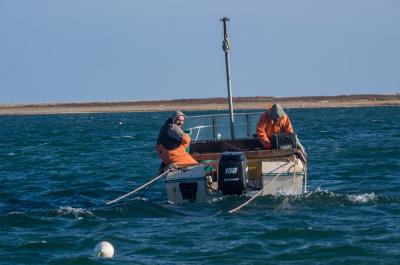
Cape Pogue Pond is historically rich resource for shellfish, including scallops and conch.
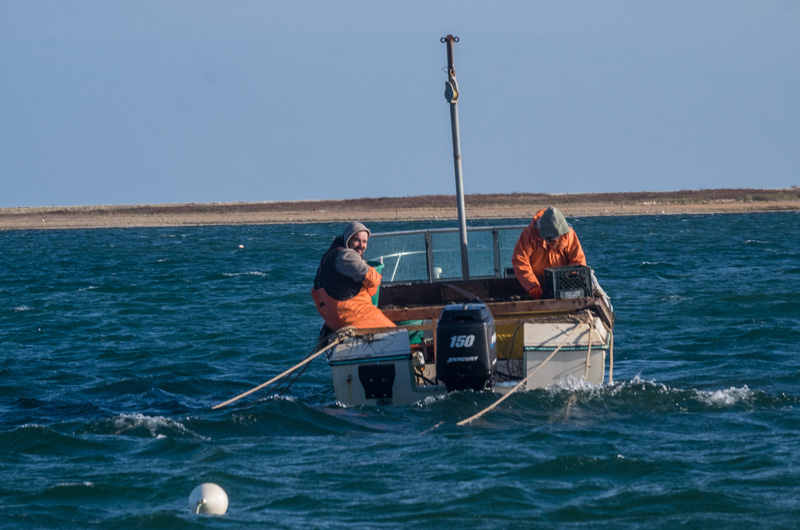
Cape Pogue Pond is historically rich resource for shellfish, including scallops and conch.
The state requires shellfish farms to operate in areas that are nonproductive for other species, and aquaculture is not allowed to cause major adverse effects on shellfish or other natural marine resources. According to the state, proposed aquaculture projects are also reviewed to look at potential conflicts with other fisheries and public use of the area.
Town regulations allow one per cent of a pond’s surface to be used for aquaculture.
Mr. Bagnall said the water quality at Cape Pogue has been closely monitored, and he noted that oysters remove nitrogen from the pond. He said in the heyday of scalloping, 25,000 bushes a year were harvested in town, while now 6,000 bushels a year is considered good.
Commercial fishermen said they support the oyster farmers but questioned parts of the plan. “Nobody has concerns about Noah,” Donny Maciel said. “There are living things at Cape Pogue. That’s the only concern I have. It’s not dead.”
Tom Turner, a longtime Edgartown commercial fisherman who has fished Cape Pogue Pond for 50 years, including for conch for 20 years, said he backs the oyster farm plan as proposed. “There’s never been eelgrass where this site is being proposed,” Mr. Turner said. “This would take away some of my fishing ground. I believe that productive oyster farms have greater value than these several-week fishery that I pursue.”
Committee member Ryan Smith, a Katama Bay oyster farmer, said he thought scallopers should be in favor of the proposal, because oysters help restore eelgrass, an important part of the bay scallop ecosystem.
“To me, it’s a fact that oysters benefit the pond,” Mr. Smith said. “I think it’s going to benefit the scallop industry.”

Some proposed a trial run of one or two leases in the area.

Some proposed a trial run of one or two leases in the area.
Some proposed a trial program of one or two leases. In the end the five-member committee voted unanimously to continue the public hearing for two weeks to give the committee time to read information presented Tuesday.
“I think there’s a balance, and I hear people are concerned with the health of the pond, and future health, and creating jobs for young families,” committee chairman Christian Thornton said, adding that he wanted to make sure this was the right place for aquaculture.
Other board members indicated they were ready to move forward.
“One thing I’m certain, is that for year-round people it’s hard,” Les Baynes said. “I’ve spoken with Paul and different people and it seems that are could sustain [aquaculture]. Personally I think aquaculture is here to stay. It’s going to grow.”
“My feeling is we should give Noah his shot, he should be allowed to go before the selectmen and see what they say,” he said. “I’d like to err on the side of the year-round people that’d like to stay here, and I really haven’t heard anything that would change my mind on that. I also feel I have the history of Katama and how it’s worked . . . it’s worked, they’ve been successful selling oysters everywhere, they have jobs, they’re part of the community.”
Shellfish committee member Nic Turner, also a Katama oyster farmer, said he heard both sides. “I’m conflicted as well,” Mr. Turner said. “I hear the comments about a beautiful, more wild space than some places that we have. I’m also an aquaculture farmers in Katama Bay so I see the value in aquaculture.”
He continued: “As a broad scope I would have to believe that ecologically, aquaculture is probably going to be a benefit for Cape Pogue, but I’m definitely hearing the opposition to it . . . I don’t take it lightly that possibly this space could be taking away livelihoods from other people while giving it to some.”
Comments
How can it not move through
Richard Very EdgartownHow can it not move through in that particular area ? If chappie residents are against it, that's ridiculous. Their walls are up and they've their private roads and beaches. The water is EVERYBODIES and the town and year rounders should have more say than the summer residents who already control beach access which to me is awful. Nantucket doesn't even have that ridiculous law. I don't see anyone talking about how the "summer " waterfront residents and their "lawns" mess up our ponds and bays when their fertilzers pummel them after rains and we can't go clamming. That's something no one wants to discuss. Let them farm . It's only fair. It's a win win.
Oh I see. And the locals don
deshandra brown mvOh I see. And the locals don't fertilize their lawns? And the locals who let their dogs run all over the place and defecate wherever they want...that doesn't get washed into the ponds? Ever heard of fecal coliform?
The only thing I would ask
Paulli D EdgartownThe only thing I would ask for is better marking in the water to route boats around - same for Katana Bay oyster farmers. I am concerned about how many licenses they are going to give out to take up space in Cape Pogue Bay. I would also question the math, 3 million oysters for $1.8 million. The time and cost at 60 cents an oyster, is this really worth it.
With all the construction work on island, and resources coming from off island to work here, can we not create a trade school for our island men and women?
Let’s look at the big picture
Philip Walsh Miami, FloridaLet’s look at the big picture: The sales of raw shellfish served on the half shell are on fire right now, and given the current evolution of distribution, the over night delivery of self refrigerated styrofoam boxes of Fresh From Martha’s Vineyard Oysters to Rocky Mountain ski resorts in Aspen, Vail and Jackson Hole, where half shell oysters sell for as much as $5.00 each vs. seeing what Boston’s paying that day makes it a business worth pursuing. Those who harvest the sea, be it for wild or farmed seafood, are eternally suspicious that their ex- vessel price benefits others in the supply chain far more than it does them, and they’re usually right.
Moreover, oysters, like all filter feeders, clean the water they grow in - and given the amount of new water the Cape Pogue’s tidal exchange provides, I don’t see nitrogen deprivation reaching damaging levels. The purity of the water in the Cape Pogue has been compared to that of a remote Pacific atoll, so aside from enabling islanders to earn a living growing, harvesting and, I️ would hope, merchandising and branding their own oysters (and what a brand!), the water in the Cape Pogue will emerge cleaner and clearer than ever before.
Oyster farming is as benign a form of Aquaculture as exists. It’s carbon footprint is negligible. I’ll be disappointed if this important initiative is voted down.
No kidding it would be a
James Pi3 Edg/New HavenNo kidding it would be a great business for whoever gets knighted the guardian of the pond. It's a golden ticket handed to you.
Cape Poge is a truly unique place and it will be ruined because 8 people couldn't find jobs doing something else. The economy is booming, there is no reason that a job that doesn't even exist yet should be the reason someone can or cannot afford to live on the island. Through recessions and hardships, we as a community were still forward thinking enough to resist spoiling this pond.
Add new comment