

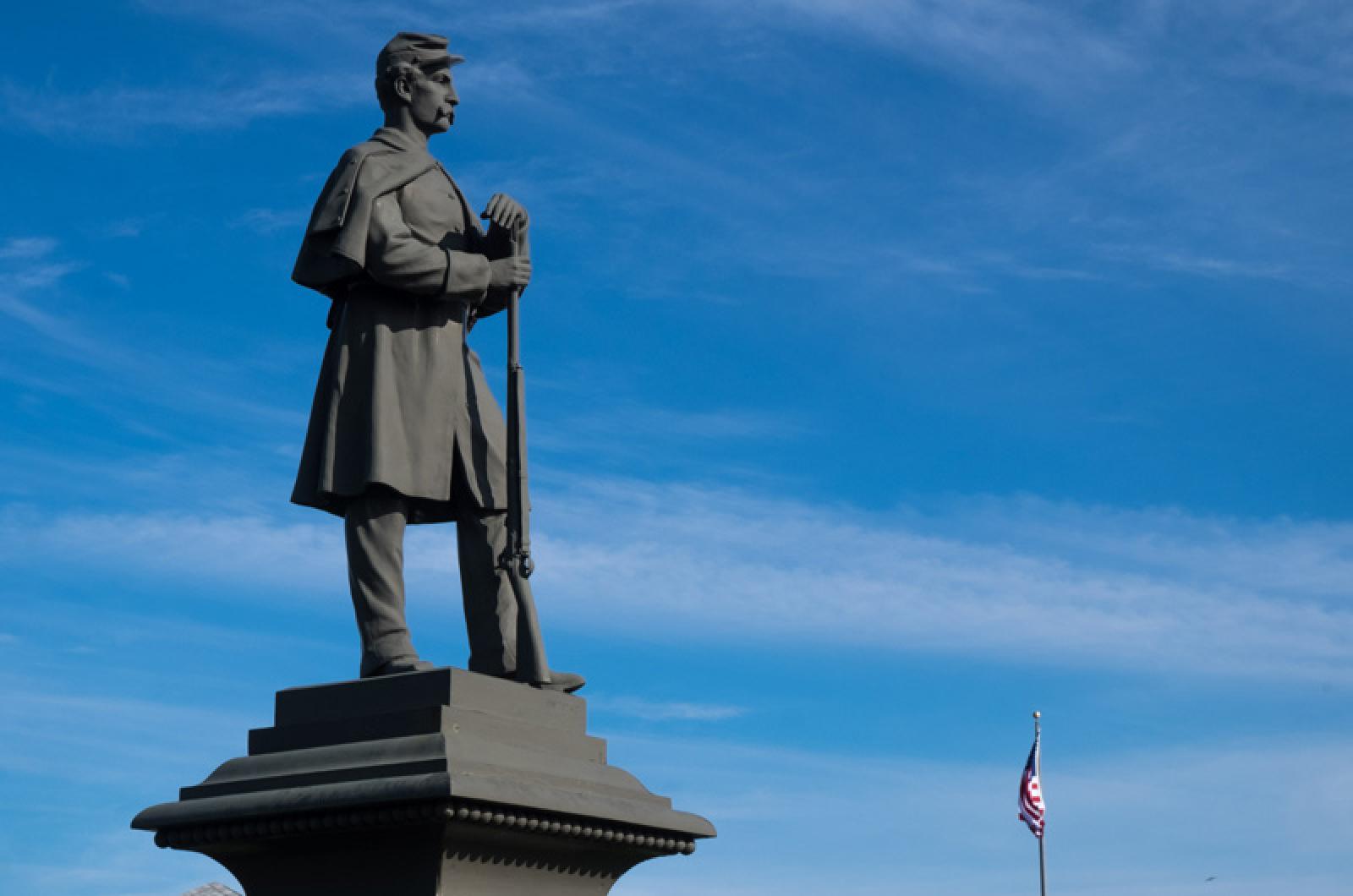
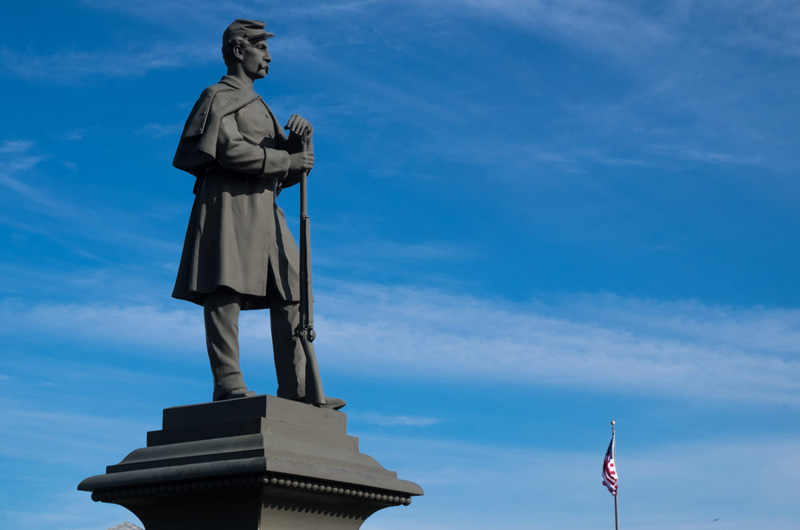
<p>Martha’s Vineyard can look with pride on its Civil War statue, built to express an aspiration as urgent today as it was in 1891: to heal a nation’s deep divisions.</p>
With Confederate monuments thrust into the spotlight after the weekend violence in Charlottesville, Martha’s Vineyard can look with pride on its own Civil War statue, built to express an aspiration that is as urgent today as it was when it was unveiled in 1891: to heal a nation’s deep divisions.
Standing at Ocean Park in Oak Bluffs, the monument depicts a Union soldier, though it has been mistakenly identified over the years as a Confederate soldier.
That’s because the person who raised the money to build the monument fought in the Confederate army.
Charles Strahan was originally from Baltimore, Md., and took part in the battle of Gettysburg. In 1884 he moved to Martha’s Vineyard with his family and took over the Cottage City Star, an Oak Bluffs newspaper, renaming it the Martha’s Vineyard Herald. Seven years later, with the psychological wounds of war still fresh and a burning desire to do something to help heal the division between North and South, Strahan embarked on a project to build a monument to the Union army. He raised the money by selling newspaper subscriptions.
Cast in zinc by J.W. Fiske and Co. of New York, with base of Quincy granite, the statue was first dedicated on August 13, 1891, 126 years ago this week.
“That this comes from one who once wore gray, I trust will add significance to the fact that we are once more a union of Americans,” Strahan said in remarks at the dedication. “A union which endears with equal honor the citizen of Georgia with the citizen of Maine; that Massachusetts and South Carolina are again brothers; that there is no North nor South, no East nor West, but one undivided, undivisible union.”
Inscriptions on three sides of the monument honored the Grand Army of the Republic and its Island chapter. Later Strahan wrote that he hoped the monument would help dissipate the “mists of prejudice” and that veterans of the Union army might some day offer a tribute to their former foes on the fourth, uninscribed side of the monument.
Strahan lived to see his wish fulfilled. In 1925 the statue was rededicated, with a fourth plaque that read: “The chasm is closed. In memory of the restored Union this tablet is dedicated by Union veterans of the Civil War and patriotic citizens of Martha’s Vineyard in honor of the Confederate soldiers.”
In 1930 the Soldiers’ Memorial Fountain (its formal name) was moved from the foot of Circuit avenue to its current location. In the decades that followed it fell into disrepair.
In 2001 it was rededicated again following a major refurbishment that included public and private fundraising.
Today it is believed to be the only memorial north of the Mason-Dixon Line to soldiers who fought on both sides of the war. Its origins couldn’t be more different than that of the Confederate statues now being removed around the country, many built long after the Civil War specifically to symbolize resistance to efforts to end Jim Crow laws and other forms of racism.
“This monument is not about excusing or explaining the grotesque and inhuman system of slavery,” said the Rev. John P. Streit, dean of the Cathedral of St. Paul in Boston who delivered the invocation at the 2001 rededication of the Oak Bluffs statue. “This monument was conceived and built as an icon of healing — as a testament to our nation’s need to come together again in spite of all the killing, all the casualties, all the destruction that both sides endured.”
As it has around the country, Charlottesville has cast a late-summer shadow in Oak Bluffs and across the Vineyard, where African Americans for generations have found respite.
On Sunday, a panel discussion at the Union Chapel led by African American leaders suddenly shifted in the struggle to comprehend what had happened. That morning the Rev. Dr. Raphael Warnock, guest preacher and senior pastor at the Ebenezer Baptist Church in Atlanta, Ga., delivered a stirring sermon to an overflow congregation at the West Tisbury Congregational Church. And on Wednesday evening at the Grand Illumination in Oak Bluffs, the richly rooted traditions of the Camp Ground shone even brighter when musical director Robert Cleasby added an extra number to the program for the community sing. The voices rang out in unison on a warm and starry August night:
“We shall overcome.”
Comments
While this article touts to
Concerned Resident Oak BluffsWhile this article touts to understand the history behind the statue, it really does little to address the salient issues at hand - is it proper in today's day and age to honor confederates? Does unity mean dedicating monuments to any and all sides, including and especially confederates or those with racist beliefs? What were the contemporary questions at the time? The historical methodology here seems incredibly slapdash, and dismissive, with the author (who it appears did not have the moral courage to include his/her name) cherry picking quotes from past artcles to support a predetermined defense of the statue. What do current residents think of the statue? I hope the Vineyard Gazette can provide more insightful work work on this topic, especially considering the necessity in today's political climate. And the last paragraph, citing community reactions to the recent events in Chaorletsville as a supposed defense of this statue (the link here is incredibly unclear) is odd. To be frank: this piece is as dismissive as it is disappointing.
I wonder how many readers
Jan AdamsI wonder how many readers have actually read what the plaque on the side of the statue says.
"The Chasm is Closed."
"In memory of the restored Union this tablet is dedicated by Union veterans of the Civil War and patriotic citizens of Martha's Vineyard in honor of the Confederate soldiers."
A photo (mine) of this plaque is here: http://happening-here.blogspot.com/2011/08/historical-travesty-in-oak-b…
Unhappily this is a monument to the phony history propagated by the losers that the Civil War was an accident that temporarily divided brothers. It wasn't. It was a war to the death over whether the enslavement of 4 million human beings would continue. The Confederate soldiers may have been deceived grunts as so many who take up arms are, but they were rebels whose aim was to end the American experiment with democracy and protect human property.
There seems no reason why the town of Oak Bluffs should continue to buy into a lie by continuing to display the plaque on the statue.
If youre going to call
Carla CooperIf youre going to call someone out for not using their name, the least you can do is use yours.
Two facts need to be
Tom West TisburyTwo facts need to be mentioned here. First, this is a Union soldier. Second, Jan Adams is correct that the fourth plaque presents a question of historical accuracy and creates confusion. The plaque itself was presented apparently by Union veterans many years after the original three,
but Charles Strahan was the force behind erecting the statue, and he was a member of the rebel army. Nevertheless, this statue does not represent a monument to those men who took up arms against the United States.
It is quite disappointing to
Puzzled ReaderIt is quite disappointing to see the Gazette endorse a position of the statue that rests fundamentally on flawed history and erasing, false attitudes of unity. From the beginning, the statue showed its true ties to the Confederacy: the former confederate soldier who donated the statue to depict a union soldier left a tablet intentionally blank so that he could eventually honor his “old comrades” (i.e. Southerners who started an insurrection against the United states to preserve slavery). He finally got his wish, and now that tablet explicitly honors Confederate, as well as Union, soldiers.
Confederate sympathizers have long used the myth of a unified country in the Reconstruction era and subsequent years to gloss over the systematic use of violence by the South to restrict African American liberties and murder many innocent citizens. It is troubling that the writer thinks Martha’s Vineyard should take pride in this statue, which is believed to be the only one of its kind above the Mason-Dixon Line.
The writer of this piece correctly notes that some have mistakenly called the soldier in the statue a confederate veteran. The writer would do well following their own call to historical accuracy.
Had they thoroughly researched the actual history of the statue (http://www.washingtontimes.com/news/2005/jul/22/20050722-085343-9433r/) and the myth of the united country after the war (https://www.amazon.com/Race-Reunion-Civil-American-Memory/dp/0674008197) in an era of segregation, lynching, and rampant civil rights violations, maybe Martha’s Vineyard would be able to start an honest debate over the role of this statue in Oak Bluffs. The Gazette should hold itself to higher editorial standards.
I'm puzzled too Puzzled
Paul V. Condlin EdgartownI'm puzzled too Puzzled Reader. Are you saying the statue is a symbol of hate and implying the Gazette is a conduit of festering racial hatred? The Gazette should re-publish their archives from 20 years ago. Anyone who truly cares about solving racial tension or other inequities In this world have to listen to each other and refrain from impulsive judgement. Thoughtful talk, not pundit sound bits, can heal more than divide.
I'm so puzzled I'm responding
Paul V. Condlin EdgartownI'm so puzzled I'm responding to myself. In 1925 a group of Civil War Veterans, once combatants, now united, are old men living out their final chapter. Their generation was decimated by this war and countless suffered and died In aftermath. (I include any and all victims). My great-grandfather was 18 years old when he joined a Union regiment. He survived, as well as the letters he sent to his mother from Port Royal, S.C., and photos of him taken before and after the war. The photos are striking. In the later photo he looks frail, sullen and aged. What happened to my young, seeming healthy great grandfather during the war. Whatever he experienced and the conditions he endured, could not have been pleasant. There was nothing in this fight that would benefit him, only others. My great grandfather had passed nearly two decades earlier when the old men gathered to place " The chasm is closed..." plaque on the monument. In 1925 this was their way to come together as one. Is that so wrong?
I come from the Vietnam Era.
Captain BullDog Thal OLD GREENWICHI come from the Vietnam Era. We shamed our unscripted soldiers and spit on them when they returned. Fortunately that us not the case now. Ross Gannon and I were classmates. Please let's stop blaming the soldiers. Blame the politicians, the ideologue but not the poor bastsrd who wore the uniform in service to his neighbors. Slavery was an abomination and contrary to every precept of common decency of human rights but there was 20 million slaves in 1830 and that represented a considerable part of the personal fortune of our American great great grand parents. Maybe if a buy back to emmancipate our brothers was offered the Civil War may have been averted. It's a money thing. You couldn't even vote without property. That concept goes back to John Locke the right to own, enjoy personal property. When was the last time you turned in a fake $100 Bill someone slipped to you to a bank teller where she took it and said thank you and you said but where is my $100?
The Navy blew uo a lobster boat 20 years ago in Long Island Siund when tge skipper said he bagged a WWII torpedo where is the money for my boat. It wasn't until Senator Dimato but in a dpecial bilk for restitutiin that the goid skipper recovered the cost of his boat.
Stop blaming the soldier. And by the way if your are a Vietnam Vet, Welcome Home!
The discussion generated on
Lee McDonald Neptune Beach, Fl.The discussion generated on the article published is most enlightening.
The article in defense of the statue's 1925 plaque gifted by union soldiers to commemorate Confederate "brothers" comes at the awkward time of severe racial tensions in the north where unfair housing based on race was a hot issue.
It was gifted and dedicated 6 years after the Chicago race riots of 1919. One of the few American writers with the moral courage to address the inequality and injustice of centuries of economic racism specifically addressing the race riots of 1919, was Carl Sandburg.
This monument is a romantic, glossy tale of, for about and by a band of "white brothers" that perpetuates revisionist and racist history.
Our times require more studious, inclusive, and factual reporting of history than this article in the Martha Vineyard Gazette.
If the fourth side of the monument or somewhere in this monument, at both the first dedication at the close of the 19th Century or the 1925 dedication of the fourth side had included a tribute to those held for centuries in bondage and a celebration of equality, then perhaps we would be moving in the right direction to preserve such a statue. But it does not. It passes not the test of justice and liberty, but of oppression and usury. It is propagandistic at best and does not speak truth.
This is a sentimental tale, of a Confederate soldier, who recovered and made his way back up the economic ladder, to make a tribute to the preservation of the UNION, but a union for the privileged, that did not celebrate the human rights of persons of color. . .or for that matter women. It misses the mark of what we should value in our history.
KNOW YOUR HISTORY!
reading the comments above
Rudy Kallock Agawam, MAreading the comments above regarding the righteous indignation about the monument, I think it is a bit much for this particular memorial. Our country is now consumed about taking down Confederate memorials. We do need to identify the Confederate flag as a current symbol of white supremacy. However, the monument in Oaks Bluff was erected as an olive branch....a man's effort to heal his heart and the heart of the country. As one who has experienced combat in Vietnam, I know that for many of us...our hearts have undergone a life long effort to mend. I see Mr. Strahan's monument as attempting to bring closure between the two sides....no more, no less. I believe those nabobs who see anything more need to find more meaningful pursuits.
Fifty years ago this month I
Islander Martha's Vineyard, MassachusettsFifty years ago this month I moved from the quiet Southern city of Washington to the quiet Southern town of Charlottesville to attend The University of Virginia. The following March, while on a trip to Penn State to set up the central Pennsylvania headquarters of the McCarthy for President campaign, I sat in a darkened apartment in the middle of the night and watched the residents of Washington literally set my hometown ablaze live on national television in the wake of the murder of Martin Luther King. I was heartbroken. This week I sat in my home on Martha's Vineyard and watched on TV as the residents of Charlottesville figuratively set their town ablaze. Again, I was heartbroken. Have folks really learned so little in half a century?
Was it really the *residents*
Susanna J Sturgis West TisburyWas it really the *residents* of Charlottesville who "set their town ablaze"? The ones carrying the torches? An awful lot of them seem to have come from somewhere else.
I was referring to the
Islander Martha's Vineyard, MassachusettsI was referring to the Charlottesville town meeting the following week.
I'm with Rudy Kallock, above.
Susanna J Sturgis West TisburyI'm with Rudy Kallock, above. So many people insist that the statue means this one thing or that one thing. I was at the statue last weekend for the Rally for Unity. I sang beside it, walked around it, took pictures of it, then went home and reread Tom Dunlop's good article about it in an old Martha's Vineyard Magazine. (Google: you'll find it.) What I'm coming to love about this statue is its ambiguity, its refusal to be stuck in a box. I even like it that for so many years people thought it was a Confederate soldier because you know what? Union and Confederate soldiers fought through the same mud, blood, death and disease. They had it a lot harder than the generals on either side, and I'm guessing that like soldiers in most wars they were fighting for their own survival and that of their comrades more often than they were fighting for one cause or another. The U.S. has engaged in some pretty dubious wars over the years, but that doesn't make the soldiers any less valiant.
I wonder about that fourth inscription, with "The Chasm Is Closed" at the top of it. I've got this hunch, based on nothing much, that for Charles Strahan the chasm was the one within, that of a young man who had fought for the Confederacy even though his home state of Maryland did not secede and who since 1884 had lived in the North, on Martha's Vineyard. He had wanted from the beginning for the monument to include Union soldiers' tribute to their Confederate counterparts, but it didn't happen till 1925. I wonder about that too. Why so long? Maybe most Grand Army of the Republic veterans wanted no part of it. Maybe only after 60 years had passed since the end of the war were enough people willing to consider it, or maybe those most set against it had died. No matter how or why, it happened, and Strahan was alive to see it. I'm glad of that.
I am one of the white
Mike Keohane OrleansI am one of the white privileged who said what's the big deal regarding all these monuments until I educated myself on their true meaning. Sorry Charles Strahan and supporters but I'm not buying the healing aspect of this monument placed in a place that Wikipedia has described as
:The New England cottages of Martha’s Vineyard have been a summer getaway for the African-American elite for more than 100 years. Drawn to the harbors of Oak Bluffs in the late 1800s, freed slaves and laborers began settling there.:
A monument dedicated to the Confederate Soldiers in a historic place for African Americans and Native Americans who have been brutally repressed by the likes should be removed.
The statue in Oak Bluffs is
Islander Martha's Vineyard, MassachusettsThe statue in Oak Bluffs is not "A monument dedicated to the Confederate Soldiers". The fourth of four plaques on the base of the statue acknowledges the Confederate soldiers. That plaque was installed in an effort to heal the schism over which a war was fought 65 years earlier.
Oh contrar. The belt buckle
Captain BullDog Thal OLD GREENWICHOh contrar. The belt buckle says the 21's Regiment of the Army of Northern Virginia. They fought for the Confederacy. The soldier is gazing South.
We need to get rid of the
Let's not stop there ... OBWe need to get rid of the Vineyard Haven Band as well ... "In 1868, eighteen Civil War veterans (both blue and gray) organized the Vineyard Haven Silver Cornet Brass Band."
Supporters say the monument
Clennon L King Boston, MASupporters say the monument symbolizes forgiveness and healing between former warring sides. But celebrating this mutual admiration between white men is hard to dignify, especially given that Massachusetts was the first state to legalize slavery.
The other problem is that this monument never bothers to mention the real victims of the Civil War: the enslaved.
And finally, I imagine how the Jewish community might have responded to a similar move in the wake of World War II.
What if, like Charles Strahan, a military veteran of Nazi Germany resettled in New York City — home to the largest concentration of Jews in the U.S.? What if he had done well in business, and chose to erect a statue, paying tribute to the Allied NATO Forces who defeated Hitler? And what if that same former Nazi successfully convinced those NATO soldiers in Manhattan to honor him and his comrades who fought in support of the Holocaust on his same statue?
The truth is, I can’t imagine it. Not in a million years.
Yet, here we are. No question the monument adds insult to injury, especially for black tourists, whose tax dollars pay for its maintenance. Martha's Vineyard can't continue selling itself as progressive and keep this monument standing.
You have said, "One can’t
Islander Martha's Vineyard, MassachusettsYou have said, "One can’t continue to sell oneself as an Island of progressives, boast being the playground for the black elite, and shamelessly point to the Obamas, Spike Lee, and Skip Gates as proof." You over-generalize. Not all Islanders are progressives. Not all Islanders boast of being the playground for the Black elite. And not all Islanders point to the Obamas, Spike Lee, and Skip Gates. Some of us like the Island all twelve months of the year when others go home to Greenwich, Scarsdale, Main Line, Roland Park, and Chevy Chase.
Many of your year-round
Jane Norton ChilmarkMany of your year-round neighbors are people of color, and have deep family roots on the Vineyard.
Some of the ancestors of your island neighbors assisted people in escaping enslavement prior to emancipation - and their ancestors lived here for thousands of years..
But you're right about this: not all islanders are progressive.Some are outright racists.
The offending tablet says
Tom West TisburyThe offending tablet says that the "chasm is closed," but it will never be closed until there is a memorial on the Washington Mall in memory of the millions of people who were enslaved in the United States.
Add new comment