


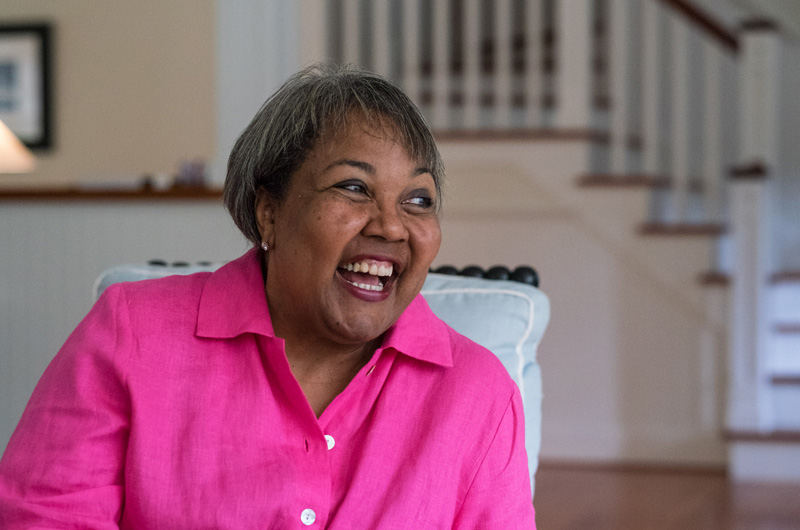
A groundbreaking project to record the oral histories of 5,000 African Americans has returned to the Vineyard, with more than three dozen videotaped interviews scheduled over two weeks.
A groundbreaking project to record the oral histories of 5,000 African Americans has returned to the Vineyard for the second time in its 17-year history, with more than three dozen videotaped interviews scheduled over two weeks.
“This project is really about discovery, and it’s about identity,” said Julieanna Richardson, founder and executive director of Chicago-based The HistoryMakers, a national archive now linked to the Library of Congress and 26 colleges and universities from coast to coast.
“Together we are doing what no one else in the history of the United States has done,” she said. And returning to the Vineyard, where The HistoryMakers first visited in the early 2000s, was a must, Ms. Richardson added.
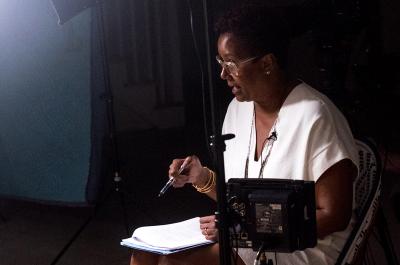
Interviewer Harriette Cole.
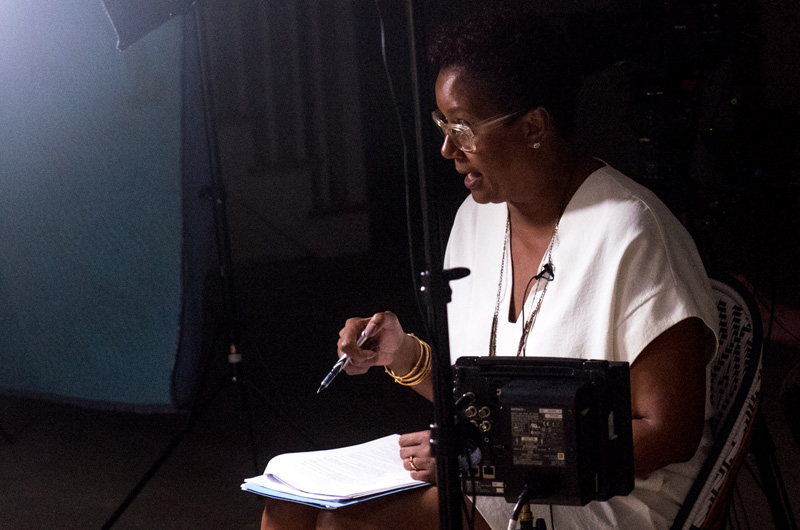
Interviewer Harriette Cole.
In interviews, African Americans on Martha’s Vineyard display a sense of pride in their history, she said. “People talk about community a lot. We really want to be part of the Vineyard community.”
At the spacious West Chop home where Ms. Richardson and her team of archivists have been staying, a lower-level room provides the video studio (and people on the main floor are cautioned not to run the water while an interview is in progress). Wednesday afternoon, as The HistoryMakers’ Harriette Cole interviewed longtime Islander Skip Finley on video downstairs, Ms. Richardson took a chair in the great room to talk about the archive and how it came about.
At its most basic, the project seeks to fill in the gaps in black history that have existed since slavery was the law of the land. Ms. Richardson’s goal is to more than double the number of interviews — 2,300 — conducted with former slaves by the Federal Writers’ Project of the Works Progress Administration from 1936 to 1938.
For the rest of the 20th century, those slavery narratives — housed at the Library of Congress — were the sole national archive of the black experience at first hand. As a nine-year-old schoolgirl in an overwhelmingly white Ohio town, “the only things we studied about black people were George Washington Carver and slavery,” Ms. Richardson recalled.
She had to wonder. “It was just hard to reconcile that he could have done all these things with peanuts when all we had been were slaves,” she said. These lessons left so many questions unanswered: What had happened before, and in between, and since? What was happening now?
The gaps in black history proved even wider the day her teacher asked the children about their family background, Ms. Richardson continued.
“Literally every hand went up,” with classmates naming all the European lands from which their ancestors hailed. Ms. Richardson put her hand up too — but after being black and Native American, she didn’t know what to say, or what her ethnic identity actually meant. Once again, she wondered: “What am I?”
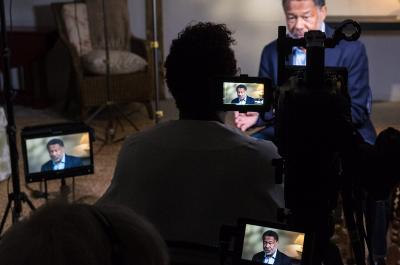
Longtime Islander Skip FInley is interviewed for HistoryMakers project.
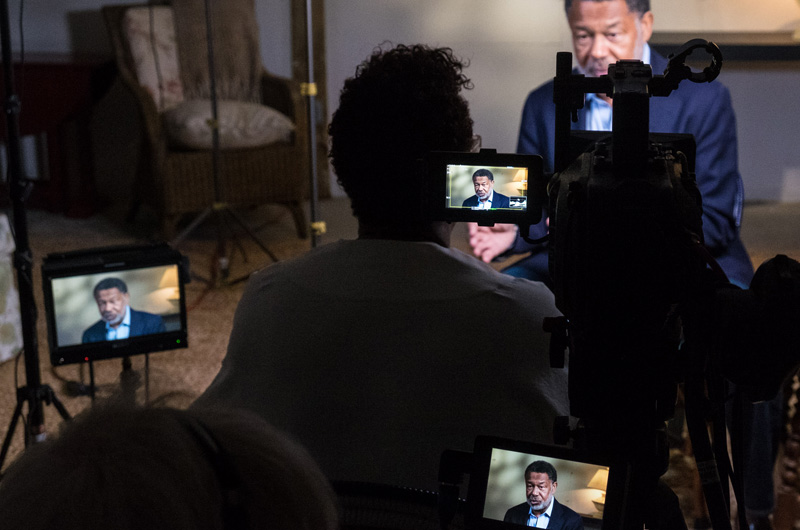
Longtime Islander Skip FInley is interviewed for HistoryMakers project.
It was an “empty feeling,” Ms. Richardson recalls, and it lasted for a decade — all the way to her sophomore year at Brandeis University, where she double-majored in theatre arts and American studies.
A research project on the Harlem Renaissance sent her to the New York Public Library’s Schomburg Center for Research in Black Culture, where for the first time she heard a recording of I’m Just Wild About Harry, the popular song written in 1921 by Noble Sissle and Eubie Blake for their boundary-shattering Broadway show Shuffle Along.
“The fact that a black songwriting team had written that song — that was like an ‘aha’ moment,” Ms. Richardson said. The empty feeling that had followed her since she was nine gave way to what she called a “euphoria of discovery,” which is still evident in the delight with which she talks about that eye-opening encounter.
Still, there were many years and multiple careers to go before The HistoryMakers was born. After Brandeis, Ms. Richardson attended Harvard Law School — “my father convinced me I could do anything with a law degree,” she said — and worked in corporate law after receiving her J.D. in 1980.
She went on to work for the city of Chicago as its chief cable administrator, a powerful position at a time when the city was actively franchising its cable network. Ms. Richardson later started her own cable television shopping channel, Shop Chicago, and followed that by founding a production company that managed several local cable channels for years.
And then — this is Chicago — she was “politically out,” Ms. Richardson said, her busy, eclectic and completely unplanned career at a standstill for the first time since law school.
“This was a hard time for me,” she told the Gazette. “I was very confused as to what my next step would be.”
But soon, a chance encounter with a panel discussion at the Memphis Civil Rights Museum would spark the idea that became The HistoryMakers 17 years ago.
“One of the panelists was Rev. Samuel Billy Kyles, who was on the balcony when Martin (Luther King Jr.) got shot,” Ms. Richardson recalled. Her next thought was, “People know Martin, but they don’t know these other people who were as important. And the name came to me at this time.
“I know what I want to do,” she recalls telling a friend. “It’s called The HistoryMakers and it’s an archive of black people.”
Ms. Richardson’s circle of friends was not convinced. In fact, some of them staged what she calls “an intervention, on a Saturday” to make sure she knew what she was talking about.
“Lots of people didn’t quite take me seriously back then — they’re telling me that now,” she said with a bubbling laugh. “I was as serious as a heart attack.”
Thanks to her cable TV ventures, she also had some seriously state-of-the-art videography equipment, which she put to use for the first interview — with radio executive Barry Mayo — in February, 2000.
Since then, The HistoryMakers has recorded 9,000 hours of testimony by African Americans from many walks of life, from stardom to obscurity. “We’re trying to balance the well-known with the unsung,” Ms. Richardson said: Whoopi Goldberg and Jessye Norman on one hand, for instance, and more than 200 top scientists on the other; a Tuskegee Airman and one of the less-renowned Golden 13, enlisted men who became the first African American commissioned and warranted officers in the U.S. Navy.
Interviews average three or four hours, with the longest at about 15 hours. That one is with the Rev. Jesse Jackson — “and he’s not done,” Ms. Richardson said. Barack Obama is in the archive, too, recorded as a young senator from Illinois.
About half of the interview subjects know a lot about their history, Ms. Richardson said, and the other half “know nothing at all.”
“I thought I would do it in five years,” Ms. Richardson said of her 5,000-interview goal. Seventeen years later, at a cost of about $1 million a year and still $12 million away from completion, she continues fund-raising through public television specials and local appearances such as the recent event Our History is Our Future, hosted by the Martha’s Vineyard Museum last Tuesday.
The evening program focused on the importance of preserving family history and lore as a legacy for generations to come. Panelists included Andrea Taylor, a former Boston-area journalist who is now the president and CEO of the Birmingham Civil Rights Institute; Marilyn Dunn, executive director of the Radcliffe Institute’s Schlesinger Library in Cambridge and longtime Vineyard resident Elizabeth Rawlins, professor emerita of education at Simmons College. After-dinner entertainment was by jazz and R&B vocalist Vivian Male, who is one of the 37 people taking part in The HistoryMakers interviews on the Vineyard this month.
Ms. Richardson has not yet been interviewed for the archive. “I want to be 5,001,” she said.
Find out more at thehistorymakers.org.
Comments
My wife Tanya and I were both
Philip Hart Los AngelesMy wife Tanya and I were both pleased to have been interviewed as part of the HistoryMakers while on island during August. We are filmmakers so we appreciate the professionalism of Julianna Richardson and her team and we both look forward to viewing the footage of our interviews and share it with our daughter and granddaughter who were on island with us. As we have done with our films, and continue to do, it is important to document our lives and contributions to American society and the world. Julianna Richardson as the driving force behind HistoryMakers is making sure African Americans are front and center in the Library of Congress and colleges and universities around the nation. Finally, I look forward to further collaboration between HistoryMakers and the Martha's Vineyard Museum and to see island history makers there as well.
Philip Hart, I was just on
Vela McClam Mitchell Atlanta, South Carolina, DenverPhilip Hart, I was just on Martha's Vineyard and remembered meeting you during a clam bake party on the island many years back that my deceased husband, Donald Mitchell, and I attended with our friends Bebe Moore Campbell and Ellis Gordon, Jr. Don was so excited to reconnect with you, a friend from his childhood in Denver. Our visits to Martha's Vineyard in the summer gave us a view of African American history that prior to our visits would have been lost to us. Thank you for sharing your story and I'm so happy to have spent that time with my husband and you recounting your earlier years.
Elizabeth Rawlins was also my
Deborah Tynes BLADENSBURG, MD.Elizabeth Rawlins was also my Professor at Simmons College and a powerful influence on me to become a teacher.
So thrilled to learn of this
Lydia Clemmons The Clemmons Family Farm in VermontSo thrilled to learn of this project, and even happier to learn that this project is African American-led and "owned". We have been recording our parents' stories for a year now- they are both 94 years old and their lives trace the stories of their grandparents in the rural south all the way up to present times here in Vermont. Many of these stories are captured as short storytelling segments- audio only or sometimes audio with video. We recently completed documenting oral histories of our parents' careers in nursing (beginning at Provident Hospital in Chicago) and biochemistry and pathology (beginning at the University of Wisconsin-Madison)- these are not yet available online but others are here: http://www.clemmonsfamilyfarm.org/farm-storytelling-channel.html Thank you and bless you for your important work!
Wonderful project! Members of
Janine Coveney Alexandria, VAWonderful project! Members of my family have been visiting the Vineyard for more than 60 years. Elizabeth Rawlins was dean when I was at Simmons; Harriette Cole was my colleague when I was an editor at Essence; and Vivian Male is my cousin! Love the Vineyard connections. These interviews are essential to preserving and honoring our stories.
I am personally elated to
Tracey Alston ChicagoI am personally elated to know that History Makers will be showcasing the storied history of African Americans on the Vineyard. My family and I vacationed there for the first time in 2003. Today, I schedule vacation for the first 2 full weeks of August on the Vineyard every year to include Family Week and the other, Girl Friends Week in which we host the annual Peaches on the Vineyard Tea. Over the past 4 years, The Peaches on the Vineyard Tea has attracted over 40 phenomenal professional women from across the country, between ages of 35-70. Several have personal stories to share with the group about growing up on the Vineyard. I recently met a woman whose grandfather was a Whaler. There are so many stories to be shared about Marthas Vineyard and we are fortunate that History Makers will be documenting them.
Thank you!
Add new comment