


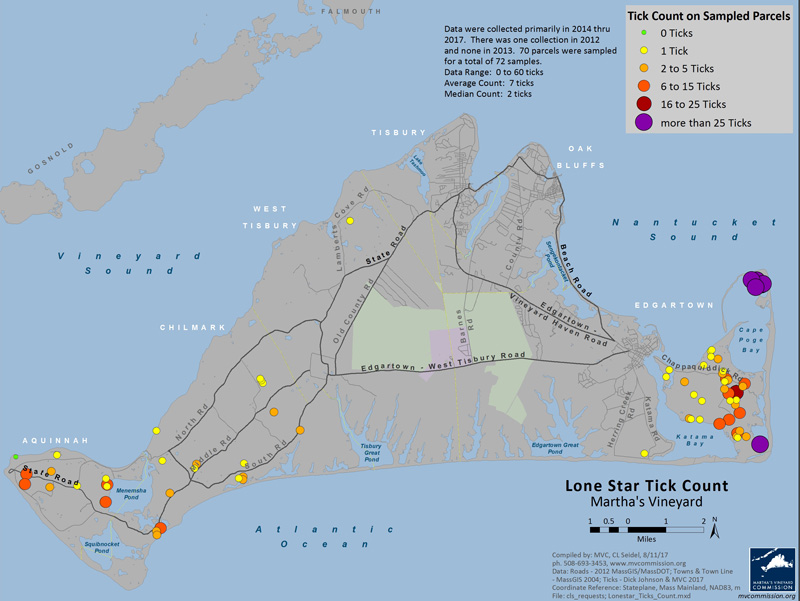
Island biologist Richard Johnson has been documenting an apparent spread of lone star ticks inland from Aquinnah and Chappaquiddick this summer.
Island biologist Richard Johnson has been documenting an apparent spread of lone star ticks inland from Aquinnah and Chappaquiddick this summer, as part of the Vineyard tick-borne illness reduction initiative. “Ten years ago, they would have told you we didn’t have lone star ticks on the Island,” Mr. Johnson said Monday during a talk at the Chappaquiddick Community Center — near the epicenter of lone star tick habitat on the Island. Around 2014, he began tracking the species in earnest and confirmed last year that they were breeding.
“Once I started looking, it was like oops, too late,” he said. “They are here.”
A new map created by Martha’s Vineyard Commission cartographer Chris Seidel and surveyor Kara Shemeth of Schofield, Barbini & Hoehn shows sites around the Island where at least one lone star tick has been officially spotted. Most sites are in Aquinnah and on Chappaquiddick — including a cluster at the northern tip of Cape Pogue where Mr. Johnson and his daughter Emma have documented hundreds of lone star ticks.
“There is an awful lot of Chappy where we haven’t looked,” said Mr. Johnson, who is now leading the Island tick program. Mr. Johnson has proposed raising money for three college interns next year to continue working with Islanders to evaluate and safeguard their properties — a job that he said has become too much for one person. He said $11,000 would likely cover those costs for a season. “I’m hoping we will give enough information and maybe enough incentive for people to begin to realize the seriousness of the problem,” he said. The Permanent Endowment for Martha’s Vineyard now accepts charitable contributions to the tick program, which began in 2011 with a $250,000 grant from the Martha’s Vineyard Hospital. The grant was extended one year but ran out in 2016.
A presentation planned for August 28 at the Agricultural Hall in West Tisbury will include an appeal to donors to help keep the program going.
Lone star ticks started out around South Carolina and have moved north, a process that Mr. Johnson said is likely influenced by warming climate trends. The Vineyard is among several Islands in the region where the species has gained a foothold, including Long Island, Cuttyhunk and Nashawena.
Adult females bear a characteristic white dot on their backs, hence the name. Unlike deer ticks, which seek out areas of moisture on the body, and dog ticks, which tend to climb up toward the head, lone star ticks will bite anywhere, and hard. They also carry several diseases, including tularemia and spotted fever, a non-deadly version of Rocky Mountain spotted fever. Mr. Johnson said the transmission of that disease from lone star ticks to humans has yet to be documented, although he noted reports of an uptick in cases of Rocky Mountain spotted fever on the Island this summer.
“My guess is that most people who are being told they have Rocky Mountain spotted fever on the Island just have spotted fever, which actually is good,” he said, noting that the latter is less serious. He plans to investigate the cases further to verify the connection.
Mr. Johnson and others have combed the scientific literature and found little information about the species in general, including its biology and feeding habits.
Lone star ticks tend to disappear in the fall, Mr. Johnson said, so he hasn’t found them attached to deer during hunting season.
Much of the talk on Monday focused on disease prevention, including the use of permethrin, rosemary oil and
other substances to kill ticks in their habitat (permethrin should not be used around cats, aquatic species or bees), and bodily protection such as permethrin-laced clothing, tucked-in socks and the use of insect repellents.
But echoing recent calls for action on the Island, Mr. Johnson said the best line of attack is to reduce the Island deer population. The Vineyard now hosts one of the highest-density deer population in the state, with between 30 and 40 deer per square mile of habitat.
Deer culling as a strategy to reduce tick-borne illness has had mixed results in the region, although Mr. Johnson pointed out that on Monhegan island in Maine, where every deer was killed in 1999, the number of ticks and the infection rate among humans also declined.
Some Islanders have argued for targeting white footed mice — the primary reservoir for Lyme disease — but Mr. Johnson estimates there are about 672,000 white footed mice on the Island, with each female having about 25 pups per year. And reducing the mouse population would have little effect on lone star ticks, which do not feed on mice and do not carry Lyme disease, Mr. Johnson said.
Efforts last year to extend the shotgun season by two weeks were unsuccessful, but Mr. Johnson is now working with the state to have archery season begin earlier and allow hunters to take more deer. He said hunters would need to increase the total take from about 625 to 800 deer per season to make a difference in the Island tick population.
Mr. Johnson said while specifics have not been announced, state Fish and Wildlife officials have said they plan to hold a hearing on the Vineyard regarding possible changes to hunting regulations to encourage the taking of more deer.
Mr. Johnson is also working with Island Grown Initiative, which promotes sustainable food production on Island, to identify a central location where the additional deer can be processed and the meat distributed to those in need.
Looking ahead, he said Chappaquiddick residents must set their own course for dealing with lone star ticks — including a management strategy and a plan for implementing it. He said his proposal to hire interns next year is one step, but he stopped short of making additional recommendations, in part because the process and the players are still undetermined.
“In the end, Chappaquiddick as a community and as a group of neighborhoods has to figure out what we are going to do about this,” he said.
Comments
Again the clarion call:
Mr. B cAgain the clarion call: "Reduce the deer population."
I agree. The animals, in their present numbers, are not merely a nuisance; they are part of a public health problem that must be addressed.
How about re-introducing the
Fox Man ChappyHow about re-introducing the red fox? They have tagged a low red fox population in a community to be correlated to a higher tick rate. Foxes eat mice! Seems a logical solution to me.
Great idea. Foxes also kill
Mary ChappyGreat idea. Foxes also kill songbirds & shorebirds, cats, small dogs, chickens, turkeys etc. etc. Lets just get rids of ALL those pesky lifeforms! Duh???!!!
@ Mary, I live in central
Carol formerly Chilmark@ Mary, I live in central Calif now (used to be tickland, a.k.a. Chilmark). We have red foxes, as well as dogs, cats, a wide diversity of songbirds and oher birds, lizards, salamanders. You know what we don't have a lot of? Ticks. (Check in with Golden Gate Audubon, they'll back me up.) The fox idea has merit. They can't possibly damage the island more than humans. Or cats, for that matter.
How about introducing red
JCHow about introducing red foxes and bobwhites?
Just a guess...but
D J TOMAN Edgartown, MAJust a guess...but concentrations at the extremities of the island hint that they may arrive via shorebirds. More research will tell the story.
DJ, you are correct. It is
Matt Poole Edgartown Health DeptDJ, you are correct. It is pretty well established that birds, particularly gulls, have played a role transporting lone star ticks to the Vineyard. Reportedly, a trip by a gull(s) from Long Island to the Vineyard with perhaps a stop on the Elizabeth Islands or Block Island is not uncommon. They've likely contributed to our tick problem.
I'd like to see the
deshandra brown EdgI'd like to see the introduction of the great horned owl. In addition to 'dining' on mice, they are the only natural predators of skunks.
Re-locate the large, in town
Throwinitoutthere OBRe-locate the large, in town flocks of Wild Turkeys to the more rural, tick infested areas. Turkeys interfere with vehicles but they eat ticks.
Can someone please ask Mr
Bit by the Tick NantucketCan someone please ask Mr Johnson to talk some sense into the people of Nantucket, who under the guidance of the Board of Health believe that Lyme disease is the only tick-borne illness existing, and will likely be releasing more mice onto the island which by extension will increase tick activity overall and likely lead to greater incidence of all tick borne disease/illness/allergy, excepting Lyme which will somehow be eradicated by the gmo mice?
Thank you for reporting on
Beth Carrison-van der Heide Middlesex CountyThank you for reporting on this tick and spreading awareness. However, I'd like to point out one missing thing about this tick. It can also make you allergic to mammal meats. Google "Alpha-gal" or mammal meat allergy caused by Lone Star tick bite. I've been dealing with this for years. Nasty critters!
The guinea hen was notorious
John Mort Atwood CircleThe guinea hen was notorious for dining on all insects, including a steady diet of ticks. Unfortunately, I don't believe there are any more on the island.
I believe I saw one running
Arlen Roth AquinnahI believe I saw one running on the road in Aquinnah the other day....beautiful bird!
Add new comment