


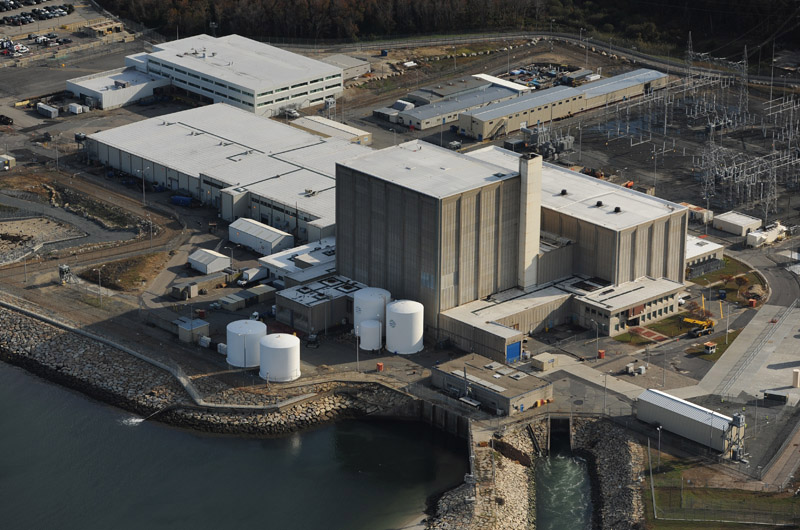
Will the NRC ever close Pilgrim? The apparent answer to that overarching question, despite the endless stream of disturbing news, is no.
Will the NRC ever close Pilgrim? The apparent answer to that overarching question, despite the endless stream of disturbing news that flows from Entergy’s Pilgrim nuclear power station in Plymouth, is no. No matter how many times an inspection or investigation of Pilgrim’s structural and operational problems reveals significant safety issues, the Nuclear Regulatory Commission never deems them sufficient to require the 45-year-old mechanical monstrosity and technological dinosaur to close. But then it has never dropped the hammer on any operating nuclear power station in its 43-year history.
In December 2016, an NRC inspection team concluded that the Pilgrim staff is “overwhelmed,” struggles to keep the plant running, and that malfunctioning equipment doesn’t get properly repaired, among other disturbing findings. In April the NRC agreed to let the station forgo safety upgrades required of other nuclear plants as a result of the catastrophe in Fukushima, Japan in March 2011. Pilgrim is both in age and design a clone of the three Fukushima reactors that melted down there, and continue to release radiation into the air and Pacific Ocean six years later. The litany of problems continues: In mid-May, an NRC quarterly inspection report revealed potentially catastrophic problems with the submerged storage system for the 3,000 highly radioactive and dangerous spent fuel rods, which has degraded. Violations of various reporting requirements were also reported. Most recently, tests on two valves in the high pressure coolant injection system revealed leaks of potential consequence in an accident scenario. It never seems to end.
Of the remaining 99 operating nuclear plants in the country, three are on what’s called the “watch list” of the NRC. These are the plants with sufficient safety issues for the NRC to provide additional oversight, and require remediation of its components. Which plants are on that short, perhaps too short, list? Pilgrim is one, and the other two are in Louisiana, also owned by Entergy. Indian Point’s two reactors, in the heart of the Hudson Estuary in New York, with which I am very familiar, has also been on and off the list in the past, are also owned by Entergy. Since 2000 when the NRC finally began its increased oversight process for troubled reactors, 12 reactors have drawn the NRC’s increased attention. Five of them, as noted, are owned by Entergy. The pattern seems clear.
The rationale for allowing Pilgrim to continue operating largely unchanged, the NRC says, is that the time required for diagnosing, designing and implementing the needed safety upgrades exceeds the time Pilgrim is likely to remain operating, perhaps two more years. What? The plant staff are not comfortable operating the plant as it is, but should continue being uncomfortable? And the five million people living in the vicinity of Pilgrim, should they feel comfortable?
What is the obvious message? To most rational minds these circumstances would more than strongly suggest not allowing the plant to operate for another day, let alone for two years in its clearly unsafe condition. Why not close it now? Instead, the NRC has allowed Entergy to refuel the reactor, and it will be back online shortly, if not already, despite the continuous stream of disturbing revelations about its decrepit condition.
Perhaps the most damning assessment of the overall Pilgrim situation comes from David Lochbaum, longtime director of the Nuclear Safety Project for the Union of Concerned Scientists in Cambridge, which tracks safety problems at all U.S. nuclear facilities. He said recently: “If Pilgrim were an [aged] horse it would have been . . . put down” by now.” I happen to have had contact with Lochbaum about the Indian Point reactors in 2001, after 9/11, and can vouch for the depth of his knowledge and integrity.
So how much more evidence and informed opinion does it take before there is an obvious conclusion that the NRC is being obtuse and obdurate about Pilgrim? Not much. And what explains the NRC’s approach? The answer is grotesquely simple: the NRC’s first priority is securing the economic viability of the nuclear industry, not the safety of the public. It prefers, as in the case of Pilgrim, to maintain a troubled plant as a column four plant on its action matrix, which is the watch category. Column five requires mandatory closure. What does it take to go from column four to column five? No one knows. It’s never happened.
So here we sit, 38 miles downwind of Pilgrim, exposed as we have been since it began operating in 1972, trapped by geography, with no evacuation plan in the event of a major radiation release like Fukushima’s, gathering frequent reports of troubling, if not outright dangerous, conditions at the plant. Which will now be allowed to continue making tons of money, millions per day, for Entergy for at least another two years.
So much for credible regulation by a federal agency supposedly tasked, at least on paper, with protecting the health and safety of the public. Not the bottom line of the industry it’s supposed to regulate. One is not wrong to wonder if this is fixable.
Richard Knabel lives in West Tisbury.
Comments
I think it should be allowed
Joel Davidson TisburyI think it should be allowed to stay online. If it was shut down, then our electric bills in the area would go up considerably and possibly the whole region. I obviously don't know as much about it as you, but I would assume that since Pilgrim has been around a long time, it must produces a significant amount of our areas electricity at a feasible rate. What are we going to replace that with, some sort of green energy source like Wind or solar. Wind will be very costly and barely produce what Pilgrim does and solar, well what do we do with the panels after they have run their course? Nobody has ever answered that question, and Edgartown will find out when the solar panels in Ocean Heights that they will take ownership of after there "usefulness" life are spent and no landfill will want them because they will be classified as hazardous waste. It certainly will be interesting. Its funny how when the Nuclear Plant Yankee Rowe closed that area became like a ghost town because of what Yankee Rowe meant to it economically. Same can be said for Vermont Yankee. Be careful of of what you wish for, you might just get it.
I'm less worried about
farmer5 chilmarkI'm less worried about electricity bills and decommissioned solar panels than spent fuel rods that remain radioactive for thousands of years.
Thank you, Richard, for
Sami Lawler EdgartownThank you, Richard, for shedding light on something of tremendous concern for us, our children, and our grandchildren. Our future health and that of our island is much more important than a potentially higher electric bill. We have a responsibility to think to the future. Nature has given us Wind and Solar. Let's work together to let that be a sustainable solution.
This is insanity at its best!
Jackie Kane TisburyThis is insanity at its best! When will we ever learn?! Fukishima to this day leaks radiation into the air and the Pacific! Call The NRC and express your concern:U.S. Nuclear Regulatory Commission: 1-800-368-5642.
Kudos to Richard Knabel for a
Alison Rose Levy AquinnahKudos to Richard Knabel for a clear-eyed analysis of the troubling safety status of Pilgrim. Yet it's hard for many of us to recognize that this plant actually puts our own and other peoples' lives at risk. And it's all so unnecessary. Stanford Professor Mark Z. Jacobson has detailed a 50 state plan for conversion to clean, renewable energy. Beginning now would lessen the need for playing Russian Roulette with a decrepit defaulting nuclear plant like Pilgraim. http://news.stanford.edu/2015/06/08/50states-renewable-energy-060815/
Creatures that cannot adapt to changing circumstance shorten their own odds of survival.
I would secure a private boat
paul adler west tisburyI would secure a private boat or plane to get out of here quick, should the need arise. There is no way the current system could evacuate everyone quickly, it would take days...I can't believe we are having this discussion, whereby the plant is near failure and little is being done. If it blows, or leaks, forget swimming, fishing, or growing crops-- and your property will be worth near zero. And someone said they were afraid of rising electrical cost?
According to ISO New England
Ann Rosenkranz West TisburyAccording to ISO New England and several news reports (one being David Abel, Boston Globe, october 13, 2015 article "Pilgrim NPS in Plymouth to shut down by 2019 ") the percentage of energy contributed to our electricity by Pilgrim Nuclear Power Station is 5-6%. We don't experience brown outs when the plant goes offline (as it does more and more frequently in recent months with all the unplanned shutdowns due to safety issues). We also do not stand to be clobbered by rate hikes should Pilgrim close. The growing share of renewable energy contributions to our power grid easily fills any gap that the loss of nuclear energy would incur.
Add new comment