


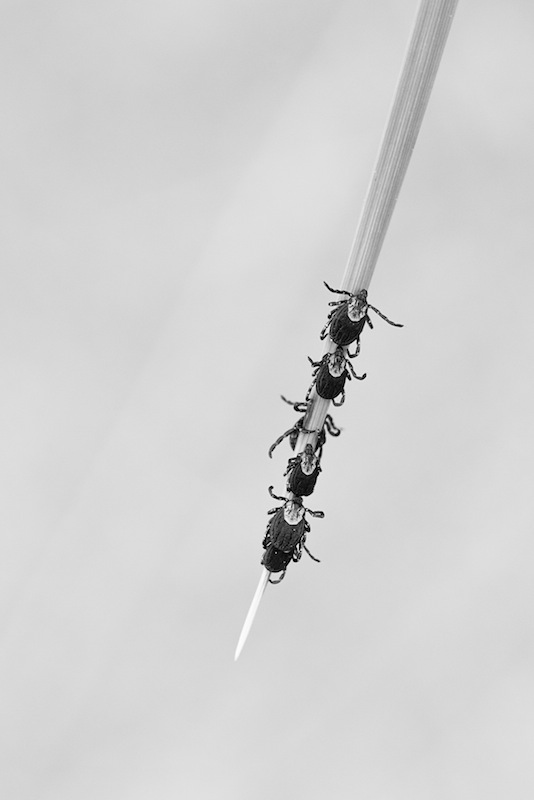
The real tick season has started as nymphs of both deer ticks and lone star ticks are out and will be present through July.
It’s mid-May and time to get serious about ticks. If you spent much time outdoors this spring, you know there have already been lots of dog ticks. Now the real tick season has started as nymphs of both deer ticks and lone star ticks are out and will be present through July. Because the nymphs are so small (about the size of a poppy seed) they are difficult to detect and thus more likely to transmit a tick-borne illness. Therefore it is particularly important that we assume responsibility for keeping ourselves and our families safe over the next two months.
Hopefully by now you have removed the dead leaves and pine needles from around your house and edge of your yard, since they provide the humid environment deer tick nymphs need to survive. I believe that getting rid of the accumulated leaf litter is the single most effective step you can take to make your yard safer. The tick program is also offering tick yard surveys to assess tick habitat and help homeowners control ticks in their yards. Please see our ad in this week’s print edition of the Gazette — or email [email protected] if you are interested in having your yard surveyed.
It is also time to get serious about personal protection. If you are working or walking in potential tick habitat, the best defense is to wear clothing treated with permethrin, including socks, long pants and a long sleeve shirt. Many people also spray their shoes with permethrin and tuck their pants into their socks. You can buy permethrin treated clothing online (Insect Shield is a popular brand) or buy permethrin spray and treat your own clothes.
If you prefer to wear shorts and short sleeves, use a good insect repellant on your arms and legs — a repellant with 25 per cent deet works best. If you are not comfortable using deet, there are several herbal repellants available, however these have not been scientifically tested to determine effectiveness so you will have to decide for yourself what works.
You should also do a thorough tick check when you or your children come inside. A shower is a good time to check for any unusual bumps or itches that may indicate a tick. If you find an attached tick, use a pair of tweezers to grasp it by the head and pull straight up, trying not to squeeze the body.
Most tick-borne illnesses are not transmitted until the tick has been attached for 24 to 48 hours, so if you are confident the tick has not been on for that long, you probably do not have to worry. However, if you are unsure or the tick shows signs of swelling, see a physician ASAP. Tape the tick to a piece of paper and take it with you to show the doctor. If taken soon enough, a double dose of doxycline will prevent most tick-borne illnesses, so time is of the essence.
Finally, if you experience flu-like symptoms, severe unexplained aches and pains, extreme fatigue or other unusual symptoms, see a doctor, even if you don’t remember being bitten by a tick. Most tick borne-illnesses are caused by a tick we never see. If treated quickly, most tick borne illnesses respond well to standard antibiotics, but if left untreated they can develop into serious illnesses that are difficult to treat.
The tick program is continuing to address the problem of ticks and tick-borne illnesses on an Islandwide basis. This year I was fortunate enough to receive a Martha’s Vineyard Vision Fellowship grant to focus on these big picture issues.
My top priority continues to be reducing the number of deer on the Island. This winter, selectmen from all six Island towns sent letters to the Massachusetts Division of Fisheries and Wildlife asking them to consider changes to the hunting regulations that would encourage the harvest of greater number of deer on the Vineyard. We are currently working with officials from fisheries and wildlife to facilitate this process.
I am continuing to encourage more landowners to allow hunting on their property. Please call (508-693-1893) or email me if you are willing to allow hunting on your land. We are also coordinating with the Island Grown Initiative to set up processing and storage facilities for farm animals and deer that will encourage hunters to take more deer. These facilities will also make it possible to process donated deer and provide free venison to people in need.
My second major concern is the increase in the number of lone star ticks on the Island. Lone star ticks are spreading through coastal New England and so far efforts to control them appear to have only limited success. An intern for the tick program will be reviewing the scientific literature for information on lone star ticks and methods of controlling them that could potentially be used on the Vineyard.
Dr. Carrie Fyler, a science teacher at the regional high school, has acquired scientific equipment that can provide sophisticated DNA analysis. Daniel Gaines, a graduating senior, hopes to use the equipment to determine what host animals lone star ticks have fed on. If he is successful, this information will be extremely valuable as we work to devise methods to control this increasingly problematic tick.
On a longer time scale, Dr. Kevin Esvelt from the MIT Media Lab is researching ways to permanently immunize mouse populations to block transmission of Lyme disease by making and releasing mice that produce protective mouse antibodies from birth and pass the immunity on to their pups. If successful, this could potentially eradicate the Lyme disease bacteria on the Vineyard.
While all these initiatives have the potential to greatly reduce the danger from tick-borne illnesses over the long run, we still need to take responsibility for our own health and safety and that of our families. There is no substitute for taking protective measures, conducting thorough tick checks, properly managing our yards and consulting a qualified physician when necessary. We know how to prevent tick bites and tick-borne illnesses; if we are mindful and put that knowledge to good use we can dramatically decrease the incidence of tick-borne illnesses right now.
Richard Johnson is an Island biologist and occasional contributor to the Gazette. For more information about the tick-borne illness prevention program, go to mvboh.org or email questions to [email protected].
Comments
What works for me is Vicks
Michael Pleasant Valley, CtWhat works for me is Vicks Vapo Rub (or its blue bottle competitors). My fields are full of all types after an easy winter. Ankles and wrists, not over you eyes on a hot day. When it melts down, ouch.
What does the author think
Steve FalmouthWhat does the author think about the use of permethrin treated tick tubes?
Dr. Johnson: Thank you, ever
Old Time Chappy EdgartownDr. Johnson: Thank you, ever so much, for your efforts. Please keep driving hard. To all of our Selectwomen (or men): Please take heed. Lyme disease is a clear and present danger to our community. Please also consider the hiring of professional sharp-shooters, particularly if said professionals would allay the concerns of certain landowners. To the owners of significant landholdings: please take the time to consider Dr. Johnson's request for hunting. As I understand it, the deer tend to "take cover" on your properties during the hunting season. Your cooperation would undoubtedly benefit the entire community. I am certain any reasonable safeguards of your properties could be accommodated. Thank you.
Yes, sharpshooters. I've
Kathy cerick ChilmarkYes, sharpshooters. I've heard of a town in Connecticut where they hired sharpshooters with 100% success. Unfortunately we do not attract enough hunters to take care of the problem here on the Vineyard.
As to prevention, the Insect
Lanny VHAs to prevention, the Insect Shield company offers a service to treat clothes you send in to them, with their insecticide. Last time I checked, it was $9 per clothing item. Find them online. Secondly, be sure not to confuse permethrin treatment of your clothing with any repellent that you might apply to your skin. Reading the application directions for permethrin should convince you to not let this product, in liquid form, touch your body. Treated clothing should be completely dry before you wear it. Lastly, the antibiotic is spelled doxycycline (4 syllables).
My first encounter with Lone Star Tick nymphs, on Chappy, resulted in around 300 (yes!) bites. Severe itching lasted for two months. Lone Stars operate very differently from other ticks we are more familiar with. They allow no time for negotiation, discovery or retreat!
In the event that one might
Kathy EdgartownIn the event that one might want to get the tick tested for various pathogens - placing the tick on scotch tape would preclude that. It is best to put the tick in a zip lock bag.
Remember it isn't only Lyme
Sarah West TisburyRemember it isn't only Lyme you have to watch out for. I spent 4 days in the hospital last summer with an acute case of Babesiosis, which is just like having Malaria and can be deadly. If you take doxycycline after a tick bite and still end up with a fever, chills and nausea, get yourself to the emergency room ASAP.
you missed a perfect
reinayou missed a perfect opportunity to inform on something extremely important. lone star ticks are the transmitter of the allergy to Alpha~Gal 1,3, a sugar found in all mammal meat and byproducts.
I hadn't thought about how
ScottI hadn't thought about how not treating any illness caused by a tick could make the disease become really dangerous. I saw a tick in my backyard yesterday, and I was wondering if it is something I should be worried about. I can see how it might be smart to have someone come spray for ticks, so my kids don't end up getting sick. https://www.mosquitocontrolssma.com/tick-control/service/
Add new comment