

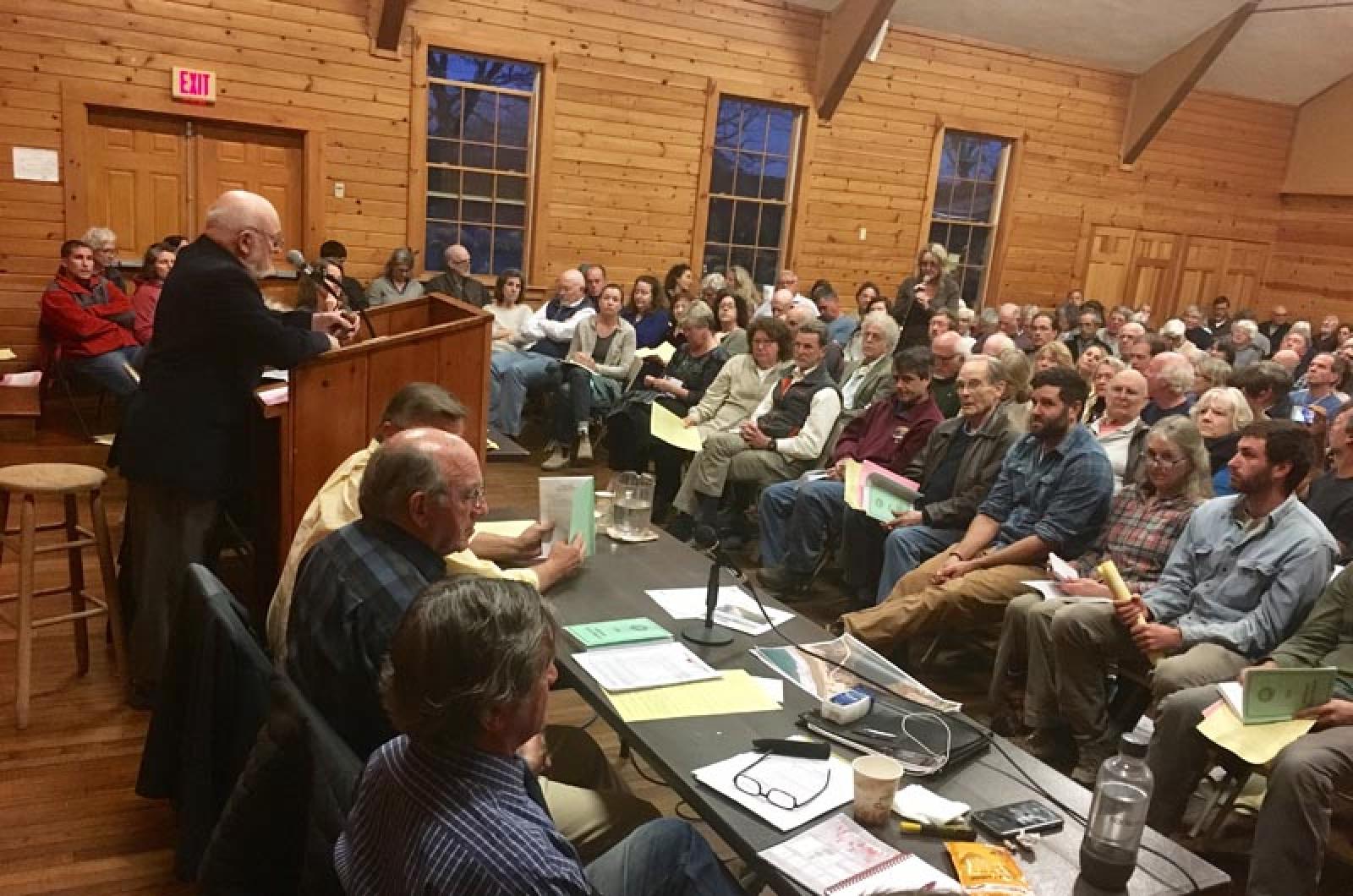
<p>At a marathon annual town meeting in Chilmark Monday, voters reaffirmed support for the Squibnocket Beach project and decided again not to allow the sale of beer and wine in restaurants.</p>
A marathon annual town meeting in Chilmark ended just before midnight on Monday, with voters reaffirming support for the Squibnocket Beach restoration project and deciding once again not to allow the sale of beer and wine in restaurants.

Moderator Everett Poole.

Moderator Everett Poole.
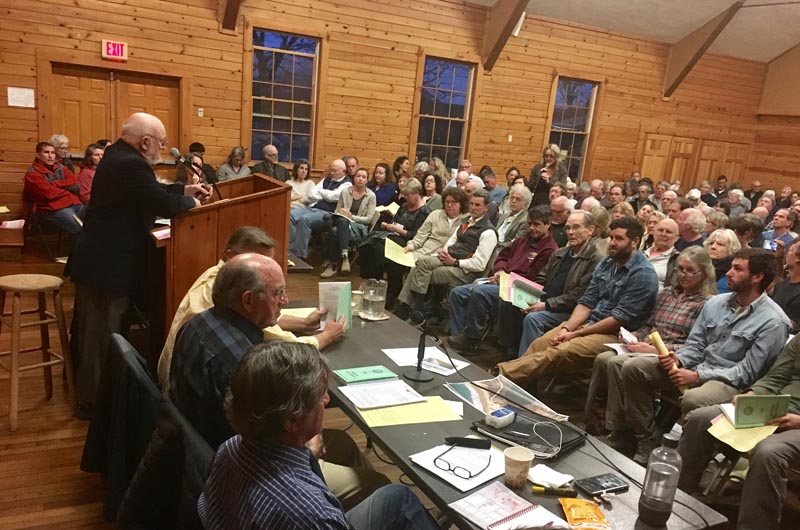
A total of 273 voters attended the annual town meeting, filling nearly every seat in the Chilmark Community Center on a chilly spring evening.
Efforts to clear the way for the beach restoration project drew heated debate during a special town meeting that began prior to the annual town meeting and resumed afterwards. Opponents took aim at a proposed causeway to the homes at Squibnocket Farm, revisiting many topics of discussion over the last four years.
The beer and wine question also saw passionate debate on both sides.

Jenna Petersiel, who operates Chilmark Tavern, said beer and wine sales would be a lifeline for restaurants.

Jenna Petersiel, who operates Chilmark Tavern, said beer and wine sales would be a lifeline for restaurants.
The two meetings spanned almost five hours, with voters adjourning at 11:49 p.m.
The long-planned Squibnocket project has been mired in litigation since last spring when a group of residents appealed the town’s approval of the causeway. The less controversial portion of the project involves relocating a town parking lot farther inland, removing a stone revetment and leasing a long stretch of beach from the Squibnocket Farm homeowners association.
In light of the appeal, the town proposed two amendments to the Squibnocket Pond district bylaw, allowing for reconstructed roadways, including elevated causeways and other provisions.
Some voters on Monday blasted the amendments as setting a poor precedent and subverting the district bylaw to fit the causeway plan.
“This is bad government,” planning board member Chris Murphy said.
Others argued that the amendments would simply clarify existing practice in town, and that existing review procedures would still condition projects appropriately.
David Damroth tried to amend the article to add language about what constitutes a public benefit within the district, but the amendment failed.

Selectman Jim Malkin.

Selectman Jim Malkin.
In the days leading up to the town meeting, residents had received postcards in the mail showing an artist’s rendering of what the causeway might look like. Filmmaker Doug Liman, who had commissioned the artist’s renderings, defended their accuracy, claiming the proposed causeway does not reflect the elements of a plan that voters approved in 2015. That vote was for “a low causeway” that follows the contours of the land. As planned, the causeway would stand about 13 feet high.
“Our children will be looking at this and wonder how it is that people allow this to happen,” Mr. Liman said, drawing applause.
Town moderator Everett Poole struggled to keep discussion on the articles and not the project, but concerns boiled over.
Some residents of Squibnocket Farm also spoke out against the causeway.
“We are not all unanimous about this,” said Damon Vickers. “The people will come and go,” he added. “But we will be left with this bridge for a long time.”
Selectman Jim Malkin recounted an exhaustive public review in 2014 that led to the proposal finally adopted in 2015. “We are bringing up the same issues that we’ve heard argued over and over and over for the past several years,” Mr. Malkin said. “There is no perfect solution, but this town voted for what it thought was the best solution.”
In the end, two petitions for secret ballots failed and the amendments passed by a standing vote, each one narrowly achieving a required two-thirds majority.

Doug Liman spoke against Squibnocket causeway.

Doug Liman spoke against Squibnocket causeway.
On the beer and wine question, Jenna Petersiel, who operates the Chilmark Tavern, argued that licensing sales would be a lifeline for sit-down restaurants in town, given what she called especially low profit margins. But others said the change would diminish the town character and open the door to hard liquor down the road.
Some were adamant about protecting the town character from outsiders.
“You must have known when you bought that we were a dry town,” said Jane Slater, reading from a prepared statement. “Did you think we were waiting for you to get here to pop the cork?” Mrs. Slater argued that the issue at hand had more to do with real estate values, because beer and wine licenses would increase the value of Chilmark restaurants.
The question failed by a standing vote of 162 to 93.
A $9.57 million annual town budget, marking a 5.67 per cent increase over last year, passed unanimously with no questions from the floor.
Voters also agreed to allow the Martha’s Vineyard Refuse District to borrow up to $2.5 million to expand its central transfer station in Edgartown. After clearing Edgartown and West Tisbury this month, the request needs only to be approved in Aquinnah, which has its town meeting in May.
A request to designate an eight-acre lot near the town landfill for general municipal purposes passed by a wide margin. Selectmen plan to use the site as a new home for the town shellfish and highway departments, as well as a training area for the fire department and a storage area for commercial fishermen.
The Chilmark finance committee had recommended not funding the town’s portion of the First Stop information and referral service, arguing that it was underutilized and too expensive. The town’s assessment this year is $10,152. Martha’s Vineyard Community Services, which recently took over the program from Dukes County, has argued that it provides the only comprehensive listing of Island services and helps integrate other programs.

Marathon meeting ended just before midnight.

Marathon meeting ended just before midnight.
Finance committee member Susan Murphy said the program has cost Island voters $174,000 since its launch in 2015. “I know businesses start websites all the time and they don’t cost that much money,” she said. “The question is, why is it going to cost the same amount that it did the first year, in the third year?”
Community Services executive director Juliette Fay said the new management has in fact kept costs down, in part by avoiding a higher costs associated with county employees. “It really has been level-funded through our agency,” she said, adding that the program has expanded the reach of the CORE program (Counseling, Outreach and Referrals for the Elderly), which is run by the same people at Community Services.
The article passed by a wide margin.
A total of $151,822 was appropriated for community preservation projects, including $31,512 to help replicate the historic roof at the Marine Hospital (owned by the Martha’s Vineyard Museum) in Vineyard Haven, and $32,500 to support the 22-unit affordable housing project on Kuehn’s Way, also in Vineyard Haven. Community preservation funds totalling $325,000 were set aside for future use.
Chilmark became the fifth Island town to back an article asking local police not to use town money to enforce federal immigration law, in keeping with current practice. There was no discussion surrounding the article, which passed with only a few dissenting votes.
Comments
ok, Chilmark, stay dry, but
ed grazda Chilmarkok, Chilmark, stay dry, but how about BANNING BOZE ON THE CHILMARK BEACHES, STARTING WITH M'NMSH.
Exactly, the circus that is
Susan North TisburyExactly, the circus that is booze filled in Menemsha is a disgusting display of filth, drugs, BBQ's and garbage. Address something important like the lack of vision those voter have that voted against beer and wine.The comment in the Gazette "Some were adamant about protecting the town from outsiders" should start at the sunset mess in Menemsha AND the comment on real estate values being driven by restaurant values culminating in the sale of beer and wine is absurd coming form a town that has homes exceeding 30,000 square feet. The beer and wine issue should have been addressed by looking at Vineyard Haven and the vacancy rate. If the island does not move forward and reign in building, yet does not support local businesses all towns will look like the empty shell VH is.
Do they fear putting alcohol
George Stein EdgartownDo they fear putting alcohol to a legitimate ballot on Election Day ?
From what I understand it is
Jay Lagemann Chilmark resident presently in BangkokFrom what I understand it is a multistep process. First at a town meeting it needs approval to be sent to the state for review. Then, if the state finds no problem with the proposal it goes back to the town and is voted on on election day.
As an early morning cyclist I
Summer person Lambert' Cove via KansasAs an early morning cyclist I am relieved that people will not be drinking on their way to the casino
GREAT !
BFGREAT !
Good for Chilmark...Dare I speculate that there still might be more of "us" !
Add new comment