

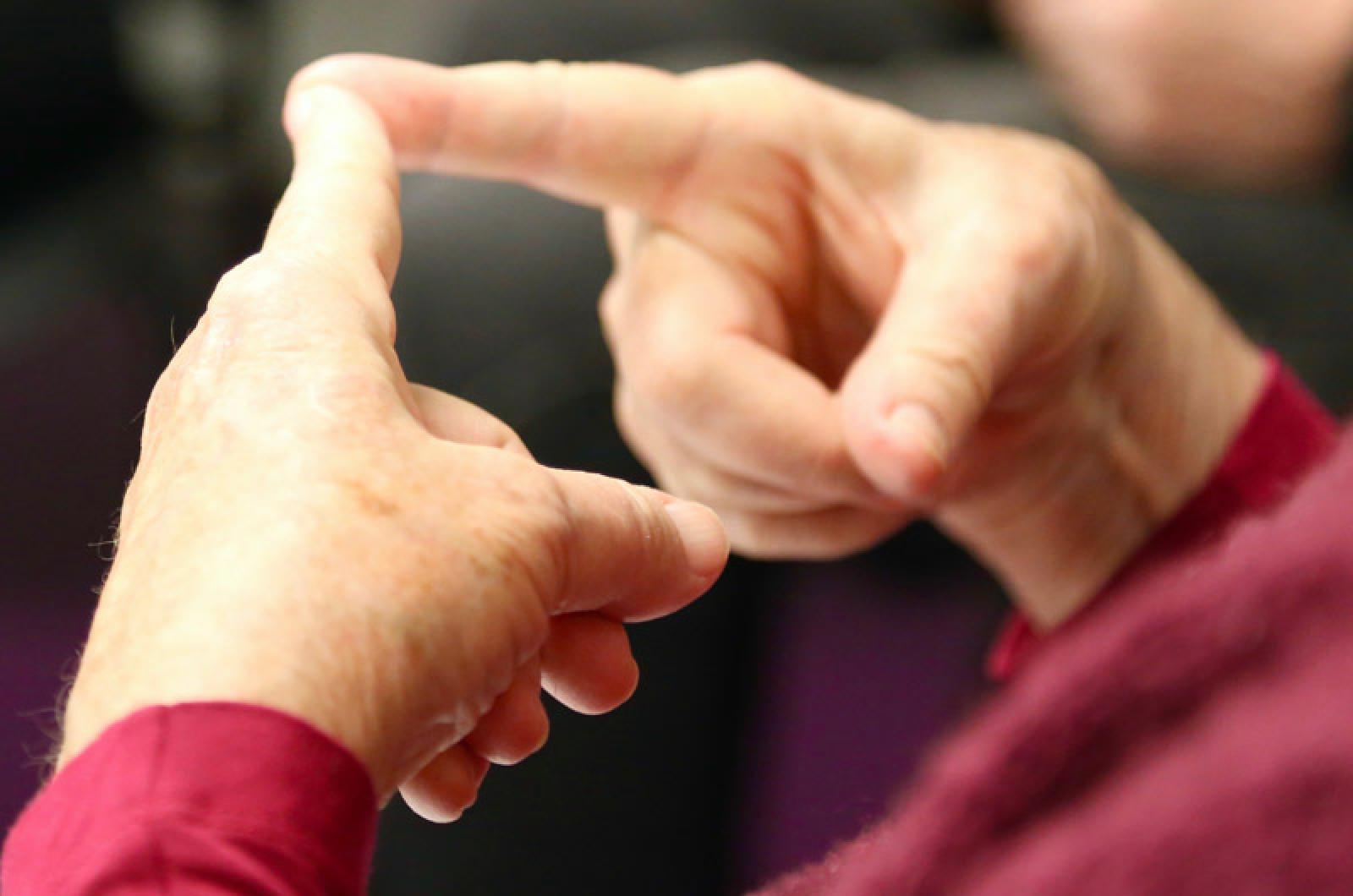
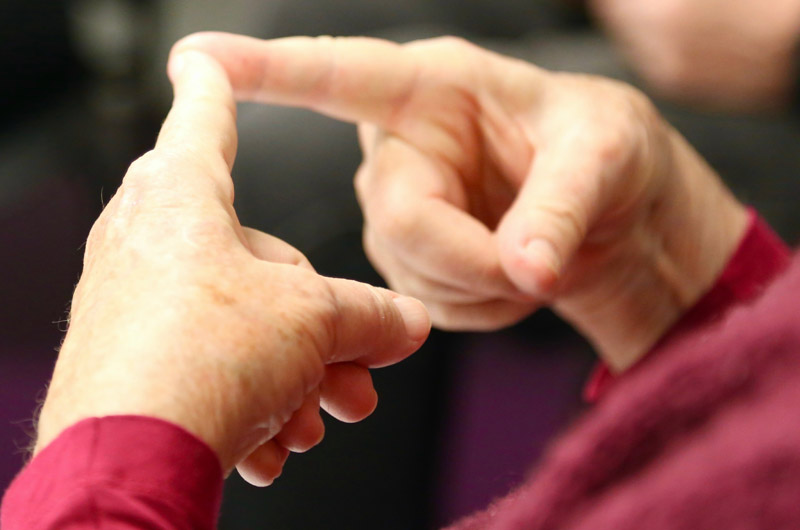
Lynn Thorp is the energy behind MV Signs: Then and Now, an endeavor to revive Martha’s Vineyard sign language used from the 17th to 19th century.
In the first floor conference room of the West Tisbury library, a quiet conversation is taking place.
“Good morning, how many people are here today?” asks Lynn Thorp. She also signs each word. Her companions, husband Bill Thorp and friend Gail Tipton reply slowly, carefully forming their hands into each sign.
“Say it as you’re doing it so that we know where you are,” Mrs. Thorp says to her husband.
Then she gives instruction: “Here’s the horizon, the sun comes up, this is noon, this is afternoon, this is evening and this is midnight.”
“I can’t do that,” said Ms. Tipton.
“But you did it!” responds Mrs. Thorp.
The sign language lesson is part of a project called MV Signs: Then and Now, Ms. Thorp’s endeavor to revive Martha’s Vineyard sign language, which was used by both the hearing and non-hearing on the Island from the 17th to 19th century. The project began three years ago, when Mr. Thorp’s hearing loss was having a large impact on the couple’s daily interactions.
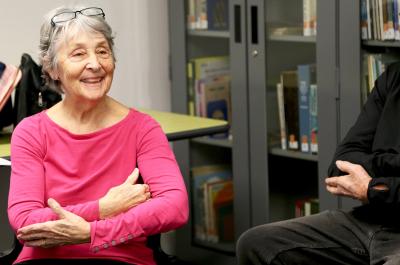
Lynn Thorp learned to sign when her husband began losing his hearing.
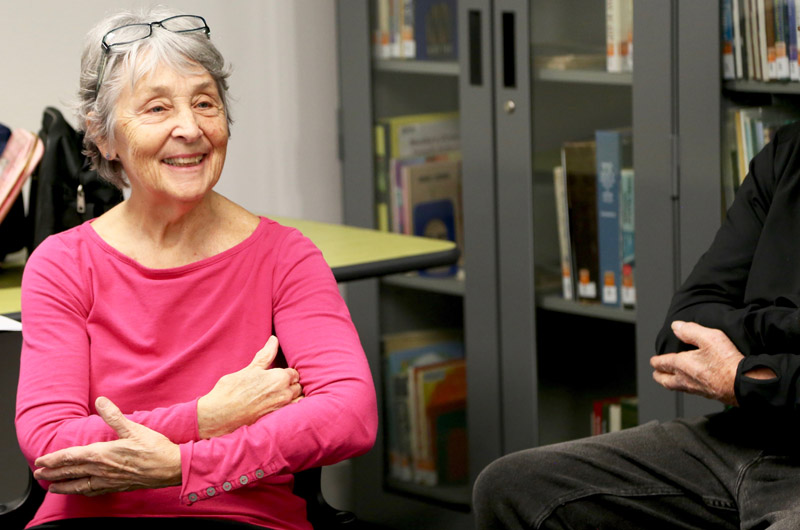
Lynn Thorp learned to sign when her husband began losing his hearing.
“We had a really hard time communicating comfortably,” Mrs. Thorp said. “His hearing [loss] is quite profound. As soon as the room changes, the ceiling is too high or there is any background noise, his hearing doesn’t happen forhim. So I thought, wow, there must be some answer.”
And there was. Mrs. Thorp heard about a sign language class held at Woodside Village, and quickly joined. When the class ended, she discovered the Interax Video Sign Language Course at the West Tisbury Library, a dated but informative series of sign language lessons led by Lyn Cook in 1989. She invited a friend to practice with her as well as several seniors from Woodside Village.
“We never really were very fast at it,” she said. “A lot of the seniors that were doing it didn’t remember it from week to week.”
It was around this time that she began reading the book Everyone Here Spoke Sign Language by medical anthropologist Nora Ellen Groce, published in 1985. The book is a comprehensive study of the history of sign language on Martha’s Vineyard collected from oral histories and historical records.
Dating back to the seventeenth century to the early days of the twentieth century, the Vineyard had an unusually large deaf population for its size, which was largely concentrated in the rural towns up-Island, in particular Chilmark.
“What I was so interested in was that there was no stigma between the hearing and the non-hearing, and that to me was really wonderful,” said Mrs. Thorp.
After reading the book, she went to the Martha’s Vineyard Museum to look at their archives on deaf history, which include notes from Alexander Graham Bell, who came to the Vineyard in the 1880s to study deafness as part of his work with oralism, which proposed that the deaf learn to speak.
To understand deafness on the Vineyard, Mr. Bell, and later Ms. Groce in her book, looked to genealogy. It turned out that all of the deaf Vineyarders had some ancestral tie to a group of families who settled on the Island between 1642 and 1710. These families originated in a small area in Kentish County, England called The Weald which, because of its rural nature, led to intermarriage and subsequently a high incidence of congenital deafness.
According to Ms. Groce’s book, the first deaf individual recorded on Martha’s Vineyard was a man named Jonathan Lambert. A descendent of The Weald, Mr. Lambert was born in Barnstable in 1657 and moved to Tisbury in 1694. Two of his children were born deaf as well.
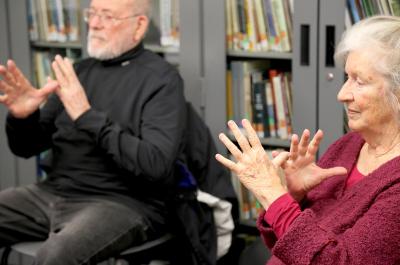
Bill Thorp and Gail Tipton practice signing.
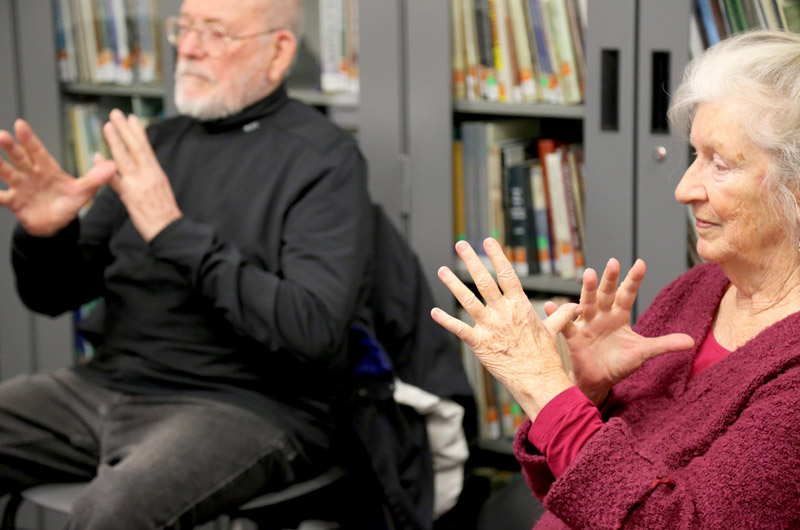
Bill Thorp and Gail Tipton practice signing.
The Vineyard at the time was similar to The Weald in that due to the rural nature of the up-Island towns, especially Chilmark, it was common to marry members within one’s family line, thus increasing the incidence of passing on the gene.
“By the 19th century, the incidence of deafness on the Vineyard was 1 in 125 — compared with 1 in 5,700 nationwide,” Ms. Groce wrote. “The greatest concentration was in Chilmark, where 1 in 25 residents were deaf.”
The incidence of deafness declined in the latter part of the 19th century when Islanders began marrying off-Islanders.
What was particularly interesting to Ms. Groce, Mr. Bell and now Ms. Thorp is that both the hearing and non-hearing used sign language in daily conversation. In oral histories with decedents of the “old Vineyard families,” Ms. Groce found that everyone knew someone who spoke sign, or “deaf and dumb,” which is what the language was referred to at the time. It was used at the Chilmark General Store where people gathered, between neighbors to communicate across distances, and at town meetings, in churches and schools. It was not a remarkable thing back then, except to those who visited from off Island.
It was somewhat of an indigenous language too, also called pidgin sign, which is to say Martha’s Vineyard sign was unique to the Island for some time. The Wampanoag tribe even had their own version of sign language in Gay Head. Special signs were created for words or representations of things unique to the Island, such as fishermen or maritime equipment.
“What I’m gathering so far is that there are a lot of lost signs that took place in those days,” said Ms. Thorp.
American Sign Language, the official language, was introduced to Islanders after 1850, when members of the deaf community were sent to the American School for the Deaf in Hartford, Conn. Ms. Groce found that no other place sent as many children to the school than the Island. Some have said that signs from Martha’s Vineyard were incorporated into that language.
And even today Islanders can remember sign being a part of their lives.
“I kept bumping into people who would ask what I was doing,” said Ms. Thorp. “They would say ‘I used to sign but I don’t anymore.’ So, what I’m finding is that there is sort of this undercurrent of sign language here.”
Ms. Thorp would like to see Martha’s Vineyard sign language revived on the Island, something that she is encouraging through the classes she holds at the West Tisbury library. And with her sister Heidi Herbert Carter behind the camera, Ms. Thorp is creating whas she calls “community action videos” which show sign being used in various ways around the Island. They have filmed the Minnesingers signing a song at their holiday concert, the charter school signing their morning meeting and seniors using sign at Woodside Village. Each new episode premieres at 9 a.m. on Saturday mornings and is repeated at 7:30 p.m. on Tuesdays and 3:30 p.m. on Thursdays.
“What I was hoping to do is have enough interesting things coming through MVTV so that people will see what is going on in different places,” she said. Advancements in technology have made communication more accessible for both the hearing and non-hearing, but that doesn’t make learning sign language any less important, according to Mrs. Thorp.
“The world is changing so much that it’s an interesting thing to think about sign language today,” she said. “But the difference between texting and sign language is heart. We are talking about connecting in a way that is very comfortable and a meeting where you can really feel that oneness. It’s communicating on a heart level rather than a head level.”
And through signing, Mrs. Thorp and her husband are making those connections again.
“Before he would have to just sit and be quiet and not hear what was going on, and now we can communicate and I can connect the dots and that’s really wonderful. And for him too.”
Comments
For more information about
Ebba Hierta West TisburyFor more information about the historic deaf community that once populated Martha's Vineyard, especially in Chilmark, look at the digital archive of materials available through the Chilmark Free Public Library's website: chilmarklibrary.org
I would love to see sign on
connieI would love to see sign on the island too! I'm deaf and come home to visit family.
I grew up on the island and
Laura Martin NjI grew up on the island and now live in NJ. I teach Sign Lang. In high school and college. Need help with this project? My students could always create a video or Skype to give lessons. I'm on the island in the summer. Let me know [email protected]
I Recently graduated from an
Donna Melrose MassI Recently graduated from an ASL/English interpreter program.
I am not yet certified, but would like to contribute in someway. Martha's Vineyard is one of my favorite places.
I am currently an RN and I did grow up with Deaf parents.
How wonderful!! That’s
Lynn ThorpHow wonderful!! That’s exactly what this project is about… people sharing their sign language interest and know-how with the residents of MV. Please do let me know some particulars for what and how you’d like to contribute.
Keep in mind that PSE (Pidgin Signed English) rather than ASL is the sign language we hope to revive as a second language on MV. Some suggestions are: volunteer teachers and facilitators of PSE who’d enjoy engaging various ages in sign-practice circles; signed activities (songs, plays, skits, videos, story-hours for toddlers & young children; signing for parents with infants & toddlers; engaging/ encouraging hearing and hard of hearing seniors to bridge communication gaps between themselves and younger generations); signing with interested folks with disabilities; working with me to orchestrate and document the above for the MVTV Series “MV Signs Then & Now.” ( as a means to inspire and show our community the activities taking place toward bridging communication gaps across the board and reviving signed English as a 2nd language on MV).
Looking forward to your response
[email protected].
Donna, my daughter's goal is
Sarah Dunphy Crestview, FLDonna, my daughter's goal is to become an interpreter. We are lucky to have a college two hours away that offers the interpreter program, and she will be applying this year, for next fall. But, I was curious as to where you went to school, just incase we need another option. Thank you!
My husband and I studied with
Lynn Thorp Martha's VineyardMy husband and I studied with Cay Monroe here on the Island. She was a wonderful teacher at the Vineyard Haven Senior Center. Cay's parents were deaf (and she later taught sign). When Cay passed on we studied with a resident from Woodside Village, Later we found the INTERAX Sign Language Course in our Library CLAMS system and we've been using it ever since. Last year, Lyn Cook, teacher and producer gave me permission to present her course to the residents of MV on local public access television (channel 13) as means to revive sign language as a second language on Martha's Vineyard.
I read the book Everyone Here
Judy Hagerman VAI read the book Everyone Here spoke Sign Language many years ago and found it fascinating as I had never known so many Islanders had been deaf, especially in Chilmark. While I still have the book, I wonder if it is still in print.
Yes, it is still around. I
Mary Kyritsis Athens, GreeceYes, it is still around. I just checked on Amazon.com and you can get it in paperback and also for Kindle.
My mother was looking for a
Sarah Dunphy Crestview, FLMy mother was looking for a good present for my daughter's last birthday. She is currently taking ASL and hopes to become an interpreter in the future. She was doing a project for her class on the history of deaf people on the island and I suggested that book. It was at Bunch of Grapes when we were there visiting last summer. My mom was all set to go to BOG the next day and pick it up, but instead found a copy that had belonged to my grandmother. She sent that copy to my daughter and she was so excited to receive it.
I have read the book by Groce
Bernice HyannisI have read the book by Groce and am interested in this. I am a retired teacher of the deaf and a graduate of Gallaudet University in Washington, DC (though not deaf). Please contact me if I can help. [email protected]
There have been studies in
Bob EdgartownThere have been studies in some anthropology classes at Texas A&M on this phenomenon on MV.
Add new comment