



Affordable housing has been part of the land bank’s planning since 1989, when it first adopted a housing policy.
Affordable housing has been part of the land bank’s planning since 1989, when it first adopted a housing policy. As a result, the land bank has been part of many of the affordable housing developments that are known to Islanders. Sepiessa Point in West Tisbury. Morgan Woods in Edgartown. Takemmy Path in Tisbury. Old South Road in Aquinnah. Twin Oaks in Oak Bluffs. Eliakim’s Way in West Tisbury. Nab’s Corner in Chilmark. Kuehn’s Way in Tisbury. In each of those cases, the land bank worked with affordable housing entities to obtain land for year-round residential development, while conserving the balance.
That represents real progress. But the land bank has offered to do more. Back in the 1990s, when the concept of a housing bank was first floated, the land bank offered to be the administrator of the funds. Collecting, processing and accounting for the two per cent transfer fee constitutes a rather large amount of the land bank’s administrative budget: it requires an analysis of each real estate transaction on the Island to determine the correct fee or, alternatively, the grounds for exemption. The land bank’s standing offer since the 1990s, if the voters and the legislature choose to add for housing purposes an extra per cent or half-per cent to the two per cent, is to handle all of the administration.
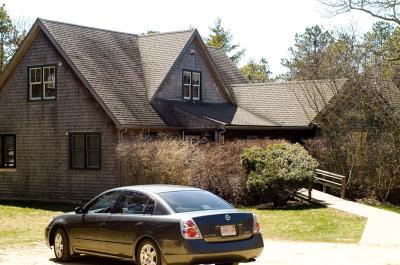
Affordable apartments at Sepiessa. The land bank adopted an affordable housing policy in 1989.
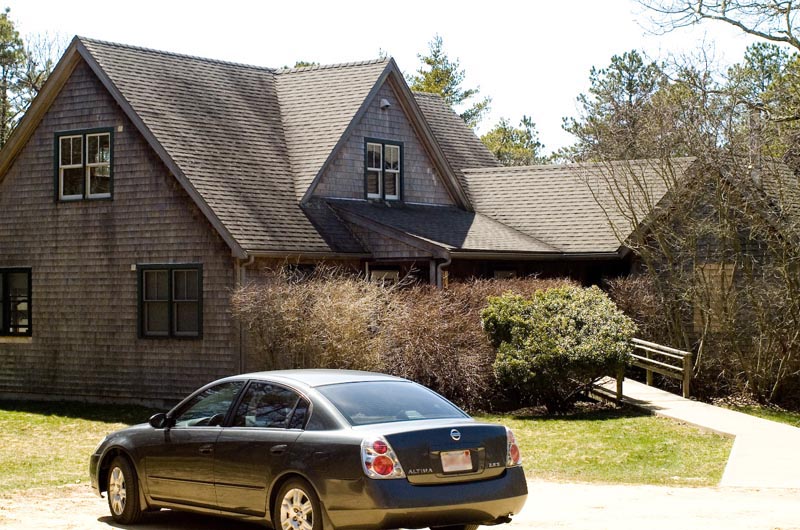
Affordable apartments at Sepiessa. The land bank adopted an affordable housing policy in 1989.
The land bank would regularly send to the housing bank its percentage, allowing the housing bank to concentrate exclusively on spending it for affordable housing efforts.
The land bank would oppose any effort to dedicate a portion of the existing two per cent for non-conservation purposes. Such a reduction would upend the land bank’s finances, since a meaningful portion of this two per cent is already allocated to fixed expenses — primarily, debt service and land management.
For instance, when the town of Oak Bluffs asked the land bank to pay $18.9 million to create the Southern Woodlands Reservation, the land bank didn’t have the cash in the bank — it had to borrow, as it did for many other properties across the Island. And funds continue to be needed to police and oversee beaches, maintain pond accesses and keep trails open.
If some of the two per cent were removed, only the leftover, after paying these fixed expenses, could be used for new land acquisitions. The percentages tell the story: in the most recent fiscal year some 52 per cent of the land bank’s revenues was spent on debt service and land management. In lean years — as recently as 2013 — the number was 83 per cent.
Vineyarders need not pit conservation and affordable housing against each other. We can do both.
James Lengyel is executive director of the Martha’s Vineyard Land Bank.
Comments
As this editorial points out,
Dan Larkosh West TisburyAs this editorial points out, both can be done only by raising the tax on real estate sales. For many people, the bulk of their nest egg is the equity in their home. Do we take that equity to build more housing? That is a point which needs serious discussion.
Thank you James. Thank you
Pat, on the back Martha's VineyardThank you James. Thank you for all you do for not only affordable housing but for keeping the faith and moving the discussion forward.
I have always said it's not the Land Bank that created the problem of affordable housing but the lack of leadership at the affordable housing level. It's nice to have your stewardship at the Land Bank and it's refreshing to show people the larger role your organization has played and is willing to play in the future.
The truth is most people on
charlie callahan so boston/edgartownThe truth is most people on the vineyard don't want affordable housing near them
Land Bank preserves for
MarieLand Bank preserves for everyone.
At what point do we stop taxing those who have already paid state and federal taxes? Do we use the land bank for health care subsidies, School renovations, police department staffing, senior citizen programs? Every time you have a shortage you cannot look to take from someone else. Solve the root problem.
Time to look at the Island economy. It is not supporting good year-round jobs. That is the problem. Is it possible that tourism is not the future?
What if a tax were levied on
Patty TisburyWhat if a tax were levied on the people who rent out their homes daily, weekly or monthly during the summer months, like the rooms tax that hotels pay? It could provide monies specifically for affordable housing.
In FLA. where I own a condo,
William ExPBA NYC & HKIn FLA. where I own a condo, I am charged 10% tax of short-term (less than 6 months) rental income. Great Idea for MVY.
Amen ! Just observing the
George Stein EdgartownAmen ! Just observing the Facebook pages the amount of funds generated pales with the actual total of funds that changes hands tax free annually.
I'm glad to see this
Dean Rosenthal EdgartownI'm glad to see this addressed publicly by the executive director in the papers, as this much discussed topic over the years has been bubbling up near the surface of late with much more frequency. That probably stimulated the response, but the topic could have just been passed over in silence by the Land Bank. James Lengyel did the brave thing by writing this commentary. I have one quibble, he writes: "Collecting, processing and accounting for the two per cent transfer fee constitutes a rather large amount of the land bank’s administrative budget: it requires an analysis of each real estate transaction on the Island to determine the correct fee or, alternatively, the grounds for exemption." Correct me if I'm wrong, but with a fixed 2% fee, the administration amounts to doing simple math for each sale registered and, for example, when first-time home buyers purchase a home, putting a lien on the property for 5 years or whatever other limited exemptions there exist. This is not a complicated system to administer? Even if there were two or three sales a day year-round that the Land Bank would have to contend with, which there aren't, applying the math or granting the exception based on a fixed number of exceptions cannot prove to be too complex for an efficient administrator and a proper budget that tax dollars support. It is my hope that the job is tended by someone who can do it with ease and alacrity.
The Land Bank fee has
Dan Larkosh West TisburyThe Land Bank fee has thirteen exemptions (see link below). Some are pretty straightforward, but others are more complex. Determining the applicability to each and very transaction on MV (including mortgage refinance when a deed out of trust is required for example) is not always simple. The Land Bank has to make certain that the exemption rules are applied fairly and with uniformity. The Land Bank employs a skilled staff to make these important and sometimes difficult decisions. Plus there is all the other work and accounting involved in acquiring and administering properties as stewards of public funds. I agree with most of what you say Dean, but just pointing out that the job of the LB is not so simple as just doing the math for each sale. http://www.mvlandbank.com/documents/lb2new.pdf
Merry Christmas
MarieMerry Christmas
An article in today's NYT Business section adresses this issue. "Solve Poverty, Not Inequality". Taking from others only gets you so far. Short sighted non-sustainable attempt at solving a problem. You can only take from other hard working people so much. Redistribution is not the answer to all economic problems.
A recent article pointed out that many of those in need came to the Vineyard in the last 15 years. What brought them here? What was the living plan? It seems like something that young people do before they realize that they need a long term plan.
What can be done to establish year-round jobs with a living wage and benefits? Foster start-ups and attract businesses that can bring good jobs that do not require transportation of products. Sounds silly but something tech would be perfect.
I know that one of the main
Von MillerI know that one of the main issues that is brought up in talks of larger scale housing is the septic and town water houses. I see all these massive mansions on the chops that must have multiple bedrooms and probably 3+ bathrooms. How is it that these things keep popping up with no problem at all yet when we cant have an apartment complex that would take up the same amount of space and could house a dozen families?
Add new comment