


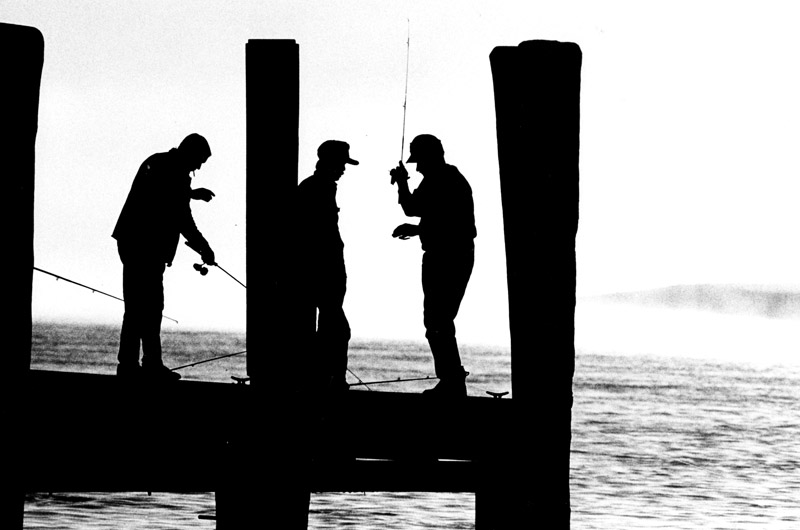
At the height of boating activity last summer in Edgartown harbor, there was a pleasant surprise. Two dolphins spent three days swimming around.
At the height of boating activity last summer in Edgartown harbor, there was a pleasant surprise. Two dolphins spent three days swimming around. They were observed meandering amid the piers, the boats and the moorings. The dolphins weren’t lost or here on vacation and they weren’t here to draw a community of spectators, though lots of folks saw them. They weren’t participants in some impromptu aquarium show. They were here because there was food, and plenty of it.
For the first time in at least two decades, Edgartown harbor was filled with forage fish. Small bait fish were swirling in the middle of the harbor beneath the forest of aluminum masts and beautiful sailboats. You could watch the activity from the dock, a deck or from a dinghy.
The fish these dolphins were feeding on were what we locally call bunker, or more widely known as menhaden. For town fishermen, the arrival of menhaden was a pleasant unexpected gift. Menhaden are a choice bait fish to catch striped bass and bluefish. During the derby this past fall, competitors were out in Edgartown harbor in small skiffs with throw nets or rods and treble hooks trying to snag them. In years past, if you wanted bunker, you had to buy it in a tackle shop. Bunker is like candy to striped bass.
Menhaden doesn’t appear in fish markets or the restaurants, which is why nobody really talks about menhaden. But every fish in the ocean loves to eat menhaden, from snapper bluefish close to shore to the whales that swim in the open ocean. Swordfish eat menhaden. Seals and dolphins eat menhaden. The only other top favorite meal of choice is squid, but that’s another subject.
Menhaden is essential to the life cycle of the ocean which is why the Atlantic States Marine Fisheries Commission is holding a series of public hearings from Maine to Florida on the future management of menhaden. On Monday, the commission held a meeting in Bourne, and the next hearing in Massachusetts will be in Braintree on Dec. 20 at the Thayer Public Library, located at 798 Washington street.
ASMFC is also seeking written comment for those unable to make it to the meetings.
The commission wants to hear from stakeholders, of which Martha’s Vineyard is definitely one. Fisheries managers are taking a new look in response to the growing concern that menhaden needs to be better managed. But this is not about quotas that will be delivered to fish markets or restaurants. The harvest is used for fish meal and shipped overseas to fish farms. This is a resource that is predominantly used as fertilizer. This is a fish caught by the ton and rendered into oil and inedible products. The steel fishing boats that work with nets as big as a football fields are as big or almost as big as our local Steamship Authority ferries. Menhaden don’t stand a chance.
But for those of us with some years under our caps, we remember a few decades ago when menhaden ruled the waters and were part of the harbor story. In those years there was drama at and below the surface, as these bait fish were chased about by bigger fish; false albacore and the once abundant squeteague, known also as sea trout.
Back then Menhaden were abundant, swarming like underwater bees in all the Vineyard harbors and in and around the coastal ponds. But mysteriously they disappeared. We still believe that not far offshore they were vacuumed up by large fishing boats from afar.
Like oysters, menhaden feed on phytoplankton and zooplankton. They don’t bite and aren’t attracted to a baited hook. Instead they swim with their mouths open and ingest microscopic creatures. They are filter feeders and play a huge part in cleaning up our waterways.
While there has been plenty of welcome attention in recent years about how oysters are key to restoring our saltwater ponds, menhaden do an even sweeter job. A century ago, menhaden and oysters ruled the harbors and coastal inlets from Maine to the Florida. They were essential like anadromous fish, river herring, shad and even salmon.
Menhaden’s gift to the world is more precious to the health of our ocean than rendered as a product to feed an economic engine. Menhaden are the lifeblood of an ecosystem that is suffering in backyard waterways, nearby estuaries and most coastal ponds. But because they aren’t sport fish, they don’t usually make big headlines. But without them everyone suffers.
Visit the Atlantic States Marine Fisheries Commission at asmfc.org for a full list of hearings. Public written comment will be accepted until 5 p.m. on Jan. 4, 2017 and should be forwarded to Megan Ware, Fishery Management Plan Coordinator, 1050 N. Highland St., Suite A-N, Arlington, VA 22201; 703.842.0741 (FAX) or at [email protected] (Subject line: Menhaden PID).
Comments
Thanks Mark; a wonderfully
Pat Tyra Edgartown & Dania Beach, FLThanks Mark; a wonderfully interesting story with historical tidbits.
For more information on
Kurt Freund ChilmarkFor more information on menhaden and their critical role in the marine ecosystem, read "The Most Important Fish in the Sea" by H. Bruce Franklin.
One single company, "Omega
TOM HODGSON WTOne single company, "Omega Protein", takes 90% of the US waters menhaden catch. One company! Here's a 2009 article: http://www.nytimes.com/2009/12/16/opinion/16greenberg.html
Good to know and how about
Bob EdgartownGood to know and how about stop buying this product people.
Fish meal and fish oil
Menhaden Defenders New JerseyFish meal and fish oil derived from menhaden can be in anything from Eggs,milk,steak,bacon,fish, margarine you name it. Best way to start avoiding products that contain Menhaden or are enhanced is to ask questions.That's right, pick up the phone or email the mfg when you see ingredients like contains Omega-3, Herring, Fish Oil, White fish, fish meal, Ocean Fish, etc these can be trick names slipped into ingredient labels, especially on dog and cat foods. You can also avoid buying Asian farm raised shrimp, salmon, tilapia and Basa/Swai as these are fed American fish meal for cheap protein.
It is almost a crime to
Adelaide Kent New YorkIt is almost a crime to convert food (for fish, in this case) to inedible substances.
I remember in the late 80'S
JC BostonI remember in the late 80'S schools of bunker in Katama Bay so thick i thought i could have walked from Katama to Chappy.
Grew up in the 50s. Waretown,
D.Dunn. Amsterdam, N.Y.Grew up in the 50s. Waretown, New Jersey..Bunker in Barnaget Bay....snapper Blues...blow fish...The Bunker was our bait for Crabs and We caught a million. Hate the ruination of our beautiful waters. Best Wishes for protection for these fish.
Great article thank Mark!
Steve FalmouthGreat article thank Mark!
Excellent article and an
Dick AquinahExcellent article and an important subject. But one side note: it's always stated--correctly--that bunker are filter feeders, gorging on a range of planktons. And yet numerous times, at least in the last few years, I've observed adult fish circling and feeding on schools of small sand eels and silversides. This has been confirmed by examining stomach contents of the fish. Has anyone else seen the phenomenon? Is it a new behavior? I don't recall it 20 or 30 years ago.
That is the first time I have
JAMES Crowley CtThat is the first time I have heard that. I do not think they are able to do that. Maybe tinker blues were the fish seen.??
I agree that the protection
Drew Martin Lake WorthI agree that the protection of these fish is important to the existence of healthy ecosystems.
the whole ocean food chain is
Bruce B.C. Canadathe whole ocean food chain is in rapid decline anything that can help save our wild salmon ban fish farms
We need to stop the
Bob Dawe MassachusettsWe need to stop the extinction of our lower food chain. Alewives and herring face the same situation, however it is urgent to note that areas that have rivers that lead to breeding grounds are being blocked or polluted. The alewife brook in Essex Ma. was so blocked that the breeders could not get to Chebbacco Lake and in the 1990's the State threw up road blocks to prevent the clearing of this stream. We need State reps to fight to cut the red tape and insist on strict protection laws!
Stop commercial fishing of
Sue Massie Virginia Beach , VaStop commercial fishing of menhaden now!
Save the Earth!!! We only
AnnSave the Earth!!! We only have one and no do overs.
Do not over fish them!!!
Julie. Hansen Freeman S. Dak.Do not over fish them!!!
Please protect echo system in
Cheryl Lawrence Scottsdale, AZPlease protect echo system in our oceans so all sea life can continue.
This must STOP. These fish
Christine Anderon Winter Park, FLThis must STOP. These fish need to be protected to keep our ecosystems protected.
I agree that the protection
Keith Cline SeattleI agree that the protection of these fish is important to the existence of healthy ecosystems.
Exploitation of the earth and
Suzanne Bennett Northern MinnesotaExploitation of the earth and its creatures must end.
I agree to the protection of
Ty Madore Nashville, TennesseeI agree to the protection of these fish species as they are important to a healthy ecosystem. We must stop the overfishing once it's depleted it's gone!!
Regulation needs to be
Patricia Vazquez Lander, WYRegulation needs to be enacted to bring balance between need and preservation and not allow greed to extinguish this critical fish population.
Add new comment