


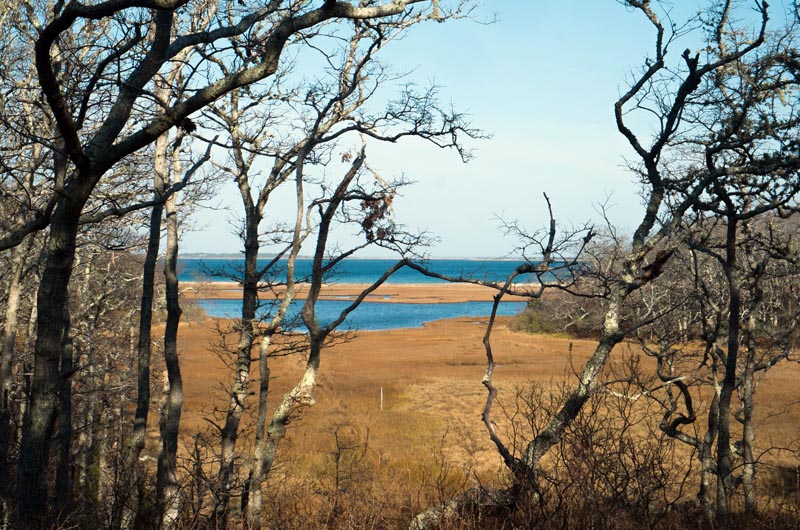
The Martha's Vineyard Land Bank recently bought 31 acres of rare land at Tom's Neck Farm, the culmination of a complicated deal involving multiple sellers, local donors and a financing model that marks a first for the land bank.
At the northeastern corner of Tom’s Neck Farm, a small hill rises out of the underbrush, overlooking Cape Pogue Bay. There’s a bench there where Ann Floyd and her husband often sit and contemplate the expanse of ocean and limitless sky.
“It is part of my heritage and it is a very sacred spot for my family,” she said recently.
Since the 1830s, Ms. Floyd’s relatives have stood on that hill, and at the edge of the saltwater pond, and along the sandy white shores of Cape Pogue Bay. Next year, these Chappaquiddick haunts will be open to the public for the first time.
Much of the land borders Cape Pogue Bay.
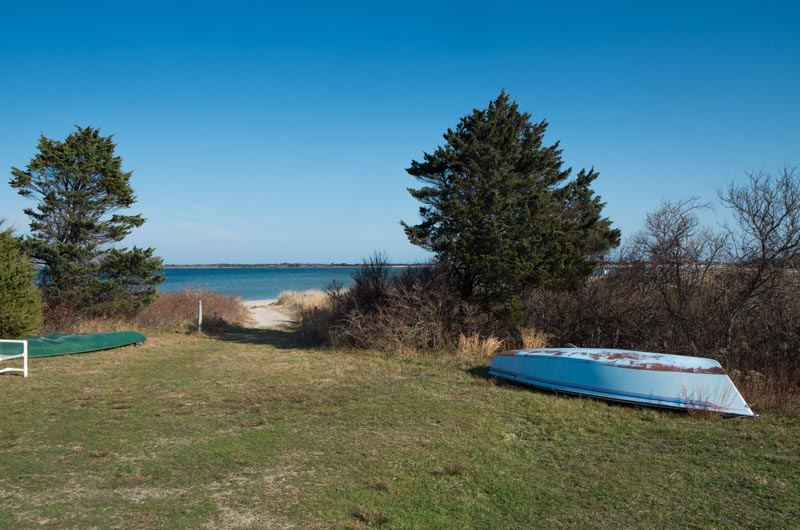
Much of the land borders Cape Pogue Bay.
The Martha’s Vineyard Land Bank bought 31 acres of the historic farm late last month from Ms. Floyd and her cousins for $5.17 million. The closing marked the culmination of a complicated deal involving multiple sellers, local donors and a group of creditors who loaned money to the land bank to help finance the purchase.
The land bank, created by an act of the state legislature in the 1980s, collects a two per cent transfer fee on most real estate transactions. The funds are used to buy public conservation land. Recently, a sizeable portion of it has been Chappaquiddick land.
That’s because more than a decade ago, a group of Chappaquiddick residents began raising money to help conserve properties on the small island. Once they identify a property they’d like to see conserved, the Chappaquiddick Open Space Committee asks local donors to sweeten the deal.
To date, the land bank has purchased a dozen properties with help from the open space committee.
But Tom’s Neck Farm was unlike any other purchase the two groups had collaborated on before. For starters, the deal was complicated by the sheer number of parties involved.
“There were so many moving pieces, so many different players,” said Nancy Hugger, the open space committee’s volunteer chairman, who orchestrated the land bank’s financial backing for the project. “It was the most complex deal we ever worked on.”
The farm, a former working farm and ancient place that was the site of the first white settlement on Chappaquiddick, has been on the open space committee’s wish list for some time, but intensive planning for the purchase didn’t begin until three years ago.

Since the 1830s, Ann Floyd's relatives have lived at Tom's Neck Farm. Next year it will be open to the public.
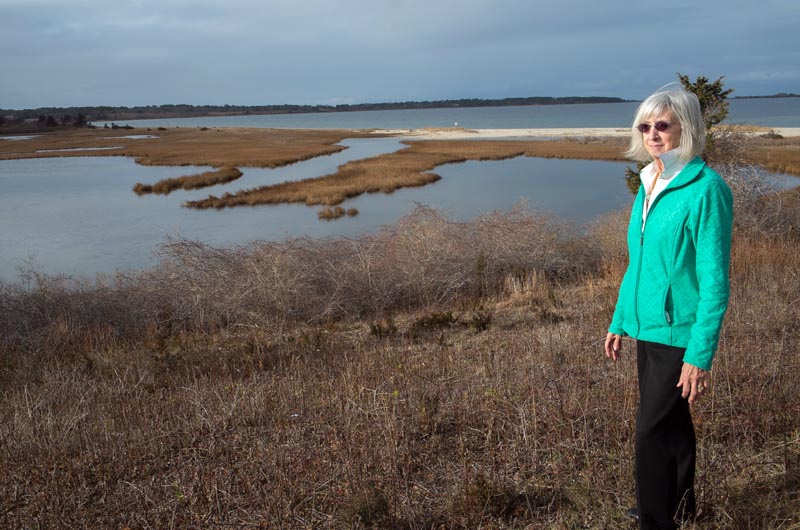
Since the 1830s, Ann Floyd's relatives have lived at Tom's Neck Farm. Next year it will be open to the public.
“We needed to open up the box and get really creative if we wanted to do this,” Ms. Hugger recalled. In January of 2013, she and Ms. Floyd stood on the fabled hill and decided to take another stab at it.
“We stood on that overlook, and we looked at each other, and we said, we can do this,” Ms. Hugger recalled.
In the end, the land bank received two outright donations — one for $2.175 million and another for $25,000 — but much of the purchase was paid by a group of 11 investors who loaned money to the land bank so the sellers could be paid up front.
The land bank will be paying off the $2.8 million in loans over the next 10 years.
“That’s what transformed it from a property the land bank admired to a property the land bank could afford,” James Lengyel said of the funding model, a first for the land bank.
“I do hope it inspires others to do the same,” Ms. Hugger said.
When it was first established in the late 1990s, the Chappy open space committee set its sights on inland parcels, a string of properties they called the emerald necklace. “We were saving land in the center of the island because it was all we thought we could do and could afford,” Ms. Hugger said. In 2004, they got more ambitious and began targeting coastal land, the so-called diamond necklace.
Tom’s Neck Farm is one of a handful of coveted properties that hug Cape Pogue Bay.
Property is prized for scenic value, varied habitat and potential trail linkages.
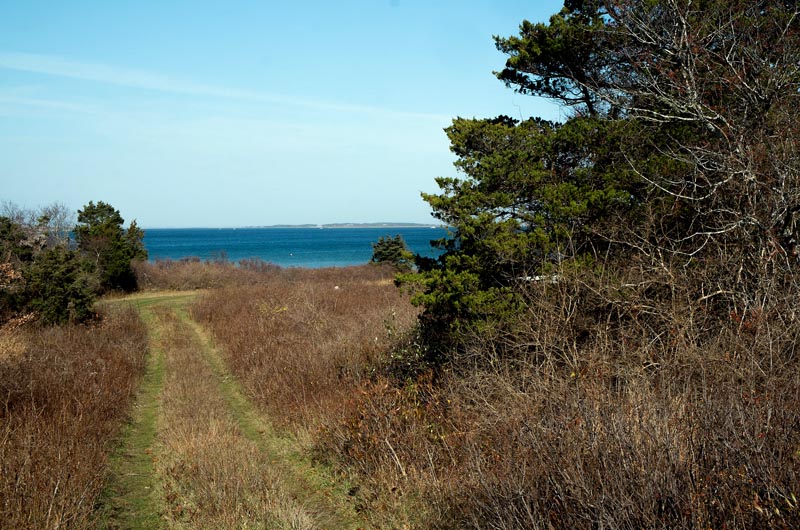
Property is prized for scenic value, varied habitat and potential trail linkages.
“It’s a little nook that has been unspoiled and undeveloped and to be able to put people on it to appreciate it is I think really important,” Ms. Hugger said. The land bank prized the property for its scenic value, varied habitat and potential trail linkages, as well as the protection its conservation would provide to the Cape Pogue Pond, a pristine saltwater bay that is one of the prime shellfish sites in the state, Mr. Lengyel said. “Taking development out of its watershed is an important conservation goal,” he said.
The land bank has already sited a series of trails for the property, which walkers will access via a trailhead at the Mytoi gardens on Dike Road. In the off-season, the land bank will also open a trail to the beach. The property will open to the public in spring 2016, after a management plan has been written for the property.
That document may include information about the long history of the property. Tom’s Neck Farm may have been named for Captain Thomas Arey, who settled there around 1750 with his family, or perhaps for Thomas Jernegan, who owned parts of Tom’s Neck Farm from 1791 to 1832.
Tisdale Smith bought the 200-acre farm in 1832, eventually passing it on to his daughter Parnell Smith, who married Charles Pease. Their son Benjamin Pease summered at Tom’s Neck Farm. His obituary, published in 1938, called it a “beautiful, varied piece of land.”
Generations later, the description is still apt. The property features several habitats including woodland, marshland, meadow and salt pond. It is a home to otters, oystercatchers and clams, which inhabit the salt pond.
“It’s a microcosm of the various habitat types on the Island,” Mr. Lengyel said.
Native Americans are thought to have settled in the inland woodlands, where geological formations made a dip in the property, sheltering the spot from the northeast. “If I were a Wampanoag, that is exactly where I would want to live,” Ms. Floyd said. “I feel I have preserved the land for their ancestors as well, so that was a very important piece of this for me, too.”
Her paternal grandparents, Elva Stuart Hoar and Roger Sherman Hoar, are buried on the land. (Elva Hoar was Ben Pease’s daughter.) The sale, though significant, did not spell the end of the Pease family’s stewardship.
The property had been previously subdivided and Ms. Floyd’s family has maintained ownership of five buildable lots closest to the Dike Road.
After working on a plan to conserve the property for 20 years, Ms. Floyd expected to feel jubilant when the sale finally went through. Instead, she said she feels peaceful about the whole thing.
“I am of the belief that we don’t own the land, the land owns us,” she said. “We had to take care of it, and this was the best way to do that.”
Tom Dunlop contributed to this story.
Comments
Many congratulations to Annie
Patricia Floyd Killian Warren VermontMany congratulations to Annie for working so hard for so many years to make this happen and to the children and cousins who helped save this amazing land forever from development.
Congratulations, Annie..you
Dana Anderson HonoluluCongratulations, Annie..you have made safe a rare legacy.
Outstanding ......Chappy is
JackMac New YorkOutstanding ......Chappy is blessed to have such an active and aware conscience in Nancy and Anne. What a wonderful gift form the future of this wonderful "place by the sea".
Congratulations on a wonderful effort!
The best of the best! An
Ellen Weinberg Dover, MA and West TisburyThe best of the best! An enlightened and spiritual understanding of property. "We don't own the land, it owns us". I am very moved and very grateful for this family's decision and to all who made it possible.
Ann, our lives have never
Scott Fedonchik New YorkAnn, our lives have never been the same since you, Tom's Neck and the Dawn Treader came into them! Thank you for everything and for this wonderful gift to the island and it's future. We look forward to seeing you soon on Chappy!
why is it that beach is only
Rebekah vineyard havenwhy is it that beach is only open in the off season. The haves and the have nots. A charitable donation to the public should be for the public use not just a tax write off for the rich and the rich neighbors who never have to be subjected to the common folk coming near them on the beach!
Happy for all involved. Good
Debbie Brown ineyard HavenHappy for all involved. Good job. Congratulations Annie. I know how hard you worked on this. Nancy Hugger what an asset you are to the Chapoy Community.
I agree with Rebekah.
Damien EdgartownI agree with Rebekah.
What a deal! Little ole Annie gets $5M plus and still gets to keep the land private.
The Gazette story conveniently omits the fact that the farm has been on the block for years after it was chopped up. No bidders for stratospheric prices. One broker told me buyers in that range were turned off by the sloppiness of the farm itself.
I know of no other Land Bank or Chappy Open Space that permits use only in the off season. Frankly, I believe it to be illegal or certainly unenforceable.
I, for one, have every intention of visiting this summer.
i went to school with roger
stevei went to school with roger hoar back in the late sixties...and stayed at the house there in the summer of '69...
Not sure why I woke up at
Bob Hill New JerseyNot sure why I woke up at midnight thinking of Tom'sNeck farm. . I haven't been there for four years since I bought my own farm here in NJ. I'm both sad and glad that this wonderful place is preserved. im glad I was able to spend time there.
I was unbelievably lucky
Rosmarie Schade Rosenheim, GermanyI was unbelievably lucky being able to spend the summer of 1952 with my girlfriend Ann and her family on Chappy. These months are unforgettable and among the most precious times of my life. I would be very happy to get in touch with Ann again. I've tried it several times in vain. I want to thak her for everything!
[email protected]
I knew Roddy years ago and
Carrie Midcoast, MaineI knew Roddy years ago and lost touch as our life paths went in different directions. I was saddened to learn of his death in Falmouth and believe that he must be happy that his sister sold part of “the farm” to be in the public’s trust. Now that he is with the ancestors, I pray that he is at rest...
Add new comment