


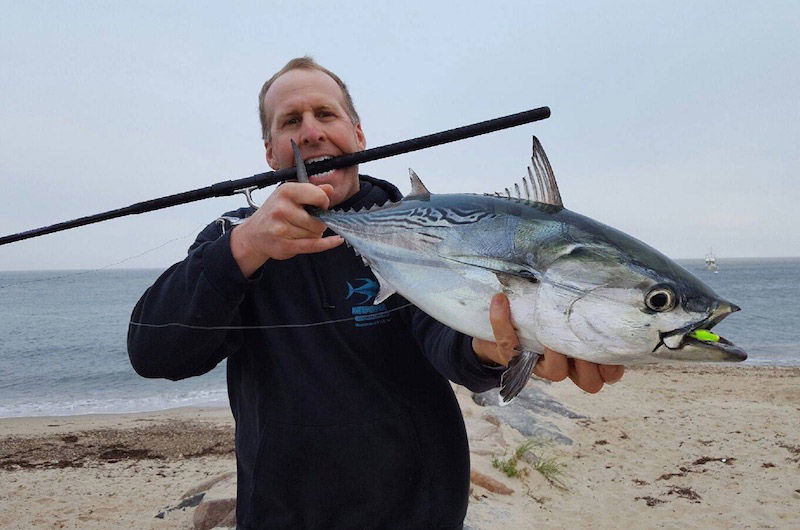
False albacore. Barely sounds like a fish. Tastes like an oily shop rag. Not even included in the official Derby name. Yet an albie is a prized possession at Martha’s Vineyard Striped Bass and Bluefish Derby headquarters.
False albacore. Barely sounds like a fish. Tastes like an oily shop rag. Not even included in the official Derby name.
Yet an “albie” is a prized possession for anyone walking up the ramp towards the scale at Martha’s Vineyard Striped Bass and Bluefish Derby headquarters. The fish can send anglers screeching in their cars from one end of the Island to the other, based on a third-hand rumor. It can induce people in waders to sprint back and forth along a pebbled beach, casting on the move in fishing’s version of basketball’s “run and shoot” offense. And when a frenzy of hungry false albacore comes screaming up the beach it can induce a rush of adrenaline that would make an emergency room doctor wince.
This fish gets under the skin of Derby fishermen more than any other. Bob Garrison, of Edgartown, spends half his summer carefully planning Derby strategy. He comes up with a detailed plan mapping out his time, his favorite fishing spots, and his pursuit of the four eligible species. Then, in late August or early September, schools of false albacore begin to arrive on Vineyard shores. “It all just goes out the window when they show up,” Mr. Garrison said. “It’s an obsession. It’s just stupid fun.”
He said the excitement of an albie hitting a lure is like no other Derby experience.
“They smash it,” he said. “They’ll actually hit it from the front most of the time. When they do, they make a huge big turn on it. It makes a massive commotion on the surface. They make a long run, really quickly, and you can feel the tail pumping. You don’t try to stop it, you just sort of exalt in the moment, and let the drag scream.”
He’s not the only one hooked around here.

Amy Hewitt, aka the albie slayer.
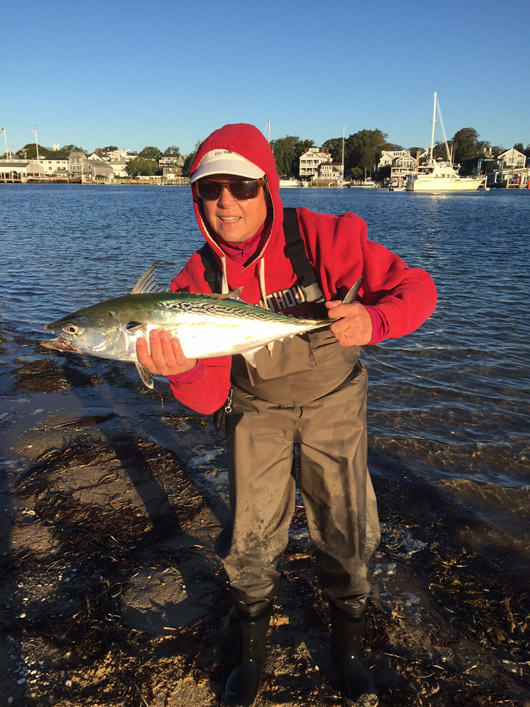
Amy Hewitt, aka the albie slayer.
“Hits like a freight train,” said Drew Patey, who travels from Daytona, Fla. each fall to fish the Derby. “They’ll pull your arm off. Big bass just roll over and play dead. These things fight to the bitter end.”
Mr. Patey, however, happily defers albie expertise to his sister Amy Hewitt, fishing just a few feet away.
“She’s the queen of albies,” Mr. Patey said.
“Slayer,” Ms. Hewitt said, only half paying attention to a nosy reporter. About 100 yards away, a slight commotion on top of the water instantly catches her undivided attention.
“Right there, see them?” she said, pointing. “Eleven o’clock.” The tension ratchets up perceptibly among the small group of anglers. Some stop casting, intent on perfect timing if the school swings close enough.
False albacore (Euthynnus alletteratus) wasn’t always a Derby fish. The Derby committee added the species in the 1980s, with an eye toward conservation of other declining species.
They look like a small tuna, and have common characteristics, but false albacore are closer to the mackerel family than the tuna family, in scientific terms. They average about 10 pounds, but it usually takes an albie north of 15 pounds to win the Derby. They have to be a minimum of 25-inches long to qualify for the Derby scale.
In the deeper waters off the mid-Atlantic coast, fishermen have landed false albacore weighing 36 pounds and measuring 48 inches long. The species inhabits Atlantic Ocean waters from New England to Brazil and from the British Isles to South Africa. They feed in very large schools, chasing bait fish that pour out of bays and inlets in the fall. Albies have no swim bladder to control their buoyancy, like many tuna species, so they have to swim constantly and relatively fast, which accounts for their unusual strength.
Talk of eating false albacore quickly accelerates toward superlatives, but not in a good way. Some say the best recipe is to season and cook it on a cedar plank, then throw out the fish and eat the plank. Others describe the dark, oily filets as fish that a hungry cat would walk away from.
Catching them elicits opposite superlatives.
Derby president Ed Jerome said when the false albacore arrive, breaking and slashing and chewing up the bait, everybody gets excited.
“I equate the albacore with juvenile delinquents,” he said with a laugh. “They come in, there are no rules. They’re so fast and strong, and they’re very plentiful.”
They are certainly not easy to catch, but they present a fair goal for most Derby participants.
Albies tend to school near the shoreline, where they can trap bait fish in a bight or inlet. No boat necessary. Derby fishermen say false albacore can hit five feet off the beach. Unlike other species, they don’t feed at night, so those daunted by wading in the dark have a shot at a fish big enough to weigh in.
They are also visible when feeding, which can turn boring doubt about whether stripers are anywhere around, into thrilling confirmation that false albacore are swimming right at you.
“They do make a lot of racket on the top if they’re there in numbers,” Mr. Harrison said. “I’ve seen mile and two mile long strips of ocean that are all albies.”
One false albacore Mr. Harrison landed while fishing with his son sticks in his mind. After checking out five potential hot spots and finding too many fishermen or too few fish, they were delighted to find plenty of fish and no fishermen near the Lake Tashmoo jetties one blustery day.
“Way up toward West Chop, I could see a big school of fish breaking,” Mr. Harrison said. “It took them a good 45 minutes, eventually they got down to us.”
He and his son cast in front of the school at the same moment, crossing lines. As soon as their lures hit the water, both hooked into false albacore. “A huge fish hit his, and a fish hit mine,” he said. “I actually think his fish was bigger.”
His son quickly lost his fish, but Mr. Harrison’s took off. “He went around the jetty into Tashmoo, then back out Tashmoo and straight out for 100 yards,” Mr. Harrison said.
When false albacore are around, word gets out pretty quickly. A few people arrived on the beach as he was trying to land the fish.
“I knew it was a big fish when I got it on,” Mr. Harrison said. “Nobody else quite knew it until it turned, 100 yards out, and the sun hit it exactly right, and it just flashed.”
He eventually landed the fish on the beach, and it was good enough for second place in the Derby that year.
Mr. Jerome, a charter operator, said he doesn’t have a particular memory about an albie he or his clients caught. The fish are difficult to land, because they usually have plenty of fight in them, even when they are just a few feet from landing.
“I remember lots of close calls,” Mr. Jerome said. “People would fight them, and the fish would win.”
Comments
I don't want to sound like I
Washashore Fisher MVI don't want to sound like I am preaching here, and I fully admit to catching and keeping fish and game. But I was always taught as a sportsman or sportswoman one should only keep what they will use and consume. It was the law where I was from, if that matters. I may be on shaky ground, since I release a lot of fish, quick as I can, but some probably don't make it. Still, intentionally killing and wasting seems terribly unsportsmanlike. This isn't PETA talking here. This is a someone who was brought up somewhere else where values were a bit different. I just wanted to share mine.
Agreed
Steve FalmouthAgreed
Go gently on the sea. Studies
Jack Princeton, NJGo gently on the sea. Studies prove that fish feel pain and 43% of the released fish die within six days of release.
That statistic isn't entirely
BryanThat statistic isn't entirely correct, because you left out some of the data that it appears was acquired from Wikipedia. Perhaps you meant released fish from tournaments vs. caught and released fish in general. The actual statistical result reads "During an Oklahoma Department of Wildlife Conservation study, up to 43 percent of fish released after being caught died within six days as a result of inadequate holding and weigh in procedures during tournaments (Federal Aid Grant No. F-50-R, Fish Research for Oklahoma Waters, Project No. 8, March 1, 1996 through February 28, 1997). The fish died due to inadequate holding and weigh in procedures and the data was also collected 20 years ago. Evidence for pain is also not proven and remains a debate.
Albies may be reasonably
Steve FalmouthAlbies may be reasonably plentiful in comparison to the other Derby species, but they are certainly not an inexhaustible resource. In my experience numbers are down this year compared to others. As you state they are essentially inedible, so I guess the allies caught in the Derby are thrown away like garbage? Why not make this awesome species catch and release? It could serve as a model for making the Derby as a whole catch and release, which given the state of the fisheries would be the right thing to do.
It's my understanding that
Joe d Oak bluffsIt's my understanding that some are eaten and the rest are used for lobster bait
Absolutely agree with the
Carol formerly ChilmarkAbsolutely agree with the other commenters - if you won't eat it, it's a catch-and-release fish.
Can't get excited about
DBar2013 EtownCan't get excited about albies. It's the MVSB&B Derby for many reasons. That said, I do admire the game of catching an albie. However, in recent years, trying to put a 40# striper on a bait is nigh impossi ble and requires a significantly greater commitment in terms of time, changing locations and hours on the water. IMHO the albie, bonito and striper populations are in serious decline and it's beyond time to act in ways to establish a sustainable fishery for these species. I've enjoyed great success in the '16 derby, but not without a price...and much harder to get "weigh-able" fish.
Add new comment