

Vineyard residents are highly concerned about ticks and tick-borne illness, according to a newly-released community survey conducted in August.</p>
Vineyard residents are highly concerned about ticks and tick-borne illness, according to a newly-released community survey in which 79 per cent of respondents said they would support a significant reduction of the Island’s deer herd to address the problem.
The online survey, conducted in August by the Vineyard Gazette in cooperation with the Martha’s Vineyard Boards of Health, drew 1,311 respondents, roughly equally divided between full-time residents and people who spend part of the year on Island.
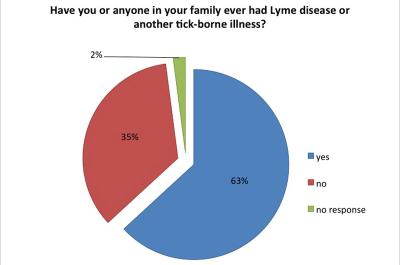
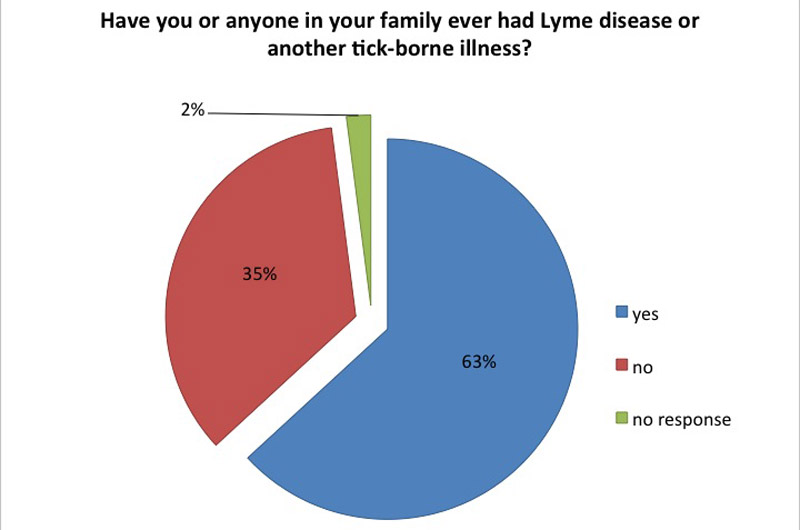
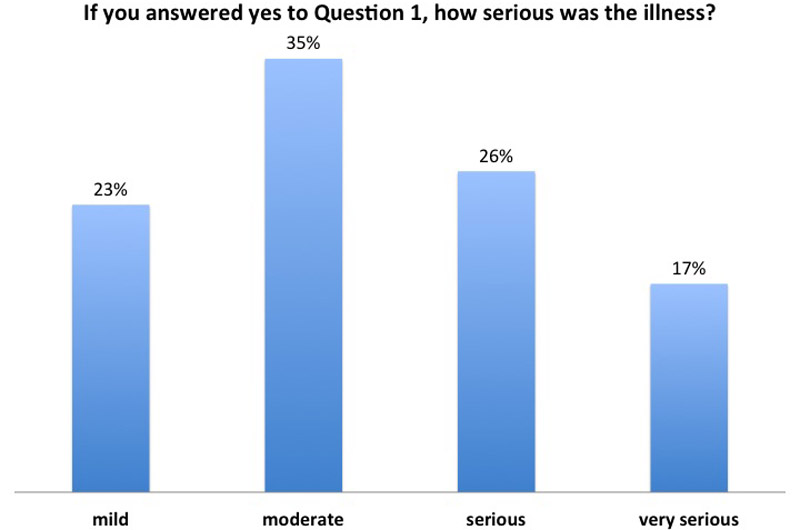
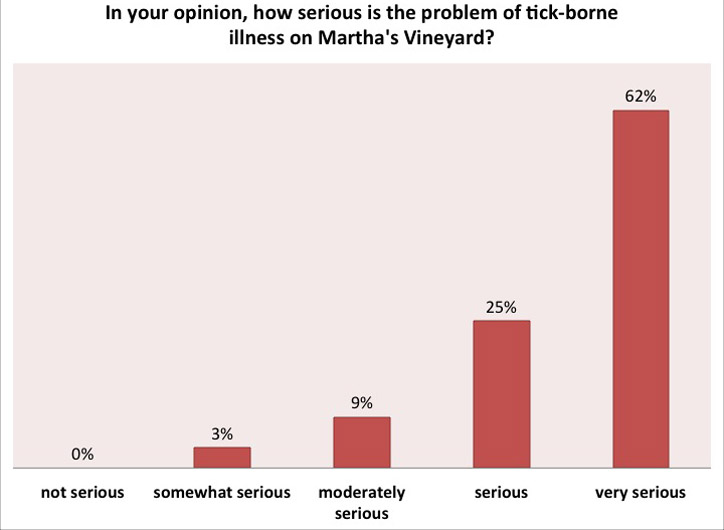
Sixty-three per cent of respondents said they or a family member had personally contracted Lyme disease or another tick-borne ailment, and 87 per cent called the problem of tick-borne disease on Martha’s Vineyard “serious” or “very serious.” Three per cent said it was only somewhat serious and less than one per cent considered it not serious.
Martha’s Vineyard has among the highest per capita rates of Lyme disease and other tick-borne illness in Massachusetts and the United States, according to data from the Massachusetts Department of Public Health and the Centers for Disease Control. These illnesses, which include babesiosis and anaplasmosis, can cause serious symptoms and may be life-threatening.
The idea of a community survey grew out of conversations between the Gazette and representatives of the boards of health’s tick-borne illness prevention program and was designed to test community attitudes about the seriousness of the problem and potential activities aimed at reducing its incidence. The survey was circulated by members of the boards of health, posted on various social media channels and distributed by email to about 12,000 Gazette readers. To guard against individuals filling out the survey multiple times, a mechanism was employed that prevented more than one response from the same computer or mobile phone.

The boards of health website at mvboh.org has a section on tick-borne illness that includes videos, tips and research on the prevention, diagnosis and treatment of the various tick-borne illnesses found on the Vineyard. Survey results showed, however, that less than a third of those responding had consulted the site.
But every measure suggested in the survey to improve public awareness of the tick problem and to reduce the Island’s tick population won strong support from respondents. In addition to culling the deer herd, more than 87 per cent of respondents supported spending town money to provide free or low-cost “tick tubes” to reduce the number of ticks feeding on white-footed mice, and 74 per cent supported spending town money on a professional to provide public education.
An analysis of the results showed equal support for all measures among year-round and part-time residents.
The survey also drew hundreds of comments, ranging from calls for more research to demands for immediate action.
“It is disappointing that Vineyard authorities are not taking more concrete, aggressive steps to deal with this grave threat to the people of the Vineyard,” one respondent said.
“This problem needs to be taken much more seriously. All towns need to fund solutions,” said another.

Many respondents described the debilitating effects of tick-borne illness and more than a few expressed a growing fear of going outdoors.
“We no longer take hikes in the woods, the state forest and some beaches,” wrote one resident. “Even though we live a mile outside of town, we have a serious deer problem in the neighborhood and we pick ticks off of ourselves and our dog daily just by staying in our yard.”
“It is the single thing in my view that keeps the Vineyard from being perfect,” another wrote. “You cannot really go to certain places on the Island without seriously worrying about getting a horrible illness.”
Many who said they favored “significantly reducing the deer herd on Martha’s Vineyard” had comments and questions about what “significantly” meant and how it might be accomplished.
“I answered ‘yes’ but with the caveat that a very carefully vetted analysis be done by qualified scientists as to the number of deer which could be safely culled so as to not permanently degrade the viability of deer on the Island,” wrote one respondent.
“As a last option because I realize that the ticks also get Lyme from other places too,” wrote another. “We need to consider the mice and other rodents. I would also want to make sure the deer meat to be used to feed people and not to be wasted if we hired professional hunters.”
Many said priority should be given to eliminating white-footed mice, and several mentioned research under way at the Massachusetts Institute of Technology to genetically modify mice to make them disease-resistant. A few were concerned about any use of chemicals in eradicating ticks.
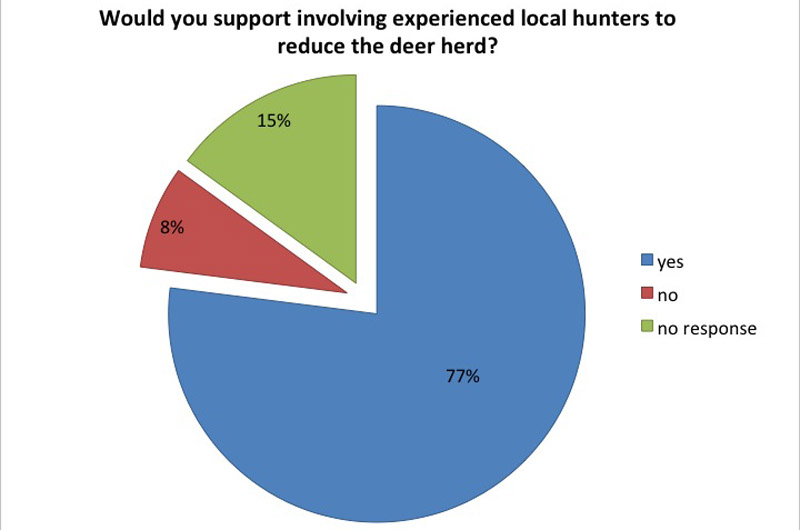
In response to a followup question, 77 per cent of those who supported culling the deer herd said they would support involving experienced local hunters to do so. Many respondents wanted to be assured that the venison would be used for food and not wasted.
Of the 1,311 respondents, 50 identified themselves as hunters. Three-quarters of these said either they or a family member had contracted a tick-borne illness and 80 per cent said they would favor significantly reducing the deer herd.
Comments
I had a tick problem at your
Tom O'Keefe Glastonbury ctI had a tick problem at your gentleman farm, my family got Lyme from ticks. I went out and got the " tick tube" and put them around the farm, two months later they were gone! The treatment I did again next spring and fall, that lasteded five years. Again we put them out spring and fall and again the ticks are gone ! We are enjoying the farm worry-free.
The Deer Tick has a 2 year
J.Counsell W.T.The Deer Tick has a 2 year life cycle, and needs 3 blood meals.Spring the 1st year they feed on small animals "like" the Deer Mouse, hence it's name by the way,chipmunks, birds,ground dwellers.Second year they feed on larger mammals "like" Deer where they will mate, females will feed for a week drop off and lay her eggs to start the cycle all over in spring where they try to feed on others like dogs,cats,horses, cattle, any warm blooded animal,yes even us.Killing deer won't do it, you would have to kill all our small animals and birds as well.There must be a better way not to destroy the chain of life,and not using pesticides to kill us all.With all the pills to cure almost everything there is,just watch TV,can't the scientists come up with a safe plan for us all, and not have to kill off other beings, we are all connected.
To grow from larvae to adults
Richard Johnson Oak BluffsTo grow from larvae to adults and then reproduce, female deer ticks do need three blood meals (males do not need feed the third time). Larvae and nymphs mainly feed on small mammals-current research indicates the white footed mouse is the primary host and where the ticks generally acquire the disease organisms. These small mammals are too numerous, and reproduce too quickly, for us to hope to substantially reduce their numbers on the Island.
That is why we are recommending reducing the number of deer as our best chance to reduce tick borne illnesses. Reducing or eliminating deer on an island or peninsula, where deer cannot move in from adjacent areas, has been demonstrated to dramatically reduce the number of deer ticks present (please see information posted in response to Jen Probst, below).
Deer are where the adult females get the blood they need to produce eggs, as well as where they mate. Adult deer ticks cannot simply switch to another host if they don’t find a deer. They have trouble feeding on skunks, raccoons and similar animals and their chance of finding a male to mate with is also reduced.
Finally, there does not seem to be any feasible way that medicine can solve the problem. We know of 13 illnesses carried by the three ticks species on the Island. Most of these are already present and affecting people - the others, as well as diseases we don’t yet know about yet, will likely be here soon. Doxycline and other more powerful antibiotics can cure many but not all of these diseases. For one (deer tick fever) there is no known cure and it is sometimes fatal.
Developing a new vaccine can cost over $100 million dollars and take 10 years or more. The possibility of creating vaccines for the 13 known illnesses plus those likely to be discovered in the future seems very low. Thus dealing with the ticks themselves and the deer that are crucial to their reproduction appears to be our most viable option to reduce the incidence of tick borne illnesses
This year we released 100
David Damroth ChilmarkThis year we released 100 quail in Chilmark. These tick eating birds used to be plentiful on the island but as with so many other avian species has almost disappeared from the island. It saddens me that we focus on the elimination of a species as opposed to rebuilding those populations that would make a huge difference for the control of tick populations. My bet is that the resilient tick will simply find another way of maintaining its own population. Despite our deeper understanding of ecosystems humans tend to focus on the first target without truly understanding the implications of our actions.
Releasing or otherwise
Richard Johnson Oak BluffsReleasing or otherwise increasing the number of ground nesting birds is something a lot of us concerned about ticks have thought about. However, I do not know of any scientific evidence that this approach can effectively reduce the number of ticks. It would be an interesting and potentially valuable experiment but there are several problems to be solved, the cost being a major one.
Also, young quail do eat ticks and other small invertebrates. However, the adults become vegetarians, eating buds and other plant matter. To have an impact you would have to establish a large breeding population or release very large number of young quail every year.
Chipmunks, skunks and raccoons will all eat eggs and young of ground nesting birds like quail. Although there is no data, many people believe the reason we now have fewer towhees and other native ground nesting birds is egg depredation by these mammals. Remember that chipmunks, skunks and raccoons (as well as squirrels and eastern cottontail rabbits) are all introduced species that are not native to the Vineyard. Fifty years ago they were either not here or present in very small numbers. Their presence has dramatically changed the Vineyard ecology, especially for ground nesting birds.
The bottom line is that releasing enough quail or restoring enough native ground nesting birds to significantly impact the number of ticks would be a very expensive and labor intensive undertaking. It would probably also require reducing or eradicating skunks, chipmunks and raccoons. An interesting endeavor but probably not feasible at the moment
Eliminate the deer. They are
Almeida Oak BluffsEliminate the deer. They are a health hazard and a huge danger to motorists. They will also threaten your future income from tourists.
You also need to put a bounty on the skunks.
PETA members and sympathizers clearly run this island and are pleased to have it stink like skunk year round and pass around another round of antibiotics cause I think I have yet another tick bite. Thanks PETA!
Next time your kid gets Lyme, we'll just chock it up to "cohabitating with nature".
Survey results...87% are in
Thomas Hodgson WTSurvey results...87% are in favor of Island Boards of Health instituting free or low-cost "tick tube" programs. Know a BOH member? Speak to them. It would take less than a year to get this into town budgets and to do something...Tick tubes are a relatively low-cost action, too. Really low cost when compared to the money that we all spend on treating our tick diseases. If the BOH people won't step up to the plate, how about the County? It would help justify their existence if they did something really useful.
I have been bitten by ticks
Bea Phear West TisburyI have been bitten by ticks at least a dozen times each year and never had Lyme. I believe it is because I had the vaccination many years ago, before it was pulled from the market. Has anyone else also experienced this? Maybe it is time to reconsider vaccinations.
I've never had Lyme also, but
Debbie Hills EdgartownI've never had Lyme also, but I did get a tick bite last fall, almost a year ago, that I went and got antibiotics for as it was different from any other tick biteI have gotten in the last 40 years. As far as the vaccination, I understood that some people got very ill from it. Everyone is different, so reactions vary and until they can come up with a safe medication, I don't believe we'll see anything soon.
During the safety study
Julia Mitchell Indian Hill, WTDuring the safety study conducted years ago on the Vineyard, I too received 3 doses of the vaccine, had no adverse reaction to it, and have not had Lyme disease since, despite dozens of tick bites. Prior to the vaccination I had both Lyme disease and babesiosis.
I too feel the tick problem
Robert Strayton ChappyI too feel the tick problem is very serious and with the Lone Star Tick now on the Island as well only creates a more urgent need to address the problem. Clearly a multi-pronged approach is the only way to attack the problem. I was unaware that Quail eat ticks, though now elucidated, seems, not only obvious, but a great idea. I know there has also been a suggestion to reintroduce red fox to help deal with the over abundance of mice and other small rodents, which I believe is another excellent suggestion. Given the tick life-cycle addressing the problem at each stage of the cycle seems to be the most efficient means of addressing the problem. I am in favor of a combination of tick tubes, deer cull, introduction of quail and red fox which would be far preferable to chemicals or MIT's "MouseZilla."
Introducing Red Fox and Quail
J.CounsellIntroducing Red Fox and Quail would be counter productive,as the Fox would kill the Quail, and most of my Chickens,Ducks and Rabbits,etc,and Wild Rabbits are already rare to see,use to be abundant years ago as well as the Quail,Pheasant,Wood cock.The Raccoons took care of all those.Those guys have nice big warm bodies for ticks to feed on.Get some Guinea Hens,aside from the noise,they do travel wide areas,and will eat those little blood sucker.Tubes sound like a good answer.Don't know much about those.I'll research them.
I too have been tick bitten for 75 years, and not had Lyme as yet,but it is a problem here.Maybe we can come up with a safe way to find the answer.You will never eliminate them all, like rats,that also make yummy hosts for ticks,but maybe keep them in safer numbers.Ticks are everywhere all over the earth.Is it really a bigger problem here? Guess because of our limited land space.
Lets keep working on a better plan than killing our wild life.
Cull is a nice word to use
Jen Probst EdgartownCull is a nice word to use but why not just say kill or slaughter. Is that too harsh a description? You can kill ALL the deer on the Island & that is not going to stop the tick population. Ticks are resilient & will still be here long after all the deer are gone. Ticks on deer start with mice & small rodents. To eliminate the tick population you should begin with discussion of the elimination of mice & small rodents, not the mass slaughter of deer. That might make some hunters happy but will not eliminate the ticks.
Please consider the following
Richard Johnson Oak BluffsPlease consider the following information before concluding that reducing the number of deer will not reduce deer ticks or the incidence of lyme disease.
The following information was taken directly from the website of the Fairfield County Deer Management Alliance (http://www.deeralliance.com/node/10)
Summary
The following information is provided by the CT Dept of Public Health and the CT Agriculture Experiment Station's National Tick Experts:
1. Lyme incidence parallels deer population growth
2. Reducing deer numbers reduces tick numbers
3. Reducing deer to below 8 to 10 per sq mile breaks the tick life cycle and prevents Lyme disease
Relationship between Deer and Lyme
There is a close relationship between the rising numbers of Lyme cases and the proliferation of deer across the United States. Areas with high rates of Lyme correspond with areas of the US that are highly populated with deer: the Northeast, upper Midwest and the west coast. Lyme disease bacteria are carried by the black-legged or deer tick. The white-tailed deer is the essential large mammal host in the successful completion of the complex 2-year life cycle of the deer tick. Even though adult ticks can feed on other mammals such as dogs, cats and raccoons, the female adult tick requires a blood meal from the deer before she can lay her 2,000 to 6,000 eggs. These eggs hatch into immature ticks that transmit the Lyme bacteria to small mammals such as white-footed mice and chipmunks and to many birds. Deer, however, play a unique role in the completion of the tick life cycle and provide a real opportunity to effectively control Lyme disease by reducing the numbers of just one species below the threshold for successful tick reproduction.
A community in Maine decided in the 1990s to try and rid itself of Lyme disease. And after only 5 years they have achieved just that. Monhegan residents were suffering from a high rate of Lyme disease when they voted to take action. After failing to achieve their goal through the use of chemicals that attack deer ticks the residents voted to remove all the deer from their island.
Monhegan Island, 10 miles off the coast of Maine had no native deer until 1955 when they were intentionally introduced at the request of islanders. By the late 1980’s deer ticks were becoming abundant and by the mid 1990’s the deer population had reached an incredible 100 per sq mile. By 1996 13% of residents had Lyme disease. Recognizing the source of the problem, the residents voted to remove every deer from the island. Remarkably, within 5 years of this being completed, the number of new cases of Lyme disease had fallen to zero.
Vector Ecol. 2011 Jun;36(1):11-23. doi: 10.1111/j.1948-7134.2011.00136.x.
Density of Ixodes scapularis ticks on Monhegan Island after complete deer removal: a question of avian importation?
Elias SP1, Smith RP Jr, Morris SR, Rand PW, Lubelczyk C, Lacombe EH.
Author information
Abstract
Questing adult blacklegged tick (Ixodes scapularis Say) abundance declined markedly three years after the 1999 removal of white-tailed deer (Odocoileus virginianus Zimmermann) from Monhegan Island, ME. Since 2000, subadult ticks have not been found on Norway rats (Rattus norvegicus Berkenhout); questing nymphs have not been found since 2002. This suggested I. scapularis was reintroduced annually via bird importation of subadult ticks, but unable to complete its two-year life cycle on the island due to lack of deer. To investigate this, we used uncertainty analysis to estimate 1) questing adult ticks/ha that would result from avian importation of nymphs, and 2) questing adult ticks/ha on Monhegan Island, using bird capture and tick burden data from Appledore Island, ME, flagged tick data from Monhegan Island, and ten uncertain parameters. During the deer-fed period (1990-2001), estimated tick density on Monhegan Island was 18 times greater than that of imported ticks. During the post-deer-fed period (2002-2008), Monhegan Island tick density was equivalent to imported tick density. This supported the premise that all I. scapularis ticks on Monhegan Island have been bird-derived since 2002.
Thank you Richard Johnson for
A. Gibbons West TisburyThank you Richard Johnson for the data and your informed responses. The Monhegan Island case is compelling. It supports the hypothesis that if the density of deer is reduced (and the blood meal necessary for ticks to survive), the populations of ticks will also decline. It make sense. And thanks to the Vineyard Gazette for undertaking this survey.
Lots of great comments. Deer
Debbie Hills EdgartownLots of great comments. Deer are an issue but I feel the mice are a bigger one. After a mild winter and an increase in the hawk population, the population of the mice seems to have exploded. Tick tubes are great but control of the mice would seem more effective. The reintroduction of quail, and any other ground dwelling birds, would help in the tick control but the idea of fox is very interesting, even if the birds would also be on its menu. We definitely need more predators of mice as with the large amount of hawks present, which consume snakes, owls, etc., the mice are becoming very proliferate. A cold winter would definitely help and bring the Snowys south to help us out.
Great work by the Gazette and
John EdgartownGreat work by the Gazette and BOH on gaining the information/thoughts of the islanders/tourists. Now that there is a consensus, it is time to get the ball rolling and start on a plan for both the deer culling and tick tubes, as they are both strongly supported.
Pills are not the answer for
Concerned OBPills are not the answer for deer, Lyme or anything else. Look where that has gotten us in OB with off-island dealers distributing their poison, plastic bags in trees and mopeds endangering our roads. #makeobgreatagain, #letthedeerlive, #scorchedearth
I have a herd of deer in my
Paul D EdgartownI have a herd of deer in my yard almost weekly. I think we need to add coyotes to the island to kill of the deer, rabbits and skunks. We are being overtaken by these animals who have no predators.
Ecology is never that simple.
Richard Johnson Oak BluffsEcology is never that simple. Coyotes might eat significant numbers of mice and rabbits and even some deer, but as both JCounsell and Island Girl point out (see their comments below), they will also eat farm animals, cats and small dogs.
They are opportunistic omnivores and will eat trash, fruit and pet food from around your home. As they become comfortable around humans and begin to associate us with food, coyotes will even attack people. From 1988 to 2003, there were 89 documented coyote attacks on people in California, including 35 attacks on small children.
Coyotes are not the answer. They may get here on their own so we need to be aware of what that means and be prepared.
I hope the island is
Colleen Sumberg CTI hope the island is considering alternative methods for the tick problem rather than simply jumping to culling herds and destroying wildlife. Many of these species can actually help with controlling tick populations as mentioned previously. Alternative methods such as tick tubes and vaccinations should be considered before messing with the ecosystem.
Coyotes? Really? Why not
J. CounsellCoyotes? Really? Why not Wolves and Cougar? They all will CULL the herds,but our farm animals, family pets, and a few Toddlers as well.Just ask those that live on Cape Cod.Coyotes, have moved into residential areas for years, and are killing family pets right and left.They had a mass extermination of their dens a few years back, but guess what? Their Back!Just like Arnold.Not sure a Coyote could take down a full size deer anyway.
Those tubes sound like the best so far, along with game birds.I'm sure my Pet Chickens do their share.I never see a tick around my little farm.
Not all Deer ticks carry Lyme, and they have to be attached for 24+ hrs to transfer it.Guess,I'm lucky to have allergies, I get a strong itch at first bite, and my hand goes right to those little bugger,even in my sleep.
Maybe a few Boa Constrictors will get the mice and rodents..Florida has plenty they want to get rid of,people let loose in the Everglades.I think not.When you introduce non native species, you just get more problems. I love seeing the Deer on my walks, bike rides, on my horse.Even enjoy seeing those Turkeys everyone want to kill,Chipmunks, Raccoons, even baby Skunks and Rabbits are cute.Get out and enjoy our wild life not destroy it.Just put on tall socks over your pant legs and a little alcohol on your ankles, and you'll be just fine.
All well and good if you do
Diane F Dalbro Wappingers FallsAll well and good if you do it. Find a food bank or kitchen and donate the meat.
I'm dismayed by the lack of
Carol formerly ChilmarkI'm dismayed by the lack of robust science informing this policy. I agree with other commenters - if the point is to drive down the tick population, reducing the deer leaves all of the other mammals - and surely no one is proposing we wipe out everything. (If you are - move to Boston.) I agree with the tick tubes, more bobwhites & other ground birds, & reintroduce the red fox. (No way to blanket pesticides. For all we know, that'll also kill some insect that also eats ticks & we'll only find that out after spraying - that's usually how those things go.) More money for the science, please! Lobby your Congressperson!
The Tubes are a poison
jJudyThe Tubes are a poison,Permethrin SFR,that is toxic to fish,so don't put close to a water source, and to most insects including Bees,also Cats.Cotton balls are sprayed with very dilute Permethrin and put in cardboard tubes for the "Deer Mice" to gather April and July when they nest.Mice use the cotton to line their nest,doesn't hurt the mice (they say) and is passed on to the ticks that grow in the mouse nests and kills the ticks when they feed on the mice.You can do it yourself,buy Damminix tubes, or the Permethrin on line, mix just 1/8th oz to 20 oz water,so very dilute,put cotton in an old TP roll and spray the cotton well.But use rubber gloves,face mask,don't touch,breath in,or get on your skin or clothing.So it is a danger to humans,and other animals,and will kill any Cat that may chew on the mice.If you live in dense wooded area and have a lot of ticks in your yard.You could place them well back in the woods and tall grass around your home about 20 to 1/2 A.area to protect.I think the bigger risk is not around our homes, but on walks in the woods and tall grass spring and fall,and it is Toxic,so should be thought through carefully, the risks and benefits..
Hunters already have Oct through Dec to Kill off our Deer populations,the reg. tally is in the hundreds,and that's not counting the ones killed and not reported,and those that are injured to go die a slow painful death.Deer are just the largest host for the ticks,they go for any warm blooded animal,and there are plenty out there. Raccoons, Skunks, Chipmunks, Rats,Mice,Birds, and the family Dog if he runs free, which he shouldn't. Killing more Deer would not get rid of ticks.
Beware of the Law of
island girl WTBeware of the Law of Unintended Consequences -- DO NOT INTRODUCE any major predators such as coyotes, red fox or wolves (or anything else that has sharp teeth!) because you will wipe out the few remaining ground nesting birds (why introduce quail if you also introduce their ace predator?), domestic animals, farm animals (including sheep, pigs, calves, poultry), and prove a danger to all of us who love and enjoy the outdoors. Deer have been increasing dramatically in numbers (as have skunks, raccoons, and rats along with other rodents and chipmunks/squirrels) and they not only carry ticks they have been particularly efficient for the past several years at destroying gardens and eating crops, as well as eating all sorts of horticultural plants. This year I know gardeners and farmers who have lost all their raspberries, dahlias, ornamentals, hostas (just to name a few) while the deer also snack on (and destroy) asters, tomatoes, beans and greens and everything else that is edible. This is a huge waste of food, as well as very expensive. Building and maintaining 8 to 10 foot fences is costly and they are difficult to maintain as well as inappropriate in various landscapes. Yes deer are cute to look at and no one likes to think of killing anything, but deer are not endangered here and they are both a nuisance and a menace because of their numbers. In fact, they are so numerous that they are over running their habitat. A massive deer cull by trained hunters could reduce the numbers to a manageable size. We also need to eliminate a lot of the skunk/raccoon and rat population as well as mice. This seems brutal but the alternatives are worse. Do you want a coyote/red wolf in your back yard chowing down on Bambi who has just eaten the plants under your dining room windows, the plants on pots on your deck or your whole market crop? Have you ever experienced a skunk/raccoon kill in your chicken coop with bloody corpses and feathers everywhere? Do you have chipmunks romping around in your attic? The annual rodent return to warmer winter quarters (your crawl space, cellar, attic, or (gasp) kitchen and pantry is underway...do I need to write more? One of the worst budget cuts that the County ever made was eliminating the rat control program many years ago. By the time it was reinstated the rats had multiplied exponentially and the vast amounts of garbage generated here as well as compost piles and bird feeder droppings feed them very nicely.
I, a life long environmentalist and real nature lover, have no problem is advocating for a massive deer cull for MANY reasons. Sad to say but we need to cut down on some of the other creatures too (I won't get into human population control; I have strong views on that issue as well) as I've yet to find a good reason to advocate for skunks, raccoons, rats, etc.
BTW, I've had Lyme at least three times and attribute my worsening arthritis to this. Friends and family have long term, chronic Lyme issues which are moderate to serious and pretty nasty. No matter how careful you are, you are bound to get bitten by a tick if you are outside, or have pets.
Question: does anyone know if the feral turkeys eat ticks (as guinea hens are alleged to do) because if they do, and considering how successfully the turkey population has multiplied, the number of ticks is increasing significantly faster. Message here is that all the guinea fowl and turkeys are not keeping the tick population under control -- not even slightly.
The final take away message (to circle back ) is to be very wary of introducing new predator species around here as the unintended consequences could be far worse than any curative effect.
Let the cull begin.
We will solve the tick
Art Markey TisburyWe will solve the tick problem about as fast as we solve the affordable housing problem. Might as well talk about affordable housing for ticks.
Did a scientist write and
KirkDid a scientist write and undertake the survey or was it a hunter? Maybe there should be some research by the former before the slaughter performed by the latter.
What I don't understand is
Chris OB/NYWhat I don't understand is that at such a high cost to not do it, so many people are against deer culling. Why? Deer are so prolific on the island and we do nothing to curb their population. We also do not listen to the science, which clearly says that if you reduce the deer population you will reduce Lyme disease. What don't we understand?
I'm from west Virginia, I
Sheila West virginiaI'm from west Virginia, I was in north Carolina when I got lyme disease.its been years and I still have problems with my muscles and nervous system. Its hard for me to walk up stairs so my family put me a ramp in. Its a constant battle. I still hurt all over and stay tired.
Add new comment