

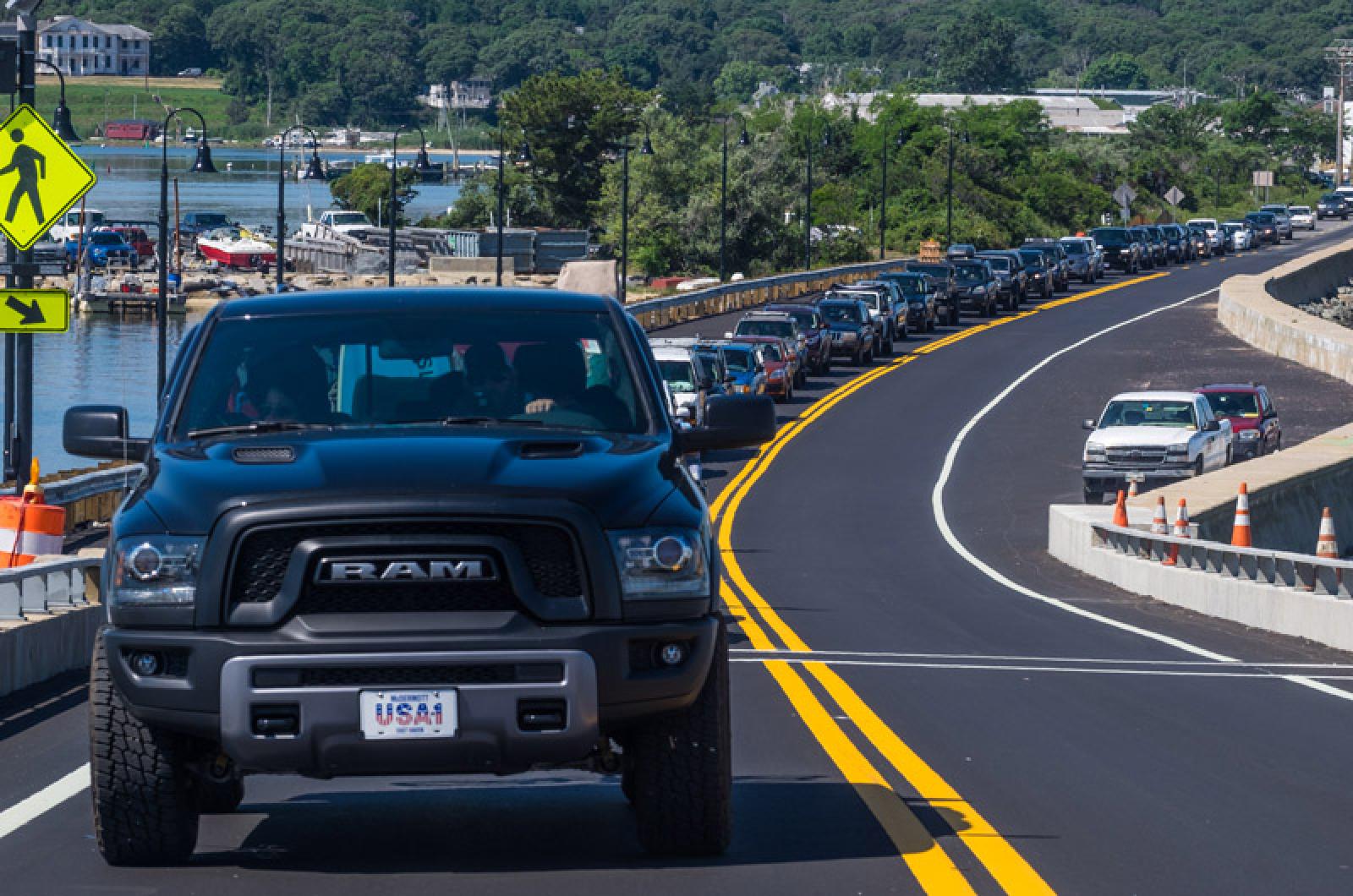
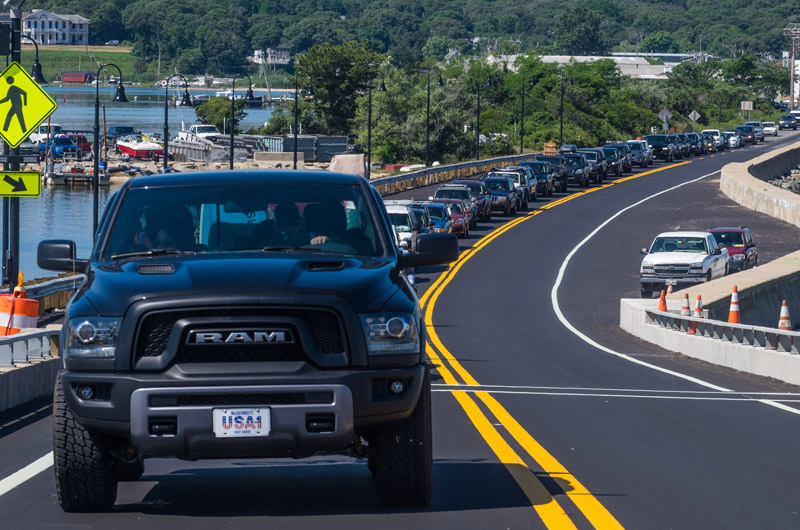
<p>After a summer of frustrating traffic backups, contractors are wrapping up work on the Lagoon Pond drawbridge.
After a long summer of frustrating traffic backups from lane closures for construction on the new Lagoon Pond Drawbridge, contractors are wrapping up work on the span. But even with two lanes now open for traffic, Island drivers may still experience long delays at times.
Design changes in the bridge mean it takes longer to raise and lower than the previous temporary bridge or the old bridge it replaced, built in 1935, officials at the Massachusetts Department of Transportation have confirmed.
The new bridge has eight separate traffic arm barriers that go into action when the bridge opens to allow a boat to pass through into the Lagoon Pond. As a result, even on days with relatively light traffic, vehicles often back up beyond sight of the bridge on both sides, as the traffic barriers swing into place.
When bridge goes up, eight separate traffic barrier arms are deployed.
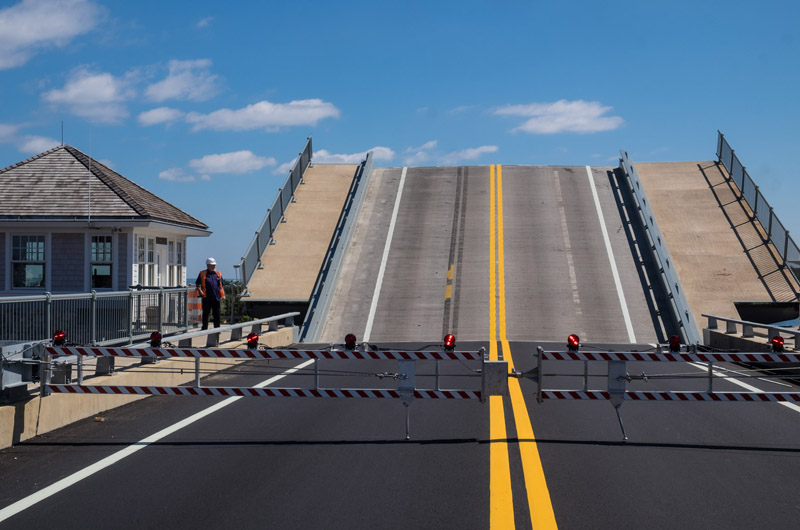
When bridge goes up, eight separate traffic barrier arms are deployed.
A MassDOT spokesman said last week that the design of the traffic barriers came at the request of the Tisbury Lagoon Pond bridge committee, for aesthetic appeal. The committee helped guide local participation in the design and construction process.
“The 180 degree articulating gates were requested by the Lagoon Pond drawbridge committee during the design process for the aesthetic appeal of the gates in the stored position, horizontal to the roadway behind the pedestrian rail,” MassDOT spokesman Judith Riley said in an email to the Gazette. “Standard bridge warning and barrier gates are 90 degree lift gates, when not in use they stand vertically perpendicular to the roadway.”
The gates are designed to official standards issued by the American Association of State Highway and Transportation officials, she also said.
But bridge committee chairman and Tisbury selectman Melinda Loberg said state engineers introduced the idea of gates that fold outside the guard rails, during discussions during the initial design phase prior to construction.
“We were not even aware they existed,” Mrs. Loberg said. “They showed us an animation of the gates, how they were tucked away, rather than horizontal. We said yes, they looked great. They also had criteria for the speed which the bridge had to open and close. We were not considering the gates were the limiting factor. That was not something the committee felt we could dictate to the state. We are not engineers. Those are the kinds of things we left to the state to figure out with their engineer.”
At a cost of $43.7 million, the new bridge was designed to be safer for motorists, pedestrians, and bicyclists. It is also considered a big improvement for boaters, with wider channels and a straighter course between the Lagoon and outer Vineyard Haven Harbor.
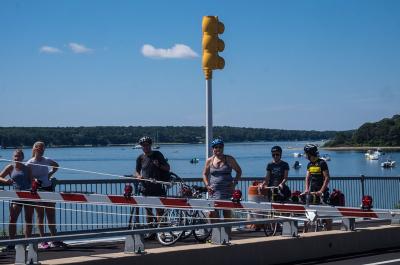
New bridge has improved safety for cyclists, pedestrians.
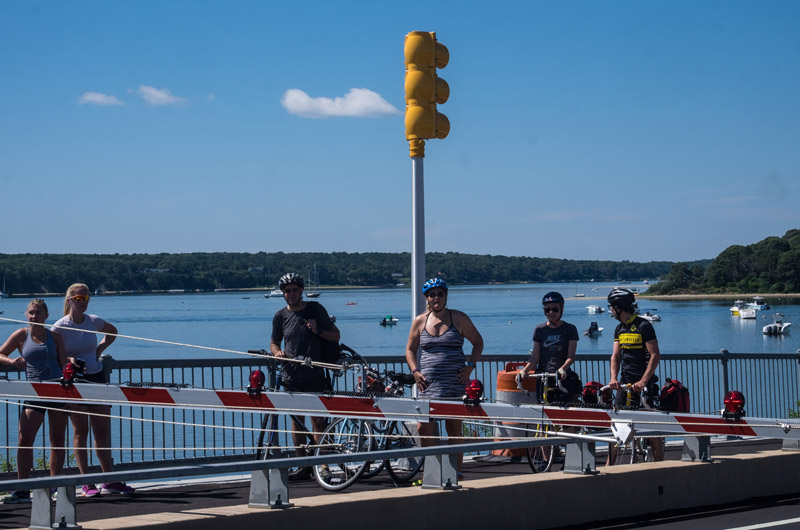
New bridge has improved safety for cyclists, pedestrians.
The new drawbridge was scheduled to be completed this spring, before the busy summer season. But unforseen delays of about five months were caused by problems in installing communication lines to the bridge control house, and permits for a salt marsh restoration that was part of the project.
MassDot determined the delays were not the fault of the contractor, Middlesex Corporation, and granted extensions without penalty.
Though construction continues around the bridge, work on the roadway and sidewalks is substantially complete, and no more lane closures are expected.
This past summer has been a trying experience for drivers contending with construction delays, exacerbated by slower operation of the bridge.
“The two of them together have created a perfect storm of traffic backups,” said Tisbury police Lieut. Eerik Meisner. “I’ve seen them all the way to Five Corners. What are you going to do? When you raise a bridge up, traffic stops.”
On a rainy Tuesday in early August, the 10:30 a.m. lift sequence when just one sailboat passed through the channel took 10 minutes, 18 seconds to complete.
From the time the yellow lights signaled traffic to stop, until the bridge was stopped in the upright position, four minutes, 10 seconds elapsed. After the vessel passed through, the reverse sequence took a little less time, three minutes, 40 seconds.
Eight separate traffic barrier arms deploy every time the bridge is lifted, two at a time, one on each side of the bridge. The outside set of barriers deploy first, with flashing lights and loud bell sounds to form a visual barrier and audio warning. The the inside set of arms, closest to the bascule lift, form a sturdier barrier, with thick double steel arms that interlock when in the down position
Both the temporary drawbridge bridge and the old drawbridge operated with two mechanical traffic arm barriers, each blocking both lanes of traffic. Both barriers were deployed at the same time.

But for motorists, when bridge opens, it's hurry up and wait.
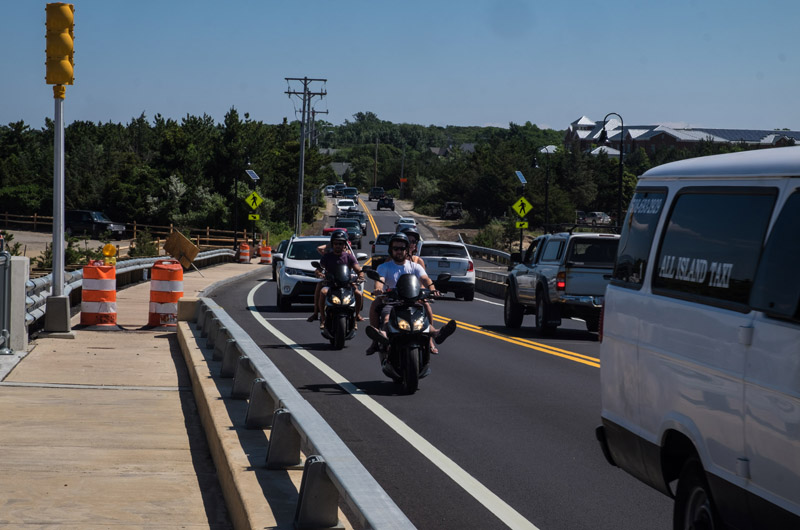
But for motorists, when bridge opens, it's hurry up and wait.
During the early August lift observation, construction was also underway, with lane closures that reduced traffic to one lane.
After the bridge sequence, 131 vehicles passed over the bridge, before the construction flagger stopped traffic again. Among the backed up vehicles were four taxis and two Vineyard Transit Authority buses.
As the summer season was winds down there remain significant backups, even when both bridge lanes are open. Last Saturday morning traffic backed up beyond sight on both sides when the bridge was lifted to allow a single vessel through from the outer harbor to the Lagoon.
“The speed in which the bridge opens and closes meets the required Coast Guard regulations, although may vary slightly due to the number of gates on the bridge,” Ms. Riley said. “MassDOT has requested more detailed information regarding the speed of a complete opening.”
Mrs. Loberg said the bridge lifting sequence has generated a few complaints.
“I haven’t had anyone talk to me, but I’ve read some,” Ms. Loberg said. “Some people love it, the way the gate sequence works. It’s kind of all over the map.”
She said the committee is exploring whether social media can help mitigate traffic backups during the summer, suggesting a text message notification could be sent when the bridge is scheduled to open, giving drivers the option of taking a different route, or planning their trip for another time.
Construction of a temporary drawbridge began in 2007 and was completed in 2013. Work began on the permanent drawbridge in 2013. The bridge opened to vehicle traffic in November 2015.
The bascule-style lifting bridge replaced an iron grate bascule bridge that malfunctioned frequently, trapping sailing vessels in Lagoon Pond, and forcing drivers to take long detours. The bridge is a key access point from Vineyard Haven and up-Island to the Martha’s Vineyard Hospital.
The bridge tender will open the drawbridge only when boats request passage by marine radio. During the summer months, boaters can request an opening at any time during five periods throughout the day. The passage windows are 8:15 a.m. to 8:45 a.m., 10:15 a.m. to 11 a.m., 3:15 p.m. to 4 p.m., 5 p.m. to 5:45 p.m., and 7:30 p.m. to 8 p.m.
If no vessels request passage, the bridge does not open.
Comments
Ten minutes is only the OPEN
Erik H.Ten minutes is only the OPEN time. It doesn't include the extra backup time that happens due to the large "slug" of cars hitting either 5 corners or OB.
If many ways, this is tailor made for a "bridge delay" electronic sign on both sides. In VH it would need to be at the ET/State intersection, to allow folks to go through the Roundabout. In OB it would also need to be far enough to send folks up Barnes or County. Plenty of folks would rather go around (or wait to travel) if they knew there would spend 15-20 minutes sitting in line.
All it takes is the activation of the "bridge delay" sign, 5 minutes before the gates go down. It wouldn't be perfect but it would be a 90% improvement.
Could the boats be required
Barbara EdgartownCould the boats be required to pass through at certain times? If a ferry is in, the traffic is much more congested. Boats could wait until that dissipates. Just a thought!
That is a good suggestion. If
Frank Brunelle vineyard havenThat is a good suggestion. If the arrival and departure times of he ferries and he opening times of the bridge were staggered so that they did not coincide, that would help quite a bit. The bridge committee would have to work it out with the SSA somehow.
Wow! Amazing photo! How did
Wanda Wright OBWow! Amazing photo! How did he get that shot? Right in front of the snake of cars!! Award winning!
Why is that the arms move two
JaredN ChappyWhy is that the arms move two at a time? Why can't they all (or at least 4) deploy at once? As it is now, most of the time is taken up by the movement of the gates rather than the bridge itself.
Add new comment