

Oak Bluffs Water District Defends Forest Clearing for Solar Project
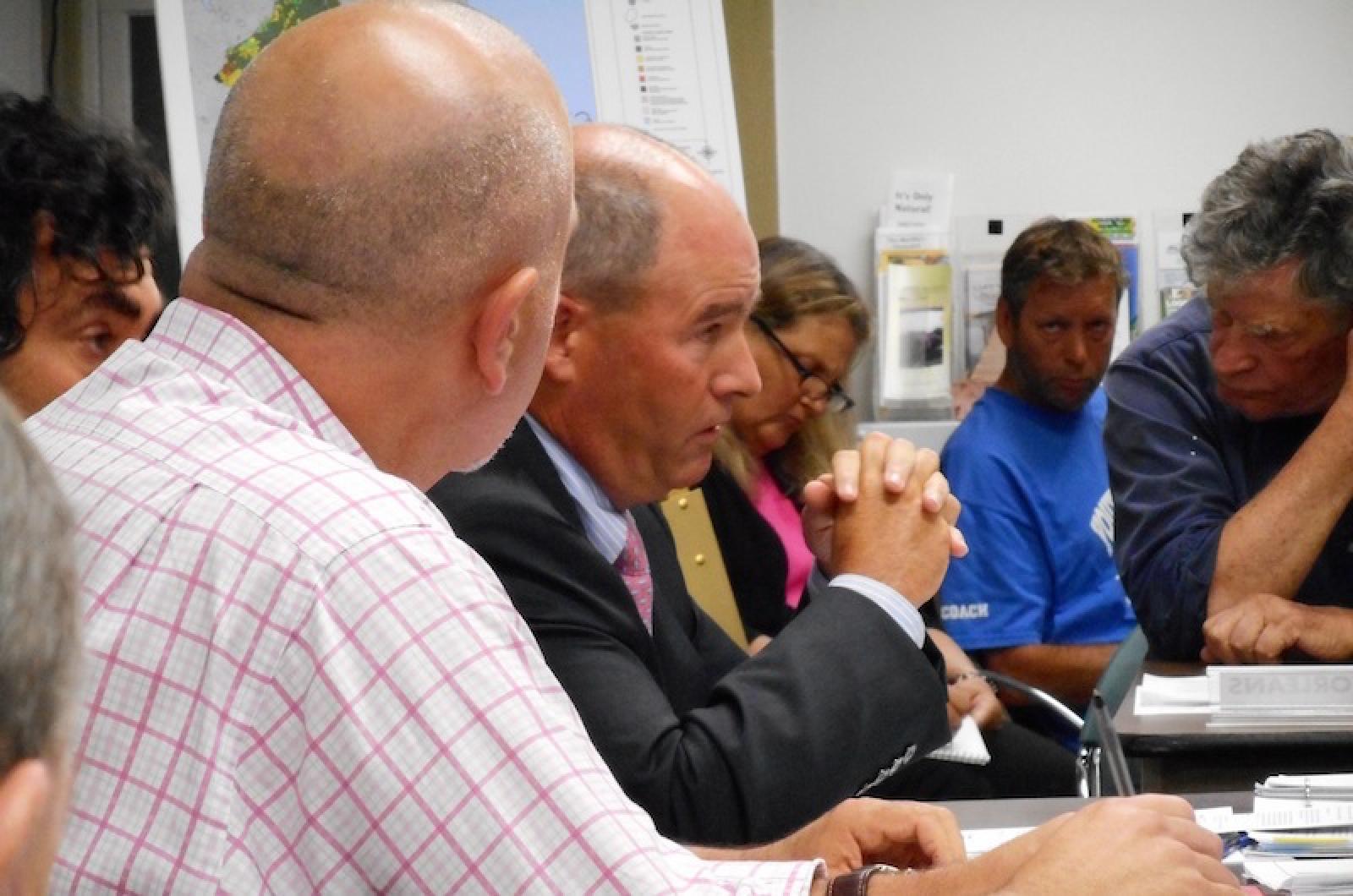
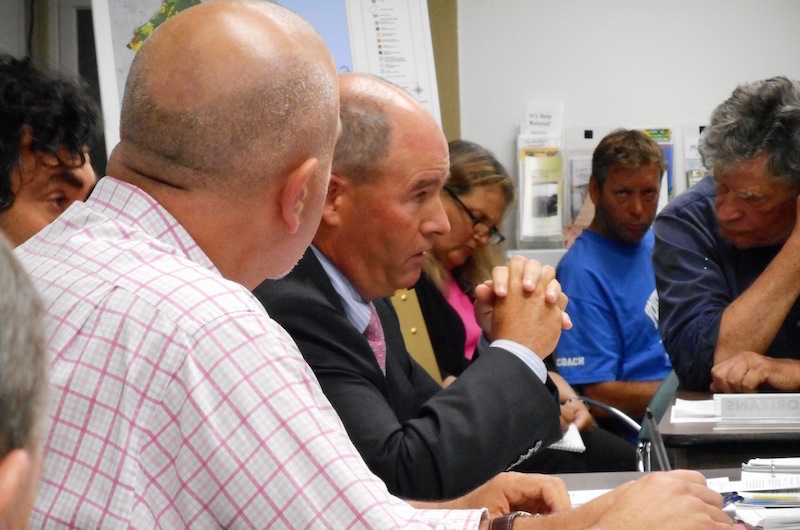
<p>At a turbulent public hearing before the Martha’s Vineyard Commission last week, a plan by the Oak Bluffs water district to clear forest for the town’s first municipal solar array came under fire.</p>
A plan by the Oak Bluffs water district to develop the town’s first municipal solar array has come under fire as ecologists and conservationists argue that the project site abutting the Manuel F. Correllus State Forest is better left as ancient woodlands.
A turbulent public hearing before the Martha’s Vineyard Commission late last week touched on issues related to forest ecology, climate change, water quality and the potential benefits of solar power on the Vineyard.
The commission is reviewing the project as a development of regional impact.
The 10.37-acre site on Alwardt Way is part of a larger area owned by the water district that abuts the state forest to the south and the Margaret K. Littlefield Greenlands to the west, an aquifer protection area. The entire 56-acre water district property, dominated by various oak species, is listed by the commonwealth as protected in perpetuity. It was unclear at the hearing last Thursday whether the land is protected by Article 97 of the state constitution, which would require additional review, including a two-thirds majority vote by the state legislature and the governor’s approval.
Water district superintendent Kevin Johnson has said the district, which operates as its own governmental entity, expects to generate energy savings of up to $800,000 over 20 years, allowing for improved facilities and equipment, although it likely will not mean lower water bills for customers.
The project would mark a first for the town of Oak Bluffs, with all other Island towns having established solar arrays in recent years. But it would also be the first solar array on the Island to replace a protected ancient woodland that has remained undisturbed for thousands of years.
The state Department of Environmental Protection (DEP) has conditionally approved the project, which would occupy a zone of contribution for three public wells on the property, along with rare species habitat. The state National Heritage and Endangered Species Program also has given preliminary approval.
The plan was significantly downsized this summer, partly out of concern for protecting wellheads. But opponents argue that water quality and the Island ecosystem would still suffer.
“The greatest thing you can do to mitigate climate change effects is to keep forests intact,” Polly Hill executive director Tim Boland said at the hearing.
BlueWave Capital spokesman Jon Mancini, (left), engineer George Sourati, attorney Sean Murphy.
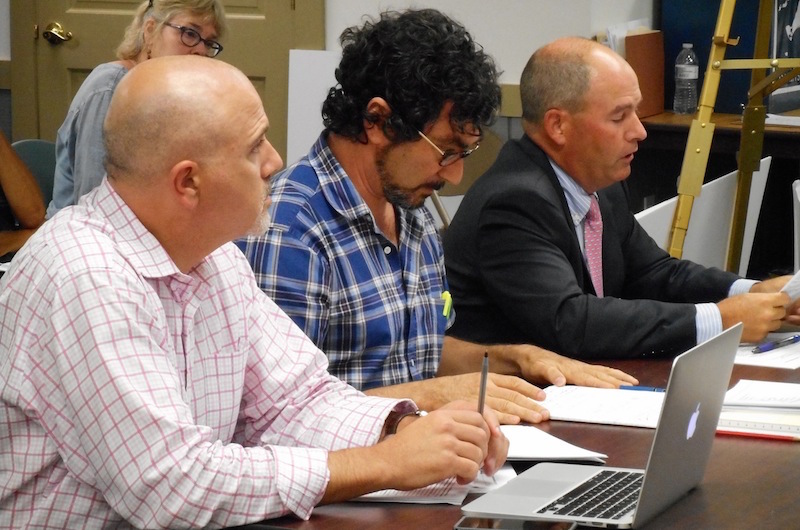
BlueWave Capital spokesman Jon Mancini, (left), engineer George Sourati, attorney Sean Murphy.
Mr. Boland and Harvard Forest director David Foster have gone on record strongly opposing the project, writing letters to the commission in August. Last week The Trustees of Reservations, BiodiversityWorks and Mass Audubon wrote their own letters of opposition to the MVC.
Among other things, conservationists point to a decline in critical oak forests around the world as a result of development and climate change. In one of three letters, Mr. Boland said oaks support more wildlife than any tree species in North America.
In a study commissioned by the water district, civil engineer John A. Edwards of Hadley found the trees in question have “no unique history” on the Island. And a recommendation by Bristol Engineering Advisors Inc of Mattapoisett and Cambridge cited low risk to the groundwater resource, as long as the topsoil remains in place within the 300-foot buffer zone around the wellheads, as proposed.
Sean Murphy, an Island attorney representing the water district, sought to downplay the concerns of ecologists. “In reading these letters, I would think that we are clearing the entire state forest,” he said at the hearing. He displayed maps to illustrate that the so-called zone-two area of contribution covered a wide area including commercial uses.
“Zone two exists throughout the whole Island,” Mr. Murphy said. “So the fact that we would go in there and cut the trees is not going to affect the water quality.”
George Sourati of Sourati Engineering Group in Vineyard Haven, which designed the project, said only the central five acres would be cleared entirely, with underbrush and small trees remaining around the perimeter. But Mr. Boland argued that having to cut those trees repeatedly so as not to block the sunlight would amount to a loss.
He noted that roots and soil in the forest remove pollutants and help maintain the quality of the groundwater. “The area you’re totally going to clear — that’s open and you put grass down — you’re completely wrecking the water quality,” he said.
Mr. Murphy objected.
“This is completely inappropriate,” he said. “We have an expert: Bristol Engineering.”
But commissioner Fred Hancock, who chaired the hearing, defended Mr. Boland as an expert in his field. “We are going to get his opinion when we need it,” he said.
Oak Bluffs selectman Gail Barmakian challenged the argument that additional development wouldn’t affect the zone two, since the water district land had been taken by eminent domain by the town some time ago to protect the aquifer. “To compare it to the rest of the town that is in zone two I think is totally irrelevant and out of context,” she said. “It was basically conservation land.”
Discussion turned to the benefits of solar power, with Mr. Murphy arguing the project would reduce the district’s carbon footprint and benefit the community by keeping water bills from creeping up over time.
BlueWave Capital, which is developing the project, has said the potential CO2 savings would be equal to about 1,081 acres of U.S. forest. But Mr. Boland said the figure, based on national averages, does not take into account the value of living forests.
Marc Rosenbaum, a renewable energy expert and director of engineering at South Mountain Company in West Tisbury, pointed out that the estimated 1.6 million kilowatt hours the project would generate per year was far more than the district needed — a result of its agreement with BlueWave Capital, which plans to sell the remaining electricity through net-metering credits.
BlueWave representative Jon Mancini, who attended the hearing, explained that energy credits would be sold to the water district at a discount, with the rest being offered to the town or nearby community for purchase. “The benefit of that is it’s on-the-Island produced power,” he said, noting the potential savings compared to the purchase of renewable energy credits from the mainland.
Ms. Barmakian said the savings were still undetermined. She and others have pressed for alternative sites, although Mr. Murphy said he was told there were none large enough. Ms. Barmakian said Oak Bluffs has been looking into developing its own solar array at the former town landfill.
The hearing was continued to Sept. 22.
In the interim, the commission plans to seek legal advice on whether the land is protected by Article 97.
Comments
Ms. Barmakian comments where
Joseph Paul Uranker Oak BlufffsMs. Barmakian comments where right to the point in pressing for the former land fill , nothing to be cut down and plenty of area to expand and grow in the future. Plus Oak Bluffs has the new Oak Bluffs Fire Department roofs to use, common sense solution.
I think the fire department
Brenda OBI think the fire department roofs are a great idea. I wonder if they could use other town buildings as they are free and available.
Completely agree. Rooftop
Carol formerly ChilmarkCompletely agree. Rooftop solar (or solar panels shading parking lots) should always be the first choice for siting. Compared to cutting down a forest, it's a no-brainer.
I don't believe that we fully
John Davis OBI don't believe that we fully understand the ecosystems services provided by these patches of land that are been cleared for solar arrays. These habitats provide more than just carbon production/capture that help to mitigate climate change.
Don't do it in the that area.
It seems crazy to cut down
James Riley ArlingtonIt seems crazy to cut down trees, which are already a kind of solar farm. What about roof tops of town buildings and schools, or land that is already cleared, like the landfill?
"The entire 56-acre water
Betty Smith"The entire 56-acre water district property, dominated by various oak species, is listed by the commonwealth as protected in perpetuity." "In perpetuity" only means "forever" until some can make a buck, apparently. There are
alternatives. "I told you so" is cold comfort after an ancient forest is cleared.
So sad to see this kind of
Kristen Bernard Poughkeepsie, NYSo sad to see this kind of thing happening on the island. We've been summer visitors for over 30 years. I work for a land conservation organization in upstate New York and we've encountered many of these solar companies and their push to private landowners and towns. All solar is not good. Well-planned solar on existing buildings and in already-cleared areas is great. Hopefully the citizens can push for solar in those areas. What everyone has to remember is that companies like BlueWave are out to make money. They will push to place their arrays wherever it is most cost effective for them. Just because they provide solar energy does not mean they are altruists. They push for large arrays that provide far more energy than needed so they can make money on the overages as well. I would also wonder about any connection BlueWave may have to Bristol Engineering - have they worked with them before? Why wouldn't the town use a local engineering firm? Bristol Eng. appears to be from Alaska. Finally, conservationists everywhere are concerned about oak forests and their decline. It becomes a slippery slope when you say, "It's just 10 acres." Unfortunately a precedent is set and the next time it could be 20 acres or 50. I hope the Town will take a step back and look at the project very carefully. The landfill seems like a much better option.
I am Oak Bluffs's Board
Richard Toole Oak BluffsI am Oak Bluffs's Board Member to the Cape Light Compact and The Cape and Vineyard Electric Cooperative as well as an early member of Vineyard Power.The Town's capped landfill has been under discussion for some time. It has a great exposure, slopped and facing south east. The Town is currently awaiting clearances from the DEP that all has been done to secure the site. Hopefully this will be done by year's end and a plan to develop a solar farm will evolve. Support from the citizens of Oak Bluffs will be needed but the solar energy produced there could more than satisfy the Town's needs without having to remove a single tree.
We should put it at the dump
Lloyd Hart Oak BluffsWe should put it at the dump and the already cleared illegal White/Lynch yard and Johnny's scrap yard and move both businesses to a light industrial zoned area
It seems incredible to me
Abraham Seiman Oak Bluffs, MAIt seems incredible to me that another site cannot be found without disturbing the one of the Island's beautiful natural resources. As with many other decisions made on M.V., the media portray's each event as a crisis which must be attended to immediately, often resulting in poor decision-making. It is a disservice to the people to the people to not provide a balanced reporting of the issues.
When locations like the town
tom hodgson wtWhen locations like the town and town rooftops are readily available, the water district puts itself in a position of defending the indefensible. It would take centuries to restore the forest to its current state. You can't replace the land. And for the prime benefit of an off-island "capital" company? Crazy.
What about using the airport
David oak bluffsWhat about using the airport for solar arrays? There's a lot of open land there, around and away from the runways, at the edges of fields.
Why am I not surprised? This
Deidre Oak BluffsWhy am I not surprised? This is the same water district that uses industrial waste fluoride to "improve" our water!
I'm not debating the Fluoride
Deacon Perrotta Oak BluffsI'm not debating the Fluoride issue, but get off the internet and read science and research papers/journals regarding Fluoride.
Individual home owners and
Jennifer Syracuse NYIndividual home owners and businesses could be contracted with the project to have solar panels installed on their roofs as well. The landfill is a wonderful idea, as is the airport and I think someone mentioned the schools. How about the tops of libraries, restaurants and hotels? They would get the electricity at a discount while the rest of it went back into the grid. Put the solar panels somewhere else instead of clearing the forest and displacing wildlife! I didn't see anything in the article about any protected wildlife species in the state forest. Are there any? Any protected plant species?
Add new comment