

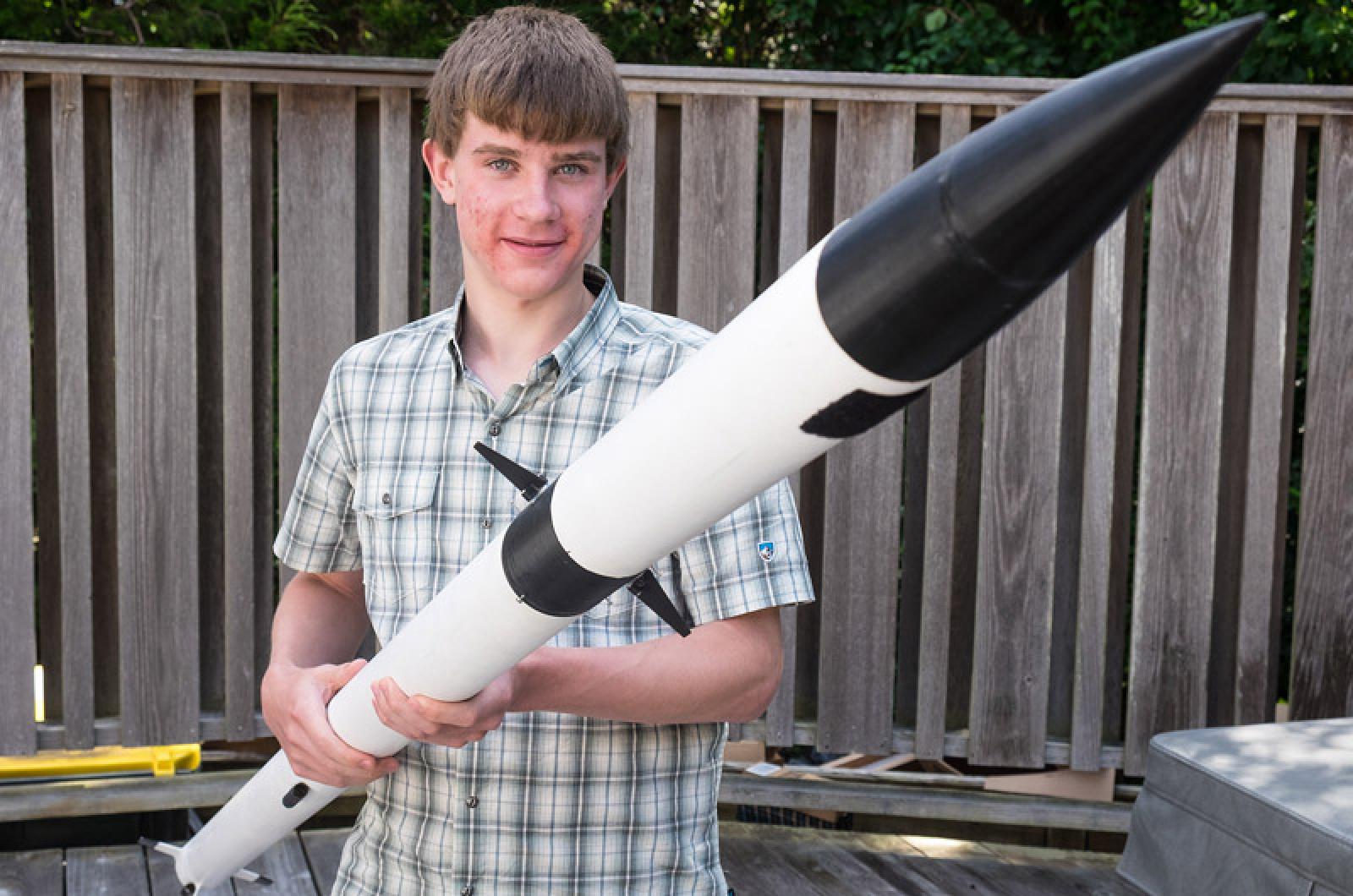
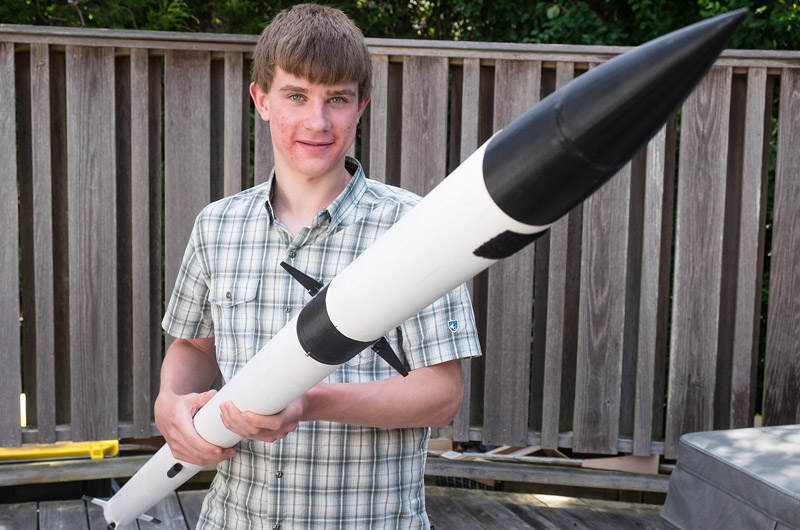
On August 11, Charlie Fenske of Edgartown was named one of the 16 teen finalists in Google's global science fair. On Sept. 27 he travels to Silicon Valley for the final awards ceremony.
Albert Einstein grew up observing his father’s electrical business. Thomas Edison conducted chemical experiments on the train as his family moved from Canada to Michigan.
In his Katama home workshop, 16-year-old Charlie Fenske built Legos.
Charlie Fenske is a Vineyard native and entering his junior at Falmouth Academy. He was recently chosen as one of the top 16 global finalists in the Google Science Fair for his project An Analysis of Rocket Guidance Systems to Enhance Space Flight Efficiency and Maneuverability. The competition will conclude in September when Charlie and the other teen finalists head to Silicon Valley for the final judging.
Charlie’s workshop at his home in Katama is crammed with all sorts of creations: hot air balloons, wheeled things, airplanes and yes, Legos. But his newest focus takes the shape of a small homemade synthetic jet actuator, a model of a device typically used in commercial airplanes to manage maneuverability and increase lift. Until Charlie attached it to a model rocket, the guidance system device had never been used on rockets.
The device is the center of his project, which he always knew would involve rockets.
Charlie in his laboratory.
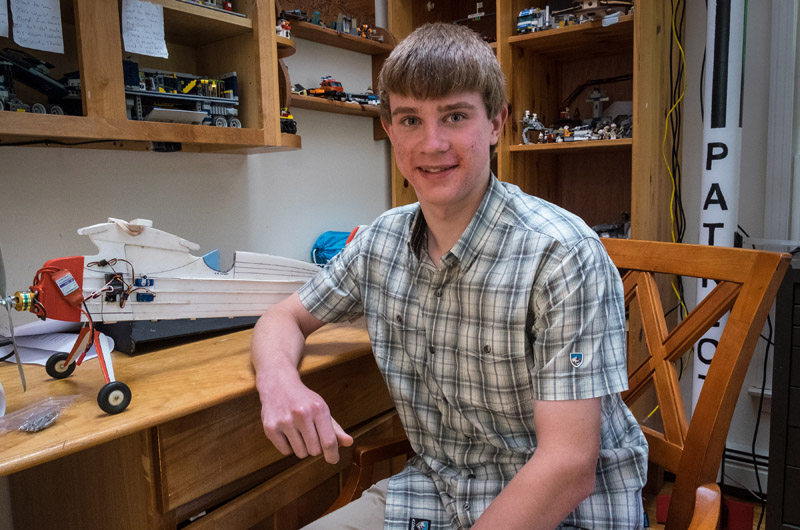
Charlie in his laboratory.
“I had to search for something because rocket engines are perfect,” he said, holding the small black box in his hand. “This device, if it reads an error, will correct the error. NASA invented it for use on airplane wings, then I adopted it for use on rockets.”
In Charlie’s proposal he describes his project this way: “The main purpose of this experiment was to evaluate Synthetic Jet Actuators, an aeroacoustic device thought to produce a laminar airflow over an airfoil, against guidance systems used currently.”
In layman’s terms, actually there really are no layman’s terms for describing his work. Essentially, Charlie’s Synthetic Jet Actuator would help guide rockets and make them more efficient.
“With a guidance system, the rocket could take specific pictures of the earth. It could specify points, potentially launch satellites in orbit, and my technology could also be used for guiding missiles,” he explained.
But Charlie also had to back up his theories with real time data, both to prove his ideas and because over the course of many science fairs he has learned the key to winning is to include both engineering and experimentation. So in addition to building a rocket, he built a wind tunnel to test whether his guidance system was more efficient than standard models.
It was.

Inside the Synthetic Jet Actuator.
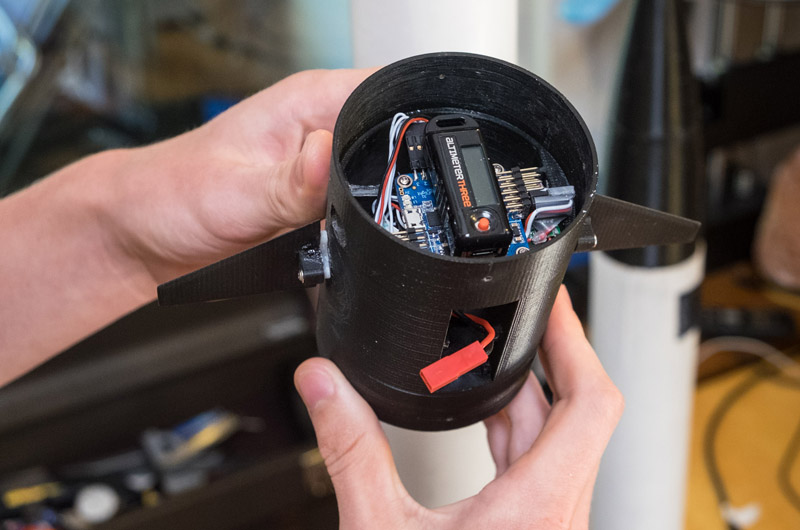
Inside the Synthetic Jet Actuator.
“There’s two main types of science fair projects. There’s the engineering type where you build something, then there’s the experiment where you test something. Neither of those [alone] do very well. You have to have both to do well. I did both.”
Charlie’s project has already won a lot of hardware. It took first place at the Falmouth Academy science fair in the spring, first at the Regional Science Fair at Bridgewater State University, and first at the State Science Fair at MIT. Next, he decided to enter his project in the Google Science Fair, which was a completely separate international online competition for high schoolers.
On August 11, he was named one of the top 16 finalists in the world. Seven finalists are from North America and the rest are from all over the world. Scholarships prizes will be awarded by sponsors. Charlie’s eyes lit up as he listed their names.
“Google, Facebook, Lego, Virgin Galactic, Scientific American and National Geographic...all give $10,000 plus scholarships.”
Charlie will bring the final project and his 100 pages of data, graphs, hypothesis, explanations, analyses and conclusions to the awards ceremony on Sept. 27. His only concern is that the rocket won’t make it through security.
In the meantime he has already starting working on his next project.
“It’s a continuation of this project, looking at different types of fins and more complex ways of measuring the forces,” he said. “I’m also going to build a new wind tunnel that’s faster and has better flow quality.”
Mr. Fenske is also taking classes at the Katama Airfield to get his pilot’s license. He is about halfway through the process, and plans on getting his license by next summer. It is all in the name of his dream to be an aerospace engineer.
“He has always been interested in flight,” said his mother, Caroline Fenske.
Onwards and upwards from here.
Comments
You're the man! Keep it up.
DanYou're the man! Keep it up. Very awesome. Congratulations.
Over the top, Charlie.
Jo-Ann Taylor West TisburyOver the top, Charlie.
Congratulations Charlie!
Renate SheinCongratulations Charlie!
Incredible accomplishments. The sky's the limit.
Fantastic!!!
Richard Lisitano Guilford CTFantastic!!!
Charlie, Congratulations on
Lenora Lee Poway, CACharlie, Congratulations on your endeavor to achieve your goals. (One of my classmates in high school became Astronaut Anthony England.) You will have a great future!
Congratulations Charlie! I
Ingrid Conlan Seymour, CTCongratulations Charlie! I always knew your name would be in print for something great!
WELL DONE!!!! I hope you
Anne Ganz ChilmarkWELL DONE!!!! I hope you win!
Awesome work! Best of luck in
Ilona Gardner San Diego CAAwesome work! Best of luck in September.
Congratulations Charlie! We
Emmi Barrett Chula Vista, CA.Congratulations Charlie! We look forward to following your career in becoming an aerospace engineer. Good luck in the Google Science Fair contest!
Hurray! I'm delighted--but
Lalise Melillo Falmouth, MAHurray! I'm delighted--but not surprised--at your success! I'll see you soon at FA, and I'll be pleased to serve as an "audience" for a run-through if you'd like to do that. I expect, however, that you have your presentation ready to go, so I can just applaud.
Affectionately,
Mrs. Melillo
Add new comment