

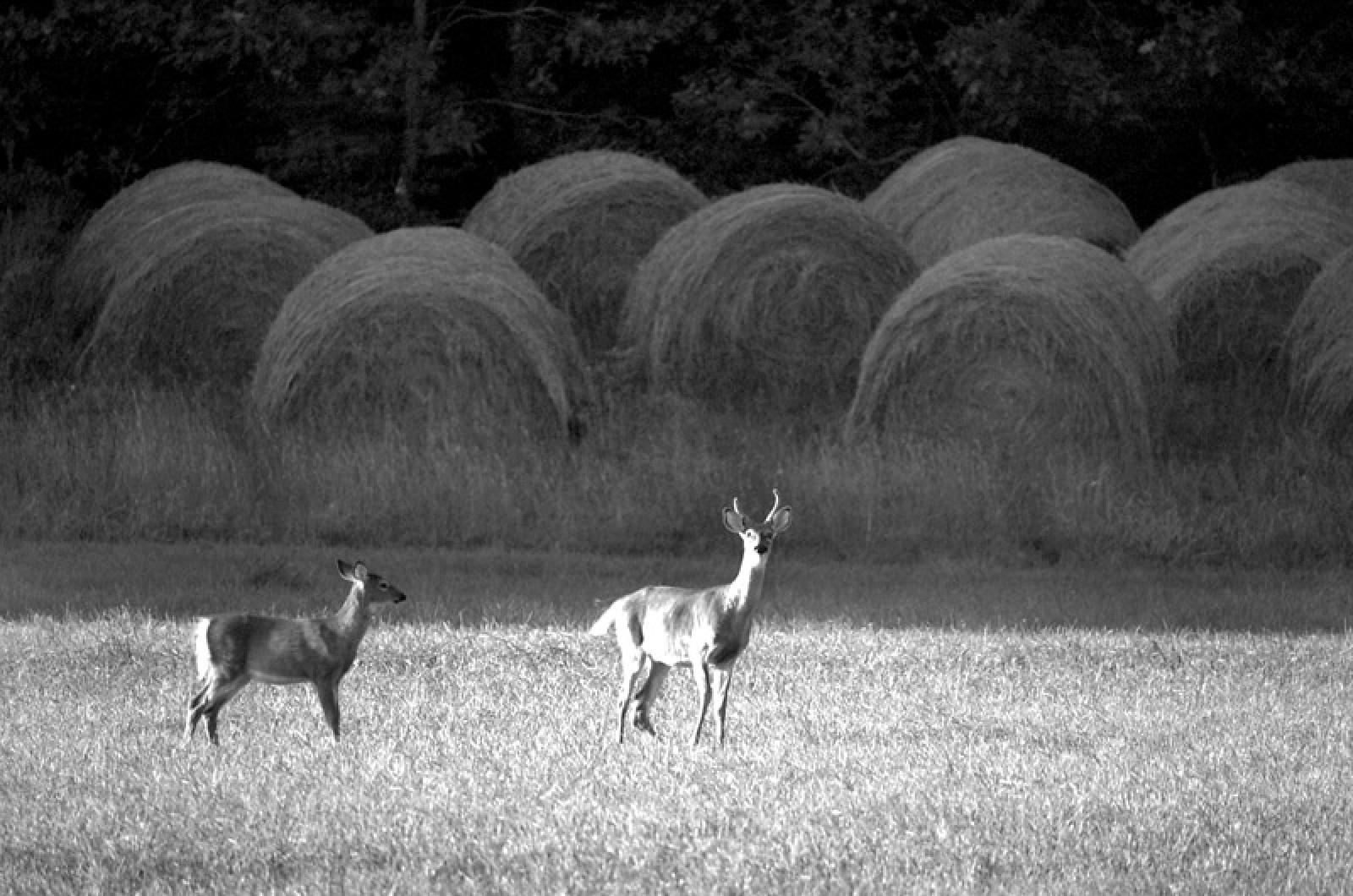
Martha’s Vineyard may soon join a growing list of communities in New England that have taken aim at white-tailed deer to reduce tick populations.
Martha’s Vineyard may soon join a growing list of communities in New England that have taken aim at white-tailed deer as a way to lower the risk of tick-borne illness. But results have varied widely across the region.
“We are learning from the literature,” state deer and moose biologist David Stainbrook told the Gazette this week. “It seems like there is some level where if deer numbers get low enough you’ll start to impact tick numbers, but it’s a very complicated system.”
Ticks carry an assortment of diseases, which they pick up from white-footed mice and other small mammals. And while the deer do not contract most tick-born illnesses, they provide food and habitat at a key point in the ticks’ life cycle – when they are mating and laying eggs. In theory, reducing the number of deer could reduce the number of ticks. But many questions remain.
“We are definitely venturing into new territory,” said Island biologist and unofficial tick czar Richard Johnson. He recently joined with others in calling for deer culling in response to the apparent spread of lone star ticks across the Island. “It’s one of the reasons I am proceeding slowly — I like to make small mistakes and not jump in too fast,” Mr. Johnson said.
Martha’s Vineyard has as many as 60 deer per square mile, according to the state Division of Fisheries and Wildlife — near the higher end of the state range. Up to 90 per cent of the Island is considered deer habitat, although deer tend to congregate in areas where hunting is limited, including private land. Efforts to thin the herd would likely focus on opening up those areas for hunting in the fall.

The Island also lacks coyotes and other predators to keep the deer population in check.
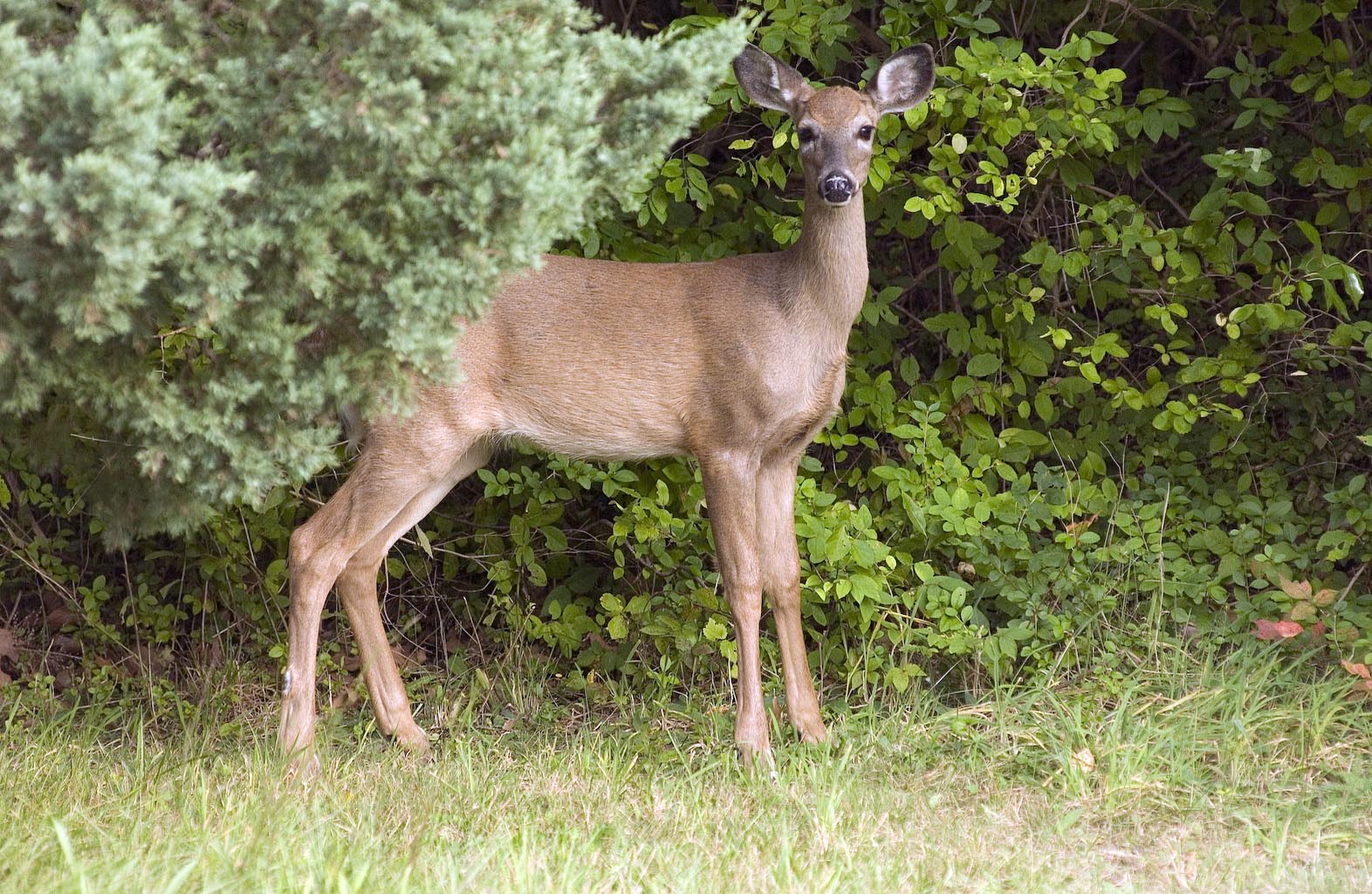
The Island also lacks coyotes and other predators to keep the deer population in check.
“That would be the number-one most effective way to increase hunting access — to start breaking these barriers down,” said Mr. Stainbrook. “That is probably the biggest limitation in management ability.” He added that increased hunting on the Island would not require any special permits, and the state has already increased the number of kills allowed per year.
“You could double the amount of land that’s open to hunting right now and you probably would still have enough permits for everybody,” Mr. Stainbrook said. The big question is how many deer would need to be removed to affect the tick population. Some studies suggest that reducing the number of deer to fewer then 20 per square mile may significantly reduce the risk of tick bites, while reducing it to around eight deer per square mile could interrupt the disease cycle itself. But the thresholds may vary from place to place.
On Crane Beach in Ipswich, reducing the number of deer from around 400 to 100 led to a decline in deer ticks, but a few years later, scientists counted even more ticks than before.
Tamara Awerbuch, an instructor at the Harvard T.H. Chan School for Public Health who has studied the Ipswich project, said there was no linear relationship between deer culling and the number of ticks in an area. The ticks will simply crowd onto the remaining deer, she said, increasing their chances of insemination.
A dramatic crash in the deer population on Naushon in the 1980s, from around 600 to 60 (attributed to predation by coyotes), also did not translate to fewer ticks. Thomas Mather, a professor at the University of Rhode Island, recalled surveying the area with other tick experts following the crash. “We all agreed that we had never seen so many ticks,” he said.
But he also noted that many areas with few deer have few ticks, and places recently invaded by deer have seen ticks become more abundant. “There is a lot of good reasoning that if we then reverse those trends, we should be able reverse the number of ticks,” Mr. Mather said.
Some studies show a link between the number of mammal species and the risk of Lyme disease in an area. With more potential hosts, fewer deer ticks will end up feeding on white-footed mice and other key hosts, potentially diluting the reservoir for disease.
Another study found a link between red foxes (which feed on smaller mammals) and the abundance of Lyme disease, suggesting that a decline in red foxes has led to an increase in the disease. “Lyme disease is notably rare in western New York, where fox are abundant, despite having among the highest deer abundance in the state,” according to the study published in 2012.
Luanne Johnson of BiodiversityWorks in Vineyard Haven said Martha’s Vineyard no longer has foxes, although grey foxes were a native species. The Island also lacks coyotes and other predators to keep the deer population in check.
The unintended consequences of deer culling on the Island are unclear. It’s possible that fewer deer could cause a spike in tick-human interactions in the first two years, since fewer adult ticks would be swept up by the deer. “It may be that they will be on other animals more, including us,” Mr. Johnson said. “But we are not going to suddenly become the host where they go to feed and mate before they lay their eggs. And I don’t think the other animals on the Island are, either. [Ticks] are pretty tightly coevolved with the deer.”
Management efforts often focus on Lyme disease, but deer also play a role in transmitting babesiosis, anaplasmosis and Powassan encephalitis, all of which are carried by ticks and can infect people. They also carry Ehrlichia chaffeensis, the causal agent for ehrlichiosis, which is transmitted by lone star ticks.
Reducing the Island deer population enough to affect the ticks would likely take several years. “I will certainly say I don’t expect it to happen in five years,” Mr. Johnson said. “I think we are going to have to use all the other methods while we work on the deer.”
Managing white-footed mice themselves would likely present an even greater challenge than managing the deer, he said. One option is using so-called tick tubes, which contain fibrous material treated with a tick toxin that the mice carry back to their nests.
At one time, the Island deer herd was treated with four-posters, feeding stations with vertical rollers that attract the deer and apply a tick toxin to their ears and neck. The stations were removed some time ago, following the death of the Cape and Islands tick and Lyme disease specialist who had run the program.
Ms. Johnson of BiodiversityWorks doesn’t advocate for four-posters in general, since they also attract skunks, crows and other animals. But Dan Gilrein, an entomologist with Cornell University, said he has noted a “dramatic decline” in deer ticks in areas of Long Island where four posters were used and maintained.
Mr. Johnson believes the strategy would be too costly to reintroduce on the Vineyard, especially since funding for the Island’s tick-borne illness reduction initiative is expected to run out this year. (The Vineyard Center for Clinical Research in Vineyard Haven, launched in 2014, may provide continued income for the initiative, but has not done so yet.)
Deer culling could be relatively affordable, since hunters would be the ones doing the work. Mr. Johnson also said a program could be set up where the extra meat could be distributed to people in need. “That, to me, is a really important part of what we are doing,” he said. “I don’t believe in going out and killing a deer and wasting it. If the deer is going to die it should go to feed somebody.”
Mr. Mather, who has also studied the sociological dimension of tick reduction efforts in the region, says it’s important to take a long-term view, and not lose sight of simple strategies — such as yard maintenance and body checks — to reduce the risk of infection. Mr. Johnson said the Vineyard was ahead of the game in that regard, with more people becoming aware of the problem in recent years, thanks largely to the tick-borne illness reduction initiative.
He said he plans to reach out to property owners this summer and begin developing a consensus around the deer culling proposal. “I think we’ve got to publicize it more, we’ve got to build an agreement,” he said. “Then we’ve just got to figure out how to do it.”
Comments
I genuinely don't believe the
Mike Marcus West TisburyI genuinely don't believe the ticks discriminate from one host to another, the deer are the largest host but I imagine the over all mass of hosts including chipmunks, squirrels, skunks, mice, rats, rabbits, feral cats etc far outweigh the amount of hosting that the deer do. Are you going to cull everything? Seems a bit ludicrous.
It seems to me that the mice
Bebe ChilmarkIt seems to me that the mice are as much of a problem as the deer are . The nymphs live on them in their first year. Everyone I know this year has been bitten by nymphs, not adult ticks. The ticks will just switch hosts if you cull the deer herd.
Sounds like an ideal time to
Jeff MVSounds like an ideal time to reintroduce the gray fox in efforts to reduce mice populations.
I couldn't agree more
Nora West TisburyI couldn't agree more heartily.
I think deer culling is a
Dave OBI think deer culling is a great first step as part of a larger plan to address the ticks on the island. We all know that the other carriers need to be addressed as well (mice, etc.), but we need to do something. Sitting and waiting is getting us no where.
You probably like to hunt
Jules VineyardYou probably like to hunt
The skunks were introduced
deshandra brown mvThe skunks were introduced here and have no natural enemies so they proliferate. They are fully of ticks. How about a skunk reduction project?
I'm with Deshandra ---- and
SusanM MV-OBI'm with Deshandra ---- and without natural predators, there is no ecological balance other than human intervention. Unless we train deer to consume skunk ?!?! :)
I have had way too many
Amy ChilmarkI have had way too many family members get sick from Lyme. Thus, I fully support this idea! What do we have do to make the deer culling happen?
Culling deer will NOT fix the
Christine Miller Oak Bluffs, MACulling deer will NOT fix the tick problem! The island is also covered in rabbits, also tick food. You're ignorant if you think this will work. It's like gun control will stop the terror attacks...NOT.
Cull the deer population and
Ken Esq EdgartownCull the deer population and start an Island-wide tick tube program to get the ones living on mice.
That sounds like a great
Andy WTThat sounds like a great solution!
When you are at war with such
WendyWhen you are at war with such an insidius enemy it is obvious to me that taking one gun and shooting is not going to win. It seems that ALL of the above mentioned methods and strategies need to be co:ordinated and used fully to fight this. Just talking about it endlessly or trying a little of this and a little of that will not tame this beast. A full out effort. Nothing less. These illnesses are no joke.
Here is a cheap and easy way
Dan ObHere is a cheap and easy way to make your own "tick tubes", which will help eliminate any ticks from your yard.
http://organicdailypost.com/make-tick-tubes/
Permethrin is highly toxic to
Steve FalmouthPermethrin is highly toxic to fish and aquatic animals FYI
To effectively cull 60 deer
George Stein EdgartownTo effectively cull 60 deer per square mile the notion of that type of volume of shooting would replicate what is going on with the humans in Chicago right now. Easier said than done. Are we going to see protest groups similar to the shark tournament types ?
It seems as if 60 per square
Ginny up-islandIt seems as if 60 deer per square mile is very low; we know how many get shot during each deer season and that should reduce the herd significantly yet there are always lots of deer around. We've always heard that there are something like 1500 deer on the island and considering the incidence of sightings, predation of gardens and people's yards, deer out in plain sight, etc. I'm guessing that a higher number is more accurate.
Don't even begin to think about introducing any more predators here to get rid of what we already have. Skunks and raccoons were reintroduced many years ago and they have wiped out the ground nesting birds and a lot of poultry. They are thriving. So are rats. When the dumps were capped and open burning prohibited the rats spread out...summer garbage and people's careless habits have caused them to flourish, also mice -- they are everywhere. Various types of ticks are carried by a lot of hosts including horses, dogs, cattle and the many sheep (first cases of Rocky Mountain Spotted Tick Disease in the east were found here on the Vineyard in the 50's). Even birds can carry ticks. Introducing more animals here would just mean more hosts so don't even joke about it. Introducing foxes or other high end predators would be a disaster. They won't wipe out the rodents and they will cause a lot of damage to farmer's livestock as well as domestic animals.
Be careful what you wish for! Culling the deer, however, would really help on a lot of fronts, including the hostas and day lilies under my dining room windows!
I think that if we multiply
Mr. B ChilmarkI think that if we multiply the 60 deer/sq. mile times (approx) 88 square miles of land (does not include water/ponds) on MV, you will get 5280 deer. Does that seem more along the lines of what you were thinking?
There's no such thing as Lyme
MaryAnnThere's no such thing as Lyme disease. It's all a figment of the imagination. Until you're the one, or your kid is the one, who gets it.
Cull baby, cull
Steve FalmouthCull baby, cull
Aside from Lyme disease, deer
Christine Powers WalthamAside from Lyme disease, deer also present a hazard on the roads. If you hit one, your car could be seriously damaged -- or you could end up dead! This is why I support the culling and hunting of deer om the Island.
I'm with you, Amy. I've had
Donna Oak bluffsI'm with you, Amy. I've had one family member almost die from Lyme, because it was not diagnosed and another who was sent home from the hospital, not diagnosed with Lyme, because the result was a false negative from the test. Whatever will help get this under control, should be tried. And, to respond to another's post I don't see or understand the need to be calling anyone ignorant.
1. All physicians who
Juleann West Tisbury1. All physicians who practice on the island should be required to take intensive lyme disease training. MD's who choose not to treat symptoms based solely on the basis of blood test results are demonstrating poor diagnostic skills and a lack of knowledge of the disease.
2. Lobby for the return of the lyme disease vaccine. A much more reliable solution. Why dogs are allowed lyme vaccine AND euthanasia -- and humans are denied both -- remains a mystery to me.
I used to visit the Vineyard
Nan CarlisleI used to visit the Vineyard on a regular basis. I will not visit again due to the horrendous number of ticks and the danger of contracting one of these deadly disease. I have already had Lyme and will not risk exposure again. This is going to impact your tourism profoundly beyond all the terrible human suffering with these diseases and your real estate prices eventually. Perhaps nobody cares or you would welcome less tourists, but when you can no longer even safely enjoy the outdoors without donning a permethrin treated "hazmat" suit perhaps you will begin ACTING. You are on an ISLAND. Monhegan Island in Maine wiped out their Lyme problem years ago by acting proactively. You must be all animal activist tree huggers who care more about deer than you do other human beings, even innocent children. Cull the herds way way down. Use tick tubes. Yes, it may take time unless all deer are removed as was done on Monhegan. Donate the meat. I hear it is a gourmet delicacy. Very expensive in restaurants I've noticed. Monitor the situation. It may take a few years but you will take back your island from this insidious threat. Remember most people with chronic Lyme have NO initial symptoms at all and do NOT remember a tick bite. The nympths are as small as the period at the end of this sentence and you will not feel them crawling on you. Good luck.
Deer culling is merely one
Elizabeth EdgartownDeer culling is merely one piece of this puzzle. The deer ticks are infected with Lyme and coinfections mainly during their nymphal stage whilst feeding on the white footed mice here. We wiped out the native grey foxes which feed on mice and rabbits, compete with the non-native skunks, and have a healthy fear of humans and pets unless you start feeding them but can easily scare them away and they do not eat veggie gardens.
Modern development of the island has altered its ecosystem in favor of the ticks and Lyme disease. We created this problem unknowingly. Native peoples in precolonial times show no record of Lyme disease and the island during that time had a healthy population of grey foxes, no skunks, and fewer deer.
We also need educated Lyme doctors and more accurate testing. So many people here have Lyme and either aren't getting diagnosed so it becomes chronic and/or once they know they have it cannot get proper treatment here on island. We are at the epicenter of this crisis and the fact that most of our physicians are in the dark as to how to diagnosis and treat it PROPERLY is absolutely unacceptable.
Add new comment