

<p>Despite fierce opposition, Martha’s Vineyard Film Festival leaders said they intend to follow through with plans to buy a tract of residential farmland in West Tisbury.</p>
Despite fierce opposition from the Island community, Martha’s Vineyard Film Festival leaders said this week they intend to follow through with plans to buy a tract of residential farmland in West Tisbury where they hope to build a permanent home.
In an email that went out to members last Thursday, the festival said it planned to buy 12.5 acres and a house at 694 Old County Road, property formerly belonging to the late Cynthia Walsh. A purchase and sale agreement has been signed to buy the property for $1.4 million. A closing is set for June 22, reportedly with no contingencies.

Old County Road resident Mark Reisman criticized MVFF plan.

Old County Road resident Mark Reisman criticized MVFF plan.
No plan has been presented yet for the property. And any plan to develop it would need to clear a gauntlet of required regulatory approvals, including from the Martha’s Vineyard Commission and an array of local boards.
“What made sense to us was to buy the property first and then have the conversations,” film festival founder and director Thomas Bena told the Gazette on Thursday. “There’s no question in our mind that it’s the right property for us.”
In late March, Mr. Bena attended a meeting of the West Tisbury planning board where he described a concept that includes a 6,000-square foot barn for film events, along with a commercial kitchen and a farming operation.
Mr. Bena said festival leaders are working to raise $2 million for the project, and that an eight-member board of directors voted unanimously on May 3 to buy the property. Steve Bernier, a well-known Island businessman and Chilmark resident, is chairman of the MVFF board.
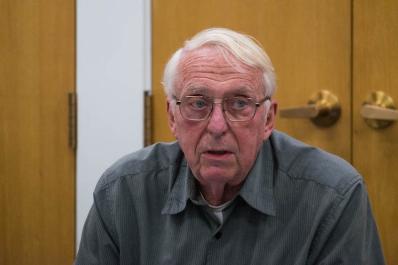
West Tisbury selectman Richard Knabel called for festival leaders to reconsider.

West Tisbury selectman Richard Knabel called for festival leaders to reconsider.
Meanwhile, outrage simmered in the community and online this week, finally spilling out at a meeting of the town selectmen on Wednesday after a story on the Gazette website had attracted a flood of comments from readers. Following about an hour of discussion, board chairman Richard Knabel publicly called on the festival directors to reconsider their plans.
“The film festival is certainly entitled to pursue their proposal,” Mr. Knabel said. “However, it clearly already has become a very contentious and divisive issue, even before a more definitive plan has been presented. I fear the situation will only become more inflamed if the proposal is in fact pursued.”
No representatives from the film festival attended the meeting. But festival managing director Brian Ditchfield said Thursday that reconsidering the plans would be premature. “We haven’t even secured the land yet,” he said. “As we do that and as we begin any planning process, absolutely we plan to reach out to abutters and beyond.”
Mr. Bena said when he met with the planning board in March he understood that because the film festival is an educational nonprofit, it could be permitted in a residential area. Mr. Ditchfield was also confident the project could be permitted. “We’ve had legal advice, we’ve had advice from friends and board members, and we’ve seen that precedent here on the Island,” he said. “So we felt as if we should move forward.”
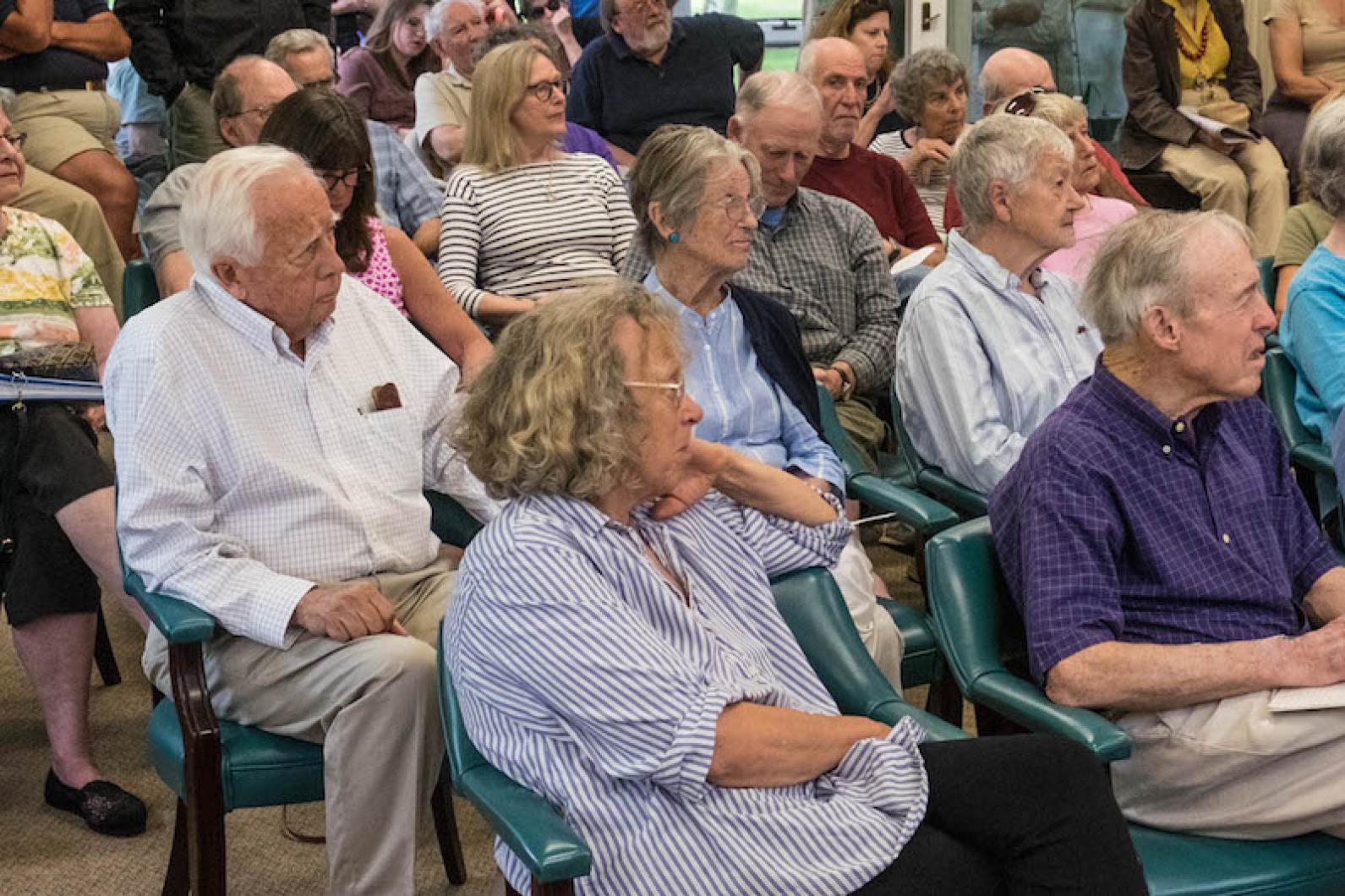
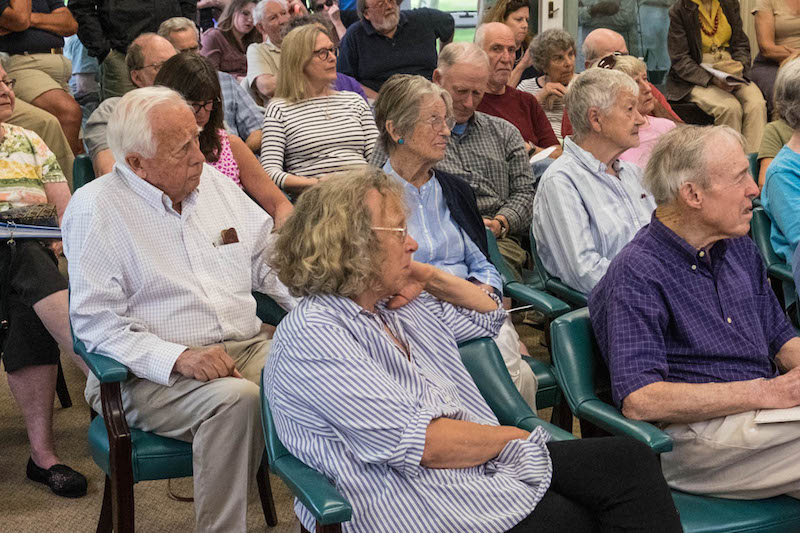
More than 50 people attended the selectmen’s meeting Wednesday, held at the Howes House, including the historian David McCullough and his wife Rosalee McCullough, longtime West Tisbury residents. Those who spoke out against the proposal included at least two people from other Island towns.
Mark Reisman of Old County Road criticized the approach. “The festival’s quick purchase of the property without any public notice and a contract that apparently has no contingency clause suggests an approach designed to intimidate residents and local governmental agencies,” he said.
Several people took aim at the festival’s mission as a nonprofit. Rez Williams, an artist who lives off the end of Old County Road, argued that a state law exempting some educational programs from land-use restrictions would not apply in this case. He noted that in its official mission statement, the festival describes its main purpose as “offering an enriched film program.”

Property formerly belonging to late Cynthia Walsh includes Greek revival home.
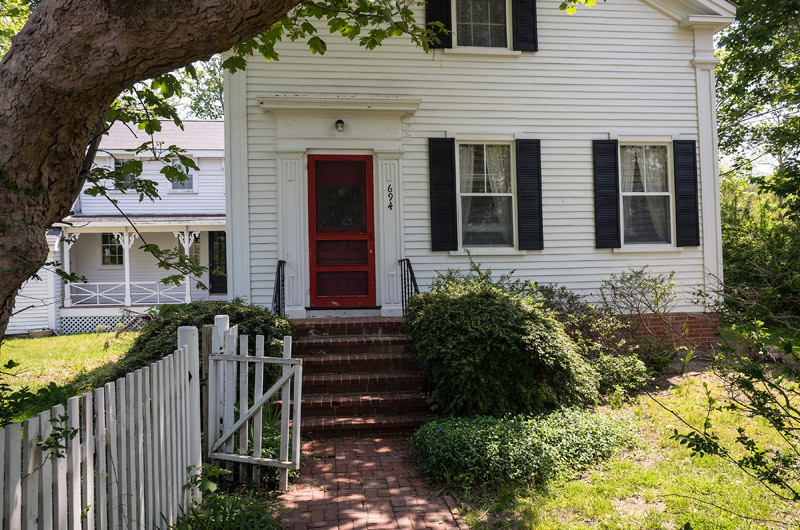
Property formerly belonging to late Cynthia Walsh includes Greek revival home.
“We seem to have a conflict here on the face of it,” Mr. Williams said of the proposal.
Chilmark Library director Ebba Hierta, who lives in West Tisbury, also criticized the festival for claiming to have a mostly educational purpose. “This is a minuscule fraction of their overall activities,” she said. “What they are proposing here is an entertainment-restaurant complex. What else is a facility with a commercial kitchen that intends to sell food to the public?” She called on the selectmen to take a lead in rejecting the proposal.
But Chilmark resident Chris Murphy pointed out that people have the right to buy property, and he urged those present to reserve judgment. “You all ought to turn around and take a look in the mirror,” he said. “If I wanted to do a project, would I want a lynch mob out there looking at me before I even get started?” He continued:
“We should all take a deep breath. Really take a look at what’s being proposed. And as far as I can see, not a lot is being proposed yet.”
Tony McClellan, who lives across from the Walsh house, took exception to being called part of a lynch mob. “We are residents . . . in the neighborhood who live there because we like the community,” he said. “And we see it being abused.” His comments drew applause.
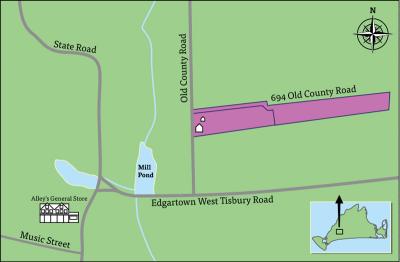
Location off Old County Road.
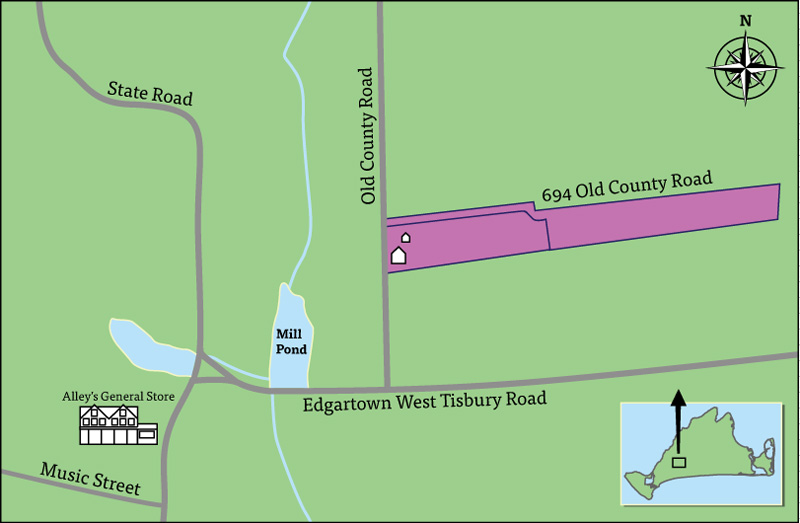
Location off Old County Road.
Despite the outrage and frustration, the meeting never fell out of order and the mood was mostly upbeat.
Several people spoke of their fondness for the neighborhood. Cynthia Riggs, a novelist whose family has owned the Cleaveland House on Edgartown West Tisbury Road for generations, said she had originally opposed efforts to form a historic district, since residents already maintained their historic properties, but she later came around.
“Somebody pointed out to me that yes, you may keep up the tradition of the village and the rural character of the land, but what would happen if somebody sells a house . . . [with] an inappropriate plan for that property,” she said. “I hope that the mission of the district to keep us a rural community will continue to stand.”
Nancy Dole, a member of the historic district commission, said the commission’s power to condition a project at the Walsh property would be limited to the first 800 feet from the road. (The property is about 2,218 feet long and 295 feet wide at the road.) “The historic district commission is not going to be able to stop a 6,000-square-foot building in there — appropriate or not,” Ms. Dole said.
Later in the meeting, Mr. Knabel again emphasized that the plans have hardly taken shape and only recently entered public awareness. “This took a fairly long time for it to percolate,” he said, noting the March planning board meeting. “But now it certainly has.”
In asking the film festival to withdraw its plans, Mr. Knabel said he was speaking only for himself but he acknowledged a demand for clear leadership from town citizens.
“I call on Tom Bena, Steve Bernier and the film festival board, for the good of all concerned, to reconsider their proposal, and spare us all the needless and prolonged unpleasantness and expense it will more than likely cause if they choose to go forward,” Mr. Knabel said.
While they did not attend the meeting, festival leaders said later they saw the process more as an opportunity than a trial.
“We have a mission here to gather people and to spark discussion, debate and action,” Mr. Bena said. “And that’s how we want to go through this process.” He also anticipated a series of public forums this year, but only after the festival takes ownership of the land.
“There’s no question in our mind that this is the place,” he said.
Comments
The community values music,
Miguel Sam de Braganca WtThe community values music, art and creative culture so much. This is why we have so many community and educational spaces that accommodate jams of all ages and mediums. There is enough plant on this island for creative entrepreneurs and organizers to put on events every night of the week, without developing this residential land. Is the need for such a space truly so great that it overrides the will and zoning of a neighborhood? Would love for the MVFF to bring some music, film, and instruction to the ag hall, the WT library, the grange, charter school, plum hill, WT elementary. And that's just WT alone! I'd be thrilled to see that. I'd contribute to that however I was asked. It would be a net positive creative contribution to the neighborhood. The MVFF is welcome to build whatever they want... But not wherever they want. If they have the need for a plant of their own, I say go for it... But don't trample the will of a neighborhood to build it. That's not community minded. Build it somewhere where residents are truly in need of the space and/or where the local zoning allows and welcomes such new structures to be raised.
Following are quotes by
Jackie ChilmarkFollowing are quotes by Thomas Bena taken from the internet, all from his published letters: Stewardship is defined as “the responsible overseeing and protection of something considered worth caring for and preserving.” ---The sight of a bridge towering above families enjoying the beach will radically change the idyllic and natural surrounds. ---My soul brother Henry David Thoreau writes: “What’s the use of a fine house if you haven’t got a tolerable planet to put it on?” ---Rather than rely on the opinions of paid engineers and architects, the MVC ought to be thinking about how we can be stewards of the island. ---Let’s be stewards, not hogs. ---Concerned by the lack of community involvement and the lack of choices on the table, a group of Chilmark residents have created an amendment to Article 20. The amendment would require Chilmark to thoughtfully explore other options. ---Dear Mr. Foley, I hope you will do the right thing and vote NO to the Stop and Shop. In my opinion, it is your job.---The proposed Dias Lumberyard seems too big and out of scale with the area. An 8,400 sq. ft. building, 42ft high, made of corrugated metal, is not in keeping with the scale or appearances of surrounding businesses and works in opposition to the new zoning bylaws to prevent blight in Tisbury. ---I’m outraged by David Handlin’s letter which was published in the Gazette on August 10. Instead of thoughtfully engaging in the actual debate, his letter seems designed to stir the pot. The movement to update the zoning laws is not about style. It’s about size, stewardship and preserving the character of our community. ---....it is in his best interest to have the zoning laws be as lax and unclear as possible~ ---Our understanding is that zoning is there to protect and preserve the character of a community, regulating the use of private land for the common good. One of the main reasons we love living on this Island is because of the open spaces and rural landscape. And we believe that’s also a major reason why most of us live and/or own second homes here. So, why wouldn’t we work together to preserve this?~(with Mollie Doyle) ---For hundreds of years people have built summer homes that are sensitive to the community and respect the rural character of our Island. Not to mention the fact that the Wampanoag tribe has lived here for many thousands of years — without even a hint of a trophy home. ---Some say the Vineyard is already “done,” but I believe with all my heart that we can take appropriate actions that will save this incredible Island for future generations. Ask yourself, “Am I doing good by building a 12, 15, or 25,000-square-foot home?” ---There are many citizens working together to update the zoning laws. We want thoughtful change that protects this Island from the over-development that has wiped out many towns around the country. ---Together. Together. Two sides gather together. Got it? ---At two of the well attended public hearings, the meeting was wrapped up after approximately 75 minutes. Many hands were still in the air, and many contentious issues were still on the table. At one such meeting, our chance to hear from the experts hired by the Squibnocket homeowners association, was cut short because they had to catch a boat. The experts only had time to present their plans and thoughts but no time to hear any public comment or take any public question. ---The fear I have is that one of the Island’s most beautiful beaches will be harmed is also real. ---I love Squibnocket Beach, as do most who’ve ever stepped foot there. And while I’m not against the folks at Squibnocket Point having access to their supersized summer homes, I’m passionately opposed to the current plan and the Chilmark selectmen’s handling of it. ---The MV Commission was enacted by State law to intelligently consider the development of growth on this beautiful Island and to protect Martha's Vineyard unique character. Please scale down this proposal. ---The MVC has the opportunity to be a leader and to show others how to properly care for this island—for our children, their children and beyond! --This year [2011] we also decided to announce our dream of building a home for the festival on Martha’s Vineyard. Audrey van der Krogt designed an interactive art installation that asked for feedback and we received lots of great ideas. We were moved by the number of people that have already jumped in by helping to look around the Island for land, offering their design services and providing ideas for moving forward. We are now engaged in an Islandwide brainstorming session and hope that more of our community will want to get involved. Please contact us with your ideas. (with Brian Ditchfield) --THE ABSURDITY OF THE PROJECT THAT HAS BEEN RAMMED DOWN OUR THROATS IS ONE THING. THE DENIAL OF VIABLE COMMUNITY INVOLVEMENT IN THE PROCESS IS ANOTHER, says Thomas Bena. (The caps are mine, although many of Thomas's statements should be in caps and written to himself and every proponent of this project. Contrary to the Bena/Ditchfield letter published in 2011, there was no island-wide brainstorming for a location. There was zero community input.)
I grew up in the old village
Dave Burt West TisburyI grew up in the old village off of Music Street. I'm not going to repeat the many moving descriptions that have been provided in these posts of the quiet peace that characterizes the village but it really is a special place, and this development will interfere meaningfully with that magical serenity. You can hear a small party going on at one of the houses overlooking the Mill Brook all the way to Alley’s. The enterprise being described is simply way too big for this area.
I purchased one of the properties overlooking the brook (directly across the street from the Walsh property in question) in 2010. It took me 20 years of hard work both on and off-island to save enough for my own place in the old neighborhood so that my children might experience at least some measure of that West Tisbury peace that has so beneficially defined my character. It is funny to think that the development of work ethic and personal integrity that have earned me my success in career began at age eleven with a job weeding flower gardens for Josie Bruno, a late abutter to the Walsh property.
I'm sure the MVFF does some good things in its support for developing artists but it appears to serve more so as an entertainment provider for people who can afford admission. The legal loophole the organization is planning to exploit is probably in place so that zoning boards controlled by wealthy landowners can’t hold up educational facility development that is needed for people with less. That doesn’t appear to be what is going on here. If it is, it should be located closer to those who are in greater need than most up-island residents and visitors.
If this is actually about some group's utopian vision that they think is better or more important than that of the existing community, then I hope they can put themselves in my shoes. There has to be some way of accomplishing this next stage of your dream without stomping out my dream and so many others by exploiting some shady legal loophole. Those zoning laws are in place for a reason, to protect the magic and peaceful timelessness of the village - and to protect families like mine from commercial development that will damage our quality of life.
The main issue underlying
Annie Cook ChilmarkThe main issue underlying much of the angst, it seems to me, is that everyone knows that, "If you build it, they will come." The reason I mentioned Menemsha, even though the "entertainment" that draws the volume of traffic (people and vehicles) isn't underwritten by human dollars -- aka, "The Best Sunset in America" as it's apparently been advertised -- is that it's a prime example of the burgeoning conflict between residential "quality of life" and accommodating appreciators of the island from near and far during the peak season. I'm an avid supporter of all of my fellows in the arts and their desire to provide that critical piece of island life at both the community and professional levels; but don't we all need to be mindful of impact on our community (by which I mean the larger island)?. What is the primary aim of any major project like this? If within any such initiative, making money (profit) is involved, then sometimes that drives decisionmaking in a way that seems to supersede sensitivity to neighbors, historical districting, or the environment. My personal view is that this is where a real paradigm shift needs to occur in our culture, and why not test that right here on the Vineyard, where "well-meaning" people find themselves doing battle over issues on which consensus is actually achievable? I'm a native who doesn't feel the need to treat that as a badge of superiority (just having relocated back here after 16 years puts me in maybe a relatively objective role on the various political battles I see being fought on my home island). Solutions are possible, but I am with those on this thread who have recommended more dialogue earlier in the process. The individualist credo of any of us just "doing what we want because we can" has led to outcomes such as Huge House syndrome, or brand new eyesores completely out of sync with their surroundings, such as some unfortunate design decisions I've happened upon on the fringe of the historic district in Vineyard Haven. On this issue, I am with Thomas Bena and can't wait to see his film on what I call the Mcbuilding frenzy. Mindfulness over selfishness: it's a different kind of libertarian concept I'm talking about; and requires an attitude that doesn't diminish the value of communities striving to preserve their character.
Maybe David McCullough and
Washing Offshore Anywhere but MVYMaybe David McCullough and Rez Williams should get the wake up call that most of the people on this thread deserve. Everyone not born on the Vineyard will leave; you can have the island to yourselves. Mr. McCullough's books and Mr. Williams multi-thousand dollar paintings can be purchased in whole by you, plenty of both seem to "washashore" to the mainland. You can stop charging "washashores" $500 dollars for $50 dollar jobs "because its an island"; you can stop collecting taxes from people who don't use the school's, barely tread the island's roads, or weigh on its finances; I'm sure the money to fill your civil coffers doesn't need to "washashore"; your simpler, bucolic life will fund itself. And you can collectively stop "washingashore" in Falmouth; you clog the roads and seem unaware that people in every other community (on Earth!) put up with the occasional, and sometimes frequent, inconvenience of living with others. Please don't "washashore" to Fenway Park or the North End of Boston either, they are historic neighborhoods that don't need another twin-cab contractors truck with a "Vineyarders" sticker clogging their narrow streets all because you want to see a baseball game. Not "washing ashore" to Logan airport will save that community the grief of your congestion as you race to "wash up" on the shores of Fort Meyers, Key West, or Sarasota in February complaining about the biting cold and grey of your island. Your forefathers dealt the cold and the isolation; it sounds like you are ready for the experience.
Add new comment